

TL;DR:
- Freeze drying preserves bacteria in a dormant state, not eliminating microbial risk.
- Canadian regulations require strict hazard control, documented plans, and compliant packaging for safety.
- Ongoing sanitation, process validation, and accurate labeling are crucial to prevent compliance issues.
Freeze drying has a reputation for being the gold standard of food preservation, but that reputation comes with a dangerous blind spot. Many candy manufacturers assume the process eliminates microbial risk entirely. It does not. Freeze drying preserves bacteria in a dormant state, meaning pathogens that enter your process can survive and reactivate later. For Canadian candy businesses operating under CFIA oversight, that misunderstanding is not just a product quality issue. It is a compliance and liability issue. This guide walks you through the microbial risks, Canadian regulatory requirements, critical control points, and labeling rules you need to get your freeze-dried candy to market safely.
Table of Contents
- Why freeze drying isn’t a kill step: Microbial risks explained
- Canadian regulations: Navigating SFCR and HACCP for freeze-dried candy
- Critical control points in freeze drying: Practical compliance for candy makers
- Labeling, allergens, and packaging: Getting freeze-dried candy retail-ready
- Why the real risk is overconfidence: Lessons from freeze-dried candy safety
- Partner with experts to streamline safe freeze-dried candy production
- Frequently asked questions
Key Takeaways
| Point | Details |
|---|---|
| Freeze drying preserves microbes | Sanitation and validated processing steps are essential because freeze drying does not kill bacteria. |
| Canadian SFCR rules apply | Follow Safe Food for Canadians Regulations and use Preventive Control Plans to stay compliant. |
| Control water activity | Test and document drying to keep water activity below 0.6, stopping microbial growth in candies. |
| Label and package for safety | Use proper bilingual labels, allergen statements, and moisture-proof packaging for safe, market-ready candy. |
| Documentation minimizes recall risk | Recording and reviewing each freeze-dried batch’s safety steps helps you pass audits and avoid costly recalls. |
Why freeze drying isn’t a kill step: Microbial risks explained
The single most dangerous assumption in freeze-dried candy production is that the process itself makes food safe. It does not. Understanding freeze drying basics is essential before scaling any candy operation, because the process removes moisture but leaves microbial life intact.
“Freeze-drying does not kill bacteria or pathogens; it preserves them in a dormant state, requiring strict sanitation, pre-cooking for high-risk foods, and a kill step like cooking upon rehydration for safety.” — USU Extension Food Safety Research
This matters enormously for candy makers because the confectionery category includes several high-risk ingredient profiles. Dairy-based fillings, egg-containing coatings, nut clusters, and high-fat or high-sugar formulations all create environments where pathogens like Listeria monocytogenes and Salmonella can persist through the freeze-drying cycle unharmed. When a consumer later adds moisture, even incidentally through humidity exposure, those dormant organisms can reactivate.
The highest-risk candy ingredients to watch include:
- Dairy components (milk chocolate, cream fillings, caramel with cream)
- Raw or undercooked egg washes used in coating processes
- Nut-based inclusions (peanut butter, almond paste, mixed nut clusters)
- High-moisture candy centers that may not reach target water activity during drying
- Imported bulk ingredients without verified microbial testing on receipt
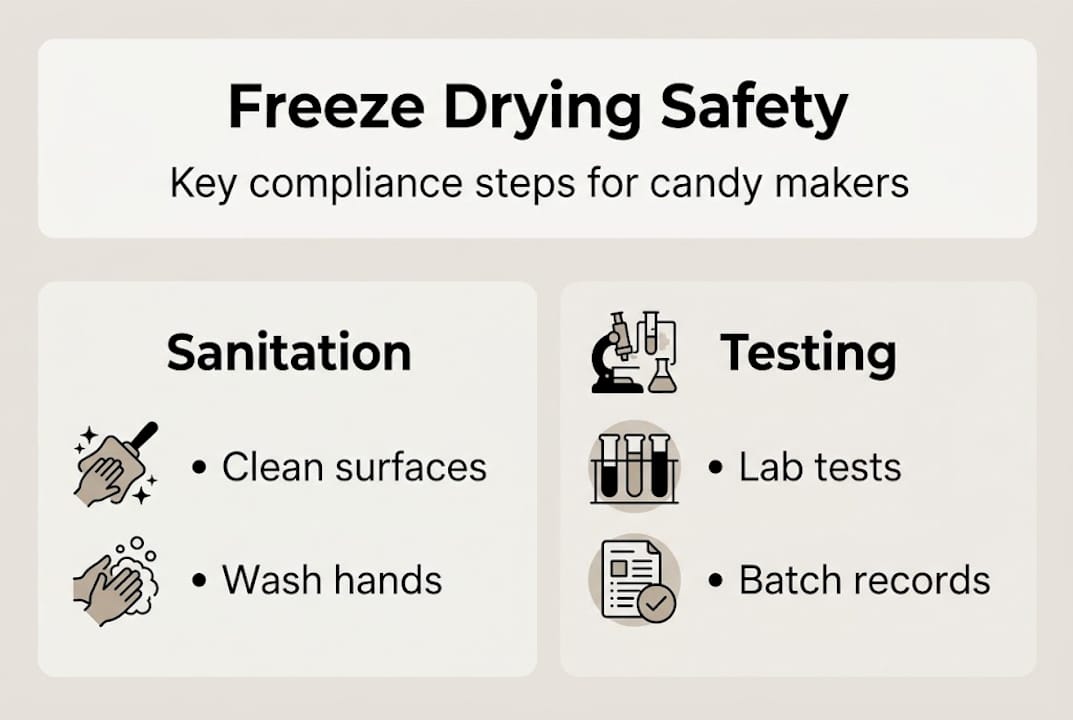
Your first line of defense is not the freeze dryer. It is everything that happens before the product enters the chamber. Validated pre-cooking for any high-risk ingredient mix, rigorous equipment sanitation between runs, and routine microbial testing of finished product are non-negotiable steps. Sanitation protocols must cover contact surfaces, trays, shelves, and any transfer equipment.
Pro Tip: Even small-batch or home-based Canadian operators selling commercially must apply the same sanitation and testing standards as large manufacturers. Provincial health authorities do not make exceptions based on batch size.
Microbial testing should include finished product sampling for Listeria, Salmonella, and total aerobic count at a minimum. Third-party lab testing adds credibility and documentation value during audits.
Canadian regulations: Navigating SFCR and HACCP for freeze-dried candy
Once you understand the microbial picture, the regulatory framework becomes easier to navigate because the rules are designed around exactly these risks. The SFCR preventive controls framework requires Canadian food businesses to identify hazards, implement controls, and document everything in a Preventive Control Plan (PCP), which is Canada’s equivalent of HACCP.
Regulatory requirements for preventive control plans under SFCR Part 4 cover hazard identification, sanitation programs (sections 82 to 85), pest control, and employee hygiene. For freeze-dried candy specifically, your PCP must address the unique hazards of low-moisture processing, including the absence of a kill step.
Here is a stepwise path to compliance for freeze-dried candy operations:
- Determine your license requirement. If you sell candy interprovincially or export, you need a federal CFIA license. Provincial-only sales may fall under provincial food safety acts, but requirements vary.
- Draft your Preventive Control Plan. Document every hazard, control measure, critical limit, monitoring procedure, and corrective action specific to your freeze-drying process.
- Validate your process. Confirm that your drying parameters reliably achieve target water activity across your full product range.
- Implement sanitation schedules. Written, dated, and signed records for every cleaning cycle.
- Train all staff. Food handler training must be documented and refreshed regularly.
- Review labeling compliance. Packaging regulations compliance is a separate but equally critical step before retail launch.
| Requirement | Provincial license | Federal CFIA license |
|---|---|---|
| Sales scope | Within one province | Interprovincial or export |
| PCP required | Varies by province | Yes, mandatory |
| Labeling standard | Provincial rules apply | SFCR and CFIA bilingual rules |
| Inspection authority | Provincial health | CFIA |
| Audit frequency | Varies | Risk-based CFIA schedule |
Freeze-dried confections fall under unstandardized foods per CFIA, which means bilingual labeling is required regardless of where you sell. Understanding private labeling benefits early in your planning process can help you design compliant packaging from the start rather than retrofitting it later.
Pro Tip: Bilingual labeling applies even to small confections. The exemption for individual one-bite pieces sold unwrapped does not extend to bagged or packaged products of any size.
Critical control points in freeze drying: Practical compliance for candy makers
Regulations tell you what to control. Here is how to actually do it at each stage of production. HACCP best practices for freeze-dried foods identify drying parameters, sanitation, and packaging as the three pillars of a compliant operation.
Follow this numbered walkthrough for each production run:
- Ingredient receiving. Inspect and document supplier certificates of analysis. Reject any lot without microbial testing results for high-risk inputs.
- Pre-processing. Apply validated cooking or pasteurization steps to any dairy, egg, or nut-containing formulations before loading the freeze dryer.
- Freeze dryer sanitation. Clean and sanitize all trays, shelves, and chamber surfaces before each run. Log the date, time, and staff member responsible.
- Drying validation. Confirm finished product reaches water activity below 0.6 aw using a calibrated water activity meter. This threshold inhibits microbial growth in storage.
- Packaging. Transfer product immediately into moisture-proof packaging. Review packaging types suited to freeze-dried candy to avoid common packaging problems like moisture ingress and seal failure.
- Storage. Hold finished product in cool, dry conditions below 21°C and away from direct light. Monitor storage area temperature and humidity daily.
| Critical control point | Critical limit | Monitoring method | Corrective action |
|---|---|---|---|
| Pre-processing cook step | Internal temp 74°C+ | Calibrated thermometer, logged per batch | Re-cook or discard batch |
| Freeze dryer sanitation | Zero visible residue, sanitizer contact time met | Visual check plus log | Re-clean before use |
| Water activity at finish | Below 0.6 aw | Water activity meter per batch | Continue drying or discard |
| Packaging seal integrity | No leaks, full seal | Visual and pressure check | Reseal or repackage |
| Storage temperature | Below 21°C | Daily thermometer log | Relocate product, investigate cause |
Pro Tip: Retain batch records for a minimum of two years. In the event of a CFIA audit or product complaint, documented CCPs are your strongest defense against recall liability.
HACCP principles also recommend equipment certification where possible. If your freeze dryer has not been validated for the product types you run, that gap needs to be addressed before your next audit cycle.
Labeling, allergens, and packaging: Getting freeze-dried candy retail-ready
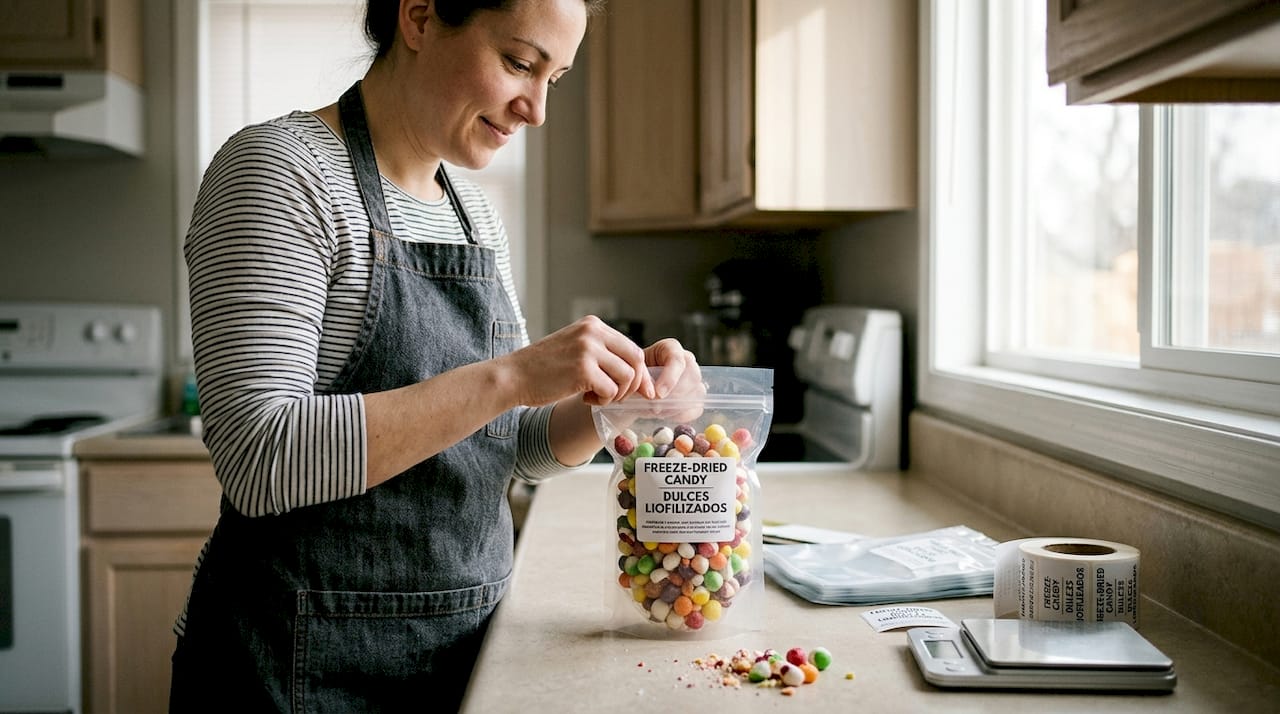
Compliant labeling is not optional and it is not just a formality. It is a legal requirement under CFIA rules, and getting it wrong can pull your product from shelves faster than any food safety issue. CFIA labeling guidance for confectionery classifies freeze-dried candies as unstandardized foods, meaning no government-defined recipe or standard exists for them, and full label disclosure is required.
Every retail package of freeze-dried candy sold in Canada must include:
- Common name of the food in both English and French
- Net quantity by weight or count
- Ingredients list in descending order by weight, bilingual
- Allergen declarations for all priority allergens (peanuts, tree nuts, milk, eggs, wheat, soy, sesame, seafood, mustard, and sulphites above 10 ppm)
- Nutrition Facts Table in the prescribed CFIA format
- Name and address of the manufacturer or distributor
- Lot code or best before date as applicable
Allergen labeling deserves special attention. A missed or vague allergen declaration is one of the top reasons for CFIA-initiated recalls in the confectionery category. If your facility processes multiple candy types with different allergen profiles, cross-contact risk must be addressed in your PCP and disclosed on the label where applicable.
Packaging itself plays a direct food safety role. Moisture-proof, resealable packaging extends shelf life and prevents the humidity exposure that can reactivate dormant pathogens. Explore creative packaging ideas and gourmet packaging options that meet both safety and retail appeal requirements. A well-designed package protects the product and builds brand trust at the shelf level. Review the full freeze-dried candies guide for additional context on how packaging choices affect product quality over time.
Why the real risk is overconfidence: Lessons from freeze-dried candy safety
Here is the part most food safety guides skip. The manufacturers who run into CFIA compliance problems are rarely the ones who ignored the rules entirely. They are the ones who thought they had it covered.
We have seen operations with commercial-grade freeze dryers, a written PCP, and genuine good intentions still face compliance issues because their documentation did not match their actual process. A corrective action was logged but never implemented. A sanitation step was assumed to be done but not recorded. An equipment change was made without updating the hazard analysis. These are not reckless mistakes. They are the predictable result of overconfidence in a system that was set up correctly but never maintained with the same rigor.
The pros and cons of freeze-dried candy for retailers include a long shelf life and strong margins, but those advantages disappear instantly if a compliance failure triggers a recall or a retail delisting. The regulatory landscape also shifts. CFIA updates guidance, allergen thresholds get revised, and labeling rules evolve. Ongoing staff training and an annual PCP review are not optional extras. They are the difference between a business that scales and one that stalls.
Over-preparation is not paranoia. It is the only sustainable strategy in this category.
Partner with experts to streamline safe freeze-dried candy production
If navigating SFCR compliance, HACCP documentation, and bilingual labeling while running production feels like too many moving parts, you are not alone. Most candy manufacturers and retailers reach a point where partnering with a specialized co-packer is the smartest operational decision they can make.
At Spaceman, we offer private label co-packing and packaging services built around Canadian food safety requirements. Our team handles the compliance complexity so you can focus on growing your brand. Whether you are launching a new SKU or scaling an existing line, our 72 bag display kit gives retailers a ready-to-sell, fully compliant solution. Reach out to discuss how we can help you move from planning to production with confidence.
Frequently asked questions
Does freeze drying make candy shelf-stable and safe from all bacteria?
No. Freeze drying preserves bacteria in a dormant state rather than eliminating them. Proper pre-processing, validated water activity levels, and moisture-proof packaging are what make freeze-dried candy safe.
What are the key Canadian regulations for freeze-dried candy?
Candy producers must comply with SFCR preventive controls, maintain a documented Preventive Control Plan, and obtain a CFIA license if selling interprovincially or exporting.
How should freeze-dried candies be packaged for maximum safety?
Use moisture-proof, resealable packaging with bilingual labeling, full allergen declarations, and a Nutrition Facts Table in the CFIA-prescribed format.
Which candies are highest risk during freeze drying?
Products containing dairy, eggs, nuts, or high-fat and high-sugar formulations carry the highest contamination risk and require validated pre-processing steps before entering the freeze dryer.