

Finding the right freeze-dried candy supplier can feel daunting when every shipment must meet strict federal standards. For Canadian snack retailers, the Safe Food for Canadians Act and Regulations unify safety requirements like preventive controls, traceability, and compliant labeling, making these more than just guidelines—they are your operational foundation. This guide cuts through the legal details and highlights what you actually need for safe sourcing, protecting both your customers and your business.
Table of Contents
- Defining Safe Food for Canadians Standards
- Types of Freeze-Dried Candy and Risk Profiles
- Compliance Steps for Snack Retail Businesses
- Preventive Controls, Traceability, and Licensing
- Common Mistakes and Legal Exposure for Retailers
Key Takeaways
| Point | Details |
|---|---|
| Regulatory Compliance is Essential | Businesses must understand and adhere to the Safe Food for Canadians Act and Regulations to avoid fines and ensure food safety. |
| Traceability is Critical | Proper documentation of ingredient sources and distribution is mandatory to facilitate quick recalls and maintain consumer trust. |
| Preventive Controls Must Be Documented | Creating and maintaining a comprehensive preventive control plan that reflects actual operations is vital for compliance and risk management. |
| Staff Training is Necessary | Regular training on food safety procedures and documentation practices keeps staff informed and helps meet regulatory standards. |
Defining Safe Food for Canadians Standards
Canada’s food safety system is built on federal standards that protect consumers across every province and territory. Health Canada sets the baseline safety and nutritional requirements, while the Canadian Food Inspection Agency (CFIA) enforces them. This dual-authority approach ensures consistent protection from coast to coast.
The Safe Food for Canadians Act and Regulations form the foundation of your compliance obligations. These regulations consolidate various food safety requirements into one framework, covering everything from how you source freeze-dried candy to how you package and label it. Think of it as your operational rulebook for staying compliant.
Here’s what the standards actually cover:
- Microbiological criteria to prevent bacterial, viral, and fungal contamination
- Chemical standards that limit pesticides, additives, and processing residues
- Physical hazards like glass or metal fragments in finished products
- Maximum allowable residues of veterinary drugs used in ingredient sourcing
The Safe Food for Canadians Regulations detail federal requirements covering licensing, preventive controls, traceability, packaging, labeling, and commodity-specific rules. These apply whether you’re importing freeze-dried fruit for blending, manufacturing private-label products, or selling co-packed items through your e-commerce platform.
Your business likely falls under the interprovincial trade requirements. If you’re sourcing ingredients from one province and distributing to another (or selling online nationally), these regulations apply to you. The framework mandates controls for microbial, chemical, and physical hazards at every stage of your supply chain.
One often-overlooked detail: the standards require you to maintain traceability records. This means documenting where ingredients come from, how they’re processed, and where finished products go. When regulators inspect your operation, they’ll ask to see these records immediately.
Food safety standards in Canada are regularly updated as science evolves and new risks emerge. Your supplier relationships matter here—you need vendors who understand and comply with these standards themselves.
The regulations also include provisions for inspection, recall, and enforcement. If contamination is discovered, federal authorities can initiate recalls and hold your business accountable for distribution.
Your responsibility extends beyond your own facility—you’re accountable for your suppliers’ compliance too. Choose partners who can prove they meet these standards.
Pro tip: Document your food safety procedures in writing and train staff annually on hazard identification. Regulators view documented prevention efforts favorably during inspections, and written procedures protect your business if something goes wrong.
Types of Freeze-Dried Candy and Risk Profiles
Freeze-dried candy comes in several varieties, and each carries its own safety considerations. Understanding what you’re stocking—and the risks that come with it—is crucial for protecting your customers and your business.
The freeze-drying process removes moisture through sublimation, which creates that signature light, crispy texture. But here’s the catch: dehydration alone doesn’t kill pathogens. If candy is manufactured with improper controls or stored incorrectly, dormant microorganisms can reactivate.
Here’s how different candy types compare in terms of risk:
- Low-moisture candies (freeze-dried fruit, hard candies): Generally safer because moisture is the enemy of bacterial growth
- Dairy-based candies (freeze-dried yogurt, milk chocolate): Higher risk if not processed with validated safety controls
- Egg-containing candies (freeze-dried meringues, certain fudges): Require strict temperature and humidity management
- Mixed-ingredient candies: Risk increases with complexity; more potential contamination points
Beyond microbial concerns, freeze-dried candy presents physical hazards your customers may not expect. The brittle texture creates a choking risk, especially for young children. Unlike traditional candy that softens in the mouth, freeze-dried pieces can shatter unexpectedly.
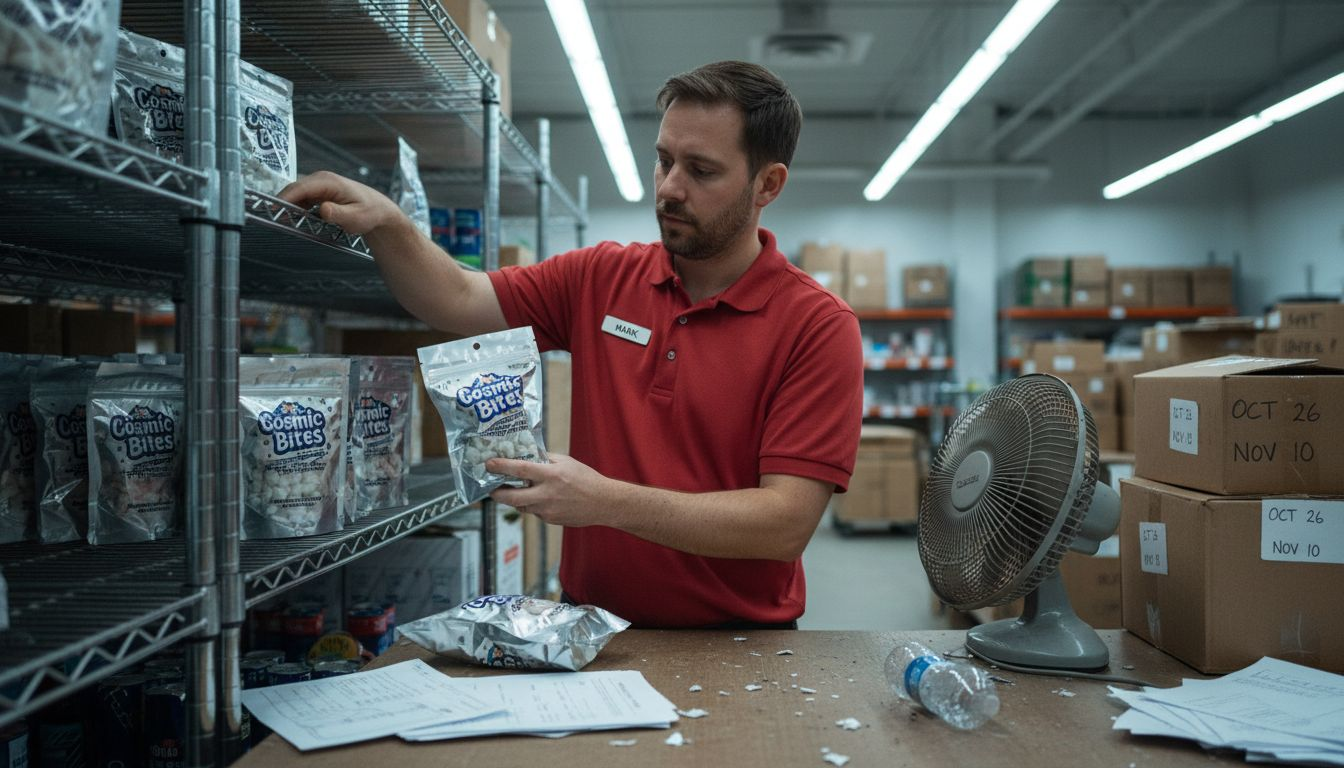
Allergens are another serious consideration. Allergens remain active throughout freeze-drying because the process preserves protein structures. Traces of nuts, dairy, or shellfish don’t vanish with moisture removal—they stay dormant in the product.
Storage conditions directly impact safety. Improper humidity or temperature can reactivate dormant microorganisms or degrade protective packaging. Your retail environment matters as much as manufacturing does.
Here’s a comparison of freeze-dried candy types based on typical risks and handling needs:
| Candy Type | Risk Level | Special Handling Required |
|---|---|---|
| Low-moisture (fruit, hard) | Lower | Standard storage, seal packaging |
| Dairy-based | Higher | Temperature controls, close monitoring |
| Egg-containing | Moderate-High | Strict humidity and temp checks |
| Mixed-ingredient | Variable | Comprehensive hazard checks |
The safest freeze-dried candies come from manufacturers with validated HACCP plans and third-party testing. Don’t assume freeze-drying eliminates all risks—it’s only part of the safety equation.
When sourcing freeze-dried candy for your retail operation, verify that suppliers use industrial-grade equipment with documented safety protocols, not home-drying methods. Ask for microbiological testing results and allergen documentation.
Pro tip: Request certificates of analysis from suppliers showing microbiological testing results and allergen statements, then store that documentation for at least two years in case regulators ask.
Compliance Steps for Snack Retail Businesses
Compliance with Canadian food safety regulations isn’t a one-time checkbox. It’s an ongoing process that protects your customers and keeps regulators satisfied. Here’s what you actually need to do.
First, determine whether you need a Safe Food for Canadians (SFC) license. If you’re importing freeze-dried candy from suppliers, selling across provincial lines, or operating an e-commerce business shipping nationally, you likely fall under interprovincial trade rules. This triggers licensing requirements.
Start by evaluating your specific business activities:
- Do you import ingredients or finished products from outside Canada?
- Do you sell products across provincial boundaries?
- Do you operate an online store serving multiple provinces?
- Do you repackage or co-pack products for other retailers?
If you answered yes to any of these, you need to obtain the appropriate license through the My CFIA portal. The application process requires demonstrating that you meet all Safe Food for Canadians Regulations requirements before you get approval.
Next, develop a preventive control plan that addresses specific hazards in your operation. For freeze-dried candy retailers, this means documenting how you manage allergen risks, contamination prevention, and proper storage conditions.
Your preventive controls should cover:
- Supplier verification and ingredient checks
- Storage temperature and humidity monitoring
- Allergen labeling accuracy and cross-contamination prevention
- Staff training on food safety procedures
- Pest control and facility sanitation
Traceability documentation is non-negotiable. You must maintain records showing where products come from (suppliers) and where they go (customers). The standard is one step back, one step forward—meaning you can trace any product to its origin and identify every retailer or customer who received it.
Strong traceability systems allow you to execute targeted recalls within hours instead of days, protecting both consumers and your business reputation.
Regular staff training keeps everyone accountable. Document what training occurred, when, and who attended. When inspectors arrive, they’ll ask to see these records immediately.
Maintain accurate labels and packaging that clearly state allergens, ingredients, and storage instructions. Any freeze-dried candy with dairy, nuts, or eggs requires prominent allergen warnings.
Below is a summary of critical compliance actions and their benefits for snack retailers:
| Compliance Action | Business Benefit |
|---|---|
| Preventive control plan | Reduces risks, streamlines inspections |
| Traceability system | Enables fast recalls, avoids penalties |
| Staff food safety training | Prevents errors, proves due diligence |
| Accurate allergen labeling | Lowers liability, builds trust |
Pro tip: Use a simple spreadsheet or inventory system to track supplier information, product lot numbers, and distribution dates, then back it up monthly to ensure you can retrieve records quickly during an inspection.
Preventive Controls, Traceability, and Licensing
These three pillars form the backbone of Canadian food safety compliance. Get them right, and inspections become routine. Get them wrong, and you’re facing fines or product recalls.
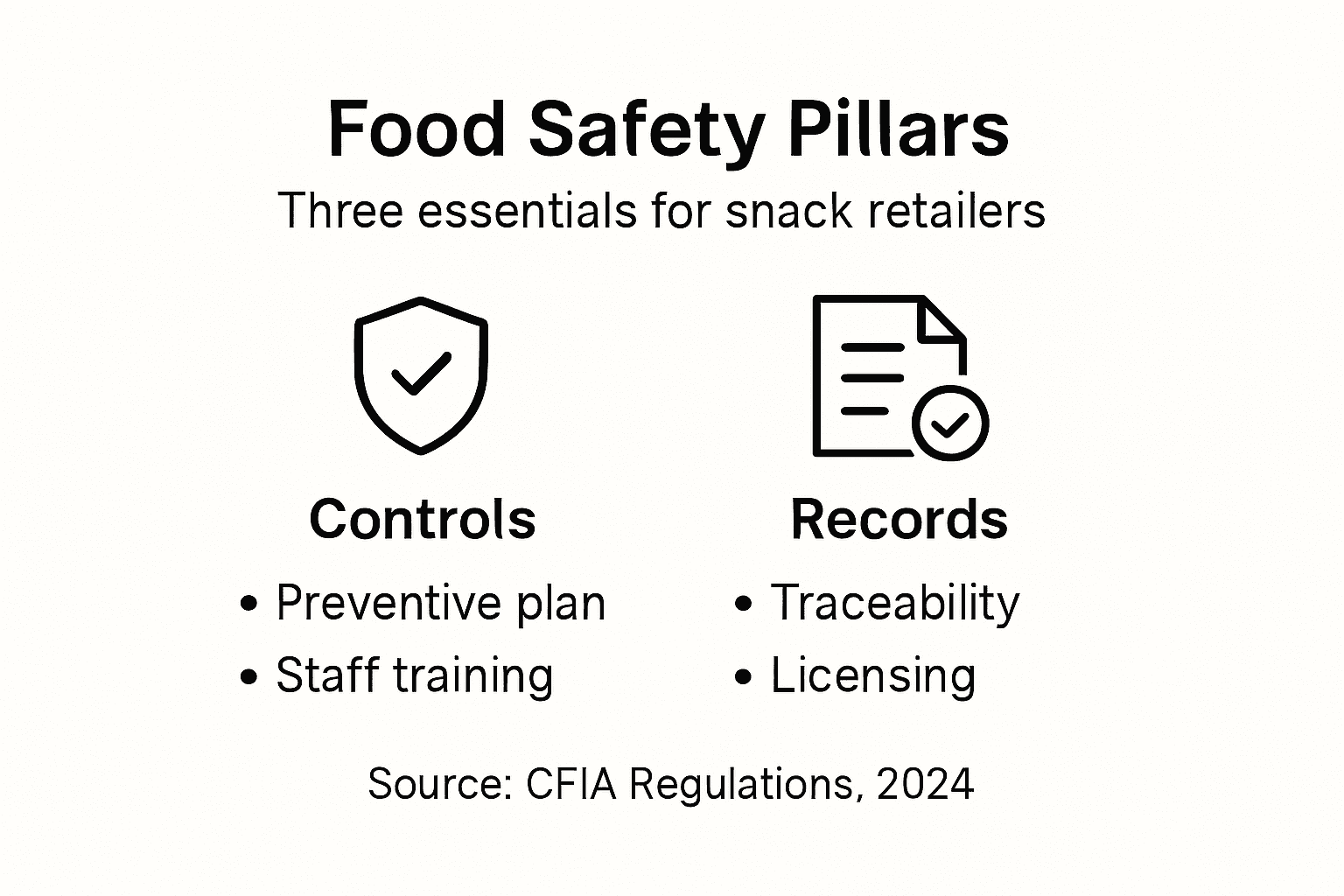
Preventive controls start with a documented plan. You can’t just think about food safety—you must write it down in a preventive control plan (PCP) that identifies hazards specific to your operation. For freeze-dried candy retailers, this means addressing allergens, moisture reactivation risks, and proper storage conditions.
Your PCP should outline specific actions:
- Temperature and humidity monitoring procedures
- Supplier verification and ingredient acceptance criteria
- Allergen management and cross-contamination prevention
- Staff training schedules and competency checks
- Sanitation and pest control protocols
- Product recall procedures
The plan doesn’t need to be complicated. It needs to be honest about your actual operations and realistic about what you can maintain. HACCP and GMP standards provide the framework most retailers follow.
Traceability is your safety net. You must track products one step forward and one step back in your supply chain. This means knowing exactly which supplier provided each ingredient batch and which retailers or customers received finished products.
Implement a system that captures:
- Supplier names and contact information
- Product lot numbers and expiration dates
- Purchase dates and quantities
- Distribution records with retailer or customer names
When a contamination issue emerges, traceability lets you isolate the problem in hours instead of days. This protects consumers and your reputation.
Licensing is mandatory if you’re importing, exporting, or selling across provincial lines. Most snack retailers operating online fall into this category. CFIA requires documented preventive control plans before issuing a license, so your PCP must be complete and current.
The application process typically takes 4-6 weeks once you submit everything. Start early—don’t wait until you’re ready to launch.
Your preventive control plan isn’t a shelf document. It’s a living record that evolves as your business changes, ingredients shift, or new risks emerge.
Review and update your PCP annually or whenever you change suppliers, products, or facility operations. Document all updates with dates and reasons.
Pro tip: Create a master traceability spreadsheet now, before you need it, so when an inspector calls or a recall happens, you’re pulling data from a tested system instead of scrambling to piece it together.
Common Mistakes and Legal Exposure for Retailers
Many snack retailers think compliance is just paperwork. They’re wrong. And that misconception can cost them thousands in fines, product seizures, or worse—a suspended license.
The biggest mistake is treating your preventive control plan like a template box to check. Generic plans that don’t reflect your actual operations signal to inspectors that you’re not serious about food safety. Your PCP must document real procedures you actually follow.
Here’s what retailers commonly get wrong:
- Writing controls that sound good but don’t match daily operations
- Assuming traceability is optional or can be done retroactively
- Mislabeling allergens or using outdated ingredient lists
- Storing freeze-dried candy in unmonitored conditions
- Failing to respond quickly when recalls are issued
- Not training staff regularly on food safety procedures
Another critical error is misunderstanding regulatory overlaps. Federal rules apply to you if you’re trading interprovincially, but provincial regulations may also apply depending on where you operate. SFCR compliance requires understanding which rules govern your specific activities, not just assuming federal rules cover everything.
Legal exposure is real and escalates quickly. The Safe Food for Canadians Act allows the CFIA to issue administrative penalties, seize products, suspend your license, or pursue criminal prosecution. A single allergen mislabeling incident can trigger a recall affecting hundreds of retailers.
Record-keeping failures are surprisingly common. Inspectors will ask to see your traceability records within minutes of arriving. If you can’t locate them or they’re incomplete, expect an inspection finding. Poor records also hamper your ability to execute a targeted recall, which exposes more consumers to risk.
A delayed response to a food recall can transform a manageable problem into a reputational disaster. Your response time matters as much as your prevention efforts.
Delayed recall responses are another expensive mistake. When CFIA notifies you of contaminated products in your supply chain, you have limited time to notify your customers and remove items from shelves. Slow responses invite enforcement action.
Mismanaging allergen information compounds these risks. Freeze-dried candy often contains tree nuts, peanuts, or dairy. If your labeling is unclear or outdated, you’re liable for allergic reactions and potential lawsuits.
Pro tip: Run a mock recall exercise annually with your team to test your response procedures and documentation system, identifying gaps before regulators do.
Ensure Your Freeze-Dried Candy Meets Safe Food for Canadians Standards
Navigating the complex requirements of the Safe Food for Canadians Regulations can feel overwhelming for snack retailers focused on freeze-dried candy. From maintaining rigorous preventive control plans to managing allergen risks and traceability, the challenges are real and can put your business at legal and financial risk. You need a trusted partner who not only understands these dynamics but can help you stay compliant while growing your brand.

At Space-Man, we specialize in freeze-dried candy manufacturing and distribution across Canada with full adherence to food safety regulations. Whether you need private labeling, co-packing, or packaging services, we provide transparent supplier verification, validated safety protocols, and detailed traceability that align with your preventive control plans. Don’t wait until an inspection uncovers gaps that could risk your license or customer trust. Take control of your food safety compliance today by partnering with industry experts committed to your success. Discover all our solutions tailored for Canadian snack retailers at Space-Man and learn how we can help you exceed regulatory expectations.
Frequently Asked Questions
What are the main requirements of the Safe Food for Canadians Regulations?
The Safe Food for Canadians Regulations cover licensing, preventive controls, traceability, packaging, labeling, and commodity-specific rules to ensure food safety across the food supply chain.
How can snack retailers ensure compliance with food safety standards?
Snack retailers can maintain compliance by developing a preventive control plan, keeping accurate traceability records, conducting regular staff training, and ensuring proper allergen labeling.
What types of freeze-dried candies pose the highest safety risks?
Dairy-based and egg-containing freeze-dried candies generally carry higher risks if not processed with proper safety controls, while low-moisture candies are considered lower risk due to their reduced moisture content inhibiting bacterial growth.
How important is traceability in the food supply chain for snack retailers?
Traceability is crucial; it allows retailers to track products from supplier to customer, enabling quick identification and response during contamination events or recalls, thus protecting consumer safety and maintaining business reputation.
Recommended
- Nutritional Value of Freeze-Dried Food: Impact on Canadian Snack Shops – Spaceman
- Understanding Food Safety Standards Canada for Retailers – Spaceman
- Why Distributors Across Canada Are Adding Freeze-Dried Candy to Their – Spaceman
- Snacks in Green Packaging: Attracting Eco-Conscious Shoppers – Spaceman
- Top alternatieven plastic rietjes – Vergelijking 2025 | Earth Saver Straws