

TL;DR:
- Freeze drying preserves intense, natural flavor by avoiding heat and liquid loss.
- Proper process control and storage are essential to maintain flavor quality.
- This method offers a competitive advantage by enhancing taste, color, and shelf life.
Most candy manufacturers assume preservation is a trade-off: you keep the product longer, but you sacrifice something in taste. Freeze drying flips that assumption entirely. Unlike heat-based methods that cook off volatile aroma compounds and dull color, freeze drying uses a cold vacuum process that locks flavor in at its peak. For Canadian candy manufacturers and retailers competing in a market where consumers increasingly demand bold, authentic taste, understanding this distinction is not just interesting — it’s a competitive advantage worth building your product line around.
Table of Contents
- Understanding the freeze drying process and its impact on flavor
- Why freeze drying excels at preserving and enhancing flavors
- Practical considerations: Getting optimal flavor in freeze dried candy
- Maximizing flavor shelf life: Storage and handling strategies
- Why flavor is the ultimate differentiator in Canadian candy — and how freeze drying helps you win
- Bring top-tier flavor to your shelves with Canadian freeze dried candy
- Frequently asked questions
Key Takeaways
| Point | Details |
|---|---|
| Minimizes flavor loss | Freeze drying preserves up to 97% of flavors and nutrients by avoiding heat damage. |
| Porous structure enhances taste | The process creates airy textures that intensify flavor release in finished candies. |
| Proper controls boost results | Fast freezing and airtight storage maximize long-term flavor retention and customer satisfaction. |
| Differentiates your products | Superior flavor retention helps Canadian candy brands and retailers attract and keep loyal customers. |
Understanding the freeze drying process and its impact on flavor
To set the stage, let’s break down exactly how freeze drying captures flavors so effectively.
Freeze drying is a preservation method built around a process called sublimation. The candy or ingredient is first frozen solid, then placed in a vacuum chamber where pressure drops low enough that ice converts directly into vapor, skipping the liquid phase entirely. This is what separates freeze drying from every other preservation method on the market. There is no heat, no boiling water, and no cellular collapse from moisture moving through the product as a liquid.
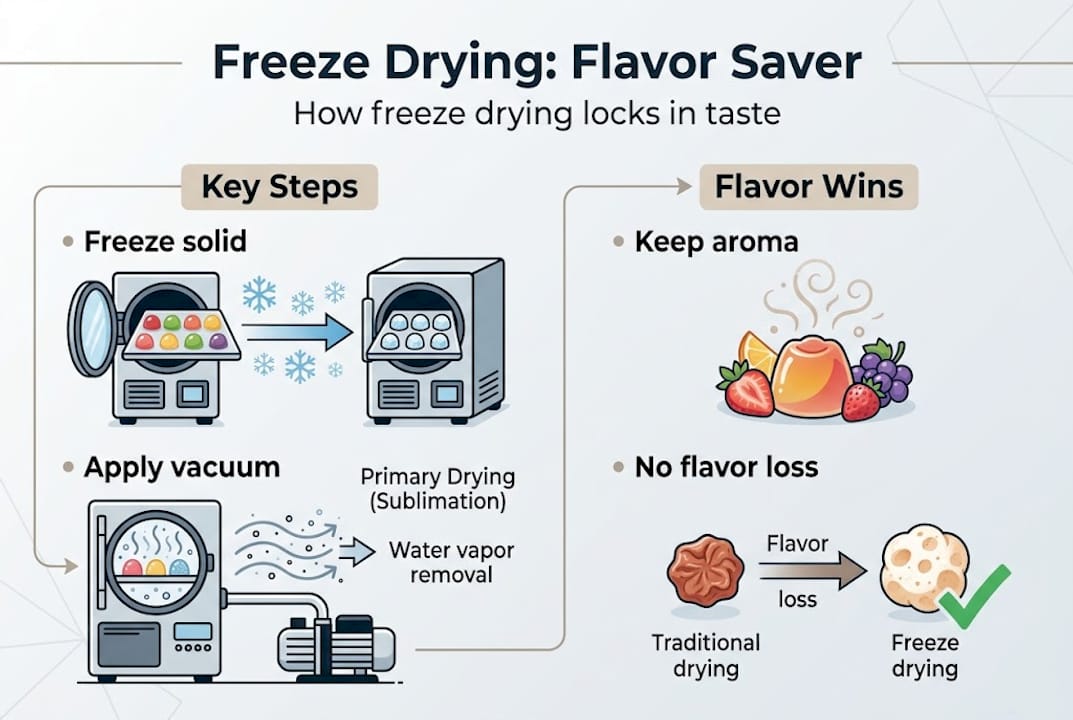
Why does skipping the liquid phase matter so much for flavor? When water passes through a liquid stage, it carries flavor compounds with it. Those compounds escape the product, and you lose taste, aroma, and color in the process. Freeze drying preserves flavor through sublimation, where frozen water transitions directly from solid to vapor under vacuum, avoiding the liquid phase that causes cellular collapse in other methods. The result is a candy that tastes remarkably close to its original form.
For a clearer picture, here is how freeze drying compares to common alternatives:
| Preservation method | Heat used | Liquid phase | Flavor retention | Color retention |
|---|---|---|---|---|
| Freeze drying | No | No | Excellent | Excellent |
| Dehydration | Yes | Yes | Moderate | Fair |
| Canning | Yes | Yes | Low | Poor |
| Air drying | Minimal | Yes | Low to moderate | Fair |
The freeze drying scientific overview confirms what candy producers experience in practice: the absence of heat and liquid transition preserves the molecular integrity of flavor compounds in ways no other method can replicate.
For manufacturers, this translates into a few immediate benefits:
- Vibrant, true-to-source flavor that consumers recognize and remember
- Consistent color that signals freshness on retail shelves
- Extended shelf life without the need for artificial flavor enhancers
- A light, porous texture that creates a distinct eating experience
If you want to understand the full difference between freeze dried and dehydrated products, the contrast in flavor outcome alone makes the case for why freeze drying commands a premium in the market.
“Freeze drying is not just about preservation. It is about capturing a product at its best and delivering that experience to the consumer intact.”
Why freeze drying excels at preserving and enhancing flavors
Now that you know the basics, let’s explore what makes freeze drying uniquely effective for taste.
The flavor advantage of freeze drying comes down to chemistry. Candy flavors, especially those derived from fruit, are built on volatile aroma compounds. These molecules are highly sensitive to heat. Even moderate temperatures can break them down, which is exactly what happens during dehydration. Low temperatures in freeze drying minimize degradation of heat-sensitive volatile aroma compounds and flavor molecules, unlike heat-based methods like dehydration. This is why a freeze dried strawberry candy tastes intensely of strawberry, while a heat-dried version often tastes flat or slightly cooked.

Here is a direct comparison of what freeze drying versus dehydration delivers for candy and fruit-based products:
| Attribute | Freeze drying | Dehydration |
|---|---|---|
| Flavor intensity | Very high | Moderate |
| Aroma retention | Excellent | Low to moderate |
| Color vibrancy | Excellent | Fair |
| Nutrient retention | 90 to 97% | 40 to 60% |
| Texture | Light, porous, crunchy | Dense, chewy |
The process retains 90 to 97% of original nutrients, flavor, and volatiles, creating a porous structure that enhances flavor release upon consumption. That porous structure is worth paying attention to. When a consumer bites into a freeze dried candy, the surface area exposed to saliva is dramatically larger than in a dense, chewy product. Flavor compounds hit the palate faster and more intensely. It is not just preserved flavor — it is amplified flavor delivery.
For candy manufacturers, this creates a ranked list of advantages to communicate to retail buyers:
- Superior taste that requires no artificial flavor boosting
- Visual appeal from retained color that drives impulse purchases
- A unique texture that creates a memorable, repeat-purchase experience
- Nutritional credibility from high nutritional value of freeze dried fruit that supports premium positioning
- Long shelf life that reduces waste and simplifies inventory planning
Pro Tip: Source your fruit-based candy ingredients at peak ripeness. Flavor compounds are most concentrated at that stage, and freeze drying locks them in exactly as they are. Starting with inferior ingredients will produce inferior results, no matter how precise your process is.
The scientific flavor retention data backs this up consistently. Freeze drying is not a workaround for flavor loss — it is the method that makes genuine flavor preservation possible at commercial scale.
Practical considerations: Getting optimal flavor in freeze dried candy
Having highlighted freeze drying’s flavor benefits, let’s discuss how to put this knowledge into action on your production line.
Flavor retention does not happen automatically. It is the result of controlled decisions made at every stage of the process. The freezing rate matters more than most manufacturers expect. Rapid freezing creates smaller ice crystals, which cause less structural damage to the candy matrix and preserve more of the volatile compounds that carry aroma and taste. Slow freezing does the opposite, and you end up with a product that has gone through the right process but still underdelivers on flavor.
Vacuum settings are equally important. The chamber pressure must be low enough to trigger sublimation without introducing heat that degrades flavor molecules. Process control, including freezing rate and vacuum parameters, is critical, and peak ripeness ingredients combined with airtight storage prevent oxidation and flavor degradation. These are not optional refinements — they are the foundation of a consistent, high-quality product.
Here are the most common pitfalls that lead to flavor loss during production:
- Overloading trays: Reduces airflow and creates uneven drying, leaving moisture pockets that degrade flavor over time
- Imprecise vacuum settings: Too high a pressure slows sublimation and risks partial melting, which reintroduces the liquid phase
- Inadequate pre-freezing: Incomplete freezing before the vacuum cycle leads to cellular damage and aroma loss
- Inconsistent ingredient quality: Variable ripeness or freshness creates unpredictable flavor outcomes batch to batch
For manufacturers exploring freeze drying controls for business, the key is treating every parameter as a flavor variable, not just a technical setting. Even something as specific as freeze drying tips for meats illustrates how process precision translates directly to end-product quality across different product types.
Pro Tip: After freeze drying, transfer product immediately into airtight, moisture-barrier packaging. Even brief exposure to ambient humidity can begin reversing the flavor stability you worked to achieve. Every minute of open-air exposure counts.
Maximizing flavor shelf life: Storage and handling strategies
Of course, even perfectly freeze dried candies can lose their magic if not stored with care.
Freeze dried candy is stable, but it is not invincible. The same porous structure that amplifies flavor on the palate also makes the product highly susceptible to moisture absorption. Once moisture enters, the candy begins to rehydrate, flavor compounds start to degrade, and texture collapses. Storage conditions are not an afterthought — they are the final step in protecting everything your production process achieved.
Here is the priority order for storage decisions:
- Temperature: Keep storage areas consistently cool. Fluctuating temperatures accelerate oxidation and can push product above its glass transition temperature, causing structural and flavor breakdown
- Humidity: Target below 25% relative humidity in storage environments. Even moderate humidity exposure shortens effective shelf life significantly
- Light exposure: UV light degrades color and certain flavor compounds. Opaque or foil-lined packaging is the standard for a reason
- Packaging integrity: Airtight, food-safe packaging with oxygen absorbers is the most reliable defense against both moisture and oxidation
For retailers, handling practices matter just as much as storage conditions. Rotate stock consistently, keep product away from heat sources like display lighting, and never store freeze dried candy near products with strong odors — the porous structure absorbs surrounding aromas easily.
“Improper storage above glass transition temperature causes flavor loss; rapid freezing preserves volatiles better. High-fat products also slow the freeze drying process and may need adjusted parameters.”
For a deeper look at best practices, the guides on storing freeze dried goods, freeze dried sweet storage, and freeze dried food shelf life cover the specifics in detail. Getting storage right is what separates a product that impresses at first taste from one that consistently delivers across its entire retail life.
Why flavor is the ultimate differentiator in Canadian candy — and how freeze drying helps you win
Stepping back from the technical details, here is the perspective winning brands share.
Most candy brands in Canada compete on price, packaging, or novelty. Very few compete on flavor science. That gap is exactly where freeze dried candy wins. Consumers do not remember the price of a candy they loved — they remember the taste. They come back for it. They tell people about it. Flavor retention is not a processing detail; it is a loyalty engine.
What surprises us most is how many manufacturers underestimate this. They invest in branding and distribution but treat the production process as a cost center rather than a flavor investment. Freeze drying flips that logic. The process itself becomes the product’s strongest selling point, because the flavor it delivers is something competitors using conventional methods simply cannot replicate.
Bold, lasting flavors also support premium pricing. Retailers know that shoppers will pay more for a product that delivers a genuinely different experience. A freeze dried candy that tastes intensely of real fruit, for example, justifies a higher price point in a way that a heat-dried alternative never could. Even applications like freeze dried fruit in baking show how flavor intensity opens new market opportunities beyond the candy aisle. The brands that recognize flavor as strategy, not just quality control, are the ones building loyal customer bases in this market.
Bring top-tier flavor to your shelves with Canadian freeze dried candy
Ready to upgrade your candy offering and deliver unforgettable flavor?
At Spaceman, we manufacture and distribute freeze dried candy right here in Canada, built specifically for brands and retailers who want to lead on taste. Our process is designed to maximize flavor retention at every stage, from ingredient selection through to final packaging.
Whether you are looking to build your own line through our private label co-packing services, stock your retail floor with our wholesale freeze dried candy display options, or sample the range with a freeze dried candy bundle, we have the solutions to help you move fast and stand out. Let’s put real flavor on your shelves.
Frequently asked questions
How does freeze drying preserve flavor better than dehydration?
Freeze drying avoids high heat and the liquid phase entirely, which means volatile aroma compounds stay intact instead of escaping with evaporating moisture. Dehydration’s heat breaks down those same compounds, leaving a noticeably flatter flavor profile.
Can freeze dried candy lose flavor during storage?
Yes. Improper storage above glass transition temperature or exposure to moisture can degrade flavor compounds and collapse the porous texture that makes freeze dried candy distinctive. Airtight, cool, and dry storage is essential.
Does freeze drying work equally well for all candies?
Most candies respond very well, but high-fat foods slow the process and may require adjusted vacuum settings and longer cycle times to achieve the same flavor preservation results.
What ingredients give the best flavor results in freeze dried candy?
Peak ripeness fruit infusions and high-grade flavor compounds perform best because peak ripeness ingredients contain the highest concentration of volatile flavor molecules that freeze drying then locks in permanently.