

Starting January 1, 2026, most prepackaged candy with high sugar, fat, or sodium levels must carry a front-of-package nutrition symbol on the label. That single requirement is already catching experienced manufacturers off guard, and it is just one piece of a larger compliance picture. Canadian candy packaging law touches everything from bilingual text and allergen declarations to net weight tolerances and food-safe materials. Whether you are launching a new product line or auditing an existing one, understanding these rules is the difference between smooth retail distribution and a costly enforcement action.
Table of Contents
- Overview of Canadian candy packaging regulations
- Labelling essentials for candy: What must appear on your package?
- New front-of-package (FOP) symbol: 2026 requirements demystified
- Packaging material standards and net quantity rules
- Why most candy recalls are labeling errors, not packaging flaws
- How Spaceman can help with compliant packaging solutions
- Frequently asked questions
Key Takeaways
| Point | Details |
|---|---|
| Bilingual labeling required | Candy packaging must always display key information in both English and French. |
| 2026 FOP symbol is mandatory | Most prepackaged candies high in fat, sugar, or sodium need the new front-of-package nutrition symbol. |
| Single vs multi-pack rules differ | Individually wrapped candies may be exempt from full labeling, but bulk and multi-packs require all information. |
| Material safety is essential | All packaging materials must be food-safe, durable, and compliant with federal standards. |
| Label mistakes cause recalls | More recalls stem from labeling errors than packaging materials—double check all labels for compliance. |
Overview of Canadian candy packaging regulations
Candy packaging in Canada is governed by three core federal frameworks. The Safe Food for Canadians standards established under the Safe Food for Canadians Regulations (SFCR) set the baseline for how food must be prepared, packaged, and labeled before it reaches consumers. The Food and Drugs Act (FDA) and the Food and Drug Regulations (FDR) layer on top of that with specific standards for composition, safety, and labeling accuracy. Together, these frameworks cover virtually every decision you make about your candy packaging.
The Canadian Food Inspection Agency (CFIA) is the primary enforcement body. It conducts inspections, reviews label submissions, and has authority to detain, seize, or restrict the sale of non-compliant products. According to CFIA candy requirements, candy packaging must comply with SFCR, FDA, and Food and Drug Regulations. Non-compliance is not just a paperwork problem. Products can be pulled from shelves, shipments can be held at the border, and repeat violations can result in license suspension.
One requirement that surprises many manufacturers entering the Canadian market is bilingual labeling. Both English and French must appear on all mandatory label elements for products sold nationally. This is not optional even if you are only targeting one province. The Canadian packaging regulations require bilingual text on the common name, ingredient list, allergen statements, and Nutrition Facts table.
The mandatory elements are:
- Common name of the food in both official languages
- Net quantity declared in metric units
- Ingredient list in descending order by weight
- Allergen declarations in plain language
- Nutrition Facts table (with specific exemptions)
- Best before date where applicable
- Name and address of the manufacturer or distributor
Pro Tip: Use the CFIA’s Industry Labelling Tool before finalizing any packaging artwork. It walks you through mandatory requirements by product type and flags common errors before you go to print.
Labelling essentials for candy: What must appear on your package?
Knowing the general framework is one thing. Knowing exactly what applies to your specific product is where most compliance errors happen. Let’s get specific about what must appear on your labels and where exceptions apply.
The six mandatory elements for most prepackaged candy are:
- Common name in English and French
- Net quantity in grams or milliliters
- Ingredient list in descending order by weight, bilingual
- Allergen and gluten source declarations using standardized language
- Nutrition Facts table formatted to federal specifications
- Best before date if the product has a durable life of 90 days or less
According to CFIA labeling requirements, mandatory elements include bilingual labeling, common name, ingredients in descending order by weight, allergens, Nutrition Facts, and best before dates.
One important edge case is the one-bite exemption. One-bite confections sold alone are exempt from most labeling requirements including the Nutrition Facts table and ingredient list. Think of an individually wrapped mint or a single hard candy sold at a checkout counter. That exemption disappears the moment those same candies are packaged together in a multi-pack or a bulk bag. At that point, full labeling requirements kick in.
Here is a quick comparison of labeling requirements by format:
| Package type | Nutrition Facts required | Ingredients required | Bilingual required |
|---|---|---|---|
| Single one-bite candy | No | No | No |
| Multi-pack (same candy) | Yes | Yes | Yes |
| Bulk bag (mixed candy) | Yes | Yes | Yes |
| Single-serve pouch (>1 bite) | Yes | Yes | Yes |
Allergen declarations deserve special attention. Canada requires that the top 14 priority allergens be declared in plain language either within the ingredient list or in a separate “Contains” statement. For candy labeling best practices, always include a precautionary allergen statement if shared equipment is used during production.

Pro Tip: Review your candy supplier labeling tips to understand how upstream ingredient declarations affect your own label obligations. If a supplier changes an ingredient, your label must reflect that change before the next production run.
New front-of-package (FOP) symbol: 2026 requirements demystified
Some packaging rules are long-standing, but 2026 brings big changes, especially for nutrition warnings on the front of your package.
Health Canada’s new front-of-package (FOP) labeling rule requires a standardized magnifying glass symbol on the front of any prepackaged food that is high in sugars, saturated fat, or sodium. The threshold is 15% Daily Value (DV) or more per serving for any one of those three nutrients. For candy, this is a significant trigger. Most gummy candies, chocolate-covered products, and sugar-based confections will hit the sugar threshold easily.
According to Health Canada’s FOP requirements, any prepackaged candy with 15% DV or more for saturated fat, sugars, or sodium requires the new FOP symbol starting January 1, 2026.
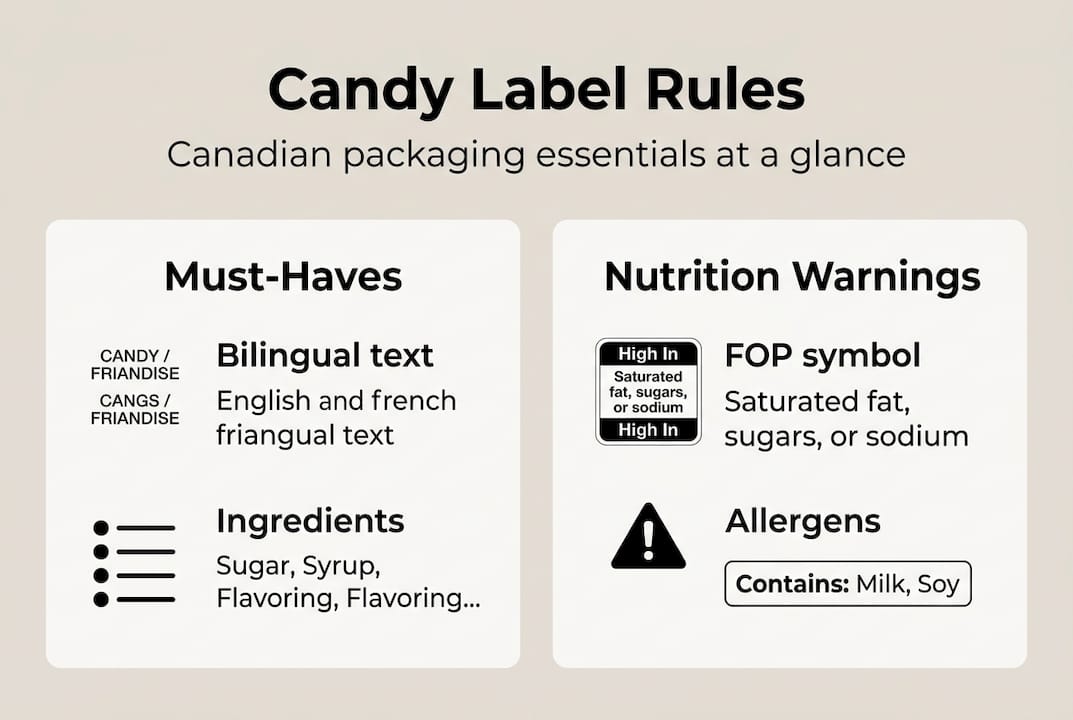
Here is how common candy types stack up against the thresholds:
| Candy type | Likely FOP trigger | Nutrient of concern |
|---|---|---|
| Gummy bears (50g serving) | Yes | Sugars |
| Milk chocolate bar | Yes | Saturated fat + sugars |
| Hard candy (15g serving) | Possibly | Sugars |
| Freeze dried candy (20g serving) | Likely | Sugars |
| Sugar-free mints | Unlikely | None typically |
Package size also matters. Products with a total surface area under 15 cm² are exempt from the FOP symbol requirement. This applies to very small individual wrappers but not to most retail bags or boxes. Check your Nutrition Facts exemptions carefully if you are working with small-format packaging.
“The front-of-package nutrition symbol is designed to help Canadians quickly identify foods that are high in nutrients that, when consumed in excess, are associated with increased risk of chronic disease.” — Health Canada
Early adopters are already printing the FOP symbol on new packaging runs to avoid a costly reprint cycle at the deadline. If your current packaging inventory will carry you past January 1, 2026, you need a transition plan now. Explore candy packaging innovations to see how brands are integrating the new symbol without compromising shelf appeal.
Packaging material standards and net quantity rules
After mastering label content, you need to ensure your packaging materials and quantities pass every compliance check.
Canada does not have candy-specific packaging material regulations, but general food packaging safety standards still apply to every bag, pouch, wrapper, or box you use. Materials must be food-safe, meaning they cannot leach chemicals into the product, introduce contamination, or physically fail under normal storage and transport conditions. According to packaging material requirements, packaging must be food-safe, prevent contamination, and meet integrity standards, with emerging requirements for plastics and extended producer responsibility (EPR) reporting.
EPR is worth watching. Several Canadian provinces are expanding their EPR programs, which require manufacturers and importers to report and in some cases fund the end-of-life management of their packaging materials. This is not yet a federal labeling requirement, but it is becoming a cost of doing business in markets like Ontario and British Columbia.
Key material compliance checkpoints:
- No migration of harmful substances from packaging into the candy
- Structural integrity under expected storage and shipping conditions
- Moisture and oxygen barrier performance appropriate for product shelf life
- Compliance with provincial EPR reporting requirements where applicable
Net quantity rules are equally important. Every retail candy package must declare the net quantity in metric units, and that declared quantity must be accurate. According to CFIA net quantity standards, net quantity follows trade customs and packages must not be underfilled. CFIA inspectors use Schedule 4 tolerances to determine whether a package is within acceptable limits. A 200g bag of candy that consistently weighs 185g will trigger a compliance action.
Slack-fill is another trap. Packaging that contains excessive empty space relative to the product volume is considered misleading under the Consumer Packaging and Labelling Act. This matters especially for creative candy packaging designs that use large decorative boxes or oversized pouches.
Pro Tip: For candy pouch packaging, weigh a statistically meaningful sample from each production run and document the results. This gives you evidence of compliance and helps catch filling equipment drift before it becomes a regulatory problem.
Why most candy recalls are labeling errors, not packaging flaws
You now know the rules, but let’s spotlight the real reason most candy products land in trouble.
Here is something most compliance guides skip over: the majority of candy-related enforcement actions in Canada are triggered by labeling mistakes, not by packaging material failures. CFIA enforcement data confirms that labels generate most enforcement action due to allergen and language errors. The packaging itself, the bag, the pouch, the wrapper, is rarely the problem. The text on it almost always is.
The two most common causes are undeclared allergens and missing French translations. Both are entirely preventable with a structured pre-shipment label audit. Yet brands skip this step because it feels redundant after design approval. It is not. Ingredient suppliers change formulations. Printers make substitutions. Bilingual copy gets dropped in a file version mix-up.
What most articles miss is that a simple one-page label audit checklist, reviewed by someone other than the designer, catches 90% of these errors before the product ships. After 2026, CFIA inspection focus is expected to increase around FOP symbol compliance, which adds a new item to that checklist. Explore custom candy packaging insights to see how proactive label reviews are built into a compliant production workflow.
How Spaceman can help with compliant packaging solutions
Ready to act with your newfound understanding of candy packaging regulations?
At Spaceman, we work with candy manufacturers and retailers across Canada who need packaging that is not just eye-catching but fully compliant. From bilingual label design to FOP symbol integration, our team understands the current requirements and the 2026 changes in detail.

Our private label and co-packing services are built to handle the full production and packaging workflow, so you do not have to manage compliance alone. Whether you need a turnkey solution or just a second set of eyes on your label before print, contact Spaceman to find out how we can support your next product launch with confidence.
Frequently asked questions
What are the mandatory label elements for packaged candy in Canada?
Most candy must display bilingual labeling, a common name, ingredient list, allergens, Nutrition Facts table, and a best before date if applicable. These mandatory labeling elements apply to virtually all prepackaged confectionery sold at retail.
Are single-wrapped mints or hard candies exempt from nutrition labeling?
Yes, one-bite confections sold individually are usually exempt from the Nutrition Facts table and ingredients list. That exemption does not apply once those candies are grouped into a multi-pack or bulk bag.
When does the new front-of-package (FOP) nutrition symbol apply to candy?
Starting January 1, 2026, most prepackaged candy with high sugar, fat, or sodium will require the FOP symbol on the front of the package.
Does Canada have specific packaging material rules for candy?
Canada applies general food packaging safety standards but does not have unique candy-specific material benchmarks. All food packaging must be food-safe and prevent contamination regardless of the product type.