

Finding the right packaging for freeze-dried candy is a challenge many Canadian store owners know all too well. Packaging problems can threaten shelf life, consumer confidence, and even business sustainability, especially when venturing into e-commerce and private label markets. With specialty confectionery products so sensitive to moisture and mechanical damage, investing in advanced packaging solutions is crucial for protecting your brand’s reputation while meeting both regulatory and consumer expectations.
Table of Contents
- Defining Packaging Problems In Confectionery
- Types Of Packaging Issues For Freeze-Dried Candy
- How Packaging Affects Product Quality And Shelf Life
- Legal And Safety Standards For Candy Packaging
- Private Label And E-Commerce Packaging Solutions
- Common Mistakes And How To Avoid Them
Key Takeaways
| Point | Details |
|---|---|
| Packaging Complexity | Confectionery packaging involves various challenges including contamination risks and material migration that affect product quality and consumer perception. |
| Freeze-Dried Candy Issues | Key packaging challenges for freeze-dried candies include moisture ingress and oxygen permeability, which critically impact shelf life and product integrity. |
| Regulatory Compliance | Manufacturers must adhere to strict safety and labeling regulations to prevent harmful chemical migration and ensure consumer safety. |
| Design Mistakes | Common packaging errors such as material incompatibility and inadequate moisture barriers can compromise product quality and should be proactively addressed through rigorous testing. |
Defining Packaging Problems in Confectionery
Confectionery packaging represents a complex landscape fraught with critical challenges that directly impact product quality, consumer perception, and business sustainability. Packaging challenges in food systems extend far beyond simple product containment, involving intricate considerations of material stability, regulatory compliance, and environmental impact.
The primary packaging problems in the confectionery industry can be categorized into several critical domains:
- Contamination risks: External environmental factors that compromise product integrity
- Material migration: Potential chemical transfers between packaging and food products
- Structural integrity: Maintaining package strength during transportation and storage
- Consumer perception: Visual appeal and packaging design that influences purchasing decisions
These packaging challenges are particularly pronounced for specialty products like freeze-dried candies, which require exceptional protection against moisture, temperature variations, and potential mechanical damage. Packaging functions in food preservation emphasize that effective packaging must simultaneously protect, preserve, and promote the product.
Understanding these packaging problems requires a multifaceted approach that considers material science, regulatory standards, and consumer expectations. Manufacturers must navigate complex requirements while maintaining product quality, shelf stability, and cost-effectiveness.
Pro tip: Conduct regular packaging stress tests to identify potential vulnerabilities before full-scale production deployment.
Types of Packaging Issues for Freeze-Dried Candy
Freeze-dried candy packaging presents unique challenges that can significantly impact product quality, shelf life, and consumer satisfaction. Packaging material performance becomes critically important for maintaining the delicate texture and flavor characteristics of these specialized confectionery products.
The primary types of packaging issues for freeze-dried candies include:
- Moisture Ingress: The most critical challenge in freeze-dried candy packaging
- Oxygen Permeability: Potential oxidation that degrades product quality
- Barrier Integrity: Maintaining protective layers against environmental factors
- Structural Weakness: Packaging that fails under mechanical stress
- Temperature Sensitivity: Compromised protection during storage and transportation
These packaging challenges are particularly complex for freeze-dried candies due to their unique processing requirements. Confectionery packaging trends highlight the intricate balance between protective functionality and material sustainability. Manufacturers must navigate multiple considerations, including food safety regulations, consumer expectations, and cost-effectiveness.
Advanced packaging solutions now focus on multilayer materials that provide enhanced barrier properties. These innovative approaches aim to address the specific vulnerabilities of freeze-dried products, such as moisture sensitivity and potential structural breakdown during handling and distribution.

Here’s a quick guide comparing freeze-dried candy packaging challenges by type:
| Issue Type | Risk Level | Business Impact |
|---|---|---|
| Moisture Ingress | Very High | Shortened shelf life |
| Oxygen Permeability | High | Taste and color fading |
| Structural Weakness | Moderate | Increased damage claims |
| Temperature Sensitivity | High | Product spoilage |
| Barrier Integrity | Critical | Increased contamination |
Pro tip: Implement rigorous packaging stress testing to identify potential material weaknesses before full-scale production.
How Packaging Affects Product Quality and Shelf Life
Freeze-dried candy packaging plays a critical role in preserving product quality and extending shelf life beyond the manufacturing process. Active packaging solutions demonstrate remarkable capabilities in protecting delicate confectionery products from environmental degradation and maintaining their original sensory characteristics.
The key mechanisms through which packaging impacts product quality include:
- Moisture Control: Preventing humidity absorption
- Oxygen Barrier: Limiting oxidative processes
- Temperature Regulation: Protecting against thermal fluctuations
- Physical Protection: Preventing mechanical damage
- Contamination Prevention: Blocking external microbiological risks
Sustainable packaging assessments reveal that advanced packaging strategies directly correlate with reduced food waste and improved product preservation. The intricate design of packaging materials can significantly extend the viable shelf life of freeze-dried candies by creating a protective microenvironment that shields against potential quality degradation.
Manufacturers must carefully select packaging materials that balance protective capabilities with cost-effectiveness and environmental considerations. Multilayer packaging technologies now offer sophisticated solutions that can maintain product integrity while addressing sustainability concerns, ultimately delivering higher-quality products to consumers.
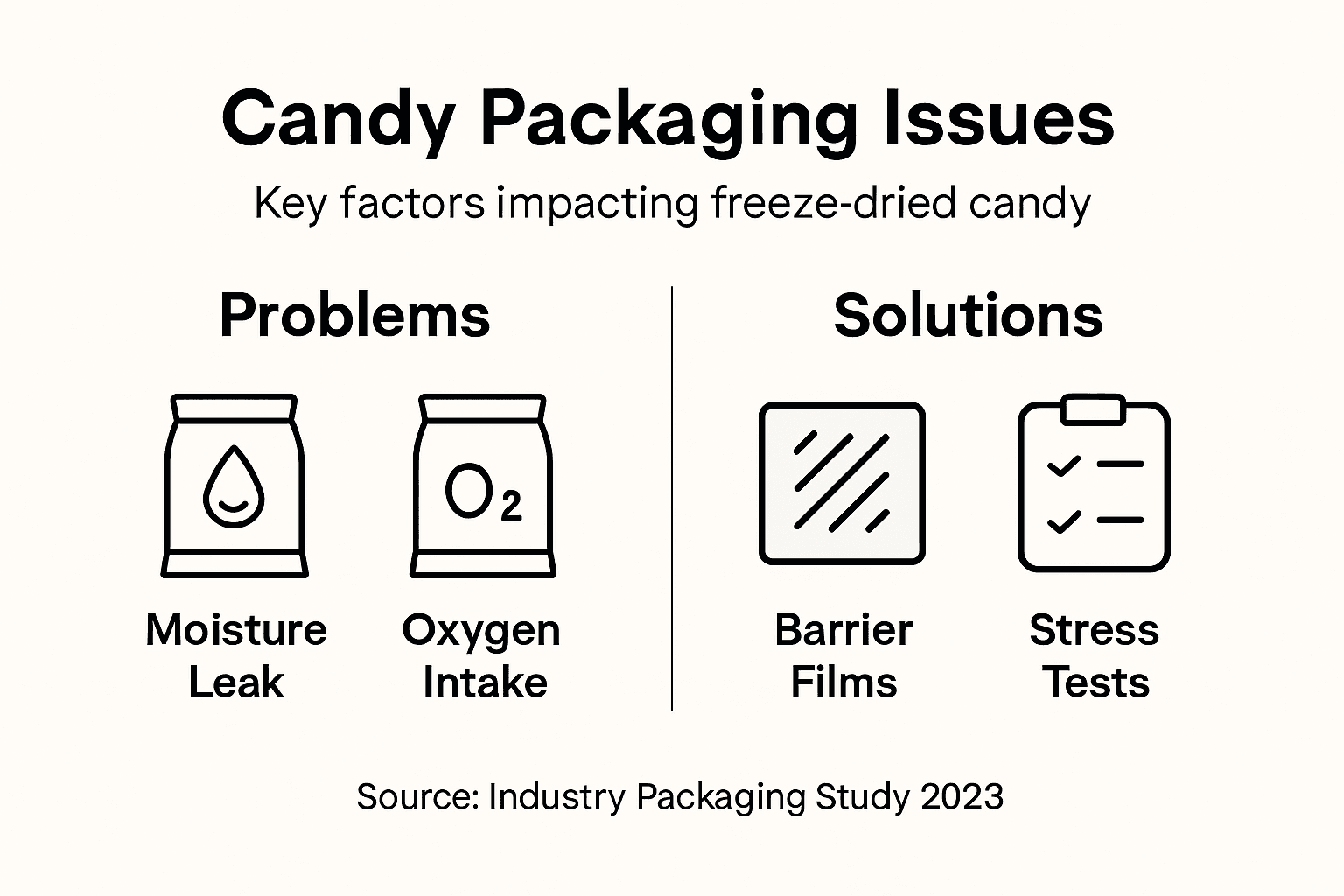
Pro tip: Invest in high-barrier packaging materials with proven moisture resistance to maximize freeze-dried candy shelf stability.
Legal and Safety Standards for Candy Packaging
Candy packaging in Canada requires complex regulatory compliance that goes far beyond simple product containment. Food packaging regulations establish rigorous safety standards designed to protect consumers from potential chemical migrations and contamination risks associated with packaging materials.
The primary legal and safety standards for candy packaging encompass several critical domains:
- Material Safety: Ensuring packaging does not introduce harmful chemicals
- Chemical Migration Prevention: Blocking toxic substance transfer
- Labeling Compliance: Accurate product information disclosure
- Recyclability Requirements: Meeting environmental sustainability standards
- Physical Integrity Standards: Maintaining packaging structural reliability
Global packaging safety assessments reveal that regulatory bodies mandate extensive testing protocols to evaluate potential health risks. These evaluations are particularly stringent for confectionery products, where packaging directly interfaces with consumable goods, necessitating comprehensive risk management strategies.
Manufacturers must navigate a complex landscape of national and international regulations, balancing consumer safety, environmental considerations, and production efficiency. This requires continuous monitoring of evolving legal frameworks and proactive adaptation of packaging technologies to meet increasingly sophisticated safety standards.
Pro tip: Conduct regular third-party certification audits to ensure ongoing compliance with the latest packaging safety regulations.
Private Label and E-Commerce Packaging Solutions
Private label packaging demands innovative strategies that address the unique challenges of online retail and freeze-dried candy distribution. Confectionery packaging innovations reveal critical considerations for developing effective e-commerce packaging solutions that protect product integrity and meet consumer expectations.
Key requirements for private label and e-commerce packaging include:
- Durability: Withstanding shipping and handling stress
- Moisture Barrier: Protecting freeze-dried products from environmental degradation
- Branding Opportunities: Creating memorable unboxing experiences
- Sustainability: Meeting recyclability and environmental standards
- Cost-Effectiveness: Balancing protection with economic feasibility
E-commerce packaging strategies emphasize the critical importance of packaging that can endure complex logistics while maintaining product quality. This requires sophisticated material selections that provide robust protection against mechanical damage, temperature fluctuations, and moisture intrusion during transit.
Successful private label brands must develop packaging solutions that not only protect the product but also communicate brand value, sustainability commitments, and create a compelling consumer experience. The intersection of functional protection and aesthetic appeal becomes crucial in the competitive e-commerce marketplace.
Compare key features of packaging solutions for private label and e-commerce:
| Feature | Standard Packaging | E-Commerce Optimized Packaging |
|---|---|---|
| Durability | Basic protection | Enhanced for shipping stress |
| Branding Potential | Limited customization | High-impact unboxing experience |
| Sustainability | Conventional materials | Focus on recyclability |
| Cost-Effectiveness | Lower upfront costs | Balanced with logistical needs |
| Moisture Protection | Basic barrier | Advanced moisture resistance |
Pro tip: Invest in packaging prototype testing that simulates actual shipping conditions to ensure maximum product protection.
Common Mistakes and How to Avoid Them
Packaging design for freeze-dried candy requires meticulous attention to prevent costly errors that can compromise product quality and consumer satisfaction. Confectionery packaging mistakes reveal critical vulnerabilities that manufacturers must proactively address to maintain market competitiveness.
The most prevalent packaging mistakes include:
- Material Incompatibility: Selecting packaging that degrades product quality
- Moisture Barrier Failure: Inadequate protection against environmental humidity
- Structural Weakness: Packaging unable to withstand shipping and handling
- Poor Branding Design: Packaging that fails to communicate product value
- Regulatory Non-Compliance: Overlooking safety and labeling requirements
Packaging technology strategies emphasize the importance of comprehensive testing and continuous improvement. Manufacturers must develop rigorous quality control processes that identify potential packaging vulnerabilities before product distribution, ensuring consistent performance across complex supply chain environments.
Successful freeze-dried candy producers recognize that packaging is not merely a protective shell but a critical component of product experience. This requires a holistic approach that integrates material science, consumer psychology, regulatory compliance, and brand communication into a unified packaging strategy.
Pro tip: Implement a comprehensive packaging prototype testing protocol that simulates extreme shipping and storage conditions.
Protect Your Freeze-Dried Candy With Superior Packaging Solutions
Packaging challenges such as moisture ingress, oxygen permeability, and structural weaknesses can severely affect your freeze-dried candy’s quality and sales. At Spaceman, we understand the critical need to maintain product integrity while offering attractive packaging that resonates with consumers. Whether you seek durable packaging to prevent damage during shipping or innovative moisture barriers to extend shelf life, our services cover private labeling, co-packing, and expert bagging solutions.
Explore our selection of high-quality products with uncompromised packaging through our Bulk Unbranded Freeze Dried Candy & Treats – Spaceman or discover The Perfect Gift : Freeze Dried Candy Bundles! – Spaceman designed to make lasting impressions while ensuring freshness.
Take action now to safeguard your freeze-dried candy’s quality and boost consumer satisfaction. Visit us at https://space-man.ca to learn how our packaging expertise can help you overcome common pitfalls and elevate your product’s shelf life and appeal.
Frequently Asked Questions
What are common packaging problems for freeze-dried candy?
Common packaging problems for freeze-dried candy include moisture ingress, oxygen permeability, structural weakness, temperature sensitivity, and barrier integrity failures. These issues can compromise product quality and shelf life.
How does packaging impact the shelf life of freeze-dried candy?
Effective packaging helps to control moisture, limit oxygen exposure, and protect against temperature fluctuations, all of which are critical for extending the shelf life of freeze-dried candy.
What are the legal standards for packaging freeze-dried candy?
Legal standards for packaging freeze-dried candy focus on material safety, chemical migration prevention, proper labeling compliance, and ensuring recyclability while maintaining physical integrity to protect the product.
How can manufacturers avoid common packaging mistakes for freeze-dried candy?
Manufacturers can avoid common packaging mistakes by ensuring material compatibility, conducting moisture barrier testing, evaluating structural integrity, focusing on branding design, and maintaining compliance with safety regulations.