

TL;DR:
- Private label candy offers full product control, exclusivity, and higher profit margins.
- Canadian regulations require detailed bilingual labeling, ingredient disclosure, and allergen info.
- Launching successful private label candy involves strategic niche targeting, vetting manufacturers, and compliance planning.
Private label candy is quietly reshaping retail shelves across Canada, and most business owners haven’t fully caught on yet. While national brands still dominate the visual landscape of candy aisles, the underlying economics are shifting fast. Consumers are no longer reaching for store brands just to save money. They want unique flavors, cleaner ingredients, and products that feel curated rather than generic. Private label growth is being driven by value perception well beyond price, including quality, dietary needs, and exclusivity. If you run a retail or food service business in Canada, this guide will show you exactly what private label candy is, why it matters, and how to launch it the right way.
Table of Contents
- What is private label candy?
- Benefits of private label candy for Canadian businesses
- Navigating Canadian regulations for private label candy
- Steps to successfully launch your private label candy
- Why private label candy is a smarter bet than most Canadian retailers think
- Ready to grow with private label candy? Here’s how we can help
- Frequently asked questions
Key Takeaways
| Point | Details |
|---|---|
| What private label means | Private label candy lets you sell unique products under your own brand, giving your business greater control and flexibility. |
| Competitive business advantage | Offering private label candy can increase profit margins and help you stand out in the Canadian market. |
| Critical compliance rules | Strict Canadian regulations require specific labeling, bilingual packaging, and allergen declarations for all private label candy. |
| Launch strategies | Success depends on carefully selecting manufacturers, piloting small runs, and focusing on a core value proposition. |
| Long-term growth potential | Private label candy appeals to shoppers seeking quality and exclusivity, making it a smart choice for sustained business growth. |
What is private label candy?
With the market’s rapid evolution in mind, let’s start with a clear definition.
Private label candy refers to products manufactured by a third party and sold under your own brand name. You are not making the candy yourself. Instead, you work with a manufacturer who produces the product to your specifications, and you put your label on it. The product becomes yours to market, price, and distribute as you see fit.
This is fundamentally different from buying national brand candy at wholesale and reselling it. With private label, you control the product identity. You decide the flavor profile, the packaging design, the bag size, and the story behind it. That level of control is something no national brand will ever hand you.
The contrast with branded candy is significant. When you stock a major brand, you are essentially renting shelf space for someone else’s marketing machine. Your margins are thin, your differentiation is zero, and your customer loyalty is tied to the brand, not your store. Private label flips that dynamic entirely.
You can see this model working at major grocery chains across Canada, where store-brand chocolate bars, gummies, and specialty confections sit alongside national names. Increasingly, private label candy manufacturers are producing premium, innovative products that rival or surpass the quality of branded alternatives. Understanding what private label means in the candy space is the first step toward using it strategically.
Here is a quick comparison to make the distinction concrete:
| Feature | National brand candy | Private label candy |
|---|---|---|
| Brand ownership | Manufacturer’s brand | Your brand |
| Margin control | Low (fixed wholesale pricing) | High (you set retail price) |
| Product customization | None | Full (flavor, size, ingredients) |
| Customer loyalty | To the brand | To your store |
| Exclusivity | Available everywhere | Only at your location |
| Dietary customization | Limited | Vegan, sugar-free, allergen-free |
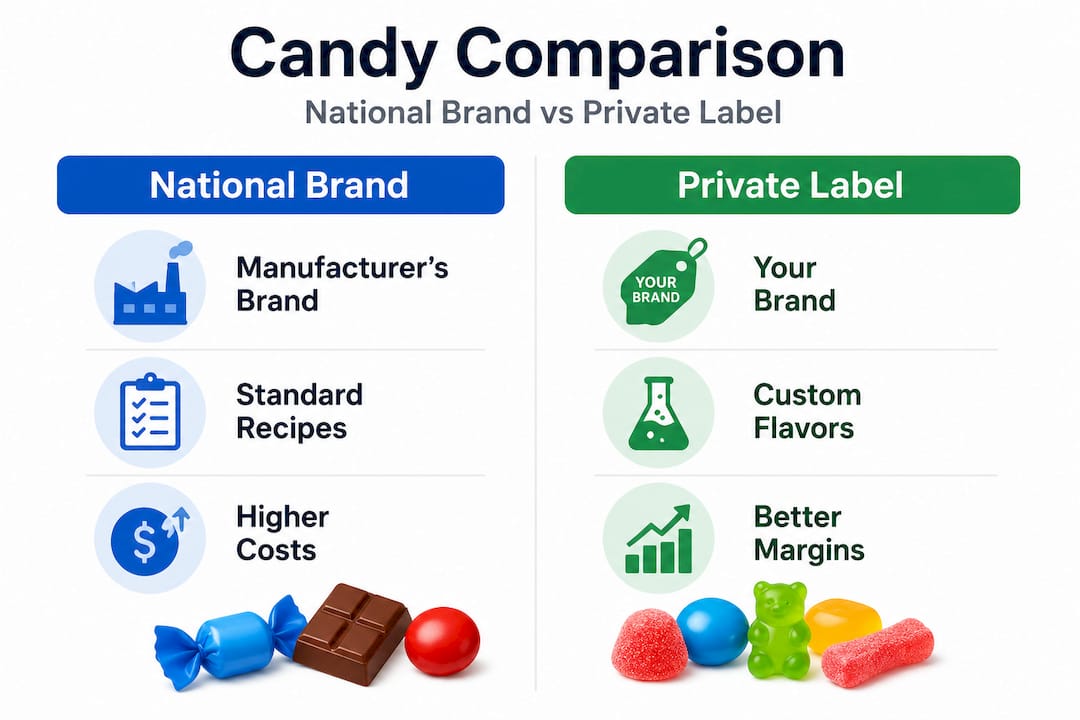
The key insight here is that private label innovation is penetrating even premium candy categories like chocolate through exclusivity and dietary differentiation, not just price cuts. This is a fundamentally different game than the bargain-bin store brand of ten years ago.
Key reasons businesses choose private label candy:
- Higher margins because you control the retail price
- Exclusive products that competitors cannot stock
- Brand building that reinforces your store identity
- Flexibility to respond to consumer trends quickly
- Dietary options like vegan, keto, or allergen-free candy that national brands are slow to offer
Benefits of private label candy for Canadian businesses
Now that you know what defines private label candy, let’s explore why so many Canadian businesses are embracing it.
The most obvious benefit is margin. When you buy a national brand candy bar at wholesale and sell it at retail, your margin is dictated by the brand. There is very little room to negotiate. With private label, you work directly with a manufacturer, eliminate the brand premium, and set your own retail price. Businesses that make the switch often see margin improvements of 20 to 40 percent on comparable products.
Beyond margin, private label candy is one of the most effective tools for store differentiation. If every shop on your street sells the same national brands, you have no compelling reason for a customer to choose you. A unique candy line under your brand changes that. It gives shoppers something they can only get from you, which builds repeat visits and genuine loyalty.
The ability to meet specific consumer preferences is another major advantage. Canadian shoppers are increasingly looking for candy that fits their lifestyle. Vegan gummies, sugar-free options, allergen-free treats, and locally inspired flavors are all categories where national brands move slowly. Private label lets you respond to these trends in weeks, not years.
Consider the data on why this matters:
| Consumer preference trend | Private label advantage |
|---|---|
| Vegan and plant-based | Customize ingredients from the start |
| Sugar-free and keto | Specify sweetener alternatives |
| Allergen-free (nut-free, gluten-free) | Control production environment |
| Local or Canadian identity | Brand and package with regional pride |
| Unique or novelty candy (e.g., freeze-dried) | Source innovative formats exclusively |
The private label advantages for retailers extend into marketing as well. When the candy is your brand, every piece of packaging is an advertisement for your business. Your logo, your colors, your story. That is something a bag of a national brand gummy bears will never do for you.
There are also meaningful private labeling cost savings when you work with the right manufacturer. You are not paying for the brand’s national advertising campaigns or their distribution network markups. Those savings flow directly to your bottom line or allow you to price competitively while still earning more per unit.
The private label benefits compound over time. As your branded candy builds recognition, it becomes an asset. Customers start asking for it by name. That is brand equity you own.
Pro Tip: Start with one or two SKUs that align with a clear consumer trend in your market, such as freeze-dried candy or vegan gummies. A focused launch is easier to manage, easier to market, and gives you real data before you scale.
Navigating Canadian regulations for private label candy
Before making any decisions, it’s critical to consider how Canadian regulations affect your private label candy plans.

Selling food in Canada means operating under some of the most detailed labeling requirements in North America. This is not a reason to avoid private label. It is a reason to plan carefully and work with manufacturers who understand compliance from day one.
Here are the core regulatory requirements you need to know:
- Ingredient list in descending order. Every ingredient must be listed from highest to lowest by weight. This is non-negotiable and applies to all candy sold in Canada.
- Allergen declaration. Major allergens (peanuts, tree nuts, milk, eggs, wheat, soy, sesame, mustard, sulphites) must be declared clearly and separately, not buried in the ingredient list.
- Sugar grouping. Canadian sugar labeling rules require that all sugar-based ingredients be grouped together under the term “Sugars” in the ingredient list, which affects how you communicate sweetener content.
- Bilingual labeling. All mandatory label information must appear in both English and French. This is a federal requirement under the Food and Drug Regulations and the Consumer Packaging and Labelling Act.
- Nutrition Facts table. A standardized Nutrition Facts table is required, formatted to Health Canada’s specifications.
- CFIA and Health Canada oversight. The Canadian Food Inspection Agency (CFIA) and Health Canada jointly oversee food labeling compliance. Non-compliant products can be pulled from shelves, and the reputational damage can be significant.
“Canadian regulations require ingredient lists in descending order, allergens declared separately, sugar-based ingredients grouped under ‘Sugars,’ bilingual labeling in English and French, and a compliant Nutrition Facts table. CFIA and Health Canada oversee enforcement.” — Food Label Solutions
The risks of getting this wrong are real. A product recall or a CFIA warning letter is not just a legal headache. It signals to your customers that you cannot be trusted. That is a hard reputation to rebuild.
Working with a manufacturer who already understands candy packaging regulations in Canada is one of the best ways to reduce your compliance risk. You should also review the packaging compliance guide before finalizing any label design.
Pro Tip: Before printing a single bag, have your label reviewed by a Canadian food labeling consultant or a manufacturer with a proven compliance track record. A $500 review can save you thousands in reprints and regulatory headaches.
If you are planning to launch in Canada for the first time, build compliance into your timeline from the very beginning. It is not something you bolt on at the end.
Steps to successfully launch your private label candy
Understanding the legal landscape helps you avoid costly mistakes. Next, let’s map out how to go from idea to shelves.
Launching private label candy is not complicated, but it does require discipline. Here is a practical sequence that works:
-
Define your niche and target customer. Are you serving a health-conscious grocery shopper, a gift shop buyer, or a movie theater crowd? Your niche determines your product format, flavor profile, and price point. Freeze-dried candy, for example, appeals to novelty seekers and snack enthusiasts. Vegan gummies appeal to a different demographic entirely.
-
Source and vet your manufacturer. This step is where most businesses either win or lose. A manufacturer with a strong regulatory track record, food safety certifications, and experience with Canadian compliance requirements is worth paying a premium for. Ask for references, visit facilities if possible, and request samples before committing. Quality failures can damage your brand significantly, so vetting rigorously upfront is essential.
-
Pilot a small run. Do not order 10,000 bags on your first production run. A small pilot lets you test the product with real customers, catch any labeling issues, and refine the offering before you invest heavily. Most reputable manufacturers will accommodate smaller initial orders for new clients.
-
Develop compliant packaging with expert help. Your packaging is your brand’s first impression. It also has to meet every regulatory requirement covered in the previous section. Work with a designer who understands Canadian food packaging rules, and have the final label reviewed before going to print.
-
Launch with a clear value proposition. What makes your candy different? Fresh, local, freeze-dried, vegan, exclusive to your store? Pick one clear message and lead with it in your marketing. Customers need a reason to try something new, and a muddled message will not give them one.
For a deeper look at how to start selling private label candy, and to find vetted candy suppliers in Canada, those resources will walk you through the specifics in more detail.
Pro Tip: Plan your launch around a seasonal moment, such as Halloween, Valentine’s Day, or summer snacking season. Seasonal launches create built-in urgency and give you a natural marketing hook.
Why private label candy is a smarter bet than most Canadian retailers think
Here is an opinion that might surprise you: most Canadian retailers are leaving serious money on the table not because they lack good products, but because they underestimate how much their customers actually want to buy from them specifically.
There is a persistent belief in retail that store brands are for budget shoppers and that premium customers will always reach for the national brand. That belief is outdated. Canadian shoppers increasingly want products that feel curated, exclusive, and aligned with their values. A well-branded private label candy line communicates that your business has taste, standards, and a point of view. That is enormously appealing to a large and growing segment of the market.
Major Canadian grocers have figured this out. They are not positioning their store-brand chocolate as a cheaper alternative anymore. They are positioning it as a premium, thoughtfully sourced product that happens to be exclusive to their stores. That shift in framing changes everything.
The businesses that get this right focus on branding and customer experience, not just compliance and cost. Compliance is the floor, not the ceiling. Once your product is legal and safe, the real work is making it desirable. Packaging design, storytelling, social media presence, in-store placement, all of it matters.
The cost savings insights from private label manufacturing are real, but they are honestly secondary to the brand-building opportunity. The margin improvement is nice. The customer loyalty you build with an exclusive product line is what actually changes the trajectory of your business.
Most businesses focus so heavily on the logistics of private label that they never develop a compelling brand story. That is where the real competitive advantage lives in 2026.
Ready to grow with private label candy? Here’s how we can help
If you are convinced it’s time to explore private label candy for your business, here’s how Spaceman can help you take the next step.
At Spaceman, we manufacture and distribute freeze-dried candy right here in Canada, and we specialize in helping retail and food service businesses build their own branded candy lines from the ground up.
Our private label co-packing services cover everything from product formulation and manufacturing to bagging, packaging, and label compliance support. We work with businesses of all sizes, from single-location specialty shops to regional distributors. If you want a low-risk way to test the waters, our retail display candy kit gives you a ready-to-sell setup with minimal upfront commitment. For businesses just starting out, the candy starter pack is a practical way to introduce freeze-dried candy to your customers before committing to a full private label run.
Frequently asked questions
What distinguishes private label candy from national brands?
Private label candy is produced by a third-party manufacturer and sold under your store or chain’s brand, giving you full control over pricing, packaging, and customization that national brands simply cannot offer. Private label innovation now penetrates premium candy categories through exclusivity and dietary differentiation, not just lower prices.
What are the labeling requirements for private label candy in Canada?
Canadian law requires ingredient lists in descending order, allergens clearly declared, sugars grouped under a single “Sugars” declaration, and all mandatory information in both English and French. Canadian labeling compliance is enforced by CFIA and Health Canada, so working with a knowledgeable manufacturer from the start is essential.
What risks should I consider with private label candy?
Quality failures can seriously damage your business’s reputation, which is why vetting manufacturers rigorously and running small pilot batches before scaling are critical steps that experienced operators never skip.
Can private label candy help my store compete with big brands?
Absolutely. Private label candy creates exclusive products that build customer loyalty to your store rather than to a national brand, and it typically delivers significantly better margins. Value-driven private label is winning shelf space even in premium candy categories that were once considered untouchable by store brands.