

TL;DR:
- Private label candy allows brands to control their story and profit margins in Canada’s competitive market.
- Compliance with Canadian bilingual labeling and ingredient regulations is essential to avoid costly recalls.
- Launch success depends on focused product offerings, strong manufacturing partnerships, and ongoing customer feedback.
Imagine watching a competitor’s candy fly off shelves while your store stocks the same generic brands everyone else carries. You’re leaving margin and identity on the table. Private label candy flips that equation: you control the brand, the story, and the profit. Canada’s confectionery market is competitive, but it rewards entrepreneurs who move fast and smart. This guide walks you through every stage of launching your own private label candy brand, from sharpening your vision and picking the right manufacturer to clearing Canadian regulations and measuring your first retail wins.
Table of Contents
- Define your brand vision and choose your target market
- Find and select the right co-packer or manufacturer
- Navigate Canadian regulations and labeling requirements
- Manage production, packaging, and launch for retail success
- Troubleshooting common pitfalls and measuring launch success
- Why most private label candy launches fail—and how to be the exception
- Get expert help with your private label candy launch
- Frequently asked questions
Key Takeaways
| Point | Details |
|---|---|
| Brand vision first | Having a clear brand identity and target market is the key foundation before entering manufacturing. |
| Choose partners strategically | Use due diligence to select co-packers or manufacturers that match your goals and scale. |
| Comply for smooth launch | Meeting Canadian candy regulations and labeling rules prevents costly mistakes and delays. |
| Start small and test | Starting with small production runs helps verify partner reliability and market acceptance. |
| Track and adjust | Monitor sales and feedback post-launch to fine-tune your candy brand and expand successfully. |
Define your brand vision and choose your target market
Before you talk to a single manufacturer, you need to know exactly what your brand stands for. Launching private label candy in Canada starts with defining your brand vision and target market first, and skipping this step is the fastest way to waste money on products nobody asked for.
Start by asking what gap you fill. The Canadian confectionery space is crowded with mass-market options, so a distinct story is your sharpest competitive edge. Are you the locally sourced, small-batch brand for farmers markets? The allergen-friendly option for parents of kids with food sensitivities? The luxury gifting brand for corporate events? Each angle demands a different product, price point, and distribution strategy.
Understanding private label meaning helps you frame your pitch to both retailers and end consumers. Once you know what you stand for, you can narrow your customer niche with precision. Common profitable niches in Canada include:
- Health-conscious buyers who want lower-sugar or functional candy
- Specialty diet markets such as vegan, gluten-free, or keto audiences
- Luxury and gift markets where premium packaging justifies higher price points
- Kids and family segments focused on fun flavors and bright branding
- Corporate and event buyers who need branded candy in bulk
Define your product values early: local sourcing, unique flavors, allergen statements, or a specific price ceiling. Then set concrete goals. Are you targeting retail distribution, an e-commerce channel, private events, or all three? Clarity here shapes every decision downstream, from your minimum order quantity to your packaging format.
For a deeper look at finding the right production partner for your niche, the candy manufacturers guide is a useful reference as you move forward.
Pro Tip: Before committing to a large production run, validate your concept with a short online survey or a pop-up tasting at a local store. Real customer reactions cost almost nothing and can save you thousands.
Find and select the right co-packer or manufacturer
With your vision in hand, you’re ready to turn ideas into products, starting by choosing the right production partner. Selecting the best manufacturing or co-packing partner is one of the most consequential decisions in your entire launch.
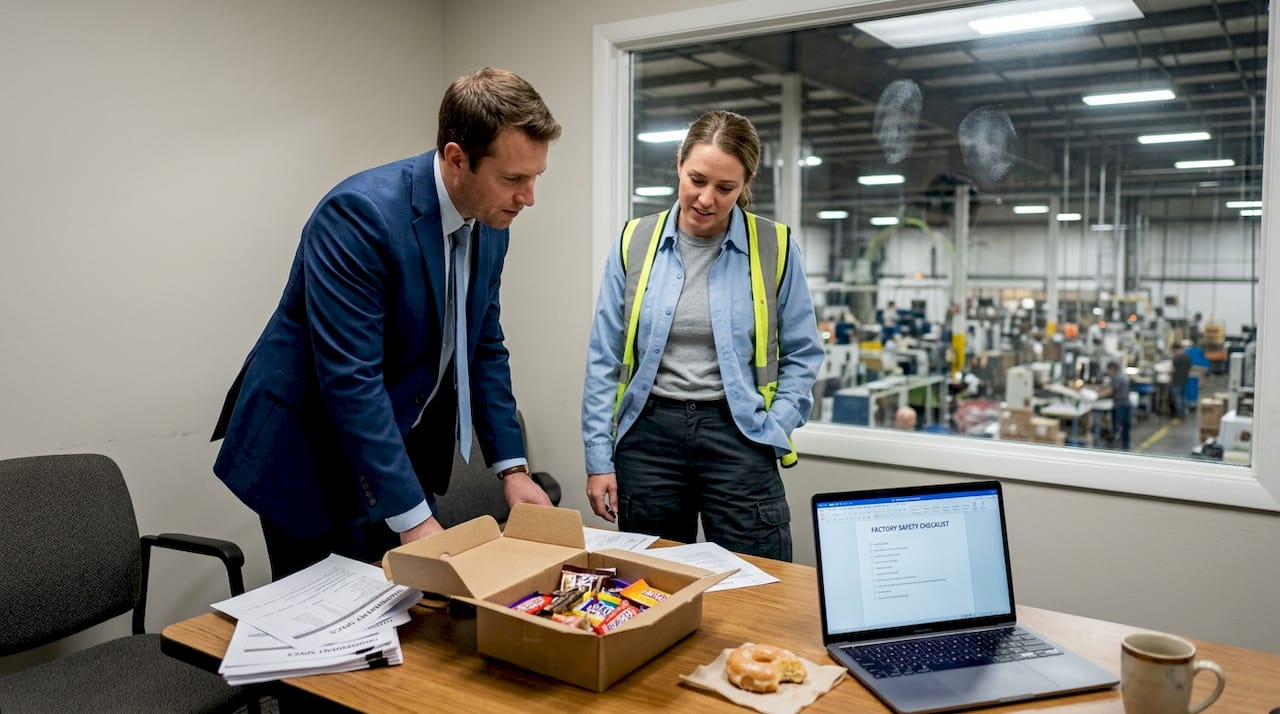
Reputable co-packers carry food-safe certifications such as HACCP, SQF, or BRC. Ask for a client reference list and look for partners who have produced similar products. Packaging flexibility matters too: can they handle pouches, tins, and custom bags, or are they locked into one format?
Here’s a quick comparison to help you choose the right production model:
| Production model | Speed to market | Customization | Cost | Best for |
|---|---|---|---|---|
| White label | Fast | Low | Low | Testing concepts quickly |
| Semi-custom | Moderate | Medium | Medium | Adjusting existing recipes |
| Custom formulation | Slow | High | High | Unique, ownable products |
Understanding cost savings tied to each model helps you pick what fits your budget and timeline. Once you’ve shortlisted partners, follow these steps:
- Send a detailed product brief covering flavor, format, target price, and volume.
- Request a formal quote including minimum order quantities (MOQs) and lead times.
- Ask about the sample process: how many rounds, what costs, and turnaround time.
- Review packaging options and confirm they can meet Canadian bilingual label requirements.
- Schedule a sample tasting session before signing any agreement.
If you’re just starting private label for the first time, a semi-custom model often gives you the best balance of speed and differentiation. The candy factory guide covers what to look for when touring or evaluating facilities.
Navigate Canadian regulations and labeling requirements
Before sending your recipe for mass production, make sure your packaging and labels comply with Canadian law. This is the section most new brand owners underestimate, and it’s the one that causes the most expensive mistakes.
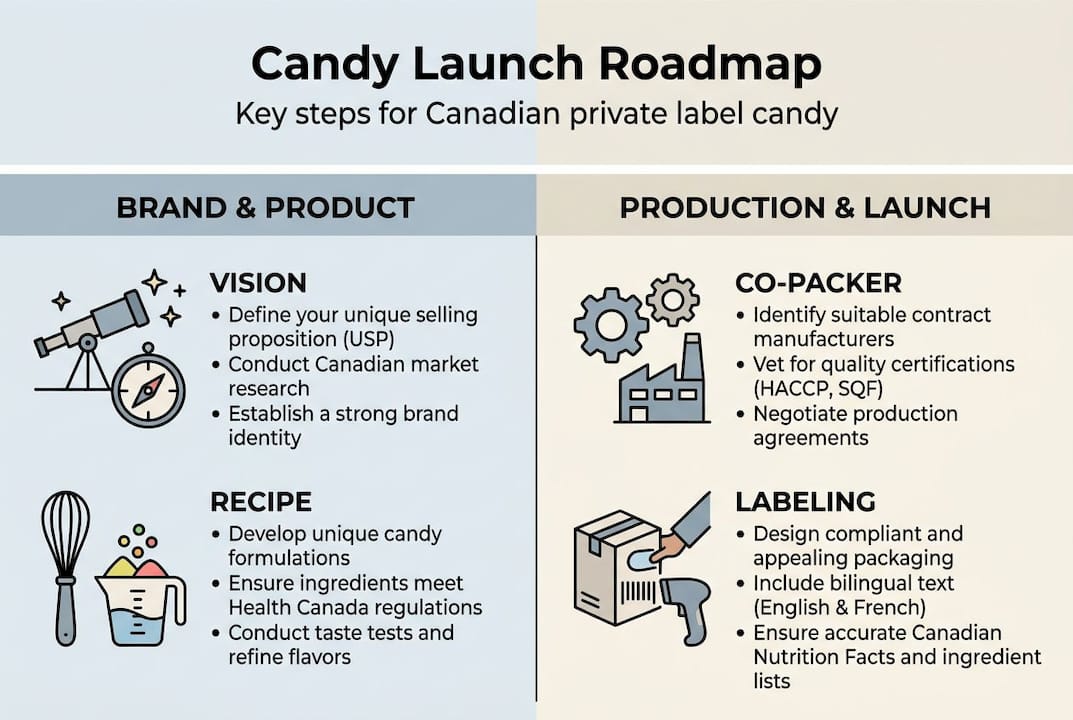
Canada’s food labeling framework is governed by the Canadian Food Inspection Agency (CFIA) and enforced through the Safe Food for Canadians Act (SFCA) and Safe Food for Canadians Regulations (SFCR). Canadian regulations require bilingual labeling with English and French, plus ingredient declarations and allergen statements, with certain exemptions available for one-bite confections.
Review the candy packaging regulations specific to confectionery before you finalize any design. Here’s a compliance checklist:
| Requirement | Details |
|---|---|
| Bilingual labeling | English and French mandatory on all principal display panels |
| Common name | Must appear in both official languages |
| Ingredient list | Descending order by weight, bilingual |
| Allergen declaration | Bold or separate statement for priority allergens |
| Nutrition facts table | Required for most packaged candy |
| Net quantity | Metric units required |
| Manufacturer info | Name and address of Canadian responsible party |
Skipping even one labeling requirement can trigger a CFIA recall, costing you inventory, retailer relationships, and brand credibility all at once. Build compliance into your design process from day one, not as an afterthought.
For candy with added vitamins, minerals, or supplements, a supplementary facts table is required and additional CFIA review may apply. Review food packaging compliance guidance to understand how functional additives change your label obligations. The full CFIA candy rules are publicly available and worth bookmarking.
Manage production, packaging, and launch for retail success
With regulatory boxes checked, you’re ready to pull the trigger on production and get your candy out to customers. Production management requires requesting samples, choosing packaging, and coordinating labeling before a single unit ships to retail.
Follow this sequence to keep your launch on track:
- Finalize your recipe with the manufacturer and confirm all ingredients meet Canadian standards.
- Request production samples and conduct an internal tasting with honest reviewers, not just friends.
- Approve packaging design with bilingual labels, correct font sizes, and shelf-ready visuals.
- Confirm production scheduling and lock in your delivery window with the co-packer.
- Coordinate sample shipments to retail buyers or distributors ahead of your official launch date.
- Place your first production order and track it through to delivery.
Packaging is where brand identity and compliance collide. Strong packaging innovations can drive impulse purchases at retail, but they must never compromise the regulatory requirements you locked in earlier. Resealable pouch packaging is a popular format for freeze-dried candy because it protects texture, photographs well for e-commerce, and stacks efficiently on shelves.
For a practical walkthrough of the early selling phase, the guide on [start selling private label candy](https://space-man.ca/blogs/spaceblog/how-to-start-selling-private label candy) covers retailer outreach, pricing strategy, and first-order logistics.
Pro Tip: Plan your first production run smaller than you think you need. A modest initial order lets you test both your manufacturing partner’s reliability and real customer acceptance before scaling up.
Troubleshooting common pitfalls and measuring launch success
After your candy hits shelves, the real work begins: measuring what works and dodging mistakes that sink new brands fast. Monitoring post-launch data and proactively avoiding typical mistakes in the Canadian candy market is what separates brands that grow from those that stall.
The most common issues new brands face include:
- Packaging delays caused by underestimating print lead times or artwork revision cycles
- Poor label placement that hides key information or fails retail shelf scanning requirements
- Flavor inconsistencies between your approved sample and the full production batch
- Missed regulatory updates from CFIA that require label changes mid-season
- Overestimating initial demand and tying up cash in slow-moving inventory
On the compliance side, CFIA issues hundreds of food recalls annually in Canada, with allergen and labeling errors consistently among the top causes. Staying current on regulatory compliance updates is not optional. Subscribe to CFIA recall alerts and review your labels at least once per year.
For tracking launch performance, focus on these KPIs in your first 90 days:
- Sell-through rate: what percentage of your initial stock sold within the first 30 and 60 days
- Retailer reorder rate: are buyers placing second orders, which signals real consumer pull
- Social media feedback: monitor mentions, reviews, and unboxing content for flavor and packaging signals
- Return or complaint rate: any pattern here points to a quality or labeling issue that needs fast action
Adjust early and adjust often. The brands that survive their first year are the ones that treat launch as a test, not a finish line.
Why most private label candy launches fail—and how to be the exception
Here’s the behind-the-scenes reality that most guides skip entirely. The majority of private label candy launches that fail do not fail because the candy tastes bad. They fail because the founder either ignored real customer feedback before launch or cut corners on compliance and paid for it later.
Operational sprawl is the second biggest killer. New brands get excited and launch five or six SKUs at once, spreading their budget thin and making it impossible to build momentum behind any single product. The smarter play is to launch one or two products, build a loyal customer base, and expand from there.
Working with proven manufacturer partners who have navigated Canadian compliance before gives you a structural advantage most solo founders lack. They have already solved problems you haven’t encountered yet.
The brands that last are ruthless about two things: honest feedback loops and airtight compliance. Solicit brutal, ongoing input from both retail buyers and end consumers. If a retailer tells you the packaging is confusing, fix it before your next run. If a buyer flags a label issue, treat it as urgent. Iteration is not a sign of weakness. It’s the operating system of every brand that makes it past year two.
Get expert help with your private label candy launch
If you’re ready to go from reading to launching, specialized help can fast-track your success.
At Spaceman, we offer private label co-packing services built specifically for Canadian entrepreneurs who want to move fast without cutting corners on compliance or quality. From custom freeze-dried candy formulations to bilingual label coordination and flexible bagging options, we handle the operational complexity so you can focus on building your brand. New to the space? Our candy starter pack is a low-commitment way to experience product quality before committing to a full production run. Learn more at Spaceman and book a consultation to get your launch moving.
Frequently asked questions
What is the minimum order quantity for private label candy in Canada?
Co-packers set MOQs you must meet for private label production, and in Canada these typically range from 500 to 5,000 units depending on the manufacturer, product type, and packaging complexity.
What are the legal labeling requirements for candy in Canada?
Canadian regulations require bilingual labeling in English and French, a common name, a full ingredient list, and allergen statements that meet CFIA standards, though certain one-bite confections may qualify for limited exemptions.
How do I choose between white label and custom formulation for my candy?
Brands can select custom formulation or use a manufacturer’s standard recipes: white label gets you to market fast with lower cost, while custom formulation creates a unique product that competitors cannot easily copy.
Are there specific Canadian regulations around candy with added vitamins or supplements?
Yes, special labeling applies when candy contains supplements or novel ingredients, including a mandatory supplementary facts table and potential additional review under CFIA and Health Canada guidelines.
Recommended
- Building a Candy Brand in Canada: Step-by-Step Success – Spaceman
- Choosing Candy Distributors Canada: Step-by-Step Guide – Spaceman
- Complete Guide to Private Label Candy Manufacturers Canada – Spaceman
- How to Start Selling Private Label Candy Easily – Spaceman
- How It Works | OffCut — Buy Packaging Designs