

TL;DR:
- Understanding the differences between dehydrators and freeze dryers is crucial for candy producers, as freeze drying achieves higher moisture removal, longer shelf life, and superior texture and nutrient retention. Freeze-dried candies are light, crunchy, visually appealing, and preserve flavor more effectively, making them ideal for premium products and e-commerce. Strategic equipment choices impact brand positioning, customer experience, and long-term profitability, requiring careful evaluation beyond initial costs.
Walk into almost any Canadian candy shop today and you’ll find bags labeled “freeze-dried” sitting next to products that are simply dehydrated. To a customer, they might look identical. To your business, the difference is enormous. Texture, shelf life, margins, brand positioning, and the equipment you buy all hinge on understanding exactly what separates these two drying methods. This guide cuts through the confusion so you can make a confident, informed production decision for your candy line.
Table of Contents
- How dehydrators and freeze dryers work: The science explained
- Moisture removal, shelf life, and nutrient retention: Key differences
- Texture, flavor, and appearance: Why freeze-dried candy stands out
- When to choose dehydration, freeze drying, or alternatives: Business decision guide
- Expert insights and industry nuances: Avoiding misconceptions
- What most candy retailers miss about drying technologies
- Take the next step: Elevate your candy offerings
- Frequently asked questions
Key Takeaways
| Point | Details |
|---|---|
| Moisture removal method | Dehydrators use heat and airflow, while freeze dryers use freezing and vacuum to achieve sublimation. |
| Shelf life and quality | Freeze-dried products offer dramatically longer shelf life and better nutrient retention than dehydrated ones. |
| Candy texture and appearance | Freeze drying produces light, airy, crunchy candies with visual appeal, ideal for premium retail. |
| Business application | Choose freeze drying for premium shelf-stable candy, dehydration for faster, lower-cost production. |
| Innovation opportunities | Alternative drying technologies can replicate or even improve on freeze drying outcomes for candy. |
How dehydrators and freeze dryers work: The science explained
Let’s break down what actually happens inside each machine, because the process determines everything downstream.
A food dehydrator is essentially a controlled oven with a fan. Heat and airflow evaporate water from the surface of the food, gradually pulling moisture out as warm air circulates. The water goes from liquid form directly to vapor, which is then exhausted from the chamber. It’s a simple, proven process that has been used commercially for decades, and the equipment is relatively affordable and easy to operate. For candy retailers working with fruit chews, gummies, or sugar-coated pieces, a dehydrator will produce a chewy, slightly shrunken product with concentrated flavor.
A freeze dryer, also called a lyophilizer, works on a fundamentally different principle. The product is first frozen to extremely low temperatures, sometimes as cold as negative 40 degrees Celsius or below. Then the chamber pressure is reduced to near-vacuum using a vacuum pump. Under these conditions, ice does not melt. Instead, it sublimates directly to vapor, jumping from solid to gas without passing through a liquid phase. A secondary drying stage then removes any remaining bound moisture.
This distinction in mechanism matters enormously for candy production:
- Dehydrators work well for fruits, herbs, and jerky-style products where chewiness is acceptable
- Freeze dryers are the only way to achieve that signature airy, crunchy puff that freeze-dried candy is known for
- The vacuum environment in a freeze dryer protects the product from heat damage, color change, and flavor loss
- True freeze drying requires specialized vacuum pumps, refrigeration systems, and precise pressure controls
Key takeaway: If a machine doesn’t create and sustain a vacuum while the product is frozen, it is not a freeze dryer, regardless of what the label says.
For a side-by-side breakdown of equipment specs, the freeze dryer vs food dehydrator guide on the Spaceman blog covers the practical machinery differences in detail. You can also explore an overview of different drying technologies that goes deeper into how the physics of each process affect your end product.
Moisture removal, shelf life, and nutrient retention: Key differences
Understanding the basic mechanisms, let’s compare how each process impacts shelf life and quality for your candy business.
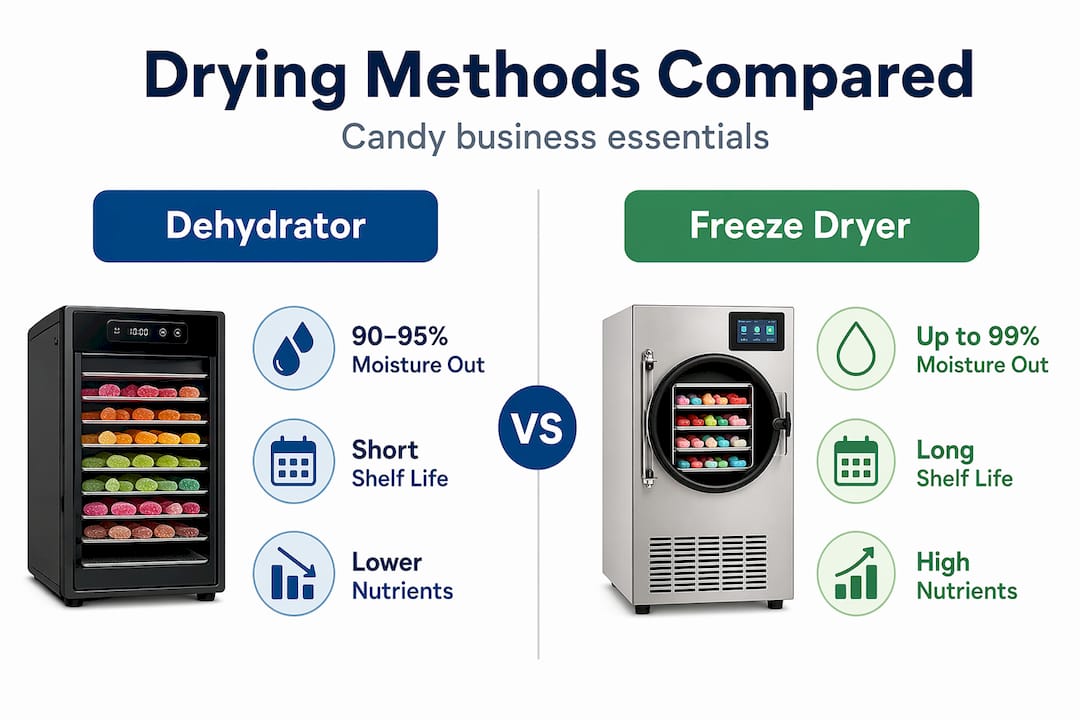
The numbers here are where the gap between these two methods becomes impossible to ignore. Freeze drying pulls out up to 99% of moisture from a product, while dehydrators typically remove 90 to 95 percent. That gap might sound small, but it has a compounding effect on shelf stability, packaging requirements, and how your product behaves over time.
| Attribute | Dehydrated | Freeze-dried |
|---|---|---|
| Moisture removed | 90–95% | Up to 99% |
| Typical shelf life | 1–5 years | 15–25 years |
| Texture result | Chewy, dense | Crunchy, airy |
| Nutrient retention | Moderate losses | 90–97% retention |
| Equipment complexity | Low | High |
| Production cost | Lower | Higher |
The shelf life difference is especially significant for candy retailers. A product with a multi-year shelf life means less waste, easier inventory management, and the ability to purchase or produce in larger batches without spoilage risk. Freeze-dried candy with a 15 to 25 year potential shelf life (under proper storage conditions) is not just a candy product. It becomes a shelf-stable, high-value SKU that you can confidently stock, ship, and sell through e-commerce without scrambling to turn over inventory.
On the nutrient side, freeze-drying retains 90–97% of most nutrients. Even sensitive compounds like vitamin C see only modest losses of around 5 to 10 percent during a typical freeze-drying cycle. Dehydration, which uses sustained heat, breaks down more of these compounds, especially in products that spend longer time in the dryer.
Pro Tip: If you’re sourcing freeze-dried candy for retail, always ask about water activity levels, not just moisture percentage. Water activity (abbreviated Aw) is the measure that determines microbial safety and true shelf stability. A well-produced freeze-dried candy should have a water activity below 0.3.
The retail impacts of drying methods are laid out clearly for candy retailers looking to understand how these specs translate to real shelf performance. For a comparison focused specifically on the food category, see this breakdown of freeze dried vs dehydrated food that covers the quality and commercial implications.
Texture, flavor, and appearance: Why freeze-dried candy stands out
Shelf life and nutrition matter, but for candy retailers, the sensory experience is what sells. Here’s why freeze-dried candies command attention and premium price points.
When gummies, taffy, or Skittles-style candies go through a freeze dryer, something dramatic happens. The product freezes below negative 40°C and then the moisture is pulled out through sublimation under low pressure. The result is a product that has puffed significantly in size, become rigid and crunchy, and kept almost all of its original color and flavor intensity. That transformation is the entire value proposition of freeze-dried candy.
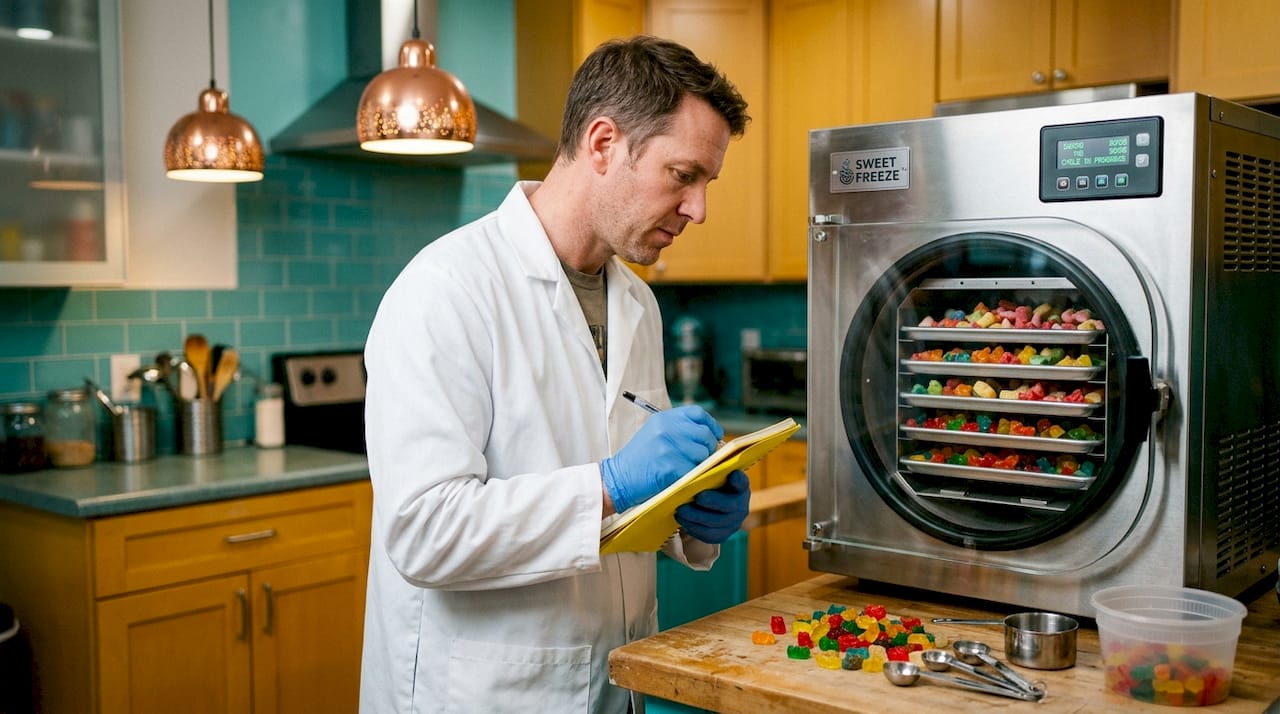
Dehydrated candy behaves very differently. The heat and airflow cause the product to shrink and toughen. Colors can darken. Sugars can become sticky or crystallize on the surface. The result is a dense, chewy piece that lacks the dramatic visual appeal of its freeze-dried counterpart.
| Quality factor | Dehydrated candy | Freeze-dried candy |
|---|---|---|
| Volume change | Shrinks noticeably | Puffs up, larger appearance |
| Surface feel | Sticky or tacky | Dry, rigid, matte |
| Color | Darkens with heat | Preserves original brightness |
| Mouthfeel | Chewy, dense | Light, crunchy, dissolves fast |
| Flavor intensity | Concentrated but can caramelize | Bright, clean, intense |
| Visual shelf appeal | Low to moderate | High |
Here is why this matters for your retail display:
- Freeze-dried candy is visually striking in clear packaging, making it a strong impulse purchase driver
- The light, crunchy texture creates a memorable eating experience that drives word-of-mouth and repeat purchases
- Flavor brightness (because no heat damages volatile flavor compounds) means customers often describe the taste as more intense than the original candy
- The unique mouthfeel, where a piece that looks solid dissolves almost instantly on the tongue, creates a novelty factor that dehydrated candy simply cannot replicate
Pro Tip: When sampling freeze-dried candy at retail events or pop-ups, lead with texture. Hand a customer a freeze-dried gummy before telling them what it is. The surprise reaction is your best marketing tool.
The distinct appeal of dried vs dehydrated candy is worth reviewing if you’re unsure how to position products on your shelf. And if you’re curious about the equipment itself, this resource on freeze dry candy machines covers the machinery side of production.
When to choose dehydration, freeze drying, or alternatives: Business decision guide
Once you know how products differ on-shelf, how do you decide what to invest in?
The answer depends on your specific business goals, not just your budget. Here is a practical decision framework for Canadian candy businesses:
- Choose dehydration if you need quick turnaround on products with a one to two year shelf life, your customers expect a chewy texture (dried mango, apricot), and you want a low-cost entry point with minimal operator training.
- Choose freeze drying if premium texture and long shelf life are your core differentiators, you’re building a brand around novelty candy experiences, or you plan to sell through e-commerce where shelf life and shipping resilience matter.
- Consider co-packing or outsourcing if you want freeze-dried quality without the capital investment in equipment, which can run from tens of thousands to hundreds of thousands of dollars for commercial-grade freeze dryers.
- Explore emerging alternatives such as vacuum-microwave dehydration if you want fast throughput with crunchy textures and some of the shelf-appeal of freeze-dried products, at a lower capital cost than traditional lyophilizers.
Business reality check: Freeze drying is generally the right call for premium quality and long-term storage, but dehydrators win on cost and simplicity when shelf life is less critical. The wrong move is assuming one method serves all products equally.
Understanding the requirements for freeze-drying is essential before you commit to equipment or a production partner. If you’re specifically focused on candy, the comparison of freeze dryer vs dehydrator for candy is a more targeted resource worth bookmarking.
Expert insights and industry nuances: Avoiding misconceptions
Making the right equipment choice means knowing where common mistakes and opportunities for innovation lurk.
One of the most persistent myths in the candy production space is that you can replicate freeze-dried results with a home freezer and some airflow. You cannot. Without a vacuum chamber, sublimation simply does not occur at the scale needed to produce shelf-stable, crunchy results. What you get instead is a combination of freezing and slow dehydration, which changes the texture profile and significantly shortens the effective shelf life compared to true freeze-dried product.
This matters for candy businesses in Canada who might be tempted to test concepts at home before scaling. The texture you produce without a vacuum will not accurately represent what your commercial product will be. You need access to proper equipment to validate your recipes.
Key nuances worth understanding before scaling:
- Freeze-dried candy production batches take significantly longer than dehydration, often 20 to 40 hours per cycle depending on the product
- Sugar-heavy candies behave unpredictably in freeze dryers and require precise control of temperature and vacuum ramp-up to avoid caramelization or collapse
- Vacuum-microwave dehydration is a legitimate alternative that can produce crisp, puffed, or chewy candy structures quickly while protecting color and flavor, without requiring a traditional lyophilizer
- Atmospheric freeze-drying using ultrasound-assisted technology is an emerging approach from CSIRO (Australia’s national science agency) that performs sublimation-based drying without a vacuum, potentially lowering capital costs and enabling continuous production
- Scaling any of these methods requires formal process development, not just buying a larger machine
Pro Tip: Before investing in any commercial freeze-drying equipment, run a co-packing trial with an established freeze-dried candy manufacturer. You’ll validate your recipe, understand cycle times, and learn what the product actually looks like at scale, without committing capital upfront.
For a broader overview of how these technologies compare in practice, the complete guide on freeze dryer vs dehydrator walks through the commercial decision points in depth.
What most candy retailers miss about drying technologies
Here’s the uncomfortable truth: most candy retailers who ask “dehydrator or freeze dryer?” are already framing the question too narrowly. The real question is: what kind of candy business do you want to be in three years?
We see this pattern repeatedly. A retailer focuses on equipment price as the deciding factor, buys a dehydrator, produces a decent chewy candy, and then watches a competitor launch a freeze-dried line that generates social media content, drives foot traffic, and commands twice the price per bag. The equipment cost comparison suddenly looks very different in retrospect.
The impact on candy businesses from choosing the right drying method extends far beyond the production floor. Freeze-dried candy creates a category experience. Customers photograph it, share it, and talk about it in a way that chewy dehydrated candy rarely inspires. In the Canadian candy market, where consumers are increasingly drawn to novelty, premium presentation, and unique sensory experiences, that differentiation has real dollar value.
The other thing most operators underestimate is how much process consistency matters. A freeze-dried candy that comes out perfect 90 percent of the time is not good enough for a retail brand. You need tight process control, documented cycle parameters, and a feedback loop where every batch is evaluated against a sensory standard. Whether you produce in-house or partner with a co-packer, that discipline is what separates a scalable product from a hobby operation.
Don’t let the “freeze dry vs dehydrate” debate become a shortcut for avoiding the harder strategic questions about who your customer is and what they’re actually paying for.
Take the next step: Elevate your candy offerings
Ready to see how advanced drying methods can transform your shelves? Spaceman makes it practical.

As a Canadian freeze-dried candy manufacturer, we work with retailers and distributors who want freeze-dried quality without the capital risk of owning and operating their own equipment. Our private label and co-packing services let you launch a branded freeze-dried candy line using our production infrastructure, your branding, and your product vision. If you’re ready to test the retail market, our wholesale display kit gives you a turnkey solution to start selling immediately. You can also explore our freeze-dried candy packs to understand the quality standard your customers will experience. Let’s build something worth talking about.
Frequently asked questions
What is the main difference in how dehydrators and freeze dryers remove water?
Dehydrators use heat and airflow to evaporate liquid water, while freeze dryers freeze the product and apply a vacuum so ice sublimates directly to vapor without passing through a liquid phase.
Which method gives candy a lighter, crunchier texture?
Freeze-drying creates a lighter, crunchier candy texture because sublimation under vacuum pulls moisture out while the product is frozen solid, preserving its puffed shape and producing a rigid, airy structure.
Does freeze-drying better preserve nutrients compared to dehydrating?
Yes. Freeze-drying typically achieves 90–97% nutrient retention because the absence of heat protects sensitive compounds, while dehydration causes greater losses, especially for vitamins like C that degrade under sustained heat.
Can I freeze dry candy at home using a regular freezer?
No. Without a vacuum chamber, a standard freezer only freezes and slowly dehydrates the product rather than sublimating ice to vapor, which means you won’t get true freeze-dried texture or shelf life.
Are there alternatives to traditional freeze drying for candy production?
Yes. Vacuum-microwave dehydration can produce crisp, puffed candy structures quickly, and ultrasound-assisted atmospheric freeze-drying offers a continuous, no-vacuum approach to sublimation-based drying that may lower production costs.