

TL;DR:
- Canadian candy packaging regulations require full bilingual labels, net quantity, common name, and dealer info.
- Mandatory Nutrition Facts Tables and Front-of-Package symbols apply, especially for high-sugar products by 2026.
- Proper allergen declaration and edge case compliance are critical to avoid costly recalls and build consumer trust.
Candy packaging feels simple until a single overlooked detail triggers a product recall or a border hold that costs you thousands. Canadian candy manufacturers and retailers operate under a layered web of regulations managed by multiple federal bodies, and the rules are more specific than most expect. Miss a bilingual requirement, skip a front-of-package symbol, or mislabel a multi-unit pack, and you’re looking at real financial and reputational damage. This guide walks you through every major compliance requirement, from mandatory label elements to edge cases that catch even experienced brands off guard, so you can sell with confidence.
Table of Contents
- Understanding candy packaging regulations in Canada
- Essential label components: getting the basics right
- Nutrition Facts Tables and front-of-package symbols
- Allergen and ingredient declarations: priority rules for safety
- Advanced compliance: edge cases and evolving rules
- A fresh perspective on Canadian candy packaging compliance
- Partner with experts for packaging success
- Frequently asked questions
Key Takeaways
| Point | Details |
|---|---|
| Labeling rules vary | Candy packaging rules differ by product type and presentation, so check for exemptions and specific requirements before printing. |
| Nutrition and FOP compliance | Almost all packaged candies require a Nutrition Facts Table and, if high in sugar, a Front-of-Package symbol in both English and French. |
| Allergens and ingredients | Accurate allergen and ingredient statements, following strict format and language rules, are crucial for both legal safety and customer trust. |
| Edge cases matter | Special rules exist for one-bite confections, multi-packs, and supplemented candies, so knowing the exceptions can save costly mistakes. |
| Regular compliance reviews | Regulations evolve; ongoing reviews and expert advice help ensure your packaging remains compliant and market-ready. |
Understanding candy packaging regulations in Canada
To understand what you must comply with, let’s first clarify who regulates candy packaging and what products fall under the rules.
Two federal bodies share responsibility for candy packaging in Canada. The Canadian Food Inspection Agency (CFIA) enforces labeling rules and investigates complaints, while Health Canada sets the nutritional standards that determine what goes on your label. Both agencies draw their authority from the Safe Food for Canadians Regulations (SFCR) and the Food and Drug Regulations (FDR). You need to satisfy both.
Not every candy product triggers the same requirements. The overview of Canadian packaging rules makes clear that prepackaged products face the full set of mandatory label elements, while some narrow exemptions exist for very specific formats. Individual one-bite confections sold singly are exempt from labeling under FDR B.01.003 and SFCR 214 and 217, but most prepackaged candy requires a full label. Lollipops, despite being small, do not qualify for this exemption because they are not true one-bite items.
A common myth is that small candy producers fly under the radar or that imported products sold in Canada follow foreign rules. Neither is true. Non-compliance can trigger product recalls, removal from retailer shelves, and significant delays at the border for importers and exporters.
Here is a quick comparison of label requirements by format:
| Candy format | Full label required | Bilingual required | NFT required |
|---|---|---|---|
| Prepackaged multipack | Yes | Yes | Yes |
| Single prepackaged unit | Yes | Yes | Yes |
| One-bite sold individually | No | No | No |
| Bulk bin (no package) | No | No | No |
Review the key candy compliance rules and cross-reference with the CFIA labeling guide to map your specific products to their correct requirements before you finalize any label design.
Essential label components: getting the basics right
With the regulatory basics in place, it’s crucial to get the fundamental label details correct to avoid costly errors.
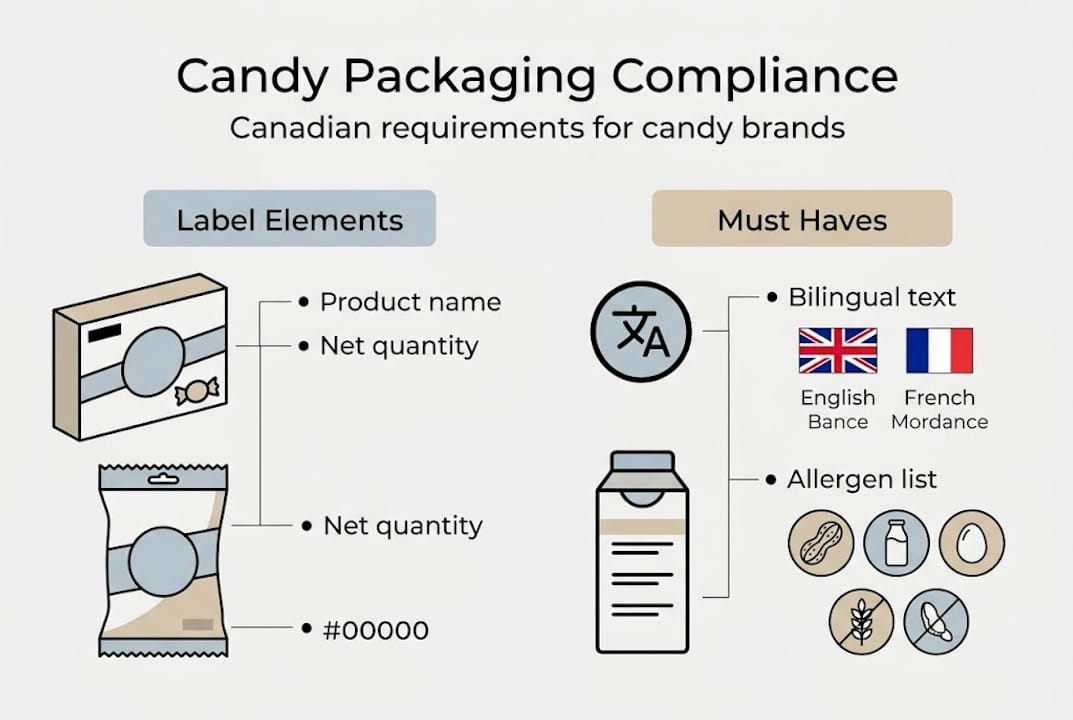
Every prepackaged candy label must include the following mandatory elements:
- Common name of the food (e.g., “gummy bears” or “sour watermelon bites”) displayed on the principal display surface (PDS)
- Net quantity expressed in metric units (grams or milliliters)
- Dealer name and address (the company responsible for the product in Canada)
- Ingredient list in descending order by weight
- Bilingual content covering all required elements in both English and French
As Canadian food labelling rules confirm, the net quantity, dealer name and address, and common name must all appear on the PDS. Burying your net quantity on a side panel is a common and costly mistake.

The bilingual requirement catches many brands off guard, especially smaller operations that started with English-only labels. There are narrow exemptions (some very small businesses or local market situations), but most candy products sold nationally must present all required label information in both languages. Review the brand requirements for candy packaging for guidance on building bilingual design without sacrificing visual appeal.
For “best before” dates, the rule is straightforward: shelf life under 90 days triggers a mandatory best before date. Most candy products have a longer shelf life, so they are technically exempt. However, if you voluntarily add a best before date, it must follow the correct format. Freeze dried candy, for example, often has a shelf life well beyond 90 days, so many brands in this category skip the date entirely and stay compliant.
Pro Tip: Always place your PDS elements (common name, net quantity) on the front-facing panel your customer sees first at retail. Regulators will check that placement, and so will your retail buyers. See the custom labeling tips resource for layout best practices.
Nutrition Facts Tables and front-of-package symbols
Once you’ve nailed the basics, specialized nutrition labeling is the next major compliance hurdle for most candy brands.
A bilingual Nutrition Facts Table (NFT) is mandatory for most prepackaged candy, covering calories, fats, carbohydrates (including sugars), protein, and sodium. The NFT must follow the standardized Health Canada format, including percent daily values (%DV) calculated against the correct reference amounts for your product type. Very small packages (under a certain surface area) may qualify for a simplified or exempt format, but this rarely applies to standard retail candy packaging.
The bigger change for candy brands in 2026 is the mandatory Front-of-Package (FOP) nutrition symbol. As of January 1, 2026, FOP symbols are mandatory for prepackaged foods that exceed the following thresholds:
- Sugars: 15% DV or more per serving (10% for small serving sizes)
- Saturated fat: 15% DV or more per serving (10% for small servings)
- Sodium: 15% DV or more per serving
Most candy products are high in sugars by design, which means the “High in sugars” symbol is almost certainly required on your packaging. This is not optional. Brands that have not updated their labels since 2025 are currently out of compliance. Check FOP labeling exemptions to see if your product qualifies for any narrow carve-outs, but do not assume you are exempt without checking.
Pro Tip: Use Health Canada’s official NFT generator and FOP calculator tools to cross-check your nutrition data before printing any labels. A single rounding error on %DV can push your product over or under a threshold and change your compliance status entirely. Also review bilingual label innovations for examples of brands that handle FOP symbols without wrecking their packaging design.
Allergen and ingredient declarations: priority rules for safety
Beyond nutrition, safe and clear ingredient and allergen labeling is critical, both for legal and customer safety reasons.
Canada recognizes 11 priority allergens and gluten sources that must be declared on all food labels:
- Peanuts
- Tree nuts (with species named)
- Milk
- Eggs
- Seafood (fish, crustaceans, shellfish)
- Sesame seeds
- Wheat and triticale (gluten sources)
- Soy
- Mustard
- Sulphites (above 10 ppm)
As confirmed by priority allergen labeling rules, these must be declared either within the ingredient list (showing the common name of the allergen source) or in a separate “Contains” statement immediately following the ingredient list. Both approaches are acceptable, but you cannot omit the declaration or bury it in technical ingredient names.
For example, if your candy contains “Modified milk ingredients,” that wording alone does not satisfy the allergen declaration. You must either write “milk” in parentheses after the ingredient name or include “Contains: Milk” after the ingredient list.
Here is an example of compliant allergen wording following the ingredient list:
Contains: Milk, Soy, Wheat. May contain Peanuts and Tree Nuts (Cashew, Almond).
Sulphites are a special case. They must be declared when present at 10 ppm or more, even if they are not added intentionally but appear as a result of processing. Grouped sugars (glucose, fructose, dextrose) may be combined as “sugars” in the ingredient list, which is one of the few simplification allowances available. Check the retail pouch labeling guide for practical examples of compliant allergen blocks on pouch-style candy packaging.
Advanced compliance: edge cases and evolving rules
After addressing the main requirements, it’s vital to understand the edge cases that can trip up even experienced manufacturers.
The distinction between one-bite and multi-unit packaging creates real confusion. Here is a side-by-side comparison:
| Product type | Label required | NFT required | FOP required |
|---|---|---|---|
| One-bite sold individually | No | No | No |
| One-bite in a multi-unit bag | Yes | Yes | Yes |
| Standard candy bar | Yes | Yes | Likely yes |
| Caffeinated candy (>56mg/serving) | Yes | Yes | Yes + caution |
As the CFIA labeling requirements specify, once a one-bite candy is packaged in a multi-unit format, the full label requirements apply to the outer package. There is no exemption for the inner pieces.
Caffeinated candy is a growing category and carries extra obligations. If your product contains more than 56mg of caffeine per serving, you must include a mandatory cautionary statement on the label, warning consumers about caffeine content and advising against consumption by children, pregnant women, and those sensitive to caffeine. This applies to supplemented food products and is monitored closely. The nutrition symbol changes introduced with the 2026 updates also intersect with caffeinated candy rules, so check both simultaneously.
Evolving edge cases to watch through 2028 include:
- Caffeine labeling transition periods for legacy products
- Novel food ingredients in functional candies
- Claims-based labeling (e.g., “sugar-free,” “keto-friendly”) and their triggered requirements
- Creative candy packaging formats that push the boundaries of standard label placement rules
Pro Tip: Maintain a compliance documentation file for every multi-pack SKU, including the label version, approval date, and supporting nutrient data. During a CFIA inspection, having that file ready demonstrates good faith and speeds up the review significantly. See snack distribution compliance for more on preparing for audits.
A fresh perspective on Canadian candy packaging compliance
Here is the uncomfortable truth most compliance conversations avoid: brands that treat labeling as a once-a-year headache are not just risking a recall. They are leaving consumer trust on the table.
The best candy brands we work with do not see compliance as a legal floor they reluctantly meet. They treat it as a communication tool. A clear, well-organized label with a properly formatted NFT, a visible FOP symbol, and a clean allergen statement signals to the buyer that you take your product seriously. That signal drives repeat purchase and retail confidence.
Regulatory monitoring is also a market intelligence activity. When Health Canada changes FOP thresholds or introduces new cautionary statement requirements, brands that catch those changes early can reformulate or redesign ahead of competitors. That is a real competitive edge, not just risk management.
We write about this often in our private labeling compliance insights resource because it applies directly to the brands we co-pack for. The ones growing fastest are the ones who baked compliance into their brand identity from day one, not the ones scrambling to catch up before a retail deadline.
Partner with experts for packaging success
If navigating these rules feels overwhelming, teaming up with experienced partners can make compliance much easier.
At Space-Man, we work directly with candy brands across Canada to handle the complexity of packaging compliance, from label design and bilingual formatting to Nutrition Facts Table accuracy and FOP symbol placement. Our private label and co-packing services are built for brands that want to move fast without cutting corners on compliance.
Whether you are launching a new SKU or scaling an existing product line, we bring the regulatory knowledge and production infrastructure to get you to market correctly. Explore our starter pack for wholesale to see how partnering with us can reduce compliance risk while accelerating your growth.
Frequently asked questions
Are single-serve candies like lollipops exempt from Canadian label requirements?
Only true one-bite confections sold individually are exempt from labeling; lollipops do not qualify for this exemption because they require more than one bite and are not considered individual one-bite confections under FDR B.01.003 and SFCR rules.
What triggers a front-of-package (FOP) “High in sugars” symbol on candy?
Candies that reach or exceed 15% of the daily value for sugars per serving must display the “High in sugars” symbol as of January 1, 2026, which applies to the vast majority of candy products.
Do all prepackaged candies need bilingual labels in Canada?
Yes, unless a specific exemption applies, all required label elements must appear in both English and French, as confirmed by Canadian food labelling rules.
When must a candy package show a best before date?
Only when the shelf life is 90 days or less; most candies are exempt because their shelf life exceeds this threshold, as outlined in food labelling requirements.
What are the allergen declaration requirements for candy in Canada?
You must declare all priority allergens and gluten sources either within the ingredient list showing the allergen source clearly or in a separate “Contains” statement placed immediately after the ingredient list.