

Navigating Canadian snack food certifications can feel overwhelming for manufacturers and retailers. Many producers struggle to understand which licenses are mandatory, how to develop compliant preventive control plans, and what voluntary certifications strengthen market positioning. Misunderstanding these requirements leads to costly delays, recalls, and lost retail opportunities. This guide clarifies the certification landscape for freeze dried candy and other snack products, walking you through licensing processes, labelling mandates, HACCP-based safety systems, and strategic voluntary certifications that enhance competitiveness in Canadian and export markets.
Table of Contents
- Key takeaways
- Understanding Canadian regulatory framework for snack foods
- Safe Food for Canadians licence and preventive control plans
- Canadian snack food labelling requirements and exemptions
- Voluntary certifications: enhancing market access and trust
- Explore Spaceman’s private label and co-packing services
- FAQ
Key Takeaways
| Point | Details |
|---|---|
| SFCR license required | Snack producers must obtain a Safe Food for Canadians license before processing, packaging, or labeling to legally sell in Canada. |
| HACCP based PCPs required | Preventive Control Plans based on HACCP principles are mandatory for licensed snack producers to manage hazards. |
| Bilingual labeling required | Labeling must include accurate bilingual ingredient lists, allergen declarations, and Nutrition Facts. |
| Voluntary certifications aid market access | Voluntary certifications such as GFSI schemes can enhance market access and consumer trust in Canada and export markets. |
Understanding Canadian regulatory framework for snack foods
Snack foods including confectionery and freeze dried candy in Canada are primarily regulated under the Safe Food for Canadians Regulations, Food and Drugs Act, and Food and Drug Regulations, enforced by CFIA and Health Canada. These laws establish the baseline for food safety, labelling accuracy, and market authorization. The Canadian Food Inspection Agency oversees licensing and compliance audits, while Health Canada sets nutritional standards and health claim rules.
Understanding this framework is essential because it determines which certifications you need before your first production run. The regulations cover everything from ingredient sourcing and manufacturing processes to package design and distribution channels. Freeze dried candy, gummies, chocolate bars, and other confections all fall under these rules, regardless of whether you sell business to business or direct to consumers online.
Compliance is not optional. Operating without proper licensing or labelling exposes you to product seizures, fines, and reputational damage that can shut down operations. The safe food for canadians standards establish clear benchmarks for every stage of production, from raw material intake to finished product distribution.
Key regulatory requirements include:
- Obtaining a Safe Food for Canadians licence before processing, packaging, or labelling food products
- Implementing preventive control plans based on HACCP principles to manage food safety hazards
- Ensuring bilingual labelling with accurate ingredient lists, allergen declarations, and Nutrition Facts tables
- Meeting sanitation and hygiene standards during manufacturing and storage
- Maintaining traceability records for recall readiness and supply chain transparency
- Complying with front-of-package nutrition symbols for products high in saturated fat, sugars, or sodium
These requirements apply whether you manufacture freeze dried candy in-house or contract with a co-packer. Retailers increasingly demand proof of compliance before accepting new snack products, making regulatory knowledge a competitive advantage.
Safe Food for Canadians licence and preventive control plans
Manufacturers processing, packaging, or labelling snacks require a Safe Food for Canadians licence from CFIA. This licence demonstrates that your facility meets Canadian food safety standards and operates under an approved preventive control plan. Without it, you cannot legally sell snack products across provincial borders or export to other countries.
The licensing process involves submitting detailed facility information, product descriptions, and your preventive control plan to CFIA for review. Approval timelines vary based on application completeness and facility complexity, but typically range from two to six months. You must renew your licence every two years and notify CFIA of any significant changes to your operations or product lines.
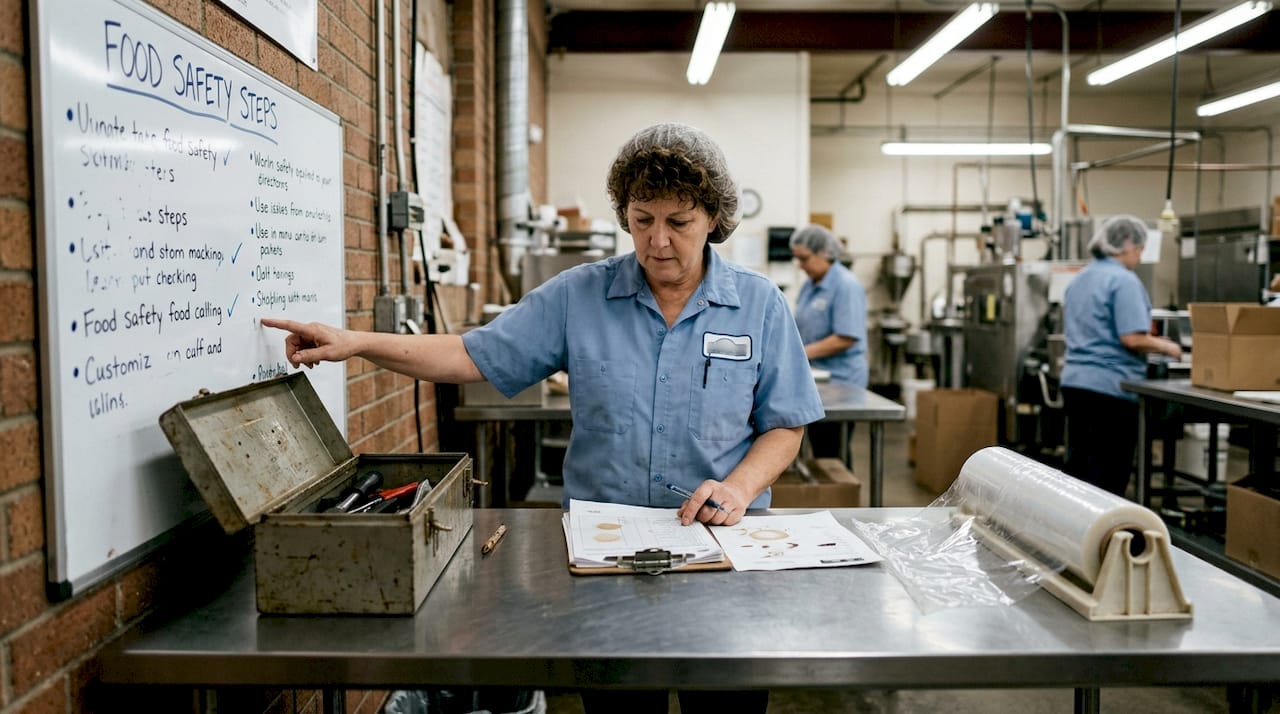
Preventive Control Plans based on HACCP principles are mandatory for licensed operators, covering hazard identification, sanitation, hygiene, and recall procedures. Your PCP must identify biological, chemical, and physical hazards at every production step, then establish control measures to eliminate or reduce risks to acceptable levels. This systematic approach protects consumers and demonstrates due diligence if issues arise.
Developing an effective PCP requires:
- Conducting a hazard analysis for each product and process, identifying potential contamination points
- Establishing critical control points where monitoring prevents, eliminates, or reduces hazards
- Setting critical limits for temperature, time, pH, water activity, and other parameters
- Implementing monitoring procedures with documented checks and corrective actions
- Verifying that control measures work through testing, calibration, and internal audits
- Maintaining detailed records of all monitoring, corrective actions, and verification activities
- Creating recall procedures that enable rapid product removal if safety issues occur
Pro Tip: Start PCP development early in facility planning or product development. Retrofitting food safety controls into existing operations costs significantly more than building them in from the start. Many manufacturers underestimate the documentation requirements and discover gaps during CFIA pre-licensing inspections.
Implementation timelines depend on your facility’s current state. Operations with basic good manufacturing practices may complete PCP development in two to three months, while facilities requiring equipment upgrades or process redesigns can take six months or longer. Budget for staff training, documentation systems, and potential facility modifications when planning your compliance timeline.
Non-compliance carries serious consequences. CFIA can suspend your licence, order product recalls, or impose operational holds until deficiencies are corrected. These disruptions damage customer relationships and create financial losses that many small manufacturers cannot absorb. The safe food for canadians standards provide detailed guidance on building compliant preventive control plans that withstand regulatory scrutiny.
Canadian snack food labelling requirements and exemptions
Labelling requirements include bilingual common name, net quantity, ingredient list in descending weight order, allergens, Nutrition Facts table, and potential front-of-package symbols for high saturated fat, sugars, or sodium. Every package must display information in both English and French, with specific font sizes and placement rules that ensure readability. The common name must accurately describe the product without misleading consumers about its nature or composition.
Ingredient lists must declare all components in descending order by weight, using prescribed names for many common ingredients. Allergens and gluten sources require highlighting through bold, italics, or other visual differentiation. The Nutrition Facts table follows standardized formats based on package size and must reflect actual product composition verified through laboratory analysis or database values.
Front-of-package symbols became mandatory starting January 2026 for products meeting specific nutrient thresholds. If your freeze dried candy or snack contains 15 percent or more of the daily value for saturated fat, sugars, or sodium per reference amount, you must display the corresponding magnifying glass symbol on the principal display panel. These symbols help consumers make informed choices and align Canadian labelling with international nutrition transparency trends.
Certain products qualify for exemptions:
- Small packages under 100 square centimeters of available display space may use abbreviated labelling
- One-bite confections individually wrapped and sold in multi-unit packages are exempt from Nutrition Facts tables
- Raw fruits, vegetables, and plain dairy products have simplified labelling requirements
- Products sold exclusively for institutional food service may follow different rules
Understanding exemptions prevents over-compliance costs while maintaining regulatory adherence. However, exemptions do not eliminate all labelling requirements. Even exempt products must declare allergens and provide basic identification information.
| Labelling Element | Standard Snack Product | Small Package Exemption | One-Bite Confection Exemption |
|---|---|---|---|
| Bilingual common name | Required | Required | Required |
| Net quantity | Required | Required | Required |
| Ingredient list | Required, descending order | May abbreviate | Required |
| Allergen declaration | Required, highlighted | Required | Required |
| Nutrition Facts table | Required, standard format | May use simplified format | Exempt if individually wrapped |
| Front-of-package symbols | Required if thresholds met | Required if thresholds met | Required if thresholds met |
Pro Tip: Design packaging with compliance built in from the start. Changing labels after printing thousands of units wastes money and delays market entry. Work with a labelling consultant or use CFIA’s online tools to verify compliance before finalizing artwork. The food labeling requirements canada guide provides detailed specifications for every required element.
Package design must also comply with net quantity declaration rules, country of origin labelling, and dealer name and address requirements. The understanding food packaging regulations canada resource explains how packaging materials, claims, and visual elements interact with regulatory requirements. Getting labelling right the first time accelerates market launch and builds consumer trust in your brand.
Voluntary certifications: enhancing market access and trust
Key voluntary certifications include HACCP, GFSI schemes like BRCGS and SQF, Organic certification, Gluten-Free verification, Halal certification, and Kosher certification, with timelines ranging from one to twelve months. While not legally required, these certifications open doors to major retailers, export markets, and consumer segments that demand third-party verification of safety, quality, or religious compliance.
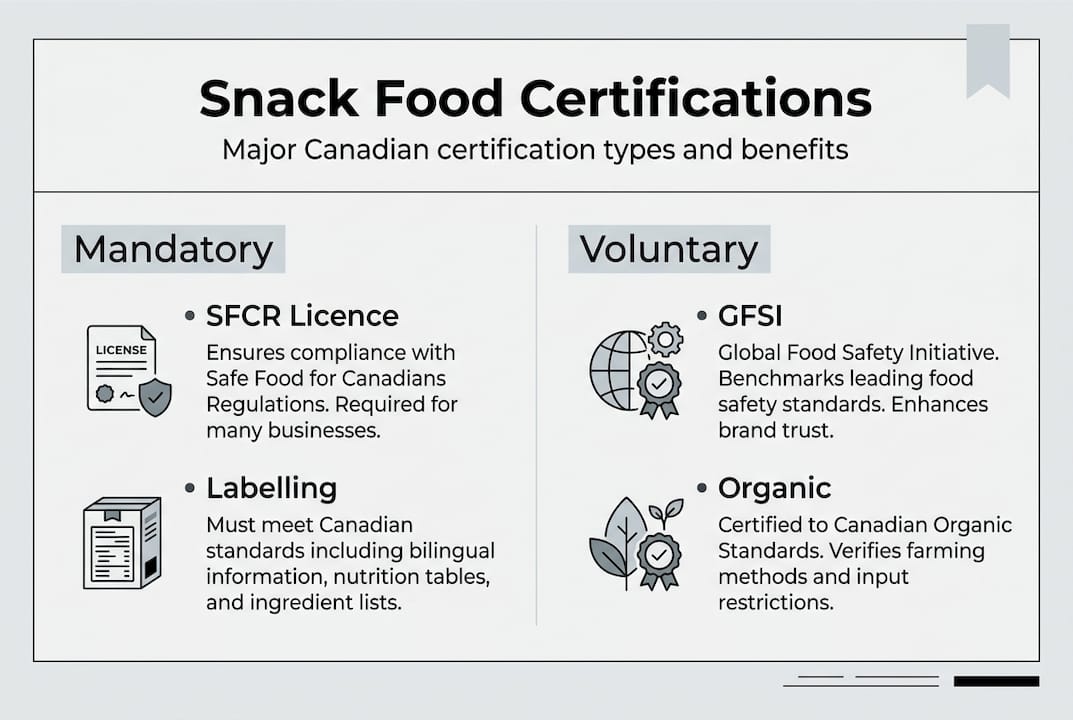
GFSI-recognized certifications such as BRCGS, SQF, and FSSC 22000 are increasingly mandatory for supplying large grocery chains and food service distributors. These schemes audit your entire food safety management system, from supplier approval and ingredient handling to finished product testing and distribution controls. Achieving certification typically requires four to twelve months, depending on your facility’s readiness and the certification scope you pursue.
Organic certification under CAN/CGSB-32.310 allows you to label products as organic and access premium market segments. The certification process involves documenting ingredient sourcing, verifying supplier organic status, and submitting to annual inspections. Organic freeze dried candy and snacks command higher retail prices, but certification costs and ingredient premiums require careful financial analysis.
Gluten-Free certification provides third-party verification that products contain less than 20 parts per million of gluten, meeting Health Canada’s definition. This certification matters for consumers with celiac disease or gluten sensitivity who rely on verified products to avoid health reactions. Testing protocols and facility controls prevent cross-contamination from gluten-containing ingredients or shared equipment.
Halal and Kosher certifications verify religious compliance for Muslim and Jewish consumers respectively. Halal certification through organizations like HMA Canada involves ingredient verification, production process review, and ongoing monitoring to ensure no prohibited substances contact your products. Kosher certification follows similar principles under rabbinical supervision, with different ingredient restrictions and equipment requirements.
Voluntary certification benefits include:
- Enhanced retailer acceptance, with many chains requiring GFSI certification as a condition of supply
- Improved export opportunities, as certifications often satisfy foreign buyer requirements
- Reduced audit burden through recognition of third-party certification by multiple customers
- Competitive differentiation in crowded snack food markets
- Consumer trust building through visible certification marks on packaging
- Operational improvements identified during certification audits
Digital platforms now streamline HACCP and GMP implementation, reducing certification timelines and costs. Cloud-based food safety management systems automate monitoring records, corrective action tracking, and verification documentation that auditors review during certification assessments. These tools are particularly valuable for small to mid-sized manufacturers lacking dedicated quality assurance staff.
Successful snack brands leverage certifications strategically. A freeze dried candy manufacturer might pursue BRCGS certification to access major grocery chains, then add Gluten-Free and Organic certifications to differentiate specific product lines. The manufacturing candy canada private labeling cost savings approach allows brands to benefit from manufacturer certifications without bearing the full certification cost independently.
Certification investments pay off through expanded market access and reduced customer audit requirements. Rather than hosting separate audits from every retailer, one GFSI certification satisfies multiple customers simultaneously. This efficiency becomes more valuable as your distribution network grows and audit demands multiply.
Explore Spaceman’s private label and co-packing services
Navigating certification requirements while launching new snack products requires expertise and infrastructure many brands lack in-house. Spaceman offers private label co packing packaging services tailored for Canadian snack brands seeking compliant, market-ready products without building manufacturing facilities from scratch.
Our certified facility handles everything from product development and regulatory compliance to packaging design and fulfillment. We maintain all required licenses and certifications, allowing you to focus on brand building and sales while we manage production complexities. Whether you need freeze dried candy, custom confections, or co-packed snack products, our turnkey solutions accelerate market entry.
Our variety pack freeze dried candy wholesale options provide retailers with proven assortments that drive impulse purchases and repeat sales. We also offer complete retail solutions like our freeze dried candy wholesale retail display rack that maximize shelf presence and simplify inventory management. These comprehensive offerings help you launch faster and compete more effectively in Canadian snack markets.
FAQ
What is a Safe Food for Canadians licence and who needs it?
A Safe Food for Canadians licence is mandatory for businesses processing, packaging, or labelling food products for sale across Canadian provinces or for export. It ensures compliance with Canadian food safety laws and requires maintaining an approved preventive control plan. Manufacturers, co-packers, and repackagers all need this licence before commencing operations.
Which snack food labelling elements are mandatory in Canada?
Mandatory elements include bilingual common name, net quantity declaration, ingredient list in descending weight order, allergen declarations, and Nutrition Facts table. Front-of-package nutrition symbols for high saturated fat, sugars, or sodium became mandatory starting January 2026 for products meeting specific thresholds. All text must appear in both English and French with specified font sizes.
What are Preventive Control Plans and why are they important?
Preventive Control Plans are HACCP-based safety plans outlining hazard identification, control measures, monitoring procedures, sanitation protocols, and recall procedures. They are mandatory for operators with a Safe Food for Canadians licence to systematically manage food safety risks. PCPs demonstrate due diligence and provide the foundation for consistent safe food production.
How long does it typically take to obtain voluntary certifications like GFSI?
Certifications such as BRCGS or SQF generally require four to twelve months to complete, depending on facility readiness and certification scope. Initial gap assessments identify areas needing improvement, followed by implementation of required controls and documentation. The certification audit occurs after all systems are operational and verified internally.
Do freeze dried candy products require special certifications beyond standard food manufacturing?
Freeze dried candy follows the same regulatory framework as other confections, requiring a Safe Food for Canadians licence and compliant preventive control plan. No special certifications exist specifically for freeze drying technology, but your PCP must address the unique hazards of your specific process. Voluntary certifications like GFSI schemes apply equally to freeze dried and conventional candy production.