

TL;DR:
- Canadian candy regulations demand strict hazard controls and accurate labeling regardless of business size.
- Effective food safety relies on systematic hazard analysis, verified controls, and robust traceability systems.
- Certifications, supplier verification, and regular mock recalls enhance safety, compliance, and market credibility.
Candy might seem like a low-stakes product, but the reality facing Canadian manufacturers and retailers is far more demanding. Recent recalls involving undeclared almonds, aflatoxins, and salmonella in chocolate and nut-based candies prove that confections carry genuine food safety risk. Canadian regulations are strict, actively enforced, and evolving quickly, with new allergen, caffeine, and traceability rules reshaping what compliance actually looks like. Whether you operate a small batch candy kitchen or a large co-packing facility, understanding what you are legally required to do and what separates safe operations from recalled ones is essential reading.
Table of Contents
- Understanding Canadian candy safety regulations
- Hazard analysis and preventive controls: Your critical checklist
- Labeling and allergens: Ensuring transparent compliance
- Best practices: Certification, supplier controls, and product recall readiness
- What most candy makers overlook about food safety in Canada
- Partnering for safer, more marketable Canadian candy
- Frequently asked questions
Key Takeaways
| Point | Details |
|---|---|
| SFCR compliance essentials | All manufacturers must follow core food safety controls, with written plans required for larger businesses or exports. |
| Hazard and allergen control | Comprehensive hazard analysis and documented allergen procedures are key to preventing costly recalls. |
| Transparent labeling | Ingredient lists, allergen declarations, and caffeine labeling are mandatory for most prepackaged candies. |
| Certification advantages | Certifications like BRC or HACCP elevate marketability and buyer trust beyond minimum compliance. |
| Recall readiness | Supplier verification and mock recall drills ensure issues are caught early and managed quickly. |
Understanding Canadian candy safety regulations
Canada’s food safety framework is built on the Safe Food for Canadians Act and its supporting regulations, collectively known as the Safe Food for Canadians Regulations (SFCR). For candy manufacturers, Part 4 preventive controls under the SFCR set the baseline requirements for good manufacturing practices (GMP), sanitation programs, pest control, employee hygiene, allergen management, and recall plans. These requirements apply whether you are producing gummies, chocolates, freeze-dried candy, or hard confections.
The SFCR distinguishes between high-risk and lower-risk foods. Candy generally falls into the lower-risk category, which creates a common question among producers: do we actually need a written Preventive Control Plan (PCP)? The short answer depends on your business size and trade scope. Small food businesses with gross annual food sales at or below $100,000 and that do not engage in interprovincial trade, import, or export are exempt from producing a written PCP for non-high-risk foods like candy. However, this exemption does not mean you can ignore the underlying controls. You must still practice GMPs, manage allergens, and have a functioning recall capability. The paperwork exemption is not a controls exemption.
Understanding key definitions matters enormously here. “Manufacturing” under the SFCR includes any transformation of a food commodity, meaning even coating, enrobing, or flavoring candy counts. “Packaging” means placing food into a container for sale. If your candy crosses a provincial boundary or leaves Canada, the written PCP requirement applies regardless of your sales volume. This catches many small producers off guard, especially those who sell at farmers markets in one province but ship e-commerce orders across the country.
| Business scenario | Written PCP required? | Core controls required? |
|---|---|---|
| Sales under $100K, sells locally only | No | Yes |
| Sales under $100K, ships interprovincially | Yes | Yes |
| Sales over $100K, any trade scope | Yes | Yes |
| Imports or exports candy | Yes | Yes |
Pro Tip: Before assuming you qualify for the small-business exemption, map every channel where your product moves. A single cross-border online order can shift your compliance obligations significantly. Work with a CFIA-registered consultant to confirm your status before your next product launch.
For manufacturers and retailers exploring Canadian food safety standards, understanding where you sit in this framework is the first step to building operations that are both legally sound and genuinely safe.
Hazard analysis and preventive controls: Your critical checklist
With the regulatory framework clear, the practical question becomes: what hazards actually exist in candy manufacturing, and how do you control them? A proper hazard analysis is not a paperwork exercise. It is a systematic review of every ingredient, process step, and environmental condition that could cause harm if not controlled.
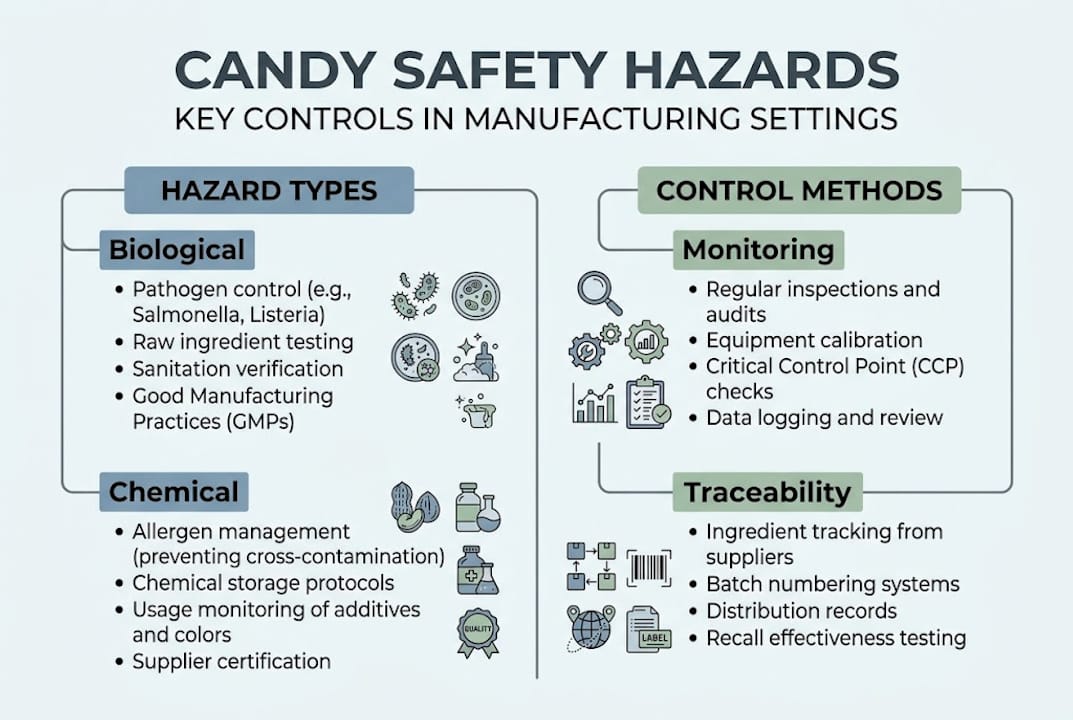
Candy environments face hazards that are easy to underestimate. Biological hazards include salmonella in chocolate, which survives in low-water-activity environments far longer than most people expect, and listeria monocytogenes in equipment crevices where sugar syrup accumulates. Chemical hazards include allergen cross-contact from shared equipment, aflatoxins in nut-based inclusions, and migration of plasticizers or inks from packaging materials into product. Physical hazards include metal fragments from worn equipment, hard foreign materials from bulk ingredient deliveries, and plastic film pieces from packaging changeovers.
Common candy hazards and controls at a glance:
- Salmonella in chocolate/nut inclusions: Control via verified supplier pathogen testing, roasting validation, and environmental swabbing
- Allergen cross-contact: Control via dedicated equipment, validated cleaning procedures, and strict scheduling protocols
- Metal fragments: Control via calibrated inline metal detectors with documented sensitivity tests
- Aflatoxins in nuts/dried fruit: Control via certificate of analysis (COA) review from suppliers and incoming lot testing
- Packaging chemical migration: Control via food-grade material specifications and supplier declarations
Hazard analysis under the SFCR must explicitly identify all risks, including allergens, physical, chemical, and biological hazards, and pair each with verified controls. This is not optional language. The CFIA expects you to demonstrate that controls work, not just that they exist on paper.
Critical control points (CCPs) in candy manufacturing typically include cooking temperatures for sugar-based products (above 71°C for pathogen reduction in filled confections), metal detection after final forming, and post-cleaning allergen verification before product changeovers. Each CCP needs a documented critical limit, a monitoring procedure, corrective action steps, and verification records.
| Hazard type | Example in candy | Typical control | Monitoring method |
|---|---|---|---|
| Biological | Salmonella in chocolate | Supplier testing, temp control | Environmental swabs, COA review |
| Chemical | Allergen cross-contact | Equipment dedication, clean-in-place | ATP swabs, allergen test strips |
| Physical | Metal fragments | Inline metal detector | Calibrated sensitivity checks |
| Chemical | Aflatoxin in nuts | Supplier COA, incoming testing | Lab analysis per lot |
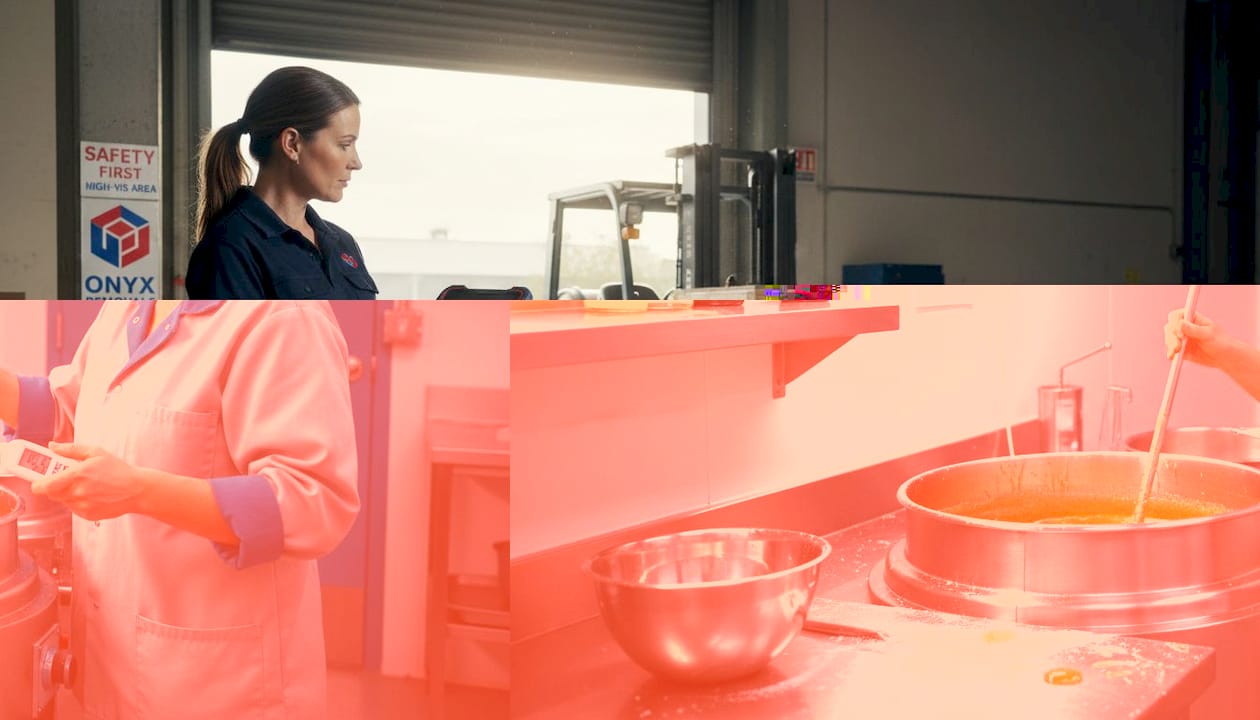
Environmental monitoring deserves special attention. ATP swabbing, where you measure adenosine triphosphate residues as an indicator of organic matter left after cleaning, is a rapid and practical tool for candy facilities. It tells you whether a surface is genuinely clean before you run the next product. Supplement ATP testing with periodic pathogen swabs, particularly in hard-to-reach areas near floor drains, conveyor belts, and cooling tunnels.
Reviewing candy quality control methods specific to freeze-dried and specialty confections provides additional context for building your monitoring program. For safety practices tied to specific processing technologies, freeze drying safety guidelines offer process-specific detail worth reviewing.
Pro Tip: Don’t skip lot code traceability even for low-risk candy lines. A precise traceability system lets you execute a recall in hours rather than days, limits your financial exposure, and can mean the difference between a targeted product pull and a brand-damaging full-market withdrawal.
Labeling and allergens: Ensuring transparent compliance
Getting your hazard controls right inside the facility means little if your label fails to communicate critical information to consumers. Canadian labeling rules for candy are detailed, and recent regulatory changes have added new layers of complexity.
For prepackaged candy, ingredient lists and allergen declarations are mandatory. Ingredients must appear in descending order by weight. Sugars can be grouped under a collective heading provided they are listed in parentheses. Allergens, gluten sources, and sulphites above 10 parts per million must appear in a dedicated allergen statement, either within the ingredient list or in a separate “Contains:” declaration immediately following it. The source name of the allergen must be used explicitly, meaning “milk,” “peanut,” or “tree nuts (almond)” rather than generic trade names.
Here is a practical checklist for compliant candy labels:
- Ingredient list in descending order by weight, with all sub-ingredients declared
- Mandatory allergen statement using source names for all Priority Food Allergens
- Gluten source declaration if wheat, rye, barley, oats, or triticale are present
- Sulphite declaration if sulphites exceed 10 ppm
- Net quantity in metric units
- Bilingual text (English and French) for all mandatory label elements
- Manufacturer or distributor name and address
- Lot code and best-before date where applicable
Recent recall cases involving undeclared allergens in chocolate-coated candies show exactly what happens when these steps are skipped or rushed. The recalls were not the result of intentional mislabeling. They resulted from ingredient substitutions mid-production, formula changes without label updates, or shared equipment that was not flagged in the allergen statement.
Regulation update to watch: Health Canada has expanded caffeine rules for candy. Products with caffeine over 56mg per serving must carry a cautionary label, and full compliance is required by January 2028. This affects caffeinated gummies and chocolate products directly. If you are developing or currently selling these products, begin your label review now rather than waiting for the deadline.
Exemptions do exist. Candy that is packaged at retail in front of the consumer from bulk bins, and single-bite confections below a specific weight threshold, may be exempt from some labeling requirements. However, these exemptions are narrow and contextual. When in doubt, apply the full label rather than risk a non-compliance finding.
For a thorough review of what full compliance looks like across your product line, candy packaging compliance and food labeling requirements provide category-specific guidance for Canadian brands.
Pro Tip: Always use the source name in allergen statements rather than relying on “may contain” precautionary warnings alone. “May contain” is not a substitute for a declared allergen when cross-contact is a known and consistent risk in your process. CFIA does not treat precautionary labels as compliance with allergen declaration requirements.
Best practices: Certification, supplier controls, and product recall readiness
Meeting the SFCR minimum keeps you legal. Building beyond that minimum is what keeps your brand intact when something goes wrong and what opens doors with major retail buyers.
Third-party certifications like BRC Global Standard for Food Safety, ISO 22000, and HACCP-based programs are not required by Canadian law. But they matter enormously in practice. BRC-certified manufacturers such as Karma Candy demonstrate how certification can position a private-label candy operation as a credible, low-risk partner for national retailers and foodservice buyers. Certification audits surface gaps that internal reviews often miss, create documented systems that survive staff turnover, and signal credibility to buyers who require verified food safety credentials from their supply chain.
Supplier verification is another area where most candy businesses under-invest until a recall forces the issue. A solid supplier control program should require the following from every ingredient vendor:
- Pathogen testing certificates for any ingredient that is a known vector (nuts, dried fruit, cocoa-based products)
- Allergen status declarations with full disclosure of shared lines and equipment
- Mycotoxin analysis for nut and grain-derived ingredients, including aflatoxin and ochratoxin
- Food-grade certificates for packaging materials confirming compliance with Canadian and applicable destination-market standards
- Annual facility audits or third-party audit summaries for high-risk suppliers
Environmental pathogen monitoring programs, particularly for chocolate and nut-candy lines, should include periodic listeria and salmonella zone testing in the production environment, not just finished product testing. Pathogens are environmental, meaning they live in your facility between production runs if sanitation is inadequate. Finished product testing alone will not catch a contamination event early enough to prevent a recall.
Real-world impact: Recalls in the Canadian market involving chocolate and nut candies due to undeclared allergens and mycotoxins show that these are not hypothetical risks. They are active, documented events that damage brands and create financial liability. Supplier verification and finished product testing together form the practical defense.
Recall readiness is often the most neglected element of a food safety program until it becomes urgent. A functioning recall program needs a documented contact tree, clear product traceability records tied to lot codes, a communication template for regulatory bodies and retail partners, and regular mock recall exercises. The CFIA expects you to be able to trace a product from your facility to the consumer and back to your raw material supplier within a defined timeframe. Annual mock recalls, ideally run unannounced internally, reveal whether your traceability data is accurate and whether your team knows what to do under pressure.
For insight into building compliant, certification-ready programs, snack food certifications outlines the Canadian landscape and what auditors typically evaluate.
What most candy makers overlook about food safety in Canada
Here is a pattern we see repeatedly: a candy business spends significant effort determining whether they qualify for the small-business PCP exemption, then stops there. They confirm they’re exempt, file nothing, and assume they’ve handled compliance. Meanwhile, their supplier verification is informal, their allergen changeover procedures are undocumented, and their lot traceability lives in a handwritten notebook.
The exemption question is the least important question in food safety. CFIA’s preventive control framework makes clear that even low-risk foods require genuine operational controls. Recalls don’t happen because businesses missed a paperwork deadline. They happen because allergen cross-contact wasn’t validated, because a supplier changed a formulation and didn’t notify the buyer, or because environmental pathogens accumulated in a facility that hadn’t done a deep clean in months.
Certifications are a business advantage, not just a compliance box. Private-label buyers increasingly require BRC or equivalent. For brands pursuing private labeling cost savings and retail partnerships, working with a certified co-packer removes enormous risk and barrier. The competitive edge belongs to businesses that treat food safety as an operational culture, not a regulatory checkbox.
Run unannounced mock recalls. Surprise your team with allergen swab audits. Those two practices will reveal more about your real food safety status than any amount of documentation review.
Partnering for safer, more marketable Canadian candy
Building a compliant, certifiable candy operation is achievable when you work with partners who have already built the infrastructure. For manufacturers and retailers looking to accelerate both safety and market reach, finding a co-packer or private-label partner with verified food safety credentials changes the risk equation entirely.
At Spaceman, we operate as a freeze-dried candy manufacturer and distributor with private label and co-packing solutions designed to help Canadian brands launch and scale safely. Whether you are developing a new candy SKU, need compliant bagging and packaging services, or want to expand your product line without building new infrastructure, our team is set up to support you. Brands ready to grow their distribution can also explore our wholesale partner program to access new channels with confidence.
Frequently asked questions
Do all Canadian candy manufacturers need a written Preventive Control Plan?
No. Small businesses under $100,000 in annual food sales that don’t export or trade interprovincially are exempt from a written PCP for candy, but core safety controls are still mandatory.
What new labeling rules affect candy with caffeine in Canada?
Candies exceeding 56mg caffeine per serving must carry a caution label, with full compliance required by January 2028, affecting caffeinated gummies and chocolate products directly.
Are ingredient lists and allergen declarations required for all kinds of candy?
Prepackaged candy requires full ingredient and allergen statements, but retail-packed bulk candy and qualifying single-bite confections may be exempt from some requirements.
Is certification like BRC or HACCP mandatory in Canada?
No, but BRC and HACCP certifications provide real advantages in retailer access, risk reduction, and private-label marketability well beyond what the SFCR baseline requires.