

TL;DR:
- Canada’s food safety regulations require documented, outcome-based preventive control plans for freeze dried candy. Effective quality control includes raw material qualification, real-time monitoring, rigorous testing, and staff training. Utilizing technology like AI and rapid test kits enhances detection and ensures continuous compliance.
Great-looking freeze dried candy can still carry real risk. Color, crunch, and flavor tell you nothing about microbial counts, residual moisture, or allergen cross-contact. In Canada, food safety regulations have moved well beyond “looks good, tastes good” and into documented, evidence-based systems that every licensed manufacturer and importer must follow. Whether you run a small co-packing facility or a high-volume production line, understanding how quality control works in this space protects your customers, your brand, and your license. This guide walks through the exact strategies that keep Canadian freeze dried candy safe, consistent, and compliant.
Table of Contents
- Understanding candy quality control standards in Canada
- Building a robust quality control system for freeze dried candy
- Advanced testing and monitoring techniques
- Practical applications and compliance tips for Canadian manufacturers
- A smarter approach to candy quality: What most Canadian brands overlook
- How Spaceman supports candy quality and compliance
- Frequently asked questions
Key Takeaways
| Point | Details |
|---|---|
| Follow Canadian PCPs | Every candy producer must meet SFCR preventive control plan standards for legal sales. |
| Go beyond taste | Quality control means checking for chemical, physical, and microbial safety—not just flavor or appearance. |
| Leverage technology | AI-based monitoring and real-time data systems greatly improve defect detection and product consistency. |
| Document everything | Detailed records and clear corrective actions make audit success and recall response far easier. |
Understanding candy quality control standards in Canada
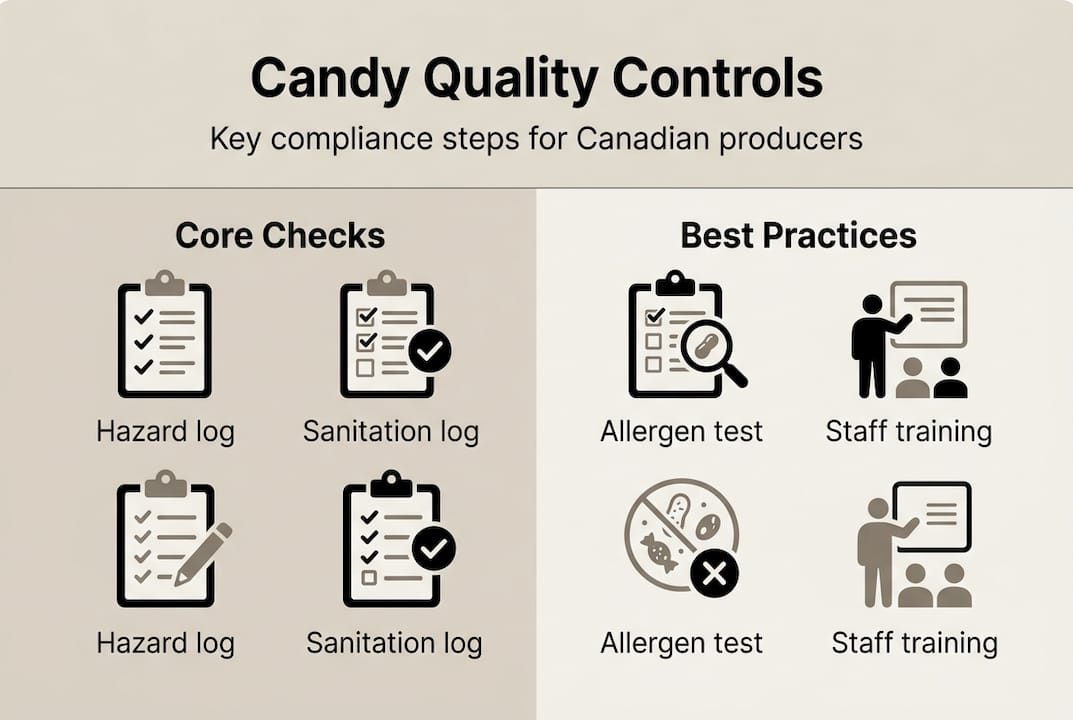
Canada’s food safety framework for candy producers is built on one foundational document: the preventive control plan, or PCP. Under the Safe Food for Canadians Regulations, licensed manufacturers must implement a PCP covering hazard identification, analysis, and control (SFCR ss.47-48), establishment conditions, sanitation and pest control, hygiene programs, and complaint and recall procedures. Importers face the same bar: they must verify that foreign suppliers meet equivalent protections.
What makes the SFCR framework distinct is its outcome-based design. You’re not handed a checklist and told to tick boxes. Instead, you define your outcomes, build controls to reach them, and prove with records that those controls actually work. This creates flexibility for innovation, but it also raises the evidence burden. If a CFIA inspector asks for validation data on your freeze dryer’s drying cycle, you need it on file.
“The PCP is not a static document. It must be updated whenever processes, ingredients, or hazards change. Treat it as a living quality system, not a one-time filing.”
Beyond regulatory requirements, candy producers need to understand sensory and chemical standards. Candy inspection methods cover sensory checks for color, aroma, taste, and texture alongside physical and chemical limits and microbial testing benchmarks. For operations handling both domestic and imported raw materials, layering these checks against Canadian candy packaging regulations is equally important.
Here’s how the SFCR PCP elements map to freeze dried candy production:
| PCP element | Freeze dried candy application |
|---|---|
| Hazard analysis | Moisture activity, allergen cross-contact, metal contamination |
| Establishment conditions | Cleanroom zoning, equipment material compatibility |
| Sanitation and pest control | Post-batch CIP protocols, sealed facility entry points |
| Hygiene program | Gowning, handwashing checkpoints, staff illness policy |
| Complaints and recall | Lot traceability, customer notification procedures |
Review the full Safe Food for Canadians standards to ensure your PCP maps correctly to your process.
Building a robust quality control system for freeze dried candy
A quality control system for freeze dried candy is not just a HACCP binder on a shelf. It’s a set of living, interconnected controls that run from the moment raw candy arrives at your dock to the minute a finished bag leaves your facility.
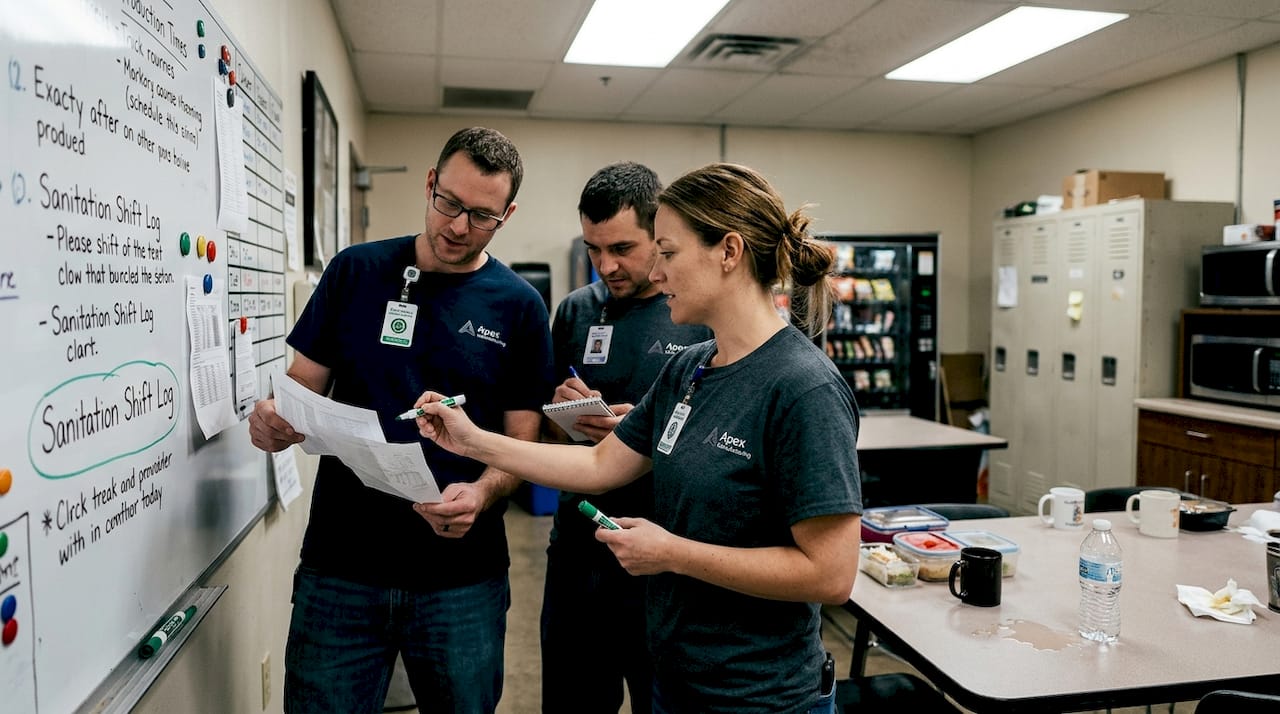
SQF-certified confectionery operations integrate GFSI certification, HACCP, GMP, internal audits, food defense, testing controls, corrective action and preventive action plans (CAPA), facility controls, production process controls including incoming inspection and allergen management, and incident management. That’s a long list. The good news is that each element reinforces the others.
Here’s how to build your system sequentially:
- Qualify your raw material suppliers. Request certificates of analysis, allergen declarations, and food safety certifications before onboarding any candy base or ingredient.
- Define your Critical Control Points. For freeze dried candy, the CCP is almost always the freeze drying cycle itself: temperature, vacuum level, and duration must hit specific targets every batch.
- Write your monitoring plan. Document who checks what, at what frequency, and what action they take if a parameter drifts out of range.
- Establish your CAPA process. When a deviation occurs, you need a documented path from detection to root cause to corrective action and verification.
- Train and re-train staff. Quality systems fail at the human layer more often than the technical one.
- Audit internally before anyone audits you. Schedule quarterly internal reviews using the same criteria a third-party auditor would apply.
Pro Tip: Set your internal allergen thresholds lower than what regulations require. If your process limit for a given allergen is 5 ppm but the legal limit is 10 ppm, you have a built-in buffer before you’re in violation.
| Framework | Canadian relevance | Key requirement |
|---|---|---|
| SFCR PCP | Mandatory for all licensed producers | Documented hazard controls with evidence |
| HACCP | Embedded in SQF and BRC | CCP identification and monitoring |
| SQF Food Safety Code | Voluntary but preferred by retailers | GFSI recognition, third-party audit |
| GMP | Baseline for all food manufacturing | Facility hygiene and personnel practices |
For details on how proper freeze drying intersects with safety protocols, the freeze drying food safety guidelines for Canadian candy are a strong reference point.
Advanced testing and monitoring techniques
Building controls is step one. Verifying that they work is the part that most operations underinvest in. Leading freeze dried candy manufacturers use a layered testing approach that catches issues at multiple points, not just at final release.
Here’s what a complete testing program looks like:
- Incoming ingredient testing: Verify moisture content, allergen status, and microbial load before candy enters your freeze dryer.
- In-process monitoring: Track vacuum pressure, shelf temperature, and sublimation endpoint in real time during every cycle.
- Finished product testing: Run sensory evaluation (color, texture, aroma), moisture activity (Aw), and microbial counts before releasing each lot.
- Retain samples: Keep labeled samples from each batch for a defined shelf period so you can investigate customer complaints with actual product.
- Metal detection and X-ray: Run all finished product through a calibrated metal detector. X-ray adds detection of dense foreign material that metal detectors miss.
The microbial limits matter more than many operators realize. Candy hygiene standards set physical and chemical limits including lead at or below 1 mg/kg, arsenic at or below 0.5 mg/kg, total colony counts for hard candy at or below 750 CFU/g, and for gummy candy at or below 1,000 CFU/g. Freeze dried versions of gummy candies need to meet these same benchmarks.
Now, the technology side is moving fast. Machine learning in food quality control demonstrates that convolutional neural networks can detect defects in gummies with more than 90% accuracy, and gummy candy classification has reached a precision of 0.93. These systems integrate directly with HACCP and ISO monitoring frameworks for real-time feedback.
Pro Tip: Rapid test kits for allergens and ATP swabs for sanitation verification give you same-shift results rather than waiting 48 to 72 hours for lab data. Use them for routine monitoring. Send samples to an accredited lab for periodic validation.
For a broader look at how Canadian production facilities are structured around these controls, the candy factory guide covers facility setup in practical terms.
Practical applications and compliance tips for Canadian manufacturers
Knowing your standards and tests is one thing. Running a facility that stays audit-ready every day is another. Here are the practices that separate top Canadian freeze dried candy operations from the ones that scramble before every inspection.
Getting audit-ready starts long before the auditor arrives:
- Keep your PCP current. SFCR preventive control plans must reflect actual current processes. Any change to your line, recipe, or supplier triggers a PCP review.
- Organize records by lot number. Auditors trace a batch from incoming material to outgoing shipment. If you can’t produce that paper trail in minutes, expect findings.
- Run mock recalls quarterly. Pull a lot, trace it forward to customers and backward to suppliers, and document how long it takes. Target under two hours.
- Document corrective actions completely. A finding without a documented root cause, action taken, and verification check is an open finding.
Unique controls for freeze dried candy specifically:
- Maintain vacuum pressure below 150 mTorr during the primary drying phase to avoid incomplete drying and elevated moisture activity in the finished product.
- Use validated cleaning protocols for your freeze dryer chambers. Residual sugar deposits breed microbial growth between runs.
- Label intermediate product by batch with timestamps so rework doesn’t compromise traceability.
- Log every loading configuration, because shelf density affects drying uniformity.
Building a quality culture matters just as much as the technical systems. Staff who understand why they’re following a protocol are far more reliable than staff who are just following orders. Brief daily pre-shift quality reviews, visible KPI boards, and a no-blame approach to deviation reporting all contribute to a team that catches problems before they become recalls.
Your packaging decisions also carry compliance weight. The Canadian packaging compliance guide for candy brands is a useful reference when updating labels or launching new SKUs. And if you’re expanding into retail or foodservice, knowing how to approach sourcing Canadian candy partnerships with quality documentation in hand speeds up onboarding significantly.
A smarter approach to candy quality: What most Canadian brands overlook
Here’s a candid observation from years inside freeze dried candy manufacturing: most Canadian brands treat quality control as a compliance event rather than a competitive asset. They build a PCP, pass their first audit, and then let the system go static. That’s where real risk accumulates.
Outcome-based regulation like SFCR is actually a signal to do more, not less. It means the minimum bar is your validated evidence of control. If you’re relying on a static checklist, you’re already behind. The brands that consistently win on retail shelves and in optimizing wholesale supply chain negotiations are the ones with real-time data, digital monitoring, and staff who own quality as part of their job, not as a side obligation.
The most agile Canadian candy factories we’ve seen share one trait: quality issues surface from the floor up, not from audit findings down. That only happens when your team understands the system and has a fast, easy way to flag concerns. Technology helps. Culture enables it.
How Spaceman supports candy quality and compliance
Turning quality control practices into operational reality is easier when you work with partners who already have the systems in place.

At Spaceman, our private label co-packing services are built around the same SFCR-aligned controls described throughout this guide. We handle documentation, traceability, allergen management, and audit-ready recordkeeping as part of every production run. Canadian candy brands working with us don’t need to build those systems from scratch. They plug into ours. Whether you need co-packing, bagging, private labeling, or guidance on compliance documentation, visit Spaceman to see how we can help your brand hit both quality and regulatory targets.
Frequently asked questions
What are the legal quality control requirements for freeze dried candy in Canada?
You must follow the Safe Food for Canadians Regulations, which require a preventive control plan covering hazards, sanitation, traceability, and proof of ongoing monitoring.
What microbial limits apply to gummy and hard candies?
Hard candy colony counts must stay below 750 CFU/g and gummy candy must stay below 1,000 CFU/g to meet hygiene standards.
How can small manufacturers implement effective quality control?
Start with the SFCR preventive control plan template, document every food safety step with dated records, and set up a regular internal audit schedule covering sanitation, allergen management, and lot traceability.
What role does AI play in quality control for freeze dried candy?
AI defect detection systems can classify product quality with more than 90% precision, catching visual defects and inconsistencies in real time that manual inspection regularly misses.
Recommended
- Stay compliant: key candy packaging regulations in Canada – Spaceman
- Candy packaging compliance: a complete guide for Canadian brands – Spaceman
- Food safety in freeze drying: guidelines for Canadian candy makers – Spaceman
- Candy Suppliers Canada: Complete Guide for Retailers – Spaceman
- Food safe wall cladding: A facility manager’s guide