

TL;DR:
- Most Canadian retailers overlook strategic placement, causing unique freeze-dried candies to go unnoticed and underperform.
- Effective merchandising combines targeted display tactics, appealing packaging, and cross-merchandising to boost impulse buys and increase basket size.
- Testing and adapting strategies continually are essential to capitalize on the novelty of freeze-dried candy and grow sales over time.
Freeze-dried candy is one of the fastest-growing segments in the Canadian confectionery market, yet most retailers are still using the same tired shelving approaches they apply to any other snack. The result? Unique, exciting products get buried in a sea of competing bags and boxes, and impulse sales never materialize. If your freeze-dried candy is sitting on a mid-shelf with minimal signage and no surrounding context, you’re leaving real money on the table. This guide walks you through proven, practical merchandising strategies designed specifically for Canadian candy retailers who want to turn curiosity into consistent sales.
Table of Contents
- Understand your audience and set merchandising goals
- Display tactics to catch the eye and attract impulse buyers
- Optimize product packaging for shelf appeal
- Cross-merchandising and strategic placement for bigger baskets
- Monitor, test, and adapt: iterating for long-term success
- Why reinventing your candy merchandising pays off
- Expand your freeze-dried candy section with Spaceman solutions
- Frequently asked questions
Key Takeaways
| Point | Details |
|---|---|
| Know your audience | Identifying your target customers guides every merchandising choice and increases product relevance. |
| Leverage creative displays | Eye-catching setups and smart placement can transform freeze-dried candy into a top seller. |
| Maximize packaging impact | Attractive, compliant, and functional packaging boosts shelf appeal and drives trial. |
| Cross-merchandise for higher sales | Placing candy near complementary products and high-traffic areas grows basket size and revenue. |
| Test and refine strategies | Continuous analysis and adaptation ensure long-term sales growth for your freeze-dried candy section. |
Understand your audience and set merchandising goals
Before you rearrange a single shelf, you need a clear picture of who is buying freeze-dried candy in your store and what outcome you want to drive. As retail candy display strategies research confirms, understanding your target customer is key to effective candy merchandising. Without this foundation, every display decision becomes guesswork.
Freeze-dried candy attracts a surprisingly wide customer base. Families with kids are drawn in by novelty and fun flavors. Impulse buyers respond to vibrant packaging and accessible placement. Novelty seekers, often older teens and young adults, are actively searching for new taste experiences they can share on social media. Each of these groups responds to different triggers, so your strategy needs to account for who actually walks through your door.
Here are the most common merchandising objectives retailers use to structure their approach:
- Increase basket size by pairing freeze-dried candy with other products during the same visit
- Drive new customer trial through sample opportunities, prominent placement, and bold introductory signage
- Boost impulse purchases by positioning products where customers pause or wait, such as checkout lines or coffee stations
- Build brand recognition for private-label freeze-dried products that set your store apart from competitors
Once you have defined your objective, use your store’s foot traffic data to guide product placement. If you track which aisles get the most dwell time, you already know where attention naturally pools. That information directly informs where your freeze-dried candy should live. Consult a solid candy pricing guide alongside your traffic data to ensure your margins support your merchandising investment.
Pro Tip: Talk to your cashiers and floor staff. They hear firsthand what customers say about your candy section and which products get picked up and put back. This low-cost feedback loop is often more valuable than any formal survey.
Display tactics to catch the eye and attract impulse buyers
Placement and presentation are everything when it comes to freeze-dried candy. The product itself is visually distinctive because the textures are unique, the colors are bright, and the concept is still novel enough to stop a shopper mid-aisle. Your display needs to amplify that natural advantage. Innovative candy display ideas consistently show that creative displays increase sales by attracting attention and encouraging purchase.
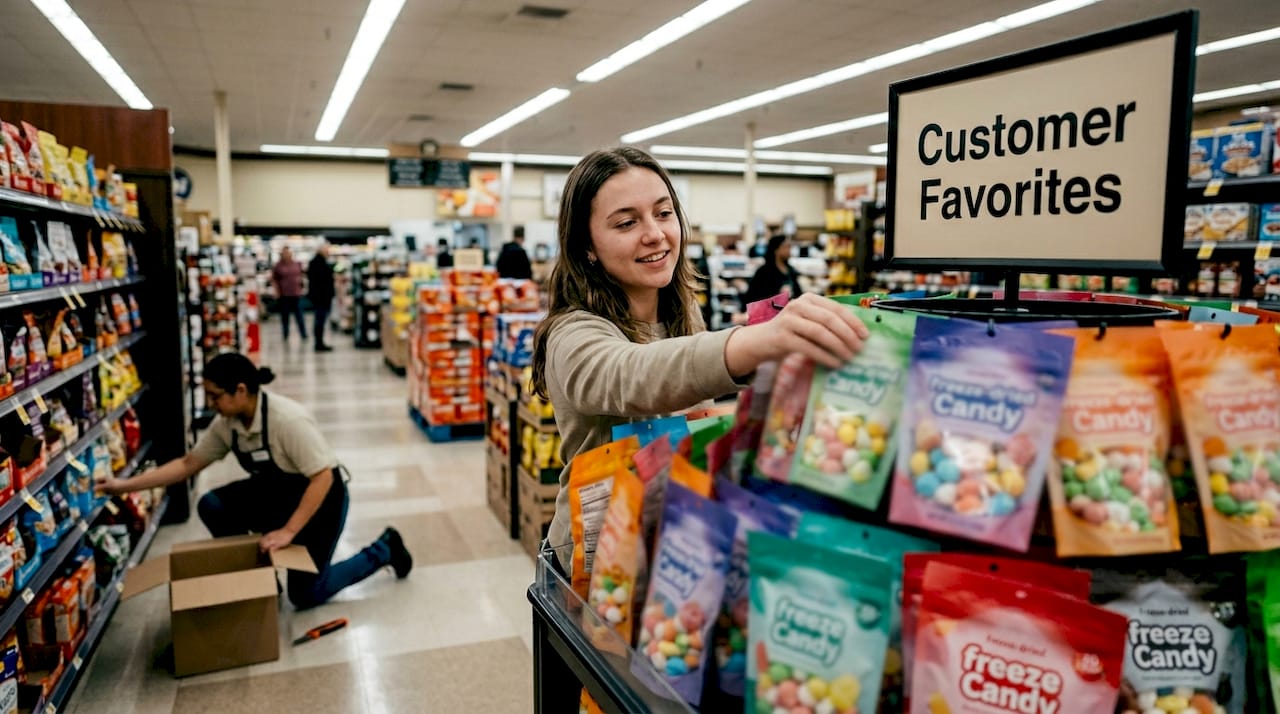
Start with shelf positioning. Eye-level placement is universally more effective than lower shelves, and end caps (the displays at the end of a store aisle) generate significantly more traffic than standard mid-aisle spots. Front-of-store placement near the entrance creates immediate awareness even for customers who weren’t planning to buy candy. These three zones should be your priority for any new product introduction.
Beyond basic shelving, consider these display formats:
- Themed racks built around seasons, holidays, or flavor profiles (sour, fruity, nostalgic classics)
- Bulk bins or open-top containers that let customers see and smell the product before buying
- Counter displays near point-of-sale terminals that catch attention while customers wait to pay
- Floor-standing spinner racks for stores with enough floor space to dedicate to the category
The comparison table below shows which display formats work best for specific retail environments and goals:
| Display type | Best for | Main advantage | Potential drawback |
|---|---|---|---|
| Eye-level shelf | All store types | Maximum visibility | Limited differentiation |
| End cap | Grocery, convenience | High foot traffic exposure | Short-term rotations needed |
| Counter display | Boutique, cafe, gift shop | Impulse conversion at checkout | Small capacity |
| Spinner rack | Specialty candy stores | High SKU count in small footprint | Requires floor space |
| Bulk bin | Candy stores, markets | Creates tactile engagement | Requires strict hygiene management |
| Seasonal themed setup | Any store with seasonal traffic | Creates urgency and novelty | Time-limited effectiveness |
Lighting matters more than most retailers realize. A small LED spotlight aimed at a display shelf can increase product pick-up rates noticeably because it signals that something worth looking at is in that spot. You don’t need a massive renovation to implement this. Even battery-powered display lights can make a meaningful difference.
“The products that sell themselves are the ones that customers can see, touch, and understand within three seconds of walking by.” This principle applies perfectly to freeze-dried candy, where the visual texture of the product does most of the sales work if you let it.
Sampling is another underused tactic. Offering a small cube or piece of freeze-dried candy during a busy shopping period introduces the product to hesitant buyers far more effectively than any sign. Use eye-catching candy displays to make your sample station feel intentional rather than improvised.
Pro Tip: Place your sampling station next to your highest-margin freeze-dried SKU (stock keeping unit), not your cheapest. Customers who try a premium flavor are more likely to buy the premium product.
Optimize product packaging for shelf appeal
Even the best display location fails if the packaging doesn’t do its job. For freeze-dried candy, packaging serves two functions simultaneously: it communicates what the product is, and it protects the delicate texture of the candy. As packaging best practices research makes clear, packaging directly impacts customer perceptions and must also meet Canadian compliance requirements for food labeling.
Transparent or windowed packaging is particularly powerful for freeze-dried candy because the visual appearance of the product is a major selling point. Customers can see the airy, crunchy texture before they buy, which reduces purchase hesitation significantly. Bold color contrast on the bag or box exterior helps the product pop against neighboring items on the shelf.
Key packaging features that directly influence sales performance:
- Transparent windows or fully clear bags so the product’s texture is visible before purchase
- Resealable closures (zip locks) that signal quality and freshness to the customer
- Bold, readable fonts on the flavor name so customers can identify options quickly from a distance
- Display-ready boxes that arrive shelf-ready, reducing the labor involved in stocking
- Bilingual labeling to meet Canadian regulatory requirements and serve a broader customer base
The data table below summarizes packaging features and their documented impact on purchase behavior:
| Packaging feature | Customer impact | Compliance benefit |
|---|---|---|
| Transparent window | Increases trial rate by reducing uncertainty | None directly, but supports accurate product representation |
| Resealable zipper | Signals premium quality, reduces waste concerns | Helps meet freshness claim standards |
| Bilingual French/English label | Expands addressable customer base | Required under Canadian Food and Drug Regulations |
| Nutritional facts panel | Builds trust with health-conscious buyers | Mandatory for all packaged food in Canada |
| Bold color contrast | Improves shelf visibility among competing products | None directly |
| Display-ready box | Reduces stocking time, enables faster restocking | None directly |
Private label packaging is worth serious consideration if you want to differentiate your store. When your freeze-dried candy carries your store’s branding, it creates a distinct identity that customers associate with your location specifically, not just the product category. This builds repeat traffic in a way that reselling a national brand never will.
Pro Tip: Test two versions of your packaging design in-store by placing them side by side on the same shelf for two weeks. Track which version gets picked up more often without sales pressure. The results often surprise even experienced buyers.
Cross-merchandising and strategic placement for bigger baskets
Cross-merchandising means placing complementary products together to encourage customers to buy more than they originally planned. It is one of the most effective and underused strategies in candy retail. As data on effective candy displays confirms, pairing candy with other products increases basket size meaningfully.
For freeze-dried candy specifically, natural pairings exist with drinks, popcorn, gifts, and novelty items. A well-placed bundle near the checkout line, a freeze-dried candy bag alongside a specialty soda or a bag of gourmet popcorn, tells a story. It creates a moment of purchase that feels curated rather than random. Customers spend more when a retailer does the “occasion thinking” for them.
Here is a step-by-step plan for building a cross-merchandising strategy for your freeze-dried candy:
- Identify your top-selling freeze-dried SKUs. Start with what already moves. Build your cross-merchandising around products customers already want.
- Map complementary categories. Think about what customers buy alongside candy: beverages, chips, novelty gifts, party supplies. Pick the strongest two or three.
- Choose two or three in-store locations where the pairing makes visual and contextual sense. Checkout, coffee stations, and seasonal displays are reliable starting points.
- Build the bundle offer. Create a simple price incentive for buying both items together, even a modest saving drives conversion. Display the bundle price clearly.
- Train staff on the story. Your team should be able to explain the pairing in one sentence if a customer asks. “It goes great with our cold brew” is more persuasive than any shelf tag.
- Set a review date two to four weeks out. Measure whether average transaction size increased in the cross-merchandised zone compared to the same period prior.
Seasonal promotions amplify cross-merchandising dramatically. Halloween, Valentine’s Day, Easter, and back-to-school periods create natural hooks for themed bundles. Using grocery merchandising ideas as a framework, you can map out seasonal bundles months in advance and execute them with consistency.
Pro Tip: Don’t wait for a holiday to create urgency. Limited-time flavor bundles, “try two new flavors” packs, or “staff pick of the month” displays generate excitement throughout the year without relying on a calendar event.
Monitor, test, and adapt: iterating for long-term success
No merchandising strategy works perfectly the first time. The retailers who consistently grow their candy sales are the ones who treat their store floor as a testing environment rather than a static setup. Testing display strategies allows retailers to find what genuinely works for their unique store, customer base, and product mix.
A/B testing is straightforward in a retail context. Run one display configuration for two weeks, then swap it for an alternative. Compare the sales data. The version that moves more product wins. Document what worked and why before you move on to the next test.
Key metrics every freeze-dried candy retailer should track:
- Product velocity: How many units of each SKU move per week, broken down by location in the store
- Foot traffic conversion: What percentage of customers who pass a display actually pick up the product
- Average transaction size: Whether customers who buy freeze-dried candy also buy other items in the same visit
- Return rate: How often customers who buy once come back within 30 days to buy again
- Markdown rate: How often products need to be discounted to move, which signals a placement or pricing problem
Collect customer feedback consistently. Short conversations at the register, a simple rating card on the display, or a social media question all provide data you can act on. The combination of hard sales numbers and qualitative customer impressions gives you a complete picture that neither source provides alone.
Why reinventing your candy merchandising pays off
Here is an uncomfortable truth about most retail candy sections: they are set up out of habit, not strategy. Retailers stock what they have always stocked, place it where there is available shelf space, and call it done. Freeze-dried candy suffers more than most categories because of this approach because it is new enough that customers don’t yet know to look for it.
The stores that are seeing outsized results with freeze-dried candy right now are not necessarily the ones with the biggest budgets. They are the ones willing to break from the standard shelf-and-sign routine. A thoughtful convenience store display strategy built around customer flow and impulse triggers will consistently outperform a passive approach, regardless of store size.
The real opportunity in freeze-dried candy is the novelty factor. This is a category where customers are still forming their preferences, which means the retailer who helps them discover a favorite flavor becomes part of that experience. That creates loyalty that branded snacks almost never generate. Most stores are so risk-averse about changing their layout that they leave this opportunity completely untouched.
Bold experimentation, even small and low-cost experiments, builds the institutional knowledge that makes your candy section genuinely better every quarter. The stores that will dominate this category in 2027 are the ones testing ideas today.
Expand your freeze-dried candy section with Spaceman solutions
Ready to put these strategies into action? Spaceman offers everything you need to build a high-performing freeze-dried candy section from the ground up.
Our distributor display rack is built specifically for Canadian retailers and arrives shelf-ready, so you spend less time setting up and more time selling. If you want products that are uniquely yours, our private label and packaging services let you build a distinct brand identity around your freeze-dried candy lineup. Just getting started? Our candy starter packs give you a curated variety at a size that fits any store. We manufacture, package, and distribute from Canada, which means faster turnaround and consistent supply for your shelves.
Frequently asked questions
What is the best location in my store to place freeze-dried candy?
High-traffic zones near checkout, end caps, and store entrances drive the most impulse sales because customers are already pausing or transitioning between tasks. These spots maximize visibility without requiring customers to actively seek out the product.
How can I use packaging to boost freeze-dried candy sales?
Transparent, colorful packaging with clear bilingual labeling increases product appeal and lowers purchase hesitation by letting customers see what they’re buying before they commit. Strong packaging design choices also signal premium quality, which supports higher price points.
Which display tactics are most effective for new candy products?
Eye-level shelf placement, end cap positioning, and sample opportunities are the strongest tools for introducing freeze-dried candy to customers who haven’t tried it. Creative display setups that highlight the product’s unique texture help differentiate it from standard candy options.
Does cross-merchandising freeze-dried candy really increase basket size?
Yes. Placing freeze-dried candy alongside complementary items like specialty beverages or snack bundles grows average basket size by encouraging customers to build a complete snacking experience rather than making a single-item purchase.