

Many American candy businesses discover that over 30% of their costs are hidden in packaging and logistics, not just ingredients. This often leads to pricing mistakes that can shrink profits fast. Understanding every expense is crucial if you want to set smart retail prices and compete with established brands. Learn how to analyze, compare, and test strategies so your candy business captures real value rather than leaving money on the table.
Table of Contents
- Step 1: Analyze All Candy Costs Including Packaging And Logistics
- Step 2: Research Market Pricing And Competitor Benchmarks
- Step 3: Calculate Optimal Retail Price For Desired Profit Margin
- Step 4: Test Pricing Strategies In-Store And Online
- Step 5: Verify Sales Performance And Adjust Pricing As Needed
Quick Summary
| Key Point | Explanation |
|---|---|
| 1. Analyze All Costs Thoroughly | Track every expense related to candy production, including ingredients, packaging, and logistics, to set profitable prices. |
| 2. Research Market Prices Carefully | Study competitor pricing and market trends to identify the best pricing strategies and potential profit margins for different candy types. |
| 3. Calculate Optimal Retail Price | Use a cost-plus-pricing strategy to establish prices based on production costs and desired profit margins while considering market factors. |
| 4. Test Pricing Strategies Effectively | Conduct experiments both in-store and online to see how different price points affect sales and customer responses. |
| 5. Continuously Verify Sales Performance | Regularly analyze sales data and market conditions to adjust pricing strategies, ensuring profitability aligned with customer perceived value. |
Step 1: Analyze all candy costs including packaging and logistics
Understanding your total cost structure is fundamental to setting profitable retail prices for candy. You need to meticulously track every expense that contributes to your final product cost, from raw ingredients to final packaging and shipping.
Start by breaking down your primary cost categories systematically. Ingredient expenses represent your first major consideration. Raw materials like cocoa, sugar, and dairy can fluctuate dramatically, potentially impacting your pricing strategy. According to industry research, these ingredient costs directly influence retail prices and require consistent monitoring. Packaging materials represent another significant expense category, with specialized or luxury packaging increasing overall production costs.
Logistics and inventory management are critical hidden cost centers. Research indicates that inventory expenses, including shrinkage and potential spoilage, typically consume 25% to 35% of revenue. Implementing careful inventory rotation techniques and using sealed storage containers can help mitigate these potential losses. Track your labor costs carefully as well, which generally represent 10-12% of total revenue. By comprehensively analyzing these interconnected expenses, you can develop a pricing strategy that ensures consistent profitability while remaining competitive in the marketplace.
Step 2: Research market pricing and competitor benchmarks
Researching market pricing is crucial for establishing competitive yet profitable candy pricing strategies. Your goal is to understand current market rates while positioning your products strategically within the existing landscape.
Start by analyzing pricing margins across different candy categories. Industry research reveals fascinating variations in profit potential. Bulk candy offers the most attractive margins, typically yielding gross margins between 60-75%. Packaged chocolates maintain steady margins around 45-50%, while novelty and gift items achieve slightly higher margins of 50-65%. Specialty products like organic or sugar-free candies hover in the 35-50% margin range.
To conduct effective market research, visit local candy stores, explore online retailers, and analyze pricing for similar products. Pay attention to packaging quality, product size, and unique selling points that might justify price variations. Track wholesale and retail pricing carefully, noting that bulk candy can support markups ranging from 150-300%. Remember that your pricing should reflect not just ingredient costs, but also your brand value, packaging quality, and target market positioning. By understanding these nuanced market dynamics, you can develop a pricing strategy that balances competitiveness with sustainable profitability.
Step 3: Calculate optimal retail price for desired profit margin
Determining the right pricing strategy is a critical step in ensuring your candy business remains both competitive and financially sustainable. Calculating your optimal retail price requires a strategic approach that balances your production costs with desired profit margins.
One effective method is the cost-plus-pricing strategy, which allows you to set prices by adding a specific percentage markup to your total production costs. For instance, if a candy bar costs $0.50 to produce and you want a 200% profit margin, you would price the item at $1.50. Contribution profit-based pricing offers another sophisticated approach, where you calculate the optimal price by considering the relationship between your product’s price and the number of units you can sell.

To implement this strategy effectively, start by tallying all direct costs including ingredients, packaging, labor, and overhead. Then calculate your desired profit margin percentage. Consider market factors like competitor pricing, perceived product value, and target customer demographics. Experiment with different markup percentages and assess how they impact potential sales volume. Remember that the lowest price doesn’t always guarantee the most sales. Your pricing should reflect the quality of your product, your brand positioning, and the unique value you provide to customers. By carefully balancing these factors, you can develop a pricing model that supports both business growth and customer satisfaction.
Step 4: Test pricing strategies in-store and online
Testing your pricing strategies is a critical step in validating your theoretical pricing models and understanding real-world customer responses. This process allows you to gather empirical data that reveals how different price points impact your sales and overall profitability.
Leverage prescriptive price optimization techniques to build comprehensive sales forecast models based on historical data. These advanced approaches help uncover complex relationships between pricing and customer purchasing behaviors. Contextual pricing strategies can be particularly effective, allowing you to simultaneously optimize product selection and pricing to maximize revenue. Start by implementing small scale tests both in physical stores and online platforms. Create controlled experiments where you adjust prices incrementally and meticulously track customer responses, sales volume, and overall profit margins.
When testing pricing, consider creating multiple pricing tiers and observing how different customer segments respond. Monitor key metrics like conversion rates, average transaction value, and customer retention. Be prepared to make swift adjustments based on your findings. Some price variations might surprise you by revealing that customers value quality and perceived value more than absolute lowest prices. Remember that pricing is not a one time exercise but an ongoing process of refinement and adaptation to market dynamics.
Step 5: Verify sales performance and adjust pricing as needed
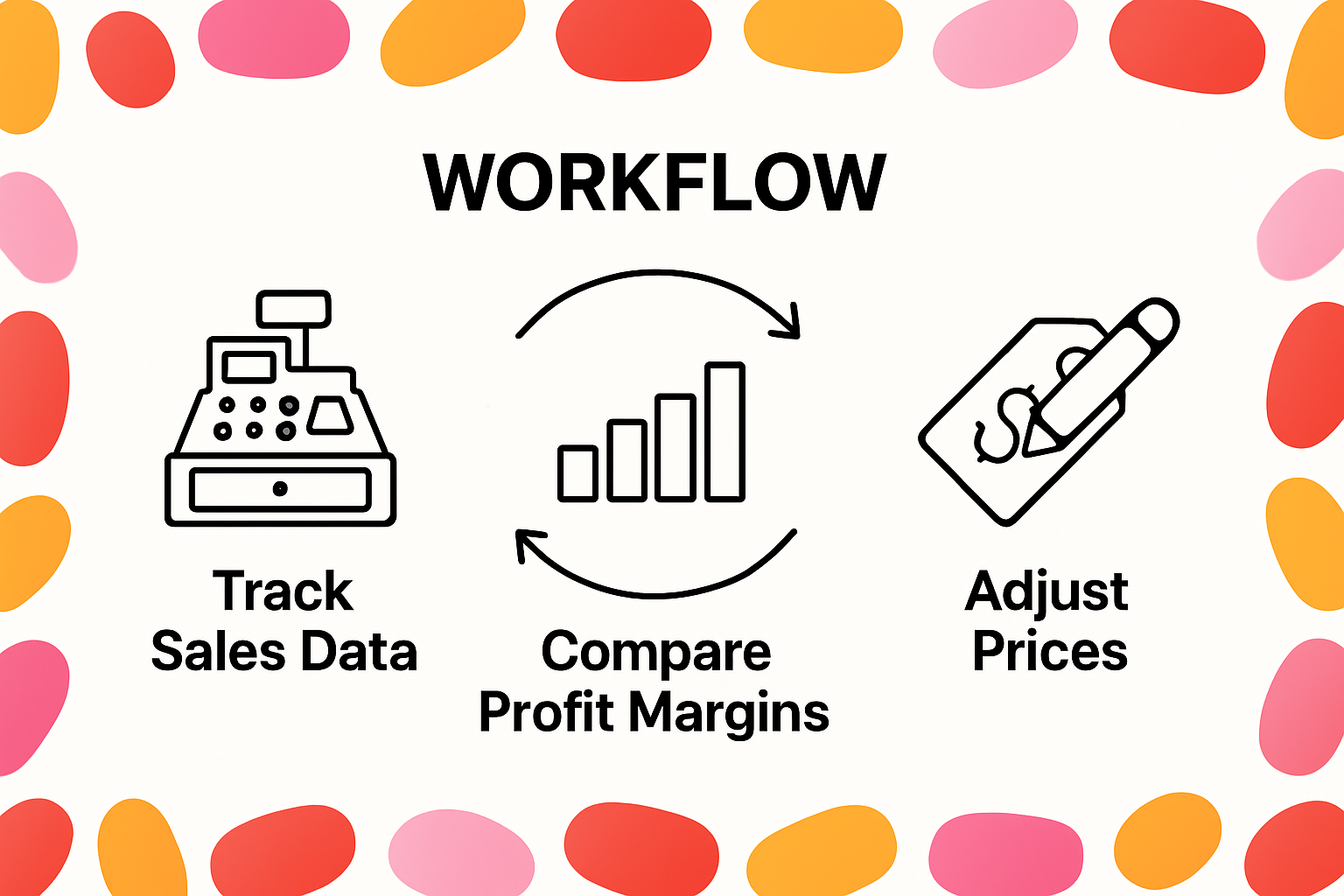
Verifying your candy pricing strategy requires systematic analysis and continuous monitoring. This critical step transforms your initial pricing model from a theoretical concept into a data driven approach that responds dynamically to market conditions.
Implement a data-driven pricing optimization system that leverages historical transactional data to analyze the intricate relationship between price points and sales performance. Counterfactual prediction techniques can help you build advanced models that predict demand under different pricing scenarios. Focus on key performance indicators such as sales volume, profit margins, customer acquisition costs, and overall revenue. This approach allows you to learn individual price elasticity and make precise adjustments that maximize your financial outcomes.
Establish a regular review cycle where you assess pricing performance monthly or quarterly. Look beyond simple sales numbers to understand deeper patterns like customer segment responses, seasonal variations, and competitive market shifts. Be prepared to make incremental adjustments rather than dramatic price changes. Your goal is to create a flexible pricing strategy that balances profitability with customer perceived value. Remember that successful pricing is an ongoing conversation with your market, requiring patience, analytics, and a willingness to experiment intelligently.
Unlock Consistent Candy Profits with Expert Packaging and Manufacturing Support
Setting the right candy price requires deep knowledge of your costs from ingredients to packaging as well as understanding market dynamics and customer preferences. If you are struggling to balance your ingredient expenses, packaging investments, and logistics while maintaining attractive profit margins, our freeze dried candy manufacturing and packaging services are here to help. We specialize in private labeling, co-packing, and tailored bagging solutions that elevate your brand value and help you achieve the premium pricing your products deserve.

Partner with a trusted Canadian manufacturer who understands how precise cost analysis and innovative packaging contribute to optimal pricing strategies. Visit Space-Man today to discover how our comprehensive services can support your retail pricing goals and maximize profitability. Take control of your candy business’s success now by exploring our packaging options and co-packing expertise designed to meet your unique needs.
Frequently Asked Questions
What is the first step to analyze candy costs for pricing?
To begin analyzing candy costs, track every expense from raw ingredients to packaging and logistics. Break down your costs into categories like ingredients, packaging, and labor to get a complete picture of your total costs before setting your retail prices.
How can I research market pricing for my candy products?
Conduct market research by visiting local candy stores and exploring online retailers to understand current pricing for similar products. Pay attention to packaging quality and unique selling points to help position your products effectively within the market.
What pricing strategy should I use to achieve a consistent profit margin?
Utilize a cost-plus pricing strategy by adding a specific percentage markup to your total production costs. For example, if your production cost is $0.50 and you want a 200% profit margin, price your item at $1.50 to ensure profitability.
How can I test different pricing strategies effectively?
Implement small-scale tests both in physical and online stores by adjusting prices incrementally. Track customer responses and sales volume closely to refine your pricing strategy based on real-world data.
What key metrics should I monitor after setting my candy prices?
Focus on metrics like sales volume, profit margins, and customer acquisition costs to evaluate your pricing performance. Establish regular reviews, ideally monthly or quarterly, to identify trends and make necessary adjustments.
How often should I adjust my candy prices?
Review your pricing strategy regularly, ideally every month or quarter, to ensure it remains competitive and profitable. Be prepared to make incremental adjustments based on sales performance and market conditions, aiming for continuous improvement.
Recommended
- Complete Guide to Private Label Candy Manufacturers Canada – Spaceman
- How to Choose Wholesale Candy for Retail and Resale Success – Spaceman
- 7 Essential Packaging Materials Every Candy Business Needs – Spaceman
- 7 Essential Types of Food Packaging for Candy Businesses – Spaceman
- 7 Key Examples of Cannabis Revenue Streams Explained - Cannabis Business Minds