

TL;DR:
- Freeze-dried candy appeals with its unique texture and growing market demand in North America.
- Proper sourcing, packaging, and staff training are essential for successful retail integration.
- Differentiation through innovation and local flavors helps small retailers succeed in this category.
Expanding your candy selection with freeze-dried treats can attract new customers, capitalize on a high-growth market, and set your business apart—if you execute correctly. Canadian retail and food service owners face relentless pressure to differentiate, and customers are actively hunting for novelty snacks that deliver something beyond the ordinary. Freeze-dried candy checks every box: it is visually striking, texturally unique, and backed by real consumer demand. The freeze-dried candy market was valued at USD 2.26 billion in 2024 and is projected to reach USD 3.99 billion by 2034, with North America leading the charge. This guide walks you through every stage of adding freeze-dried options to your lineup.
Table of Contents
- Assessing your current candy offerings and market trends
- Getting ready: Sourcing, packaging, and needed resources
- Successfully launching freeze-dried candy in your store or menu
- Monitoring sales, troubleshooting issues, and scaling up
- Our perspective: Innovation over imitation in the new candy frontier
- Unlock new sales: Freeze-dried candy solutions for your business
- Frequently asked questions
Key Takeaways
| Point | Details |
|---|---|
| High growth market | Freeze-dried candy offers rapid sales potential and increased margins for Canadian retailers. |
| Practical sourcing tips | Choose reputable suppliers and prioritize protective packaging to ensure product quality. |
| Strategic launch matters | A well-planned launch and clear marketing can quickly attract new customer segments. |
| Monitor and adapt | Track performance and refine your approach to maximize the impact of freeze-dried offerings. |
| Innovation drives success | Standing out requires creativity, local adaptation, and engaging presentation—not just following trends. |
Assessing your current candy offerings and market trends
Before you add anything new to your shelves or menu, you need an honest look at what you are already selling. A regular candy audit is not just a bookkeeping exercise. It tells you which products are earning their shelf space, which are collecting dust, and where a high-margin newcomer like freeze-dried candy could slot in without disrupting what already works.
The market growth for freeze-dried candy in Canada is not a rumor. North America leads the global freeze-dried candy category, and Canadian consumers are already buying these products online and in specialty stores. If your competitors get there first, you lose the first-mover advantage in your local area.
Consumers today want three things from snacks: novelty, texture, and a story. Freeze-dried candy delivers all three. The airy, crunchy texture is unlike anything in a standard candy aisle. The visual transformation of familiar treats creates shareable moments on social media. And the production process itself is a conversation starter that drives repeat curiosity.
Ask yourself these questions before moving forward:
- Which candy categories currently sell best in your store or on your menu?
- Do you have any novelty or premium snack options, or are you mostly stocking mainstream brands?
- What price points are your customers comfortable with for impulse purchases?
- Have customers ever asked for freeze-dried products specifically?
- Do you have shelf or display space available for a new category?
Understanding the popular freeze-dried candy types that perform well in Canada will also help you prioritize your first orders and avoid slow-moving inventory.
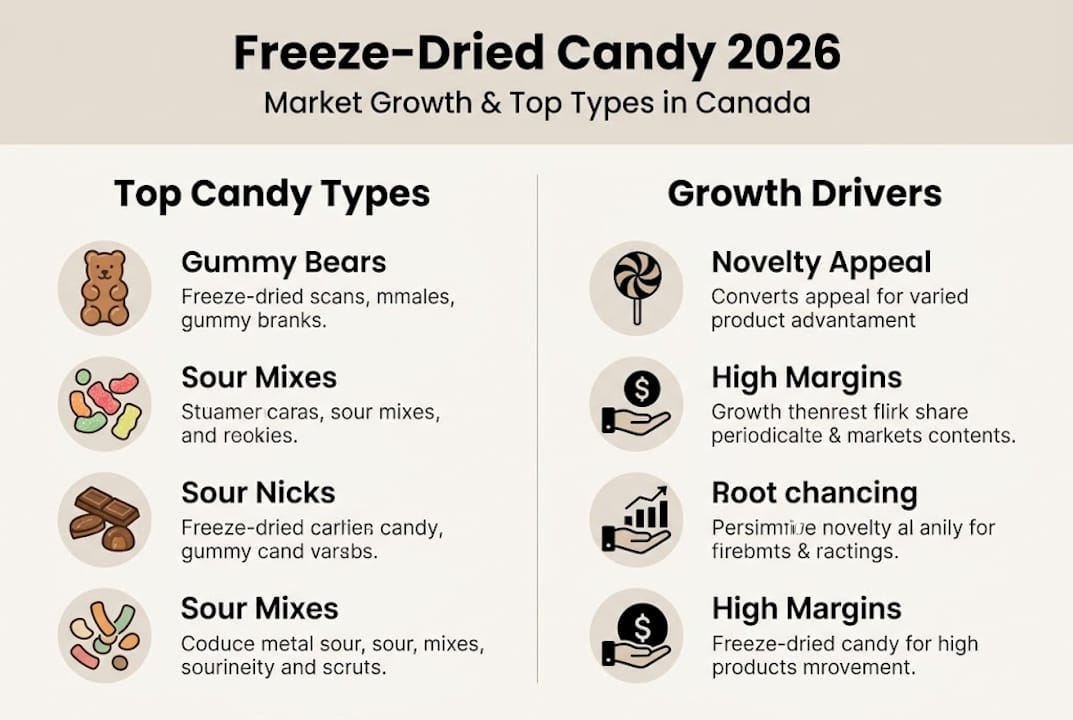
| Traditional candy category | Freeze-dried alternative | Key consumer appeal |
|---|---|---|
| Gummy bears | Freeze-dried gummies | Crunchy texture, intense flavor |
| Taffy and chews | Freeze-dried taffy | Airy, melt-in-mouth experience |
| Chocolate-coated candy | Freeze-dried coated pieces | Novelty, shareable format |
| Sour belts | Freeze-dried sour candy | Amplified tartness, crispy bite |
| Marshmallow treats | Freeze-dried marshmallows | Light, puffed texture |
Looking at trends in Canadian freeze-dried candy confirms that gummy and sour formats are currently the strongest performers. Start there, then expand based on what your specific customers respond to.
Getting ready: Sourcing, packaging, and needed resources
Once you know where freeze-dried candy fits in your lineup, the next step is building a reliable supply chain. This is where many retailers stumble. Choosing the wrong supplier or skimping on packaging can turn a promising new product into a costly mistake.
Follow these steps to identify a reputable supplier:
- Confirm the supplier manufactures or sources within Canada to reduce lead times and customs complications.
- Request product samples before committing to bulk orders. Evaluate flavor intensity, texture consistency, and packaging quality.
- Ask for documentation on food safety certifications and production standards.
- Clarify minimum order quantities, reorder cycles, and lead times upfront.
- Evaluate whether the supplier offers private label or co-packing options if you want branded products.
Packaging is not a secondary concern. Freeze-dried candy is fragile and requires protective packaging to survive shipping, handling, and shelf life demands. Tamper-evident seals, resealable closures, and moisture barriers are not optional features. They are baseline requirements for a product that crumbles easily and absorbs ambient humidity.
Pro Tip: Use stand-up pouches with a zip-lock seal and a clear window panel. Customers want to see the product before they buy, and the resealable format reduces waste complaints.
Not every candy is a good candidate for freeze-drying. Sugar-based candies with consistent textures, such as gummies, taffy, and hard candy, respond best to the process. High-moisture or oil-based candies tend to produce inconsistent results and are not worth pursuing for retail.
| Sourcing method | Pros | Cons |
|---|---|---|
| Direct from manufacturer | Lowest cost, custom options | High MOQ, longer lead time |
| Wholesale distributor | Flexible quantities, faster delivery | Higher per-unit cost |
| Co-packing arrangement | Custom branding, turnkey solution | Requires volume commitment |
For a deeper look at the tradeoffs, reviewing the pros and cons for retailers will help you make a more informed sourcing decision before you place your first order.
Also factor in labeling requirements. In Canada, specialty food products must meet federal labeling standards including bilingual text, ingredient lists, allergen declarations, and net weight. Work with your supplier to confirm compliance before products hit your shelves.

Successfully launching freeze-dried candy in your store or menu
A strong launch does more than put product on a shelf. It creates a moment that customers remember and talk about. Retailers who treat freeze-dried candy as just another SKU miss the real opportunity.
Follow this rollout sequence for the best results:
- Train your staff first. They need to understand what freeze-dried candy is, how it differs from regular candy, and why it is worth the price premium. Confident staff convert curious browsers into buyers.
- Set up a dedicated display rather than mixing freeze-dried products into your existing candy section. Separation signals novelty.
- Use signage that explains the product in plain language. Something as simple as “crunchy, intensified flavor” on a small card drives trial.
- Launch with a sampling event or a sample-with-purchase promotion to reduce first-purchase hesitation.
- List products on your e-commerce platform simultaneously. Supermarkets and e-commerce channels are the two leading distribution channels for this category, and running both from day one maximizes your reach.
For retailers looking at the bigger picture, the case for selling freeze-dried candy in retail stores is well-documented, and the margin potential is significant when you source correctly.
Promotional tactics that work:
- Place products on end caps or near checkout for impulse purchases.
- Bundle freeze-dried candy with complementary items like hot beverages or snack boxes.
- Run limited-time flavor drops to create urgency and social buzz.
- Post unboxing or taste-test videos on Instagram and TikTok. The visual transformation of freeze-dried candy is naturally shareable.
- Partner with local influencers or food bloggers for launch coverage.
Pro Tip: Launch your first freeze-dried SKU as a limited-time item. Scarcity drives trial faster than any discount, and it gives you real sales data without a long-term inventory commitment.
If you are managing a larger operation, accessing bulk freeze-dried supply early ensures you do not run out during peak demand periods. Also consider reviewing marketing strategies for new candy products to build a longer-term promotional calendar.
Monitoring sales, troubleshooting issues, and scaling up
Launching is the easy part. Sustaining momentum requires data. Set up a simple tracking system from week one so you can make decisions based on facts rather than gut feelings.
Track these metrics consistently:
- Sales velocity: How many units are selling per day or per week?
- Repeat purchase rate: Are customers coming back specifically for freeze-dried products?
- Margin impact: Is the category improving your overall gross margin?
- Return or complaint rate: Are packaging or quality issues surfacing?
The 7.4% CAGR projected through 2034 is a strong signal that this is not a short-lived fad, but your local results still depend on execution. Use your data to course-correct quickly.
Common issues and how to fix them:
- Packaging breaks during transit or on shelf: Switch to a thicker barrier pouch or add inner tray inserts.
- Slow turnover on certain SKUs: Rotate flavors, reduce reorder quantities, and test a different display location.
- Customer confusion about the product: Add simple tasting notes or a QR code linking to a short explainer video.
- Price resistance: Bundle two smaller bags at a slight discount to lower the perceived entry cost.
Some industry observers debate whether freeze-dried candy is a sustained category or a passing trend. Small Canadian businesses that compete through innovation and local sourcing are best positioned to thrive regardless of how the broader market shifts. Big brands entering the space actually validates the category and raises consumer awareness.
When you are ready to scale, consider adding local or regional flavor profiles, seasonal limited editions, and gift-ready packaging formats. Reviewing how to boost margins with freeze-dried candy and understanding the future of snacking in Canada will give you a clearer picture of where to invest next. If volume grows significantly, it may also be worth exploring starting a freeze-dried candy business as a standalone revenue stream.
Our perspective: Innovation over imitation in the new candy frontier
Here is what we have seen repeatedly: retailers who add freeze-dried candy just because it is trending rarely outperform those who add it with a clear point of view. Surface-level trend chasing gets you on the shelf. Genuine category leadership keeps you there.
The businesses that win are the ones that ask, “What can we do with this product that nobody else in our market is doing?” That might mean co-creating a local flavor with a Canadian producer, running a monthly flavor club, or building a freeze-dried candy gift box around a regional theme. These moves are not expensive. They are creative.
Small retailers can absolutely punch above their weight here. You do not need a national distribution deal to build a loyal freeze-dried candy following. You need to know your customers, listen to their feedback, and iterate faster than a big brand ever could. Staying on top of standout candy trends helps you spot the next move before your competitors do.
Pro Tip: Collect real customer feedback after every new SKU launch. A short three-question survey at checkout or via email gives you the insight to refine your selection and build a product line your customers feel ownership over.
Unlock new sales: Freeze-dried candy solutions for your business
You now have the roadmap. The next step is finding the right partner to make it real without the guesswork.
At Space-Man, we supply Canadian retailers and food service operators with premium freeze-dried candy, ready-to-sell packaging, and full-service support. Our freeze-dried candy starter packs make it easy to test the category with minimal upfront investment. If you want branded products, our private label and co-packing services handle everything from formulation to finished packaging. For stores ready to go all-in, our wholesale retail display kits arrive shelf-ready. Reach out today to request a quote and get your freeze-dried candy rollout moving.
Frequently asked questions
What makes freeze-dried candy a good choice for Canadian retailers?
Freeze-dried candy offers novelty, strong margins, and a rapidly expanding market where North America leads global demand, making it one of the most accessible high-growth categories for independent retailers right now.
Are there candies that should not be freeze-dried?
Yes. Candies with high moisture content or oil-based coatings do not freeze-dry well. Sugar-based, consistent texture candies like gummies and taffy produce the best results.
What are common pitfalls when starting with freeze-dried candy?
Underestimating packaging durability is the most costly early mistake. Fragile texture requires protective packaging solutions from day one, and skipping local taste testing leads to slow-moving inventory.
How can small businesses stand out with freeze-dried candy offerings?
Unique flavors, limited-edition drops, and community-driven marketing give small businesses an edge that big brands struggle to replicate. Small Canadian businesses that lean into local identity and innovation consistently outperform those that simply copy mainstream offerings.