

Finding ways to stand out in the crowded Canadian candy market can feel challenging, especially when shoppers crave both novelty and quality. Freeze dried candy offers a unique solution, transforming classic treats into ultra-light, intensely flavored bites that keep customers talking and sharing online. This modern twist—rooted in technology originally improved by NASA—creates products with crisp texture, long shelf life, and eye-catching appeal, giving your store a fresh edge over traditional offerings.
Table of Contents
- What Is Freeze Dried Candy Technology
- Why This Matters For Your Candy Business
- Popular Freeze Dried Candy Types And Features
- How Freeze Drying Works For Confections
- Legal And Packaging Rules For Canadian Candy Sales
- Critical Mistakes When Sourcing Freeze Dried Candy
Key Takeaways
| Point | Details |
|---|---|
| Freeze Drying Technology | Freeze drying preserves the candy’s flavor, texture, and nutritional value while eliminating moisture, offering a unique product for retailers. |
| Consumer Appeal | Freeze-dried candy features intense flavors and a desirable texture, attracting health-conscious customers and encouraging repeat purchases. |
| Market Opportunities | Retailers can cater to trends by offering freeze-dried products in various categories, such as gift boxes and dietary-specific options. |
| Regulatory Compliance | Adhering to Canadian labeling and safety regulations is essential for building consumer trust and avoiding legal issues. |
What Is Freeze Dried Candy Technology
Freeze drying sounds like science fiction, but it’s actually a straightforward process that turns ordinary candy into something extraordinary. At its core, freeze drying (also called lyophilization) removes almost all moisture from candy while keeping its shape, flavor, and nutritional value intact. The result? Ultra-light, crispy candy that stays fresh for months on your shelves.
The technology isn’t new—it’s been around since the 1890s. NASA even contributed to modern improvements, using freeze drying to create astronaut rations that needed to be lightweight and shelf-stable. Today, that same technology is creating a retail candy revolution, and it’s perfect timing for Canadian shop owners looking to stand out.
How the Process Works
Freeze drying happens in three main steps. First, the candy gets frozen solid at extremely low temperatures. Next, pressure drops dramatically, creating a vacuum environment. Finally, the ice turns directly into vapor through a process called sublimation—it skips the liquid stage entirely.
This low-temperature approach is the magic ingredient. Traditional drying methods use heat, which damages delicate flavors and textures. Freeze drying preserves everything you care about.
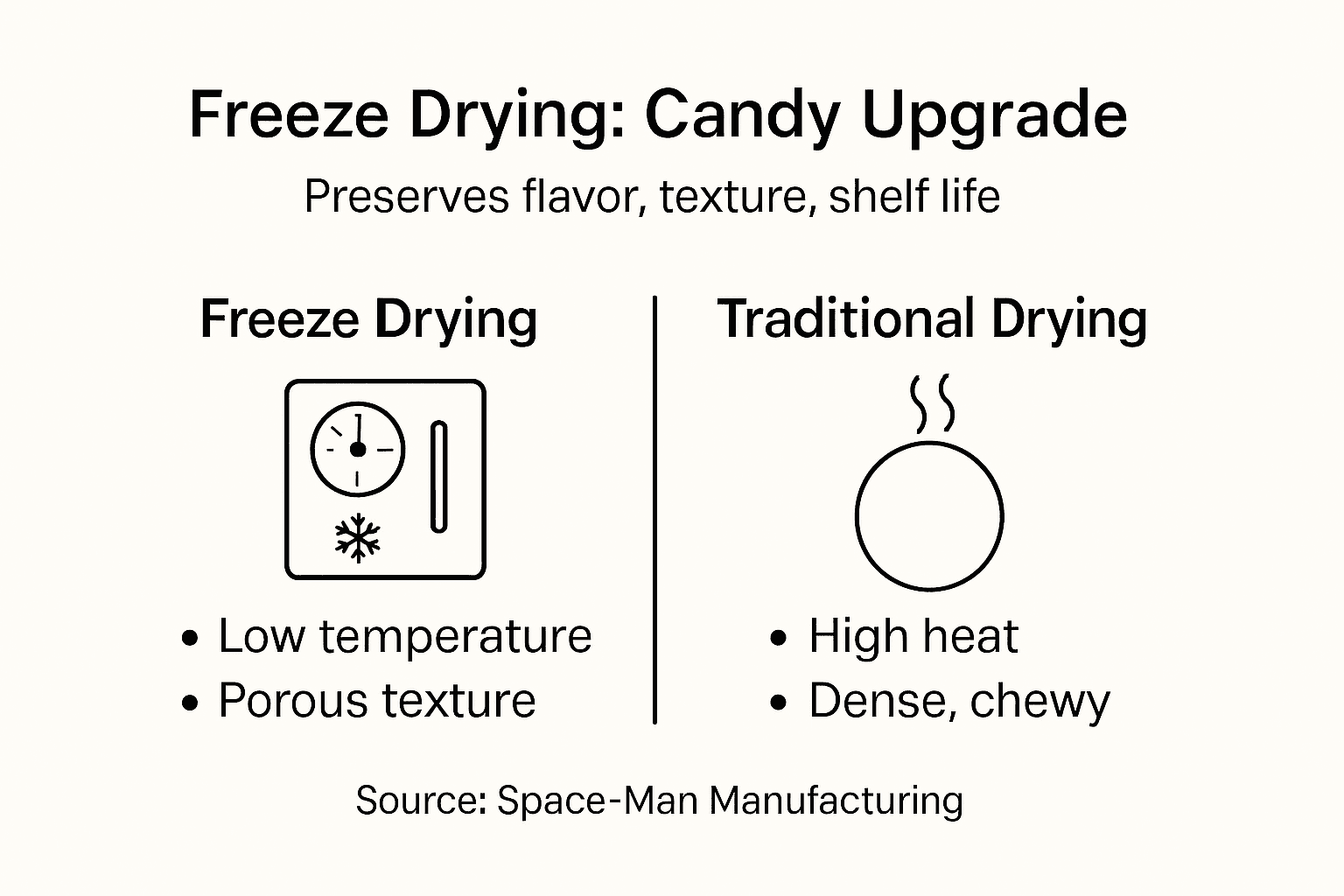
Here’s a helpful summary highlighting how freeze drying differs from traditional drying methods for candy:
| Aspect | Freeze Drying | Traditional Drying |
|---|---|---|
| Process Temperature | Very low | High heat |
| Texture Preservation | Maintains original | Often lost, chewy or hard |
| Flavor Intensity | Highly concentrated | Reduced, sometimes dull |
| Shelf Life | Months, sometimes years | Weeks to few months |
| Nutritional Value | Preserved (95%) | Partly lost |
| Weight Reduction | Up to 95% lighter | Minor change |
| Visual Appeal | Bright, crisp appearance | Darkened or shrunken |
| Need for Preservatives | None required | Sometimes required |
Why This Matters for Your Candy Business
You’re probably wondering: why should I care about how it’s made? Because your customers care about the end result. Here’s what freeze-dried candy delivers to your shoppers:
- Intense, concentrated flavors that taste fresher than the original fruit
- Ultra-crispy texture that keeps customers coming back
- Long shelf life without artificial preservatives
- Lightweight products perfect for gifting and shipping
- Instagram-worthy appearance that drives social media engagement
The texture is what really hooks people. When someone bites into freeze-dried strawberry, they experience a satisfying crunch that instantly dissolves. It’s addictive. And that addictive quality translates to repeat customers and word-of-mouth referrals.
Freeze-dried candy preserves 95% of original nutrients while removing 98% of moisture—that’s shelf stability without sacrificing quality.
Real-World Applications in Retail
Understanding how freeze-dried candy is made helps you explain the value to customers. When someone asks why your freeze-dried berries cost more than regular gummies, you have a solid answer: the technology preserves what matters while eliminating what doesn’t.
Canadian retailers are using freeze-dried candy for:
- Premium gift boxes and specialty assortments
- Trending TikTok-worthy candy displays
- Dietary-specific options (gluten-free, vegan-friendly)
- High-margin impulse purchases near checkout
The Canadian market specifically loves premium, artisanal products, and freeze-dried candy fits that profile perfectly. You’re offering something locally distributed while giving customers access to a trendy technology they’ve seen online.
Pro tip: Start with small test batches of freeze-dried berries or tropical fruits—these sell fastest because the flavor concentration is dramatic compared to fresh fruit.
Popular Freeze Dried Candy Types and Features
Freeze-dried candy isn’t a one-size-fits-all product. The category spans multiple candy types, each with unique appeal to different customer segments. Understanding what’s available helps you build a product mix that drives sales and keeps shoppers engaged.
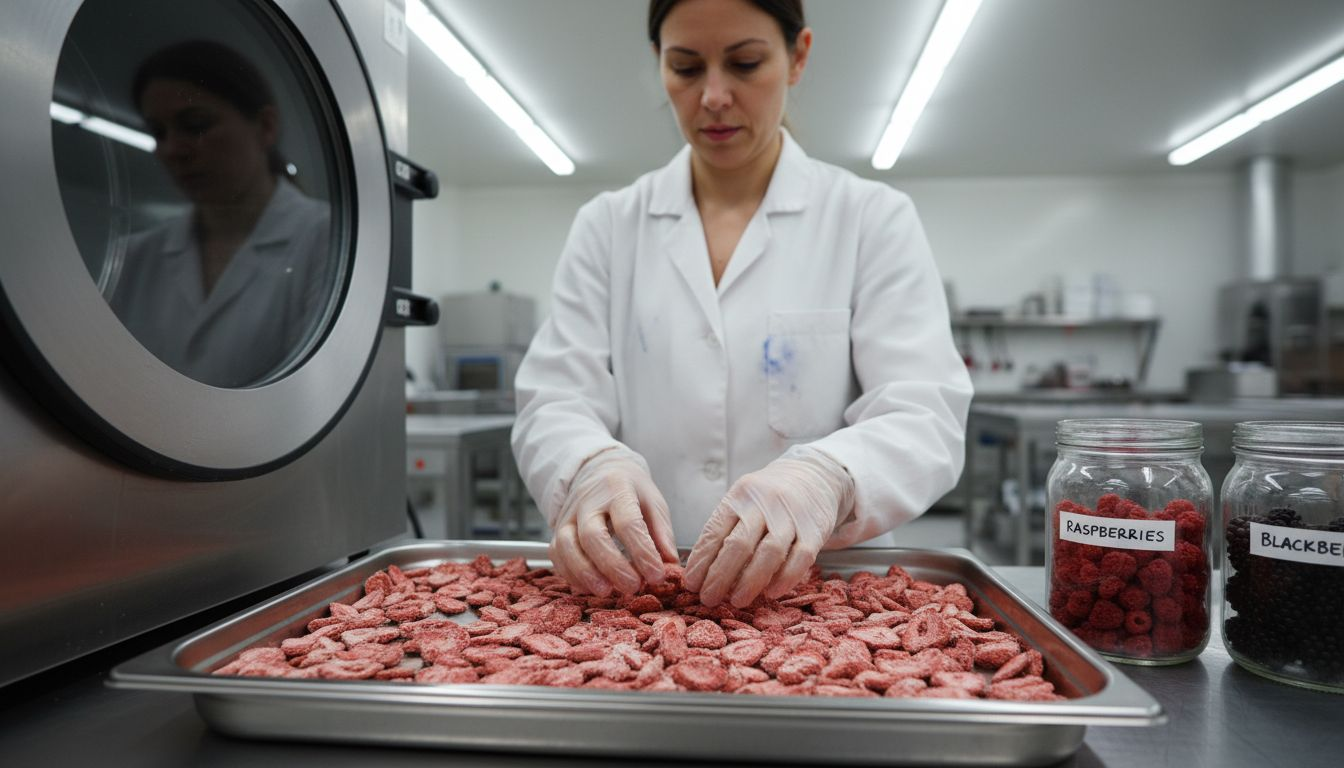
The most popular freeze-dried candies start with fruit. Strawberries, raspberries, and blackberries dominate because freeze drying intensifies their natural sweetness and creates an irresistible texture. But the market has expanded far beyond simple fruit pieces.
Top Freeze-Dried Candy Varieties
Your inventory should reflect customer demand. Here’s what’s moving in Canadian retail:
- Freeze-dried fruit pieces (strawberries, raspberries, blueberries, tropical fruits)
- Fruit powders and dust (perfect for baking, smoothies, and specialty drinks)
- Freeze-dried gummies (light, crispy versions of traditional gummies)
- Mixed berry assortments (premium gift-box appeal)
- Specialty items (freeze-dried marshmallows, candy clusters, chocolate combinations)
Fruit powders deserve special attention. They’re incredibly versatile—customers use them in baking, coffee, yogurt, and desserts. One product serves multiple purposes, which drives higher perceived value.
Key Features Your Customers Want
When someone picks up freeze-dried candy, they’re drawn to specific qualities. Understanding these features helps you market effectively and set fair pricing.
Freeze-dried candies deliver unique texture and flavor preservation that regular candy can’t match. The crispy, porous structure creates immediate sensory appeal. The taste? Intensely concentrated—one bite delivers pure flavor without artificial additives.
Shelf stability is another major selling point. These products last months without refrigeration or added preservatives. For Canadian retailers managing inventory, that’s huge. You can stock confidently without worrying about spoilage.
Freeze-dried candies are lightweight—sometimes 95% lighter than their fresh equivalents—yet maintain full nutritional value and intense flavor.
Weight reduction opens new market opportunities. Customers love freeze-dried candy for travel, camping, and emergency rations. Parents appreciate the lightweight snack-pack convenience.
Why These Features Matter for Your Margin
Features directly impact pricing power. Natural ingredients, long shelf life, and Instagram-worthy appearance justify premium pricing. Your customers aren’t comparing freeze-dried berries to regular gummies—they’re investing in a completely different product category.
The expanding demand for natural and organic products works in your favor. Many freeze-dried options contain zero additives. That authenticity resonates with health-conscious shoppers willing to pay more.
Consider creating themed assortments around these features:
- “Natural Snacking” bundles (no additives, pure fruit)
- “Travel-Friendly” packs (lightweight, shelf-stable)
- “Baking Essentials” (fruit powders for home cooks)
Pro tip: Stock freeze-dried berries in both bulk bins and premium gift containers—the same product at different price points captures impulse buyers and gift-givers.
How Freeze Drying Works for Confections
Freeze drying for confections might sound complicated, but it’s actually a controlled, three-step process that’s become the gold standard for preserving delicate candies. Understanding the mechanics helps you appreciate why the product quality justifies premium pricing and why consistency matters for your retail operation.
The magic happens through careful control of temperature and pressure. Unlike traditional drying that uses heat, freeze drying removes moisture while keeping the candy’s structure, flavor, and nutrition completely intact. That’s why a freeze-dried strawberry tastes so intensely like strawberry.
The Three Phases of Freeze Drying
The process breaks into distinct stages, each critical to the final product:
- Freezing - The candy gets frozen solid at extremely low temperatures, creating small ice crystals that preserve texture and quality.
- Primary Drying - A high vacuum removes about 95% of moisture through sublimation, where ice converts directly to vapor without passing through liquid form.
- Secondary Drying - Gentle heat removes remaining bound water, creating exceptional shelf stability that lasts months or even years.
Each phase requires precision. Temperature and pressure must be carefully controlled to avoid damaging the delicate candy structure. Too much heat, and you ruin the product. Too little, and moisture remains.
Why Rapid Freezing Matters
The first step seems simple but it’s actually critical. Rapid freezing creates small ice crystals rather than large ones. Small crystals preserve the candy’s original texture and appearance. Large crystals would create damage and structural problems.
That’s why commercial freeze-drying equipment uses specialized freezing chambers. The faster the freeze, the better the result. This is one reason why freeze-dried candy costs more than alternatives—the equipment investment and precision required command higher production costs.
The Sublimation Magic
Here’s where things get interesting. During primary drying, ice doesn’t melt into water. Instead, it converts directly into vapor through sublimation. This process happens under high vacuum, which lowers the pressure enough to make ice skip the liquid phase entirely.
This sublimation step is why freeze-dried candies maintain their shape and texture so perfectly. Traditional heat-drying would soften, shrink, or discolor the candy. Sublimation leaves everything exactly as it was—just without the water.
The entire freeze-drying process removes up to 98% of moisture while preserving nutritional value and flavor intensity that fresh candy simply cannot match.
What This Means for Your Business
The technical precision translates to retail advantages. Your inventory stays fresh longer. Customers get superior taste and texture. You justify premium pricing because you’re offering something genuinely different.
The process also enables rehydration. If customers add freeze-dried berries to water, they reconstitute into a beverage. Add them to baking, and they plump up. This versatility drives repeat purchases across different customer types.
Pro tip: Emphasize the “no preservatives needed” angle when training staff—the freeze-drying process itself extends shelf life, so you’re selling a naturally preserved product that appeals to health-conscious shoppers.
Legal and Packaging Rules for Canadian Candy Sales
Canadian candy retailers operate under strict regulations that exist for good reason—they protect consumers and your business. Getting compliance right prevents costly recalls, fines, and reputation damage. For freeze-dried candy specifically, understanding these rules is non-negotiable.
Canada’s regulatory framework covers everything from ingredient safety to label design. The Canadian Food Inspection Agency enforces standards that apply to every candy product you stock, whether you manufacture locally or import from elsewhere. Compliance isn’t optional; it’s the foundation of legitimate retail operations.
Labeling Requirements You Cannot Ignore
Packaging labels must follow strict Canadian standards. Here’s what you absolutely need:
- Bilingual labeling (English and French on all packaging)
- Clear net quantity declaration using metric units (grams, milliliters)
- Truthful ingredient lists in order of weight
- Allergen warnings for any potential allergens present
- Manufacturer or distributor information with contact details
- Best-before dates clearly marked
The Consumer Packaging and Labelling Regulations specify exactly how this information must appear. Your label cannot be misleading—no exaggerated health claims, no false nutritional information. If you claim “natural,” every ingredient must be natural. That’s non-negotiable.
Bilingual labeling trips up many retailers. If your freeze-dried berries say “100% strawberry” in English, the French side must convey identical meaning. Translation matters here—accuracy prevents regulatory issues.
Food Safety and Ingredient Compliance
Canada’s Food and Drugs Act establishes baseline safety standards for all candy products. This covers ingredient safety, manufacturing processes, and facility standards. The Canadian Food Inspection Agency enforces these rules.
For freeze-dried candy specifically, you need to verify:
- All ingredients are approved for food use in Canada
- No banned or restricted substances are present
- Manufacturing facilities meet sanitation standards
- Products are free from contamination
When sourcing freeze-dried candy—whether from your own facility or distributors—request documentation proving compliance. Get certificates of analysis. Verify supplier credentials. This protects you from liability if a product causes harm.
Allergen Declarations
Allergens require clear, prominent labeling. If your freeze-dried product contains or was processed alongside nuts, soy, dairy, or other common allergens, customers must know. Place allergen warnings on the front and back of packaging.
Canadian regulations also require “may contain” warnings if cross-contamination is possible during manufacturing. A freeze-dried berry product processed on equipment that handles tree nuts should be labeled accordingly.
Non-compliant labeling or food safety violations can trigger product recalls, government fines, and legal liability—so verify every detail before products reach your shelves.
Packaging Material Standards
Packaging materials themselves must meet food-contact standards. Safe food packaging for Canadian retailers requires materials that won’t leach harmful chemicals into candy. Use packaging suppliers who can verify compliance with Canadian Food and Drugs Act standards.
This matters for resealable pouches, gift boxes, and bulk containers. Substandard materials create liability. Quality suppliers provide documentation proving their materials are approved for food contact.
Practical Compliance Steps
Protect your business by implementing a simple system:
- Request compliance documentation from all suppliers
- Audit labels for bilingual accuracy and ingredient truthfulness
- Verify allergen declarations match actual ingredients
- Keep organized records for Canadian Food Inspection Agency inspections
- Train staff on regulatory requirements
Pro tip: Partner with a supplier who handles compliance documentation—it’s worth the partnership to have someone tracking regulatory changes and verifying your products meet current Canadian standards.
Critical Mistakes When Sourcing Freeze Dried Candy
Sourcing freeze-dried candy sounds straightforward until something goes wrong. A bad supplier decision, a single oversight in quality control, or inadequate vetting can result in products that spoil, disappoint customers, or create legal liability. Understanding common mistakes helps you avoid expensive disasters.
The difference between a successful freeze-dried candy program and a failed one often comes down to supplier diligence and understanding what makes quality products tick. Canadian retailers often rush sourcing decisions without asking the right questions. That’s where problems start.
Production Quality Mistakes
Quality issues typically originate in manufacturing. If a supplier cuts corners during freeze drying, you’ll inherit the problems.
The most critical production mistakes include:
- Inadequate freezing - Large ice crystals form when freezing is slow, destroying texture and creating mushy, inferior candy
- Inconsistent vacuum pressure - Fluctuating pressure during primary drying leads to incomplete dehydration and moisture retention
- Poor temperature control - Too much heat damages flavor; too little leaves residual moisture
- Skipped secondary drying - Incomplete removal of bound water reduces shelf life dramatically
These aren’t minor issues. A product with poor moisture control and texture problems will disappoint customers and potentially spoil during storage. When vetting suppliers, ask about their freezing equipment, vacuum systems, and drying protocols. Reputable suppliers welcome technical questions.
For quick reference, here’s a comparison of mistakes retailers should avoid when sourcing freeze-dried candy:
| Mistake Type | Impact on Candy | Business Consequence |
|---|---|---|
| Poor Freezing | Mushy, inconsistent | Customer disappointment, returns |
| Weak Vacuum Control | Moisture remains | Spoilage, reduced shelf life |
| Packaging Failures | Absorbs moisture | Mold, product waste |
| Regulatory Oversight | Non-compliant labels | Fines, legal action |
| Food Safety Negligence | Risk of contamination | Recalls, loss of reputation |
| Preparation Errors | Uneven texture | Lower perceived product quality |
Packaging and Storage Failures
Even perfectly manufactured freeze-dried candy fails if packaging allows moisture re-entry. This is where many retailers get blindsided.
Hermetic sealing is non-negotiable. Your packaging must protect against moisture and air infiltration. Substandard pouches, containers with weak seals, or materials that aren’t food-grade allow humidity to penetrate. Result? Your shelf-stable product becomes sticky, moldy, or stale within weeks.
Always verify packaging specifications with suppliers. Ask about moisture barrier ratings. Request samples stored under various humidity conditions. Test them yourself—don’t assume.
Regulatory and Labeling Oversights
Not verifying supplier compliance with Canadian regulations creates serious liability. This includes:
- Missing or incorrect bilingual labeling
- Incomplete allergen declarations
- False or exaggerated health claims
- Inadequate ingredient transparency
- Non-compliant packaging materials
These aren’t just bureaucratic headaches. Regulatory violations trigger recalls, fines, and customer lawsuits. Request compliance documentation from every supplier before accepting products.
Food Safety Negligence
Microbial contamination is a silent killer. Freeze drying removes moisture but doesn’t sterilize. If manufacturing facilities lack proper sanitation controls, contamination happens.
Demand certificates of analysis and food safety testing from suppliers. Verify manufacturing facility certifications. Ask about Hazard Analysis and Critical Control Points (HACCP) protocols.
A single contamination incident costs thousands in recalls, destroys your reputation, and creates legal liability that far exceeds any savings from cutting corners on supplier vetting.
Pre-Treatment and Preparation Errors
Before freeze drying, fruit needs proper preparation. Improper size reduction, skipped blanching, or inadequate pretreatment affects final product quality.
These upstream mistakes create downstream problems—uneven drying, texture issues, shortened shelf life. Ask suppliers about their preparation protocols. Quality manufacturers document these steps.
Red Flags to Watch
When sourcing freeze-dried candy, run if you see:
- Suppliers who avoid technical questions about their process
- No documentation of food safety testing or compliance
- Prices that seem too good to be true
- Vague packaging specifications
- Unwillingness to provide samples or references
Pro tip: Start with small pilot orders from any new supplier—test shelf stability yourself, monitor customer feedback, and verify compliance documentation before committing to large volumes.
Elevate Your Candy Business with Premium Freeze Dried Treats
If you want to stand out in today’s competitive candy market you need products that deliver intense flavor, irresistible texture, and long shelf life. Freeze dried candy offers all of these benefits while matching the growing demand for natural, preservative-free snacks that excite your customers on every level. Whether you are launching a new product line or enhancing your existing selection explore the exceptional range of Freeze Dried Candy & Treats – Spaceman designed to captivate and convert.
Don’t let sourcing and packaging challenges limit your growth. At Space-Man we specialize in manufacturing and distributing top-quality Canadian freeze dried candy with private labeling, co-packing, and packaging services tailored to your needs. Discover wholesale opportunities in our Wholesale Freeze Dried Candy & Treats – Spaceman collection and delight your customers with perfectly curated options like The Perfect Gift : Freeze Dried Candy Bundles! – Spaceman. Take the next step now to transform your retail offering with products that speak quality, innovation, and taste. Visit us today to learn more.
Frequently Asked Questions
What is freeze-dried candy?
Freeze-dried candy is a type of confectionery that undergoes a process called freeze drying, which removes moisture while preserving the candy’s texture, flavor, and nutritional value. The result is an ultra-light, crispy candy with a long shelf life.
How does freeze drying affect the flavor and texture of candy?
Freeze drying enhances the flavor and texture of candy by concentrating its taste and creating a crispy, porous structure. This results in a richer, more intense flavor compared to traditional candies, which may lose their qualities during heat drying.
What types of candies can be freeze-dried?
Popular candied varieties that can be freeze-dried include various fruit pieces like strawberries and blueberries, freeze-dried gummies, fruit powders, and specialty items such as marshmallows and chocolate combinations. Each type retains a unique appeal.
What are the shelf life and nutritional benefits of freeze-dried candy?
Freeze-dried candy can last for months or even years without refrigeration, all while preserving approximately 95% of its original nutrients. This makes it an ideal snack option that remains fresh and nutritious over time.