

The freeze dried snack market in North America reached $1.5 billion in 2023 and continues accelerating at 7.5% annually, driven by health conscious consumers and viral social media trends. Canadian retailers are discovering that these crispy, lightweight snacks offer premium margins and unique merchandising opportunities that traditional snacks cannot match. This article explores the market dynamics, retail advantages, operational challenges, and technological innovations shaping freeze dried snacks as a strategic category for Canadian snack businesses in 2026.
Table of Contents
- Key takeaways
- Understanding the freeze dried snack market in Canada
- Retail benefits of stocking freeze dried snacks
- Challenges and considerations for freeze dried snack retailers
- Innovations improving freeze drying efficiency and product appeal
- Explore private label and co-packing services for freeze-dried snacks
- Frequently asked questions
Key Takeaways
| Point | Details |
|---|---|
| Market growth trajectory | The North American freeze dried snack market reached 1.5 billion in 2023 and is on pace to reach about 3.5 billion by 2033, with annual growth near 7.5 percent. |
| Premium margins for retailers | Retailers enjoy premium pricing that yields margins well above traditional snacks, with prices typically 30 to 50 percent higher and gross margins 15 to 25 percentage points higher. |
| Consumer trends driving demand | Health conscious shoppers seek clean label products with minimal processing and no artificial additives while Gen Z favors novelty and social media shareable freeze dried formats. |
| Innovations boosting quality and efficiency | Advances in processing and packaging are improving freeze drying efficiency and preserving nutrition and visual appeal, supporting higher product quality and operational performance. |
Understanding the freeze dried snack market in Canada
The North American freeze dried snack market demonstrates remarkable momentum, with valuations climbing from $1.5 billion in 2023 toward a projected $3.5 billion by 2033. Canada participates actively in this expansion, fueled by consumer demand for clean label products and convenient nutrition options. The global freeze dried candy segment alone is expected to reach $2.38 billion by 2030 at an 8.3% compound annual growth rate, highlighting the category’s cross border appeal.
Several consumer trends converge to accelerate freeze dried snack adoption across Canadian retail channels. Health conscious shoppers prioritize products with minimal processing and no artificial additives, attributes that freeze drying naturally delivers. Social media platforms, particularly TikTok, amplify product discovery as visually striking freeze dried candies and fruits generate viral content that translates directly into purchase intent. Gen Z consumers lead this demographic shift, valuing novelty, authenticity, and Instagram worthy packaging that freeze dried formats provide effortlessly.
| Market Segment | 2023 Value | 2030/2033 Projection | CAGR |
|---|---|---|---|
| North America freeze dried snacks | $1.5B | $3.5B (2033) | 7.5% |
| Global freeze dried candy | Data not available | $2.38B (2030) | 8.3% |
Freeze dried snacks command premium positioning compared to conventional chip and candy categories. Retailers typically price these products 30 to 50% higher than traditional equivalents, reflecting both production costs and perceived value among target consumers. This pricing structure creates attractive margin opportunities for stores willing to educate customers about texture, flavor intensity, and nutritional retention benefits. The freeze dried candy future in Canada looks particularly promising as distribution networks mature and consumer familiarity grows.
Key demographic drivers shaping freeze dried snack demand include:
- Gen Z shoppers seeking novel textures and social media shareable products
- Health focused millennials prioritizing clean ingredient lists and portability
- Outdoor enthusiasts valuing lightweight, shelf stable nutrition for activities
- Parents looking for mess free, nutrient dense options for children
The nutritional value of freeze dried food remains largely intact through processing, preserving vitamins and minerals while removing only water content. This scientific advantage supports marketing claims that resonate with wellness oriented consumers, differentiating freeze dried options from heavily processed competitors in adjacent snack aisles.

Retail benefits of stocking freeze dried snacks
Freeze dried snacks deliver higher profit margins through premium pricing structures that consumers willingly accept for perceived quality and uniqueness. Retailers report gross margins 15 to 25 percentage points above conventional snack categories, compensating for slower inventory turns with superior per unit profitability. This economic model works particularly well for independent retailers and specialty shops that emphasize curated product selection over volume driven strategies.
The visual drama of freeze dried products creates natural merchandising advantages that traditional snacks struggle to match. Vibrant colors intensify during processing, producing eye catching displays that stop shoppers mid aisle. Transparent packaging showcases the product’s distinctive appearance, eliminating guesswork and building purchase confidence. These aesthetic qualities translate seamlessly to social media content, where customers become brand ambassadors by sharing photos and videos that drive organic reach without paid advertising investment.
Smaller production runs and flexible formulation make freeze dried snacks ideal candidates for private label development. Retailers can partner with co-packers to create exclusive flavors or regional specialties that differentiate their offerings from national brands. This approach builds customer loyalty while capturing the full retail margin typically shared with branded manufacturers. The benefits for retailers and shops extend beyond margins to include strategic positioning as innovation leaders within local markets.
Social media platforms, especially TikTok, function as powerful demand generators for freeze dried candy and snacks. Viral videos showcasing texture transformations and flavor intensification reach millions of viewers, creating immediate purchase intent that drives foot traffic to stores carrying featured products. Retailers who actively engage with these trends through in store sampling and social content amplification capture disproportionate sales gains. The freeze dried candy new snack category represents a genuine merchandising opportunity rather than a passing fad.
Core retail advantages include:
- Premium pricing justified by novelty and quality perception
- Extended shelf life reducing waste and markdown pressure
- Lightweight products lowering shipping costs per unit
- Impulse purchase appeal driven by visual presentation
- Cross merchandising flexibility with multiple departments
Pro Tip: Position freeze dried snacks near checkout counters or endcaps where visual appeal triggers impulse purchases, and train staff to offer samples that demonstrate the unique texture and flavor intensity customers cannot evaluate from packaging alone.
Challenges and considerations for freeze dried snack retailers
Freeze drying equipment requires substantial capital investment, with commercial scale machines costing $50,000 to $500,000 depending on capacity and automation features. The process consumes significant energy over 24 to 48 hour cycles, creating high production costs that manufacturers pass through to wholesale pricing. These economic realities limit mass market penetration and concentrate production among specialized facilities rather than mainstream food manufacturers who prioritize volume efficiency.
Scalability challenges emerge as demand grows beyond artisanal production levels. Batch processing inherent to freeze drying technology creates throughput constraints that continuous flow systems used for chips or extruded snacks do not face. Manufacturers must add equipment capacity in discrete increments rather than gradually adjusting line speeds, complicating expansion planning and working capital management. Retailers should evaluate supplier production capacity before committing to promotional programs that could outstrip available inventory.
Food safety considerations require particular attention for freeze dried products containing raw dairy, eggs, or meat ingredients. Freeze drying preserves but does not kill pathogens like Salmonella or Listeria, necessitating validated cooking protocols before or after processing. Retailers must verify that suppliers follow proper safety procedures and maintain appropriate certifications for products in this category. The rise of home freeze drying equipment has introduced amateur producers to markets, creating quality and safety variability that professional retailers should avoid through careful vendor selection.
Packaging fragility presents logistical complications throughout the distribution chain. Freeze dried products shatter easily under pressure, requiring protective packaging that adds cost and bulk relative to product weight. Retailers experience higher damage rates during shipping and shelf stocking compared to conventional snacks, impacting shrink percentages and customer satisfaction. Strategic retail pricing strategies 2026 must account for these handling realities when calculating true landed costs.
Key operational challenges include:
- Equipment investment barriers limiting supplier base
- Energy costs embedded in wholesale pricing
- Batch processing constraints affecting supply consistency
- Specialized packaging requirements increasing per unit costs
- Temperature and humidity sensitivity during storage
Pro Tip: Establish minimum order quantities and lead times with suppliers that reflect batch production realities, and communicate these constraints to your purchasing team to avoid stockouts during promotional periods when demand spikes unexpectedly.
Consumer price sensitivity remains an open question as freeze dried snacks transition from novelty to mainstream acceptance. Premium positioning works well for early adopters and specialty retailers, but broader market penetration may require price compression that current production economics cannot support. Retailers should monitor freeze dried candy distribution tips and competitive pricing trends to adjust category strategies as market dynamics evolve.
Innovations improving freeze drying efficiency and product appeal
Hybrid drying technologies combine microwave and radiofrequency assistance with conventional freeze drying to reduce cycle times by 30 to 50% while cutting energy consumption proportionally. These systems apply targeted electromagnetic energy to accelerate sublimation without compromising the structural integrity and nutritional retention that define freeze dried quality. Commercial adoption of hybrid methods remains limited in 2026 but pilot installations demonstrate technical feasibility and economic benefits that should drive broader implementation over the next decade.
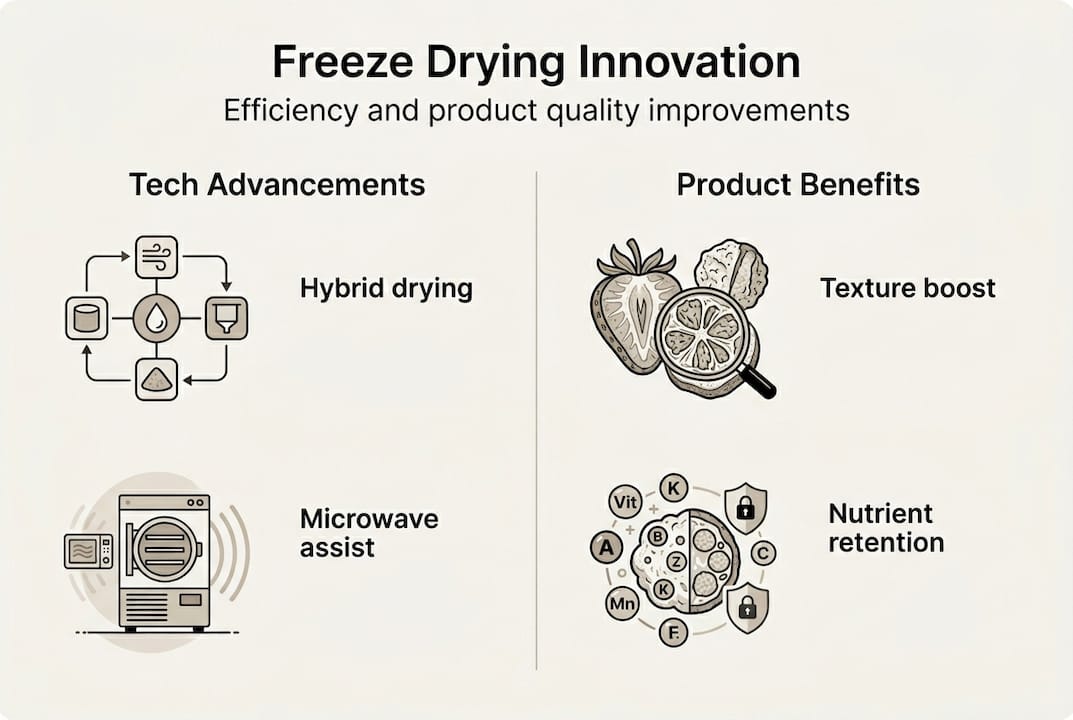
Pretreatment methods enhance both processing efficiency and final product characteristics. Blanching, osmotic dehydration, and enzyme treatments applied before freeze drying improve drying rates and modify texture profiles to meet specific consumer preferences. These techniques also stabilize color and prevent enzymatic browning, extending shelf appeal and reducing quality degradation during distribution. Manufacturers investing in pretreatment optimization gain competitive advantages through superior product consistency and lower processing costs.
| Drying Method | Processing Time | Energy Use | Texture Quality | Nutrient Retention |
|---|---|---|---|---|
| Conventional freeze drying | 24 to 48 hours | High | Excellent | 95 to 98% |
| Hybrid freeze drying | 12 to 30 hours | Medium | Excellent | 95 to 98% |
| Spray drying | Minutes to hours | Low | Poor to fair | 80 to 90% |
| Microwave drying | 30 to 90 minutes | Medium | Fair to good | 85 to 92% |
Spray drying and microwave drying offer faster, cheaper alternatives but sacrifice the texture and appearance that differentiate freeze dried products in retail environments. Spray drying produces powders suitable for beverage mixes and ingredients rather than stand alone snacks. Microwave drying creates uneven results with less appealing visual characteristics. These trade offs explain why freeze drying maintains dominance for premium snack applications despite higher costs, and why innovations focus on improving freeze drying efficiency rather than replacing the technology entirely.
The advantages of freeze dryers for snack businesses extend beyond product quality to include operational flexibility. Freeze drying accommodates diverse input materials from fruits and vegetables to complete meals, enabling manufacturers to pivot production based on seasonal availability and market trends. This versatility supports private label development and limited edition releases that keep product assortments fresh and generate repeat customer visits.
Future outlook for freeze drying technology points toward continued incremental improvements rather than revolutionary breakthroughs. Incremental cycle time reductions, energy efficiency gains, and equipment cost declines will gradually expand the economic envelope for freeze dried snacks, supporting volume growth and mainstream distribution. Retailers who establish category expertise and supplier relationships now position themselves to capitalize on these trends as production costs decline and consumer familiarity grows.
Explore private label and co-packing services for freeze-dried snacks
Canadian retailers ready to capitalize on freeze dried snack trends can accelerate market entry through specialized private label co packing packaging services designed specifically for this category. These partnerships provide turnkey solutions from formulation development through final packaging, eliminating the capital investment and technical expertise barriers that prevent many retailers from participating in this high margin segment.
Explore starter options like the freeze dried candy starter pack featuring 40 bags across multiple flavors, perfect for testing consumer response without overcommitting inventory dollars. Retailers seeking immediate merchandising impact can leverage ready to deploy solutions such as the freeze dried candy retail display rack containing 72 bags in an attractive fixture that drives impulse purchases through strategic placement and visual appeal.
Frequently asked questions
What are freeze dried snacks?
Freeze dried snacks are foods preserved through a process that freezes products then removes moisture under vacuum conditions, leaving a crispy, lightweight structure that retains original flavor and nutrients. The technique maintains cellular structure better than conventional drying methods, creating distinctive texture that consumers find appealing. Shelf life extends to months or years without refrigeration when properly packaged.
Why are freeze dried snacks popular among Gen Z consumers?
Visual novelty and texture transformation make freeze dried snacks highly shareable on platforms like TikTok, where viral videos drive immediate purchase intent among younger demographics. Gen Z values authenticity and unique experiences over traditional brand loyalty, characteristics that freeze dried products deliver naturally. Clean ingredient lists and perceived health benefits align with wellness priorities prevalent in this age group.
What should retailers consider about the safety of freeze dried snacks?
Freeze drying preserves existing microbial populations rather than eliminating them, meaning raw dairy or meat products require cooking before or after processing to ensure pathogen destruction. Retailers should source exclusively from suppliers who follow validated food safety protocols and maintain appropriate certifications for their product categories. Home produced freeze dried items present particular risks due to inconsistent process controls and should be avoided in commercial retail settings.
How do freeze dried snacks compare to traditional snacks in terms of nutrition?
Freeze drying removes only water content while preserving 95 to 98% of vitamins, minerals, and other nutrients present in fresh ingredients, significantly outperforming conventional drying or cooking methods. The process does not add oils, sugars, or artificial ingredients unless present in the original formulation, supporting clean label positioning. Caloric density increases on a per weight basis due to moisture removal, so portion awareness matters for calorie conscious consumers.