

Freeze-dried candy transforms ordinary sweets into crunchy, flavor-packed sensations that command premium prices and captivate consumers. This innovative preservation method removes ~95% of moisture through sublimation, creating an expanded texture and intensified taste that traditional drying simply cannot match. The North American market for freeze-dried candy is expanding at nearly 9% annually, with Canadian brands leading innovation in this fast-growing segment. This guide explores how freeze-drying technology works, market opportunities for retailers, practical challenges to navigate, and strategic advantages for your snack business.
Table of Contents
- Key takeaways
- Understanding freeze-drying technology
- Market trends and growth potential for freeze-dried products
- Challenges and considerations for retail businesses
- Advantages for Canadian retail and online sales
- Support your freeze-dried product success with Space-Man
- Frequently asked questions
Key Takeaways
| Point | Details |
|---|---|
| North America leads market | North America leads the freeze dried candy market with strong Canadian innovation driving growth. |
| Flavor and crunch preserved | The freeze drying process concentrates flavor and creates an expanded crunchy texture. |
| Time and vacuum required | The process requires freezing to very low temperatures and lengthy vacuum drying. |
| Waste reduction and online fit | Freeze dried candy reduces waste and improves shipping efficiency for online retailers. |
Understanding freeze-drying technology
Freeze-drying, also known as lyophilization, transforms candy through a sophisticated three-stage process that preserves quality while creating distinctive characteristics. The process begins by freezing candy to temperatures between -18°C and -50°C, solidifying water content into ice crystals throughout the product structure.
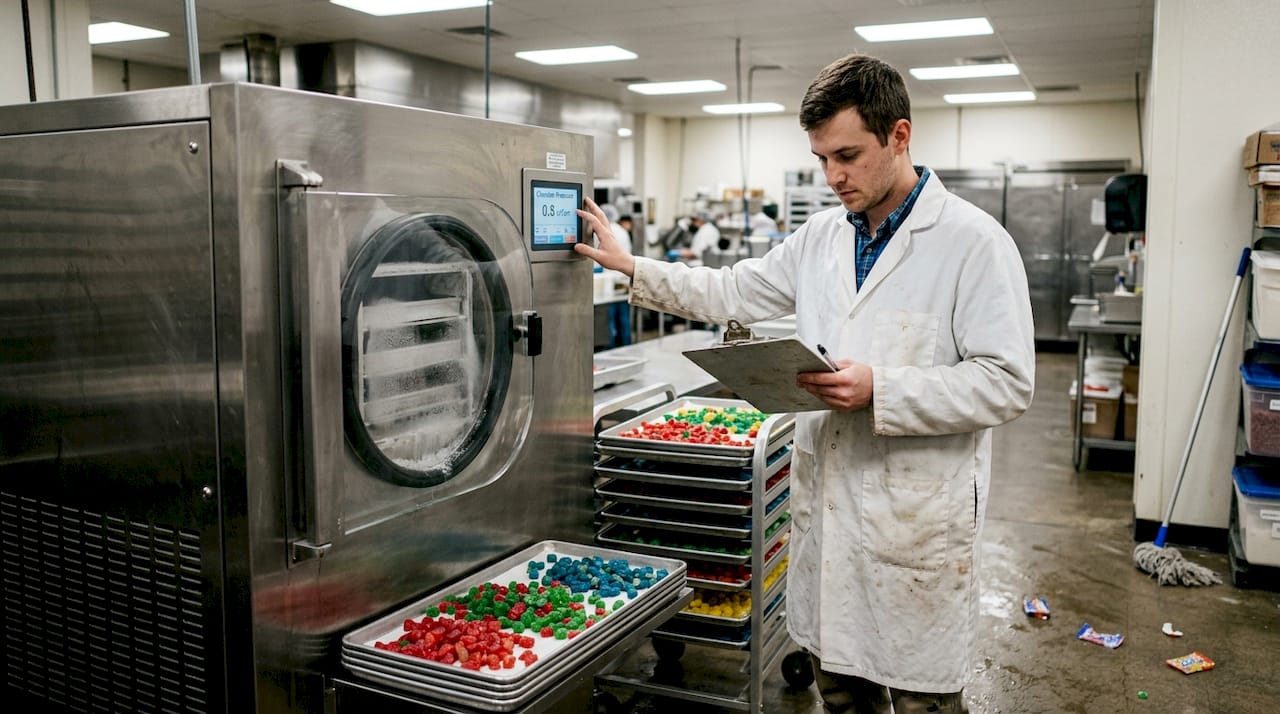
During primary drying, manufacturers place frozen candy into a vacuum chamber where pressure drops dramatically. This vacuum environment allows ice to sublimate, transitioning directly from solid to vapor without passing through a liquid phase. The sublimation process removes approximately 95% of the product’s moisture content while maintaining the candy’s original cellular structure. This preservation of structure explains why freeze-dried candy develops its signature expanded, airy texture rather than shrinking like conventionally dried products.
Secondary drying follows, targeting residual moisture molecules bound within the candy’s matrix. Technicians gradually raise chamber temperature while maintaining vacuum conditions, drawing out the final 3-5% of moisture. This step ensures long-term stability and prevents degradation during storage. The entire cycle typically requires 20 to 40 hours depending on candy composition, thickness, and desired final moisture content.
The resulting product exhibits remarkable characteristics: intense flavor concentration, satisfying crunch, and shelf stability lasting months or years without refrigeration. Understanding how lyophilizers work helps retailers appreciate why these products command premium positioning in snack aisles.
Pro Tip: Temperature control during initial freezing critically impacts final texture. Rapid freezing creates smaller ice crystals, producing finer texture and better structural integrity in the finished product.
Market trends and growth potential for freeze-dried products
The freeze-dried candy market reached $1.5-2.3 billion globally in 2024 and analysts project growth to $3.2-4 billion by 2033, representing compound annual growth of approximately 8.8%. This expansion reflects shifting consumer preferences toward premium snacks with novel textures and authentic flavor profiles.
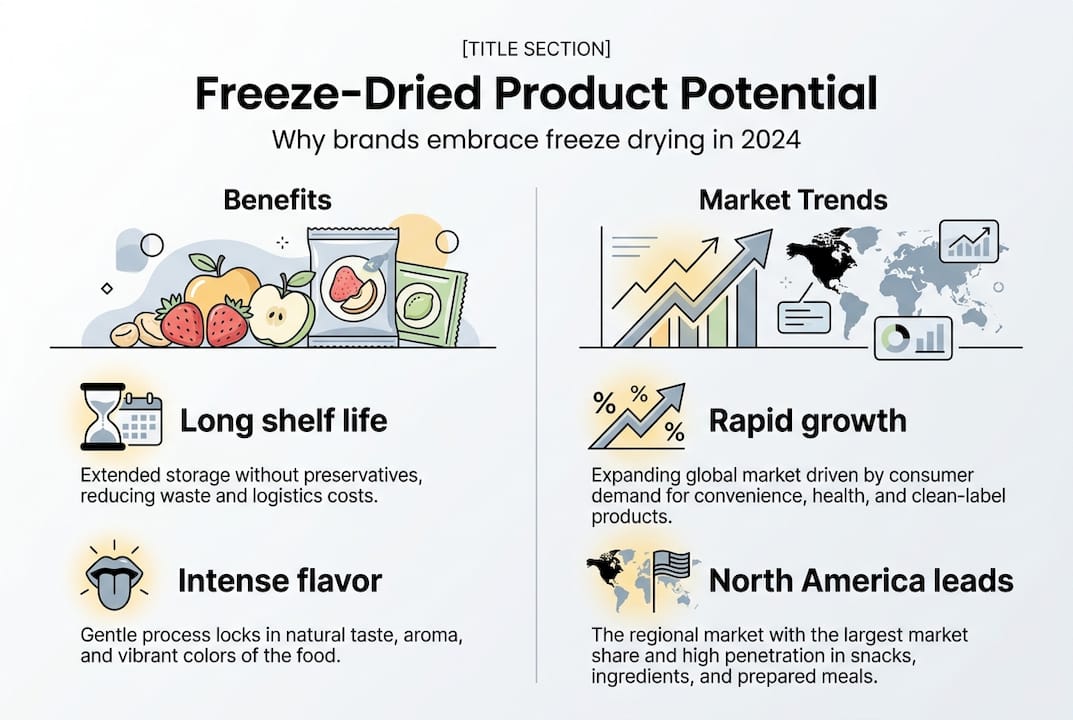
North America dominates this landscape, capturing roughly 45% of worldwide market share. Canadian brands contribute significantly to this regional strength, developing innovative products that resonate with domestic and international consumers. Social media platforms amplify interest, with viral videos showcasing the dramatic transformation of familiar candies into crunchy, intensified versions driving consumer curiosity and trial.
Several factors fuel this robust growth trajectory. Consumers increasingly seek unique snacking experiences that break from conventional offerings. Freeze-dried candy delivers on this demand with textures and flavors impossible to achieve through traditional manufacturing. The premium positioning aligns with willingness to pay more for perceived quality and novelty.
| Market Metric | 2024 Value | 2033 Projection | Growth Rate |
|---|---|---|---|
| Global Market Size | $1.5-2.3 billion | $3.2-4 billion | 8.8% CAGR |
| North American Share | ~45% | Sustained leadership | Stable dominance |
| Key Growth Drivers | Social media, novelty appeal, premium positioning | Expanding distribution, product innovation | Accelerating |
Retailers who recognize this wholesale opportunity early position themselves to capture market share in a segment where consumer awareness continues building. The combination of strong fundamentals and cultural momentum creates favorable conditions for strategic product adoption.
“The freeze-dried candy segment represents one of the fastest-growing niches in confectionery, driven by consumer desire for Instagram-worthy snacks and authentic flavor intensity that conventional processing cannot deliver.”
Challenges and considerations for retail businesses
While market potential appears compelling, retailers must navigate specific limitations and requirements inherent to freeze-dried products. Not all candies respond well to the lyophilization process. High-fat chocolates and confections may crumble or melt during processing unless manufacturers implement specialized pre-treatment protocols. This product selectivity requires careful curation of offerings.
The freeze-drying process demands significant energy input to maintain vacuum conditions and temperature control over extended cycles. These operational costs translate to higher production expenses compared to conventional drying methods. Retailers must factor this premium into pricing strategies while ensuring perceived value justifies the cost differential for consumers.
Marketing education becomes essential rather than optional. Many consumers lack familiarity with freeze-dried candy characteristics, benefits, and quality advantages. Without clear communication about texture transformation, flavor intensity, and shelf stability, products may sit on shelves as curiosities rather than moving as regular purchases. Canadian companies have addressed this challenge through sampling programs, social media content, and point-of-sale materials that demonstrate product attributes.
Equipment requirements present another consideration. Freeze-dry candy machines represent substantial capital investments, making in-house production impractical for most retailers. Partnering with established manufacturers or co-packers offers a more accessible entry point.
Key challenges retailers face:
- Product suitability varies significantly by candy type and composition
- Energy-intensive processing increases per-unit production costs
- Consumer education requires dedicated marketing investment
- Capital equipment costs prohibit small-scale production
- Quality control demands specialized expertise and monitoring
Pro Tip: Start with candy types proven to freeze-dry successfully, such as Skittles, gummy bears, and marshmallows, before expanding to more challenging products.
Freeze drying versus dehydration comparison:
| Factor | Freeze Drying | Traditional Dehydration |
|---|---|---|
| Texture Result | Crunchy, expanded, airy | Chewy, dense, shrunken |
| Flavor Retention | Excellent, intensified | Good, some loss |
| Nutrient Preservation | Superior, minimal heat | Moderate, heat exposure |
| Processing Time | 20-40 hours | 6-12 hours |
| Energy Cost | High | Low to moderate |
| Equipment Investment | $15,000-$50,000+ | $500-$5,000 |
| Shelf Stability | Excellent, years | Good, months |
Advantages for Canadian retail and online sales
Freeze-dried products align exceptionally well with current Canadian retail trends and consumer preferences. Extended shelf life addresses a critical pain point for retailers managing inventory and minimizing waste. Products remain stable for months without refrigeration, allowing flexible stocking strategies and reduced markdown pressure. Manufacturers can process surplus inventory into freeze-dried versions, converting potential waste into profitable premium products.
The lightweight nature of freeze-dried candy creates significant shipping advantages. Moisture removal reduces product weight by 90% or more compared to original candy, cutting transportation costs and environmental impact per unit sold. This efficiency proves particularly valuable for ecommerce operations where shipping expenses directly affect margins. Canadian retailers expanding online channels benefit from products that ship economically across the country’s vast geography.
Consumer appeal centers on novelty and sensory experience. The dramatic texture transformation and flavor concentration create memorable eating occasions that drive social sharing and repeat purchase. Canadian consumers increasingly seek unique snack options that differentiate from mass-market offerings, positioning freeze-dried candy favorably within premium and specialty segments.
Business benefits for Canadian retailers:
- Reduced spoilage and markdown requirements through extended shelf life
- Lower shipping costs enable profitable ecommerce and national distribution
- Premium positioning supports healthy margins despite higher production costs
- Novelty factor generates social media buzz and word-of-mouth marketing
- Alignment with sustainability goals through waste reduction and efficiency
Strategic implementation steps:
- Identify target consumer segments most receptive to premium novelty snacks
- Develop sampling programs to build awareness and trial among new customers
- Create educational content explaining nutritional value and benefits
- Optimize packaging to protect product integrity while showcasing visual appeal
- Leverage ecommerce channels where shipping economics favor lightweight products
- Monitor consumer feedback to refine product selection and marketing messages
The convergence of sustainability benefits, ecommerce growth, and consumer demand for unique experiences creates a favorable environment for freeze-dried product adoption. Retailers who move decisively can establish market position before competition intensifies.
“Freeze-drying technology enables retailers to transform traditional candy categories into premium offerings that command higher prices while reducing environmental footprint through waste reduction and shipping efficiency.”
Support your freeze-dried product success with Space-Man
Navigating the freeze-dried candy market requires expertise in production, packaging, and positioning. Space-Man brings comprehensive capabilities to help Canadian retailers succeed in this growing segment.
Our private label and co-packing services enable retailers to launch freeze-dried products without capital equipment investment or technical expertise. We handle production, quality control, and packaging while you focus on marketing and sales. Whether you need small batch specialty items or scaled production for broader distribution, our flexible approach adapts to your business requirements.
Explore our complete product range to discover how freeze-dried innovation can differentiate your snack offerings and capture consumer interest in Canada’s dynamic retail landscape.
Frequently asked questions
What candies are best suited for freeze drying?
Fruity, low-fat candies like Skittles, Jolly Ranchers, gummy bears, and marshmallows freeze-dry exceptionally well, producing consistent texture and flavor results. These products contain minimal fat that might interfere with moisture removal. Avoid high-fat chocolates and cream-filled confections unless specially formulated, as they tend to crumble or separate during processing. Pre-chilling delicate candies before freeze-drying helps maintain structural integrity throughout the sublimation cycle.
How does freeze drying compare to traditional dehydration in cost and quality?
Freeze drying preserves flavor compounds and creates superior texture compared to heat-based dehydration, but requires significantly higher energy input and longer processing time. Production costs run 3-5 times higher than conventional drying methods. However, the quality differential justifies premium pricing that maintains healthy margins. Dehydration offers lower costs but produces chewy, dense products rather than the crunchy, expanded texture consumers seek in freeze-dried candy. Retailers must weigh quality advantages against cost implications based on target market positioning.
What are the sustainability benefits of freeze-dried products in retail?
Freeze drying reduces food waste by converting surplus inventory into stable products with extended shelf life. The process removes 95% of water weight, dramatically lowering shipping emissions per unit through reduced fuel consumption. Lightweight products also decrease packaging material requirements. These environmental advantages align with corporate sustainability goals while delivering cost savings. Extended shelf stability minimizes spoilage throughout the distribution chain, further reducing waste from production to consumer.
How long does freeze-dried candy maintain quality and freshness?
Properly processed and packaged freeze-dried candy maintains quality for 12-24 months at room temperature, significantly longer than conventional candy. Moisture content below 2-3% prevents microbial growth and chemical degradation. Airtight packaging with oxygen absorbers extends shelf life further by preventing rehydration and oxidation. This stability enables retailers to stock products confidently without aggressive turnover requirements. Quality remains consistent throughout the shelf life period, unlike some conventional candies that may develop texture or flavor changes over time.
What marketing strategies work best for freeze-dried candy products?
Sampling programs prove most effective for building trial and awareness, allowing consumers to experience the unique texture and intensified flavor firsthand. Social media content showcasing the transformation process and dramatic before-after comparisons generates engagement and sharing. Point-of-sale materials explaining freeze-drying benefits educate shoppers at decision moments. Positioning products in premium or specialty sections rather than mainstream candy aisles sets appropriate price expectations. Highlighting novelty, quality, and unique sensory experience resonates more effectively than competing on price with conventional alternatives.