

TL;DR:
- Freeze-dried ingredients preserve more nutrients, color, and shelf life compared to air-dried options.
- Sourcing domestically from Canadian suppliers simplifies compliance, reduces costs, and speeds up product development.
- Private-label and co-packing programs enable brands to innovate rapidly and maximize profit margins.
Most retailers assume that dried is dried. If it’s shelf-stable and lightweight, it must work the same way regardless of how it was processed. That assumption costs Canadian candy and snack brands real money. Freeze-dried ingredients are fundamentally different from air-dried or dehydrated alternatives, and the gap shows up in your finished product’s taste, texture, color, and regulatory paperwork. Preserving up to 97% of nutrients with a shelf life stretching 18 to 25 years, freeze-dried sourcing is one of the most strategic decisions a Canadian retailer can make. This guide walks you through supplier selection, compliance requirements, private-label opportunities, and the sourcing pitfalls that catch new entrants off guard.
Table of Contents
- Understanding freeze-dried ingredients: What makes them ideal for candy and snack products
- Sourcing strategies for Canadian retailers: Key suppliers and procurement workflow
- Navigating compliance: Regulations, food safety, and import rules in Canada
- Private-label solutions and advanced trends: Innovating with freeze-dried ingredients
- A Canadian insider’s perspective: Avoiding the pitfalls and capturing hidden opportunities
- Partner with Canadian experts for all your freeze-dried sourcing needs
- Frequently asked questions
Key Takeaways
| Point | Details |
|---|---|
| Freeze-dried advantage | Freeze-dried ingredients offer superior shelf life, nutrition, and product texture compared to air- or heat-dried options. |
| Prioritize Canadian suppliers | Sourcing from Canadian companies simplifies compliance and speeds up delivery for candy and snack makers. |
| Requirements for compliance | Always verify certifications, traceability, and proper documentation to streamline imports and ensure safety. |
| Private-label boosts margins | Using private-label and co-packing services leverages freeze-dried innovation and premium trends for ROI growth. |
Understanding freeze-dried ingredients: What makes them ideal for candy and snack products
Freeze drying is not just a fancier version of dehydration. The process drops ingredient temperature to around -22°F, then uses a vacuum chamber to pull moisture out through sublimation, meaning ice converts directly to vapor without passing through a liquid phase. The result is an ingredient that retains its original cell structure, color, and flavor profile in a way that heat-based drying simply cannot replicate. Understanding the freeze-drying process helps you ask smarter questions when evaluating suppliers.
From a product development standpoint, the numbers matter. Freeze-dried ingredients retain 95 to 97% of nutrients, reach moisture levels below 3%, and can last up to 25 years under proper storage. Compare that to air-dried alternatives, which typically lose significant color vibrancy, flavor intensity, and nutritional density during processing. A freeze-dried vs. air-dried comparison shows clear advantages in nutrition, color retention, and sensory quality, even if the upfront cost per kilogram runs higher.
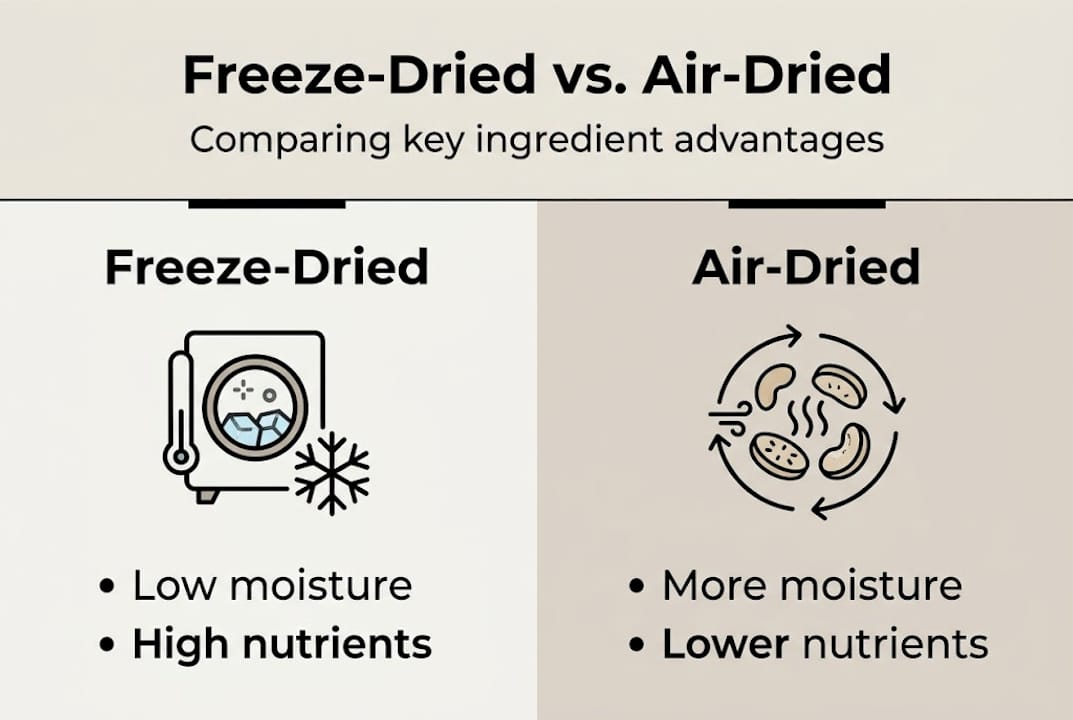
For candy and confectionery specifically, two technical properties make freeze-dried ingredients stand out: low moisture content and low water activity (Aw). When you add inclusions to chocolate or gummy formulations, excess moisture triggers sugar bloom and fat migration, two defects that ruin shelf appearance and customer trust. Freeze-dried fruit pieces and powders carry water activity well below 0.3, which keeps your finished product stable and visually appealing from production through to the retail shelf. Explore the full range of freeze drying benefits to see how this translates across different product categories.
Ingredient types best suited for freeze-dried sourcing:
- Whole and sliced fruits (strawberries, raspberries, mango, banana)
- Fruit and vegetable powders for flavoring and coloring
- Inclusions for chocolate bars, trail mix, and gummies
- Yogurt and dairy-based pieces for coating applications
- Herb and botanical ingredients for functional snack lines
| Property | Freeze-dried | Air-dried |
|---|---|---|
| Moisture content | Below 3% | 10 to 25% |
| Nutrient retention | 95 to 97% | 40 to 60% |
| Color vibrancy | High | Moderate to low |
| Shelf life | Up to 25 years | 1 to 3 years |
| Water activity (Aw) | Below 0.3 | 0.4 to 0.6 |
Pro Tip: Always test freeze-dried ingredients in your actual finished formula before committing to a full purchase order. Color migration, moisture pickup from surrounding ingredients, and texture changes under coating all behave differently depending on your specific recipe.
Now that you know why freeze-drying is so valuable, let’s explore how to find the right suppliers for your needs.
Sourcing strategies for Canadian retailers: Key suppliers and procurement workflow
Canada has a growing ecosystem of freeze-dried ingredient suppliers, and knowing who does what saves you weeks of back-and-forth. Vancouver Freeze Dry (VFD) is one of the most established players, with a broad catalog and certifications that satisfy most retail and foodservice buyers. The Canadian Centre of Freeze-Drying (CCFD), operated through HappyYak, focuses on contract freeze drying and custom formulations. Astro Foods rounds out the landscape with specialty ingredient lines. Each has different strengths depending on whether you need bulk commodity ingredients, custom blends, or private-label finished products.

When evaluating any supplier, certifications are your first filter. Look for SQF, Kosher, and BRCGS certifications as baseline indicators that a supplier operates under rigorous food safety standards. HACCP certification is also non-negotiable for most retail buyers in Canada. A supplier without documented food safety programs creates liability exposure for your brand the moment something goes wrong.
Here is a practical sourcing workflow to follow:
- Define your ingredient spec including moisture target, particle size, Aw limit, and any allergen restrictions before reaching out to any supplier.
- Request samples in the format you intend to use them, not just raw bulk samples.
- Ask for a batch Certificate of Analysis (CoA) that includes moisture, Aw, microbial counts, and allergen testing results.
- Verify certifications directly through the certifying body, not just a supplier-provided document.
- Negotiate minimum order quantities (MOQs) early. Most suppliers offer flexibility for new accounts if you show a credible volume forecast.
- Confirm lead times and cold chain requirements for your first shipment before signing any supply agreement.
| Supplier | Certifications | Specialization | MOQ flexibility |
|---|---|---|---|
| Vancouver Freeze Dry (VFD) | SQF, Kosher, HACCP | Bulk commodity ingredients | Moderate |
| CCFD (HappyYak) | HACCP, custom programs | Contract freeze drying, custom blends | High |
| Astro Foods | BRCGS, Organic | Specialty and functional ingredients | Moderate |
For Canadian retailers evaluating freeze-dried snacks, the domestic supplier route consistently outperforms import-heavy strategies on both speed and cost. Canadian snack wholesalers are increasingly building direct relationships with domestic freeze-dry facilities for exactly this reason.
Pro Tip: Request samples in your intended use format. A strawberry piece that performs well as a standalone snack may behave completely differently when embedded in a chocolate bar or compressed into a tablet form.
With an understanding of supplier roles and process, your next step is ensuring your sourcing aligns with Canadian regulatory demands.
Navigating compliance: Regulations, food safety, and import rules in Canada
Compliance is where many new entrants stumble. Canada’s food safety framework is specific, and the documentation requirements for freeze-dried ingredients, whether imported or domestically sourced, are not optional.
If you are importing freeze-dried ingredients from outside Canada, you need a Safe Food for Canadians (SFC) license. Importers require SFC licenses, CFIA compliance, full traceability, and allergen-tested CoAs for every shipment entering the country. The Canadian Food Inspection Agency (CFIA) can audit your records at any point, which means your documentation trail needs to be airtight from day one. Review the food safety guidelines specific to freeze-dried candy and snack production to understand what a compliant operation looks like in practice.
Documentation every shipment should include:
- Certificate of Analysis (CoA) covering moisture, Aw, microbial counts, and heavy metals
- Allergen declaration from the manufacturing facility
- Country of origin documentation
- Lot and batch traceability records
- Supplier food safety certification (SQF, BRCGS, or equivalent)
- Ingredient specification sheet matching your purchase order
Domestic sourcing simplifies this significantly. When you buy from a Canadian supplier already operating under CFIA oversight, much of the import documentation burden disappears. You still need CoAs and traceability records, but you skip the SFC import licensing process entirely for domestically produced ingredients.
Working with Canadian freeze-dry suppliers means your ingredients arrive with documentation already aligned to CFIA standards, which cuts your compliance review time and reduces the risk of shipment holds at the border.
Understanding freeze-dried snack manufacturing from a production standpoint also helps you ask the right compliance questions when auditing a new supplier. Once you understand the legal and food safety groundwork, you’re ready for advanced sourcing options such as private labeling and new product development.
Private-label solutions and advanced trends: Innovating with freeze-dried ingredients
The most profitable Canadian snack brands are not just buying freeze-dried ingredients. They are using private-label and co-packing programs to build proprietary product lines with better margins and stronger brand equity. Source86, CCFD, and Thrive Freeze Dry all offer private-label and co-packing solutions that let you bring a finished, branded product to market without owning freeze-dry equipment yourself. Thrive Freeze Dry is particularly strong for specialty and organic private-label runs.
The market timing is favorable. Demand for freeze-dried ingredients is growing at an 8% CAGR, with organic and premium-certified segments commanding meaningful price premiums over conventional options. Retailers who lock in private-label supply agreements now are positioning ahead of that demand curve rather than chasing it.
Benefits of private-label and co-packing for Canadian retailers:
- Full brand control over packaging, flavor profiles, and ingredient sourcing
- Lower capital investment compared to in-house production
- Faster speed to market for new SKUs
- Access to certified organic and specialty ingredient runs without minimum facility requirements
- Flexibility to test new formats (pouches, display bags, bulk bins) without long-term commitments
From a formulation standpoint, three factors consistently improve finished product quality when working with freeze-dried inclusions. First, uniform particle or piece size ensures even distribution and consistent bite experience. Second, low water activity (Aw below 0.3) protects surrounding ingredients from moisture migration. Third, late-stage addition during production, meaning you add freeze-dried pieces after any heat or moisture-intensive steps, preserves texture and color through to the final product.
Stat callout: The organic freeze-dried segment is growing faster than conventional, with certified products commanding 20 to 35% price premiums in retail channels. For private-label candy manufacturing, that premium translates directly to margin. Pairing a strong private-label program with smart ingredient sourcing is one of the fastest ways to boost retail sales without increasing your footprint.
Armed with both sourcing strategy and trend knowledge, let’s zoom out for a fresh take on what most in the industry overlook.
A Canadian insider’s perspective: Avoiding the pitfalls and capturing hidden opportunities
Here is something the industry rarely says out loud: cheap imported freeze-dried ingredients almost never stay cheap once you factor in the full cost of compliance. An SFC import license, third-party lab testing to verify foreign CoAs, potential CFIA holds, and the time your team spends managing documentation can easily add 15 to 30% to your landed ingredient cost. Brands that chase the lowest per-kilogram price from overseas suppliers often discover this the hard way after their first shipment delay.
The smarter approach is to treat domestic contract freeze drying and private-label programs as your primary sourcing strategy, not a fallback. Prioritizing Canadian suppliers delivers lower logistical costs, faster turnaround, and simpler compliance, all of which compound into real competitive advantage over time. When you control ingredient sourcing, formulation, and branding through a single domestic partner, you also move faster on new product launches.
The brands winning in Canadian freeze-dried snacks right now are not the ones with the cheapest ingredients. They are the ones with the tightest supply chains and the clearest compliance records. If you are exporting freeze-dried snacks beyond Canada, that documentation advantage becomes even more valuable.
Pro Tip: Use contract manufacturing to consolidate ingredient sourcing, compliance documentation, and branding into one relationship. It is faster, cleaner, and gives you far more control than managing three separate vendors.
Partner with Canadian experts for all your freeze-dried sourcing needs
If you are ready to move from research to action, Spaceman makes it straightforward. We work with Canadian retailers and product developers to build turn-key sourcing programs that cover everything from ingredient selection to finished, shelf-ready product.
Our private label and co-packing solutions are built specifically for brands that want speed, compliance, and quality without the overhead of in-house production. If you are looking to test the retail channel, our wholesale display kits give you a proven format that moves product. Ready to scale? Start with our wholesale application and our team will match you with the right program for your volume and goals.
Frequently asked questions
What certifications should I require when sourcing freeze-dried ingredients in Canada?
Look for SQF, HACCP, and BRCGS certifications as your baseline, plus Organic certification if you are targeting premium or natural retail channels. These credentials confirm both food safety rigor and quality consistency.
How do freeze-dried ingredients help prevent issues like sugar bloom and fat migration in candy?
Freeze-dried ingredients carry water activity below 0.3 and moisture below 3%, which prevents the moisture transfer that triggers sugar bloom and fat migration in chocolate and compound coatings.
What is the typical minimum order quantity (MOQ) for freeze-dried ingredients?
MOQs for powders run 5 to 25kg, while whole or sliced fruit pieces typically start at 10 to 25kg. Most Canadian suppliers will negotiate lower entry quantities for new accounts with credible growth plans.
Why is sourcing domestic freeze-dried ingredients recommended for Canadian retailers?
Domestic sourcing eliminates the SFC import licensing requirement, keeps your ingredients already aligned to CFIA compliance standards, and significantly reduces lead times compared to international shipments.
What trends are shaping freeze-dried ingredient demand in the snack industry?
Premium fruit inclusions, certified organic lines, and private-label functional snacks are the primary growth drivers, with demand growing at 8% CAGR and organic products commanding the strongest retail premiums.