

TL;DR:
- Canada’s freeze-dried snack exports are booming, driven by health trends and innovative product features.
- Exporters must comply with Canadian licensing, destination country rules, and US FDA regulations to succeed.
- Building strong relationships, proactive communication, and proper documentation are key to long-term export success.
Canada’s consumer-oriented food exports hit $33.8 billion in 2024, and freeze-dried snacks are one of the fastest-moving segments riding that wave. Yet most retailers and store owners who want to source these products from Canadian manufacturers run into the same wall: the export process feels like a maze of licenses, labeling rules, and foreign regulations. The good news is that the path is clearer than it looks once you understand the key steps. This guide breaks down exactly what you need, from compliance requirements to practical export strategy, so you can confidently add Canadian freeze-dried snacks to your product lineup.
Table of Contents
- Why export freeze-dried snacks from Canada?
- Legal requirements and certifications for export
- Step-by-step export process for Canadian freeze-dried snacks
- Key considerations for top export markets like the US
- What most exporters get wrong—and how you can be smarter
- How Spaceman helps retailers succeed in snack exports
- Frequently asked questions
Key Takeaways
| Point | Details |
|---|---|
| Major export growth | Canadian snack exports are booming, especially freeze-dried options that align with global health trends. |
| Strict compliance required | SFCR licensing and attention to both Canadian and foreign standards are non-negotiable for legal exports. |
| Step-by-step execution | Following a documented process and using official requirement libraries helps avoid costly mistakes and border issues. |
| US market is unique | The US requires FDA registration, special notices, and stricter labeling than most other destinations. |
| Expert help available | Partnering with experienced co-packers and export specialists simplifies the challenges of snack export logistics. |
Why export freeze-dried snacks from Canada?
The global appetite for snacks is not slowing down. Health-conscious consumers are actively seeking alternatives to traditional chips and candy, and freeze-dried snacks check every box: long shelf life, bold flavor, light weight, and a texture that genuinely surprises first-time buyers. For retailers looking to differentiate their shelves, that novelty factor alone is a competitive edge.
Canadian manufacturers are well-positioned to meet this demand. Savory snacks are the top growth import category in Canada right now, which signals that demand for innovative snack formats is rising on both sides of the border. Freeze-dried fruit, vegetables, and candy align perfectly with the consumer push toward cleaner ingredients and unique eating experiences.
Here is a quick look at why freeze-dried snacks stand out as an export product:
- Long shelf life: Most freeze-dried snacks last 12 to 25 months without refrigeration, making them ideal for international shipping and retail inventory management.
- Lightweight and compact: Lower shipping costs per unit compared to moisture-heavy snack formats.
- Premium positioning: Retailers can charge higher margins because the product is perceived as specialty.
- Health alignment: No artificial preservatives needed, which resonates with today’s label-reading shoppers.
- Novelty appeal: The crunchy, melt-in-your-mouth texture drives repeat purchases and social sharing.
| Snack type | Avg. shelf life | Export margin potential | Health perception |
|---|---|---|---|
| Traditional chips | 3 to 6 months | Moderate | Low to moderate |
| Freeze-dried fruit | 12 to 25 months | High | High |
| Freeze-dried candy | 12 to 18 months | High | Moderate |
| Granola bars | 6 to 12 months | Moderate | Moderate to high |
Understanding why freeze-dried snacks make commercial sense is the first step. The nutritional benefits of freeze-dried foods also give you a strong selling story when pitching to buyers or writing product descriptions. Canadian snack exports to the US alone reached $277 million in 2024, with 96% of volume going south of the border. That is the market you are tapping into.
Legal requirements and certifications for export
Now that you understand the opportunity, here is what you need to know about the legal and compliance framework.
If you are preparing, packaging, or labeling freeze-dried snacks for export, you must hold a valid Safe Food for Canadians (SFCR) licence. This is not optional. The SFCR framework requires food businesses to have documented preventive controls, traceability systems, and sanitation procedures in place before they can legally export prescribed foods from Canada.
Beyond the SFCR licence, the step-by-step export process involves four core actions:
- Meet all Canadian food safety requirements and any destination-country-specific rules.
- Obtain a CFIA export licence if your destination requires one.
- Secure an export certificate if the importing country demands it.
- Ensure your preventive controls and traceability records are complete and current.
Here is a side-by-side look at requirements for two common export scenarios:
| Requirement | Domestic Canadian sale | Export to the US |
|---|---|---|
| SFCR licence | Required | Required |
| CFIA export certificate | Not needed | Sometimes needed |
| FDA facility registration | Not applicable | Required |
| Prior notice to FDA | Not applicable | Required |
| Bilingual labeling (EN/FR) | Required | Not required |
| FSMA compliance | Not applicable | Required |
One edge case worth knowing: snacks that contain animal-based ingredients, such as meat-flavored coatings or gelatin, can face stricter controls that go beyond standard food export rules. Always check the CFIA Export Requirements Library for your specific product type.
“Even if no CFIA certificate is needed, exporters are still responsible for ensuring their products meet all foreign requirements. Canada’s policy protects against exporting substandard goods.”
Pro Tip: Bookmark the CFIA Export Requirements Library and check it every time you add a new product or enter a new market. Regulations update more often than most exporters expect. Pair this with the Canada snack food certifications guide and review Safe Food for Canadians requirements to stay current.
Step-by-step export process for Canadian freeze-dried snacks
Understanding the legal requirements, here is a step-by-step process to exporting freeze-dried snacks from Canada.
- Confirm your SFCR status. Before anything else, verify that your manufacturer holds a valid SFCR licence. If you are sourcing from a co-packer, ask for documentation.
- Identify destination requirements. Use the CFIA Export Requirements Library to pull up rules specific to your target country. Do not assume what applies to one market applies to another.
- Document preventive controls. Your freeze-drying process guide should align with your hazard analysis and preventive control plan. Keep these records accessible.
- Apply for a CFIA export licence if your destination country requires one. Processing times vary, so build this into your timeline.
- Register with the FDA if shipping to the US. This includes facility registration and submitting prior notice at least two hours before your shipment arrives at the US border.
- Prepare compliant labeling. US labeling rules differ from Canadian ones. Ingredient lists, allergen declarations, and net weight formats must meet FDA standards, not just Health Canada standards.
- Arrange traceability records. You need to be able to trace your product one step back (supplier) and one step forward (buyer) at all times.
- Prepare export samples. Border inspectors can and do pull samples. Having clean, properly labeled samples ready speeds up clearance.
The step-by-step export process also clarifies an important nuance: non-compliant food can be exported if the destination country does not have that specific requirement and the product is not adulterated or fraudulent. But you must notify CFIA if you are requesting an export certificate for such a product. This is a narrow exception, not a workaround.
Pro Tip: Prepare a single export documentation folder for each shipment. Include your SFCR licence copy, product specs, ingredient declarations, and any FDA registration numbers. Customs brokers and border agents will thank you, and clearance will move faster.
Reviewing wholesaler insights on how distributors handle documentation can also give you practical ideas for streamlining your own process.

Key considerations for top export markets like the US
Now let’s focus on the US market, which is the first stop for most Canadian snack exports.
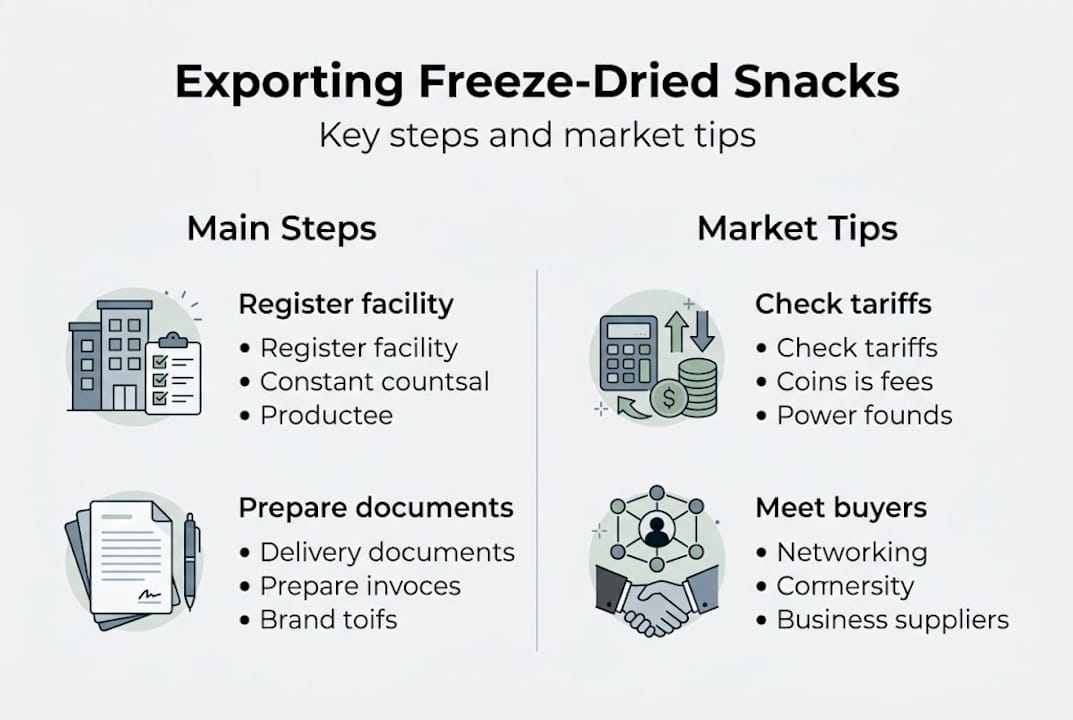
The US is not just the largest market for Canadian snacks. It is a highly regulated one. FDA facility registration is mandatory for any foreign facility that manufactures, processes, packs, or holds food for US consumption. This registration must be renewed every two years during the October to December window. Missing that window can block your shipments.
Here is what US-bound freeze-dried snack exports require:
- FDA facility registration for the manufacturing site.
- Prior notice submitted electronically before the shipment arrives at the US border.
- FSMA importer accountability: Your US importer of record is responsible for verifying that your product meets US safety standards. Build a strong relationship with them.
- Labeling compliance: Nutrition facts panels, allergen statements, and ingredient lists must follow FDA formatting, which differs from Health Canada’s requirements.
- Low-acid canned food rules: These do not typically apply to freeze-dried snacks, but confirm with your manufacturer if any product involves sealed packaging with water activity concerns.
“Use the CFIA Export Requirements Library for destination-specific rules and leverage FTAs like USMCA for tariff reductions if rules of origin are met.”
The USMCA trade agreement can reduce or eliminate tariffs on Canadian freeze-dried snacks entering the US, but only if your product meets the rules of origin. This means sufficient Canadian processing and sourcing. If your manufacturer uses mostly imported ingredients, the tariff benefit may not apply. Confirm this with a trade lawyer or customs broker before pricing your export shipments.
For a broader view of what compliance looks like from the retail side, the importing snacks legal guide and the overview of benefits of freeze drying are worth reviewing before you finalize your supplier agreements.
What most exporters get wrong—and how you can be smarter
Here is where many new exporters go wrong, and what truly works.
Most first-time exporters treat compliance as the finish line. They get the SFCR licence, register with the FDA, and assume the hard work is done. It is not. Even without a CFIA certificate, you remain fully responsible for meeting every foreign requirement your product lands in. The checklist gets you to the starting line. What wins the race is strategy.
The exporters who build lasting relationships with US and international buyers do a few things differently. They customize their labeling and packaging for the target market, not just for compliance, but for shelf appeal. They send product samples proactively. They stay subscribed to trade alerts from both CFIA and FDA so they catch rule changes before those changes catch them.
Another overlooked move: talking directly to local importers and distributors in your target market before you finalize your product. They know what sells on their shelves. That intelligence is worth more than any market research report.
If you are thinking about starting a snack export business, treat every export relationship as a long-term partnership. Buyers remember suppliers who are transparent, responsive, and consistent. Those qualities are rarer than you think, and they are what drive repeat orders.
Pro Tip: Regulations shift and market preferences evolve. Schedule a quarterly review of your export documentation and a check-in call with your key buyers. Small adjustments made early prevent costly shipment rejections later.
How Spaceman helps retailers succeed in snack exports
Navigating the freeze-dried snack export market is far easier when you work with a manufacturer that already knows the terrain.
At Spaceman, we handle everything from recipe development to export-ready packaging, so you are not piecing together compliance on your own. Our private label and co-packing services are designed specifically for retailers who want to move fast without cutting corners on quality or documentation. We produce freeze-dried snacks in Canada with the certifications and traceability systems already in place. Whether you need custom labeling for the US market or a full co-packing solution, Spaceman is built to help you scale confidently. Reach out today to explore how we can get your export program off the ground.
Frequently asked questions
Do I need a special license to export freeze-dried snacks from Canada?
Yes, you need a valid SFCR licence if you prepare, package, or label freeze-dried snacks for export. This applies to manufacturers and co-packers operating in Canada.
What documents are required to ship freeze-dried snacks to the US?
You need FDA facility registration, prior notice, and labeling that meets FDA standards. Your US importer of record also carries accountability under FSMA.
Can I export snacks that don’t fully meet Canadian standards?
In limited cases, yes. If the destination country lacks that requirement and the product is not adulterated or fraudulent, export may be permitted, but you must notify CFIA when requesting an export certificate.
Are there extra rules for snacks with animal ingredients?
Yes, snacks containing animal-based ingredients can face stricter controls, sometimes comparable to pet food import regulations. Always verify with CFIA before exporting these product types.
Where do I check the latest requirements for exporting freeze-dried snacks?
Use the CFIA Export Requirements Library for destination-specific rules, and cross-reference with your destination country’s food import authority, such as the FDA for US shipments.