

Check the serving size and servings per container first, since every number below it depends on that math. Then scan the %DV column: 5% or less is low, 20% or more is high. Keep saturated fat, sodium, and added sugars near the low end, and look for fiber, vitamin D, calcium, iron, and potassium closer to the high end. That’s the whole system in one breath.
TL;DR:
- Always check that the serving size matches how you plan to eat, and multiply all nutrients if you consume more than one serving per container.
- Aim for less than 5% daily value for sodium and added sugars, and look for high percentages (20% or more) for fiber, calcium, and vitamin D.
- Be wary of ingredients listed high in sugar, oils, or trans fats, and verify labels for hidden added sugars using multiple ingredient names.
- The %DV helps compare products quickly, with 5% or less being low and 20% or more indicating a high nutrient level, but consider individual needs for children or pregnant women.
- Use nutrition labels as comparison tools rather than strict health judgments, balancing intake across the day and considering personal dietary requirements.
Table of Contents
- How to Read Nutrition Facts: Start With Serving Size
- Calories: Reading the Big Number and Using Simple Thresholds
- Nutrients to Limit and Nutrients to Get More Of
- Percent Daily Value and the 5%/20% Rule
- Ingredient List: Spotting Hidden Added Sugars and Oils
- Quick Shopping Checklist: 6 Things to Check in 30 Seconds
- Author Expertise and Space-man’s Take on Snack Labels
- Understanding Fat Types: Trans Fats, Unsaturated Fats, and What They Do to Your Body
- Understanding Sugar Types: Natural vs. Added Sugars
- Allergen Disclosure: Finding What’s Really in the Package
- Allergen-Free Claims vs. What the Label Actually Certifies
- Labeling Rules Change Depending on Where You’re Shopping
- Reading %DV Differently for Kids, Pregnant Women, and Other Special Cases
- Use the Label to Guide You, Not to Run Your Life
- Sources
How to Read Nutrition Facts: Start With Serving Size
Serving size is not a suggestion about how much you should eat. It’s a standardized amount the FDA sets based on what people actually tend to eat in one sitting, so labels across similar products can be compared fairly. A “portion” is whatever you personally put on your plate, and it can easily be double or triple the listed serving.
Here’s where people get tripped up: servings per container.
- Find the serving size at the top of the label (say, ½ cup).
- Check “servings per container” right below it (say, 4).
- Multiply every number on the label by however many servings you actually eat.
A pint of ice cream that lists 4 servings per container but gets eaten in one movie night means you multiply every number, calories included, by four. Bottles of soda often work the same way, and some packages use dual-column labels showing per-serving and per-package values side by side specifically because the whole thing is realistically a single sitting.
Calories: Reading the Big Number and Using Simple Thresholds
Calories per serving tell you the energy in that one serving, not the whole package. Multiply by the number of servings you’re actually going to eat before you judge anything.
Rough thresholds that make quick sense of the number:
- About 40 calories per serving counts as low.
- Around 100 calories per serving is moderate.
- 400 calories or more per serving lands in high territory.
Most labels reference a 2,000-calorie diet, which is a general benchmark, not your personal number. Someone active and six-foot-two burns through more than someone sedentary and five-foot-two, so treat 2,000 as a starting point and check MyPlate.gov if you want an estimate closer to your own needs.
Nutrients to Limit and Nutrients to Get More Of
Some nutrients you want to keep low. Others you want to chase.
Limit these:
- Saturated fat, which raises LDL cholesterol over time.
- Trans fat, which has no known safe amount.
- Sodium, linked to higher blood pressure.
- Added sugars, tied to excess calorie intake without added nutrition.
Get more of these:
- Dietary fiber, for digestion and steady blood sugar.
- Vitamin D and calcium, for bone health.
- Iron, especially relevant for menstruating people and kids.
- Potassium, which helps balance sodium’s effect on blood pressure.
Pro Tip: The recommended daily sodium limit for people 14 and older is 2,300 milligrams, roughly one teaspoon of salt. When you’re comparing two snack bags side by side, whichever one has a lower sodium mg number per matching serving size is the better everyday pick.
Percent Daily Value and the 5%/20% Rule
The Percent Daily Value, or %DV, puts every nutrient on the same 0 to 100% scale so you don’t need a calculator in the snack aisle. It’s based on a 2,000-calorie diet, and your actual needs might run higher or lower depending on age, activity, and health conditions.
The rule that makes it useful:
- 5% DV or less is low. Good news for saturated fat, sodium, and added sugars.
- 20% DV or more is high. Good news for fiber, calcium, iron, potassium, and vitamin D.
Picture two granola bars side by side. Bar A wins on both counts without you doing a single multiplication problem. That’s the entire point of %DV: it turns milligrams and grams into a scale your brain can actually use standing in an aisle.
Ingredient List: Spotting Hidden Added Sugars and Oils
Ingredients are listed in descending order by weight, so whatever sits first makes up the largest share of the product. If sugar, syrup, or oil shows up in the first three ingredients, that item is a bigger part of the product than the marketing on the front of the bag suggests.
Added sugars hide under a lot of aliases:
- High-fructose corn syrup
- Cane juice or evaporated cane juice
- Agave nectar
- Dextrose, maltose, or rice syrup
Watch for “partially hydrogenated oil” specifically. A product can legally list 0 grams trans fat on the panel while still containing up to half a gram per serving, and that only shows up if you read the ingredient list, not the numbers box. Eat two or three servings and those hidden half-grams add up fast.
Pro Tip: If a snack lists three different sugar names in the first five ingredients, that’s your sign the “reduced sugar” label on the front is doing some creative marketing. For a deeper walk through hidden sugar names, Space-man’s ingredient label guide breaks it down ingredient by ingredient.
Quick Shopping Checklist: 6 Things to Check in 30 Seconds
You don’t need a nutrition degree standing in the snack aisle. You need thirty seconds and this order of operations:
- Serving size. Is it realistic for how you’ll actually eat it?
- Servings per container. Multiply everything if you’re eating more than one.
- Calories per package. Not just per serving, the whole thing you’re about to eat.
- %DV for sodium and added sugars. Under 5% is a win; over 20% is a flag.
- Fiber and protein. Higher numbers here generally mean more staying power.
- First three ingredients. Sugar or oil up top tells you what you’re really buying.
| Check | Good sign | Warning sign |
|---|---|---|
| Serving size | Matches how you’ll eat it | Unrealistically small |
| Sodium %DV | 5% or less | 20% or more |
| Added sugar %DV | 5% or less | 20% or more |
| Fiber | 20% DV or more | Under 5% DV |
| First ingredients | Whole food listed first | Sugar or oil listed first |
That’s a genuinely solid snack, and you figured it out faster than it took to read this paragraph.
Author Expertise and Space-man’s Take on Snack Labels
Chadi has spent years breaking down how snack and candy labels actually work for everyday shoppers, not just nutrition students.
A quick real-world comparison: two freeze-dried candy bags, same serving size. Same shelf, same price range, very different snack.
- How to Read Nutrition Labels for Smarter Candy Choices
- Understanding How to Read Ingredient Labels Clearly
Understanding Fat Types: Trans Fats, Unsaturated Fats, and What They Do to Your Body
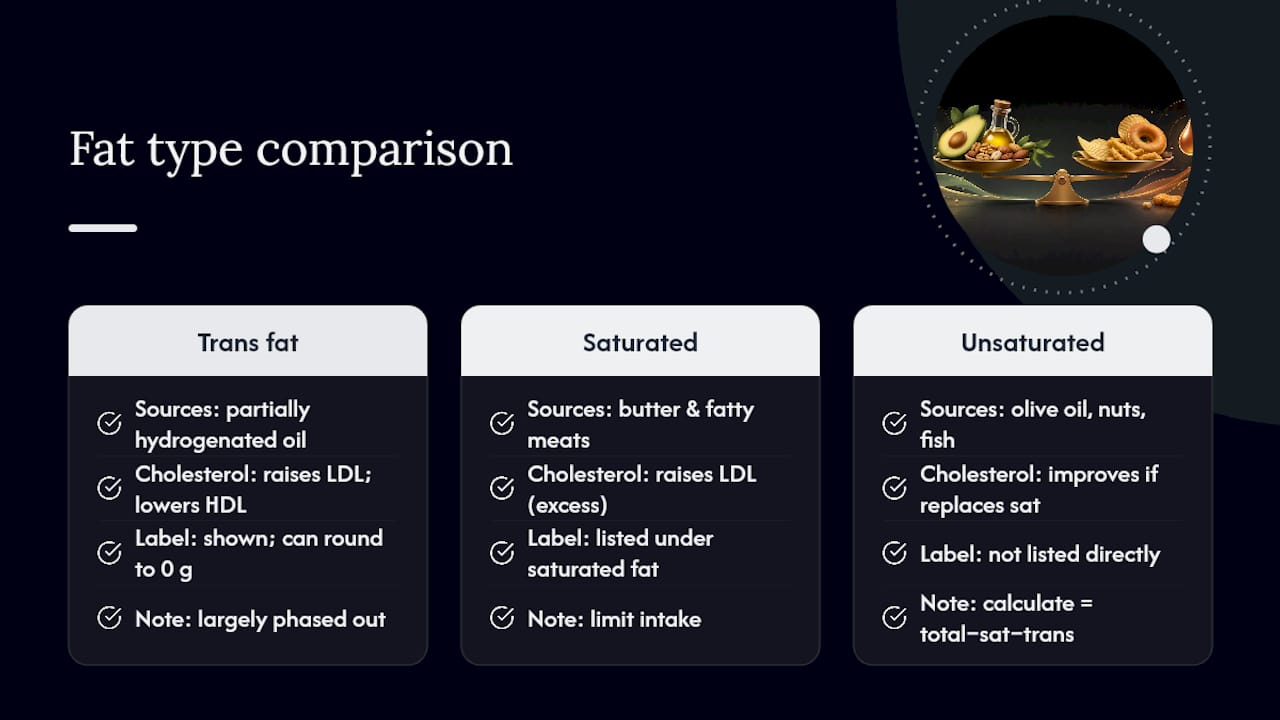
Not all fat grams on a label carry the same risk, and lumping them together is one of the most common label-reading mistakes. Saturated fat, found in butter, fatty meat cuts, and some baked snacks, raises LDL cholesterol when eaten in excess, which is why it sits on the “limit” list.
Trans fat is a different animal entirely. It occurs naturally in tiny amounts in some animal products, but the version that matters on labels is artificial trans fat, created by partially hydrogenating vegetable oil to extend shelf life. It raises LDL cholesterol while also lowering HDL, the “good” cholesterol, a double hit that no other fat type causes. That’s why manufacturers have largely phased it out, though small amounts can still legally hide in products that round down to “0 g” on the panel.
Unsaturated fats, both monounsaturated (olive oil, avocados, most nuts) and polyunsaturated (fish, walnuts, sunflower seeds), work in the opposite direction. They tend to support healthy cholesterol balance when they replace saturated fat in your diet rather than just piling on top of it. The label lists total fat first, then breaks out saturated and trans fat underneath, but it won’t call out unsaturated fat by name; you calculate it by subtracting saturated and trans fat from the total. A snack with 8 grams total fat and only 1 gram saturated is mostly running on the unsaturated side, which is generally the better bet.
Understanding Sugar Types: Natural vs. Added Sugars
The “Total Sugars” line on a Nutrition Facts label bundles together sugar that occurs naturally in the food and sugar that got added during processing, but those two things affect your body very differently. Fruit contains natural fructose alongside fiber and water that slow how fast your body absorbs it. Milk contains natural lactose. Neither shows up as a health concern in the amounts found in whole foods.
Added sugar is another story, which is exactly why the FDA updated the label in 2016 to break “Added Sugars” out as its own line underneath Total Sugars. Added sugars contribute calories without the fiber, protein, or micronutrients that come packaged with natural sugar sources, and they’re the number worth watching closely.
Here’s a practical way to use both lines together: a container of plain yogurt might show 12 grams total sugar and 0 grams added, meaning all of it comes from the milk itself. A flavored yogurt right next to it might show 22 grams total sugar with 15 grams added, meaning more than half of that sugar got poured in during manufacturing. Same food category, very different profile, and you’d never catch the difference without checking the added sugars line specifically. The ingredient list backs this up: if you see sugar, syrup, or juice concentrate anywhere near the top, that’s where the added sugar count is coming from.
Allergen Disclosure: Finding What’s Really in the Package
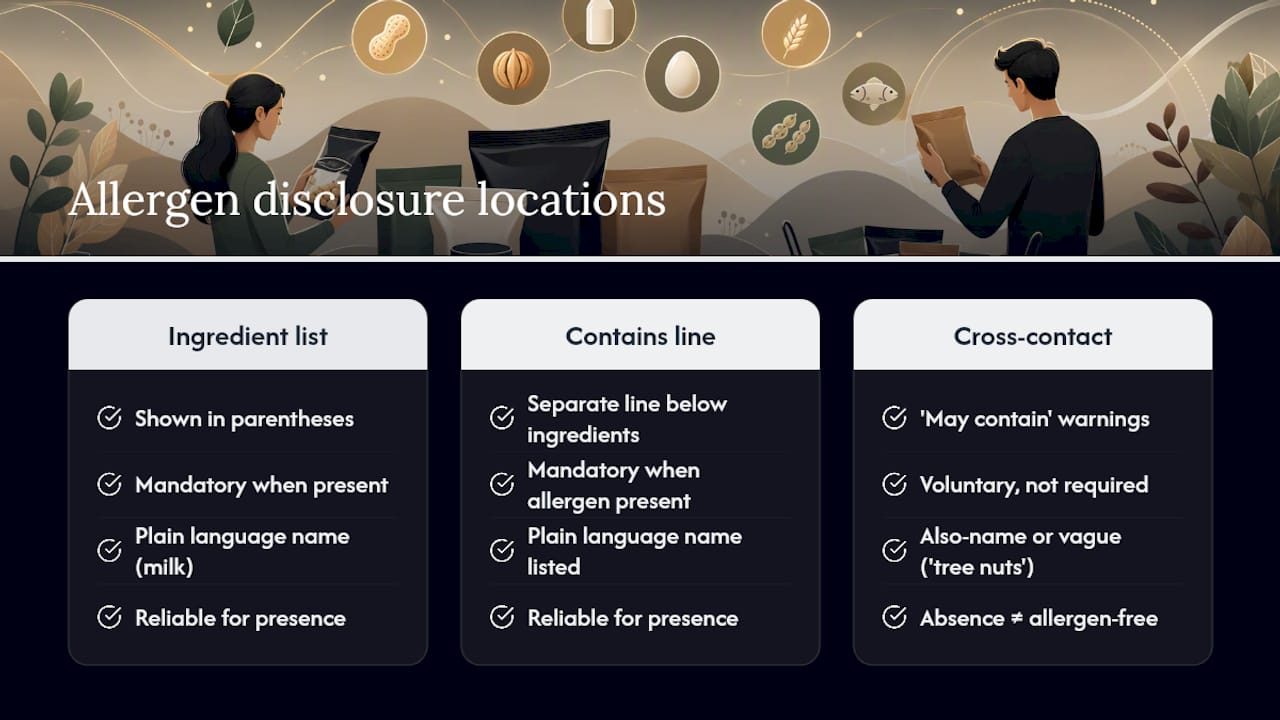
Food labels in the United States are required to call out major allergens clearly, and knowing where to look saves you from having to decode ingredient names under pressure in a checkout line. The disclosure usually appears in one of two spots: either directly in the ingredient list, in parentheses right after the ingredient it applies to (“whey (milk)”), or in a separate “Contains” statement printed right below the ingredient list.
The major allergens that require disclosure include milk, eggs, peanuts, tree nuts, wheat, soybeans, fish, shellfish, and sesame. If a product contains any of these, it has to be named in plain language, not hidden behind a scientific or Latin ingredient name. That’s the whole reason the requirement exists: “casein” alone might not register as a dairy product to someone scanning fast, but “casein (milk)” does.
Where this gets murkier is cross-contact warnings like “may contain traces of tree nuts” or “processed in a facility that also handles peanuts.” These statements are voluntary, not mandatory, which means their absence doesn’t guarantee a facility is allergen-free. A manufacturer that runs a genuinely dedicated allergen-free line will often say so explicitly, while one that simply didn’t bother adding a voluntary warning leaves you guessing. If you have a serious allergy, treat the absence of a cross-contact warning as neutral information, not a green light, and check directly with the manufacturer when the stakes are high.
Allergen-Free Claims vs. What the Label Actually Certifies
“Gluten-free,” “dairy-free,” and “nut-free” printed on the front of a package sound like guarantees, but the strength behind each claim varies a lot depending on which word is used and whether a certification body backed it. In the United States, “gluten-free” is a regulated term. A product can only carry it if it contains fewer than 20 parts per million of gluten, and that’s an enforceable standard, not just marketing language.
Terms like “dairy-free” or “nut-free” don’t carry the same federal weight. There’s no single regulated definition forcing a manufacturer to meet a specific threshold before printing those words on a bag, which means the claim reflects the manufacturer’s own standard rather than a government-verified one. Third-party certification logos, like those from allergen-specific certifying organizations, add a layer of independent verification that a plain front-of-package claim doesn’t offer on its own.
The practical takeaway: a front-of-package claim is a starting point, not the final word. Flip the package over and read the “Contains” statement and ingredient list every time, especially for a severe allergy, because the back of the package is where the legally binding information actually lives. A “nut-free” claim next to an ingredient list that says “processed on shared equipment with tree nuts” is telling you two different things, and the ingredient list wins.
Labeling Rules Change Depending on Where You’re Shopping
The Nutrition Facts format described throughout this guide is the U.S. standard, and it’s not universal. Canada uses a similar but distinctly different Nutrition Facts table, with its own rounding rules and a slightly different list of mandatory nutrients. The European Union uses a “Nutrition Declaration” format that leans on per-100-gram values rather than per-serving values as the primary reference point, which changes the math you’d do to compare two products.
Allergen disclosure rules vary by region too. The EU’s list of mandatory allergens includes a few items the U.S. doesn’t require in the same way, such as celery, mustard, and lupin. If you’re comparing a product made for one market against a product made for another, don’t assume the same %DV thresholds or the same allergen list apply, because the underlying regulation is genuinely different, not just formatted differently.
For everyday shopping in your own region, stick to the standard your country’s food safety agency publishes. For anyone dealing with imported snacks or shopping cross-border online, it’s worth a quick check of which country’s regulation applies to that specific package before assuming the numbers translate directly.
Reading %DV Differently for Kids, Pregnant Women, and Other Special Cases
Every %DV on a label is calculated against a 2,000-calorie reference diet, and that number was never meant to describe every person eating the product. Practitioners consistently note that %DV works best as a comparison tool between products, not as a personalized nutrition target, and that gap matters most for people whose needs sit far from the average adult.
A toddler eating on a 1,000 to 1,400 calorie diet will hit “high” nutrient thresholds much faster than the label’s percentages suggest, since those percentages assume nearly double the calorie intake. Pregnant women, on the other hand, typically need more of specific nutrients, iron and folate especially, than the 2,000-calorie reference accounts for, so a product showing “high” iron by label standards might still be worth prioritizing rather than avoiding.
The safest approach for anyone outside the standard adult range: use %DV to compare similar products against each other, exactly as intended, but don’t treat the raw percentage as a verdict on whether that specific amount is right for a specific person. A pediatrician or prenatal care provider can translate general label guidance into numbers that actually fit an individual situation, and that conversation matters more than any percentage printed on a bag.
Use the Label to Guide You, Not to Run Your Life
Here’s the thing nobody says plainly enough: a Nutrition Facts label is a tool for comparison, not a moral scorecard. Health agencies frame it as a way to make dietary trade-offs across your whole day, not a pass/fail test on every single item in your cart.
Plan portions when it matters, split that oversized bag into real servings ahead of time, and let yourself enjoy a treat without spiraling into a %DV audit over it. Balance is genuinely the goal: a high-sodium lunch pairs fine with a lower-sodium dinner. If you’re shopping for kids or older family members with different needs, that’s worth its own read, and Space-man’s candy label guide and healthy snack roundup both dig into those specifics further.
— Chadi
Ready to put this into practice? Space-man’s freeze-dried candy starter pack comes with clearly printed Nutrition Facts on every bag, so you can run the checklist yourself before you buy. And if you run a store or brand looking to put your own label on shelf-ready treats, check out Space-man’s private label and co-packing services to see how that process works from your side of the counter.
Sources
- How to Understand and Use the Nutrition Facts Label - FDA
- Understanding Food Labels • The Nutrition Source (Harvard T.H. Chan)