

Most Canadian candy shop owners recognize that many customers overlook label details when reaching for their favorite treats. With American nutrition regulations often influencing package designs in Canada, staying informed can make a real difference. By understanding the hidden messages and numbers on nutrition labels, you can guide your customers to healthier choices while confidently breaking down even the most confusing packaging facts. Over 60 percent of shoppers say clear nutrition information helps them buy smarter products.
Table of Contents
- Step 1: Gather Packaged Candy Products For Label Comparison
- Step 2: Identify Key Sections Of Nutrition Labels
- Step 3: Decode Serving Sizes And Calorie Information
- Step 4: Analyze Sugars, Fats, And Ingredient Lists
- Step 5: Verify Nutritional Claims For Accuracy
Quick Summary
| Key Point | Explanation |
|---|---|
| 1. Gather a variety of candy products | Collect different brands and types for a broad nutritional comparison. Aim for at least 5-7 diverse items. |
| 2. Understand key label sections | Focus on serving size, calorie content, and ingredient lists to assess candy nutrition. Each section reveals vital information. |
| 3. Analyze sugars and fats carefully | Differentiate between total and added sugars and fats. Check ingredient lists to understand their impact on health. |
| 4. Verify nutritional claims accurately | Cross-check marketing claims with actual nutritional content to avoid misleading information. Terms like ‘fat-free’ have specific definitions. |
Step 1: Gather packaged candy products for label comparison
To make informed nutrition choices, you will need to collect a diverse range of packaged candy products for comprehensive label analysis. Start by selecting candies from different brands, types, and categories to ensure a representative sample that covers various nutritional profiles.
Visit local grocery stores, convenience shops, and specialty candy retailers to build your comparison collection. Focus on gathering products with different nutrition labeling requirements to understand how manufacturers present nutritional information. Select packaged candies that represent multiple styles like chocolate bars, gummy treats, hard candies, and sugar-based confections. Aim to collect at least 5-7 different products to create a meaningful comparison group.
While selecting candies, pay attention to packaging details like serving sizes, ingredient lists, and nutritional facts panels. Some packages might have front-of-pack nutrition summaries or detailed back-of-pack breakdowns. Look for variations in how different brands present their nutritional information.
Pro tip: Take clear smartphone photos of each nutrition label to easily review and compare details later at your convenience.
Step 2: Identify key sections of nutrition labels
In this step, you will learn how to navigate the detailed sections of nutrition labels to make informed candy purchasing decisions. Understanding these critical components will help you quickly assess the nutritional value of different products.

Nutrition labels typically contain several essential sections you should focus on. Key components of food labels include serving size, calorie content, and detailed nutrient breakdowns. The serving size appears at the top of the label and serves as the foundation for understanding all subsequent nutritional information. Pay close attention to this number, as all percentage values are calculated based on a single serving.
Below the serving size, look for the calorie count and a breakdown of macronutrients like total fat, carbohydrates, and protein. The label will also list specific nutrients such as added sugars, sodium, and vitamin content. Some labels include percent daily values which help you understand how much of each nutrient contributes to a standard daily diet. Focus on the ingredient list, which is usually located near the nutrition facts panel and lists components in descending order of quantity.
Pro tip: Always compare serving sizes across different candy products to ensure an accurate nutritional comparison.
Here’s a quick summary of key nutrition label sections and their purpose:
| Section | What It Tells You | Why It Matters |
|---|---|---|
| Serving Size | Typical portion per serving | Basis for all nutrition values |
| Calorie Content | Calories per serving | Helps manage daily intake |
| Macronutrients | Amounts of fat, carbs, protein | Essential for balanced diet |
| Added Sugars | Sugars added during processing | Indicates extra sweeteners |
| Ingredient List | All ingredients by weight | Reveals product composition |
| % Daily Values | Percentage of recommended daily amount | Puts nutrients in context |
Step 3: Decode serving sizes and calorie information
Understanding serving sizes and calorie information is crucial for making informed dietary choices when selecting candy products. This step will help you interpret the numbers and make sense of the nutritional details printed on packaging.
Serving sizes on nutrition labels are standardized measurements that represent typical consumption amounts. These numbers are critical because all nutritional information listed on the label is calculated based on a single serving. For example, a candy package might list a serving size as two pieces or a quarter cup. Pay close attention to this number to accurately calculate your actual calorie and nutrient intake.
When examining calorie information, look beyond the total number and consider the serving size context. A small package might seem low in calories, but if the serving size is unrealistically small, you could consume multiple servings without realizing it. Some candy labels use visual tricks to make calorie counts appear lower. Multiply the calories by the number of servings you are likely to consume to get a true understanding of your potential calorie intake.
Pro tip: Use a small sticky note to mark the actual serving size on candy packages to help track your real consumption.
Step 4: Analyze sugars, fats, and ingredient lists
In this crucial step, you will learn how to critically examine the sugar, fat, and ingredient content of candy products to make more informed nutritional choices. Understanding these components will help you identify potential health impacts and make smarter selections.
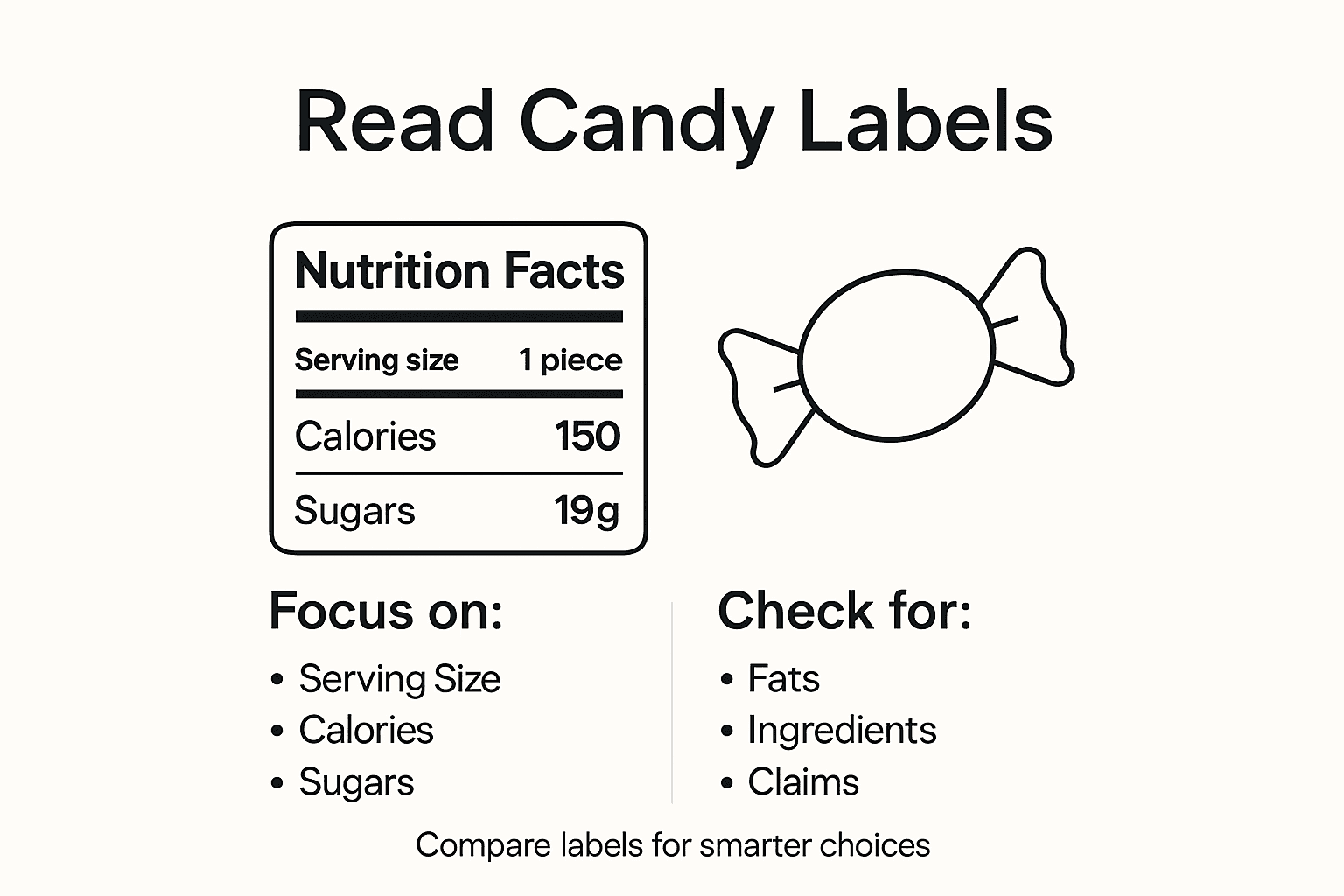
Nutritional labels provide detailed information about sugars and fats, often using color coded systems to indicate low, medium, or high levels. Pay special attention to two key sugar categories: total sugars and added sugars. Total sugars include both natural and manufactured sugars, while added sugars represent sweeteners incorporated during processing. Look for ingredients ending in ‘ose’ like sucrose, fructose, and glucose which indicate sugar content.
When analyzing ingredient lists, remember they are organized by weight in descending order. This means the first few ingredients represent the largest proportion of the product. Watch for hidden sources of sugar like corn syrup, honey, maple syrup, and fruit juice concentrates. For fats, distinguish between saturated and unsaturated types. Saturated fats typically come from animal products and can raise cholesterol levels, so limit your intake. Unsaturated fats from nuts or plant sources are generally healthier alternatives.
Pro tip: Use your smartphone to quickly research unfamiliar ingredients while shopping to understand their nutritional impact.
Step 5: Verify nutritional claims for accuracy
In this critical step, you will learn how to critically evaluate the nutritional claims on candy packaging and ensure you are making truly informed purchasing decisions. Understanding how to decode marketing language will help you see through potentially misleading statements.
Government regulations mandate strict guidelines for nutritional claims on food packaging. Terms like ‘fat-free’ or ‘low sugar’ are not just marketing buzzwords but have specific legal definitions. For example, ‘fat-free’ means the product contains less than 0.5 grams of fat per serving, while ‘low sugar’ indicates a specific threshold of sugar content. Be aware that manufacturers often use creative formatting to make these claims seem more impressive than they actually are.
Always cross-reference the nutritional claims with the actual ingredient list and nutrition facts panel. Look for specific wording that might indicate marketing spin. Phrases like ‘made with real fruit’ do not necessarily mean the product is healthy, and ‘natural’ is not a regulated term that guarantees nutritional value. Pay special attention to serving sizes, as companies might manipulate these to make nutritional claims appear more favorable. If a claim seems too good to be true, it probably is.
Compare common nutritional claims and what they legally mean:
| Claim Term | Legal Definition | What To Watch For |
|---|---|---|
| Fat-Free | <0.5g fat per serving | May still contain small amounts |
| Low Sugar | Meets specific sugar threshold | Serving size often manipulated |
| No Added Sugar | No sugars added during processing | Product may still be high in sugar |
| Made with Real Fruit | Contains fruit or juice | Amount may be minimal |
| Natural | No regulated definition | Not always healthier |
Pro tip: Snap a quick photo of the nutrition label with your smartphone to compare claims across different candy brands later.
Make Smarter Candy Choices with Clear Nutrition and Quality You Can Trust
Understanding nutrition labels is a critical step toward choosing healthier candy options that fit your lifestyle. The article highlights the challenges of decoding serving sizes, sugars, fats, and marketing claims that often confuse shoppers. If you want candy products that simplify these decisions and align with your nutritional goals, consider exploring high-quality freeze dried candy options. These treats offer a unique appeal by preserving flavor and texture while often reducing added sugars and unhealthy fats.

Discover how our expert freeze dried candy manufacturing and private labeling services can provide you with transparent, delicious, and thoughtfully crafted candy products. Whether you are a retailer or a direct consumer, our commitment to clear packaging and honest ingredients supports the goals outlined in the article. Take control of your candy choices today and visit Space-Man’s website to explore our innovative offerings and make a healthier, smarter purchase now.
Frequently Asked Questions
How can I compare the nutrition labels of different candy products?
To compare nutrition labels effectively, gather at least 5-7 different candy products. Focus on key sections such as serving size, calorie content, and added sugars to make an informed assessment of each option.
What should I look for regarding sugar content on candy labels?
Pay attention to both total sugars and added sugars on candy labels. When comparing products, aim for options that have lower added sugars, typically less than 5 grams per serving for a healthier choice.
How do serving sizes affect calorie counts on candy packaging?
Serving sizes determine how calorie counts and other nutritional information are calculated. Always note the serving size and multiply the calorie count by the number of servings you might consume to understand your total intake better.
What are some common misleading claims on candy packaging?
Common misleading claims include terms like ‘fat-free’ or ‘made with real fruit’ that do not guarantee the product is healthy. Always cross-check these claims with the actual ingredient list and nutrition facts to verify their accuracy.
How can I quickly assess the nutritional quality of a candy?
To quickly assess the nutritional quality, focus on the first few ingredients listed, which make up the bulk of the product. Aim for candies where whole ingredients, like nuts or fruit, are listed near the top of the ingredient list for a healthier option.