

TL;DR:
- There is no widely sold Amul-branded cotton candy snack in the United States. Amul’s cotton candy flavor refers to Indian ice cream products and not a packaged candy available locally.
There is no Amul-branded cotton candy snack widely sold in the United States. What shows up in search results as “Amul cotton candy” is actually a regional ice cream flavor sold in India, not a packaged candy product distributed to U.S. retail. If you landed here looking to buy it off a shelf or order it online, that product simply does not exist in this market. Here is what you can do instead:
- Consumers: Check Indian grocery stores for Amul sweets (gulab jamun, peda, laddoo) — those do reach the U.S. through ethnic grocery channels. A cotton-candy-flavored snack from Amul is not among them.
- Businesses and brands: Your real options are sourcing cotton-candy flavor compounds or flossing sugar from U.S. ingredient suppliers, then working with a co-packer like Space-man to produce freeze-dried cotton-candy-flavored products under your own label.
- FDA note: Any packaged candy sold in the U.S. must comply with FDA food labeling rules, including ingredient statements, allergen declarations, and nutrition facts panels.
Table of Contents
- What does “Amul cotton candy” actually mean?
- Can you actually buy Amul cotton candy in the U.S.?
- How to source cotton candy for freeze-dried products in the U.S.
- How does freeze-drying cotton-candy-flavored candy actually work?
- What can Space-man provide for private-label co-packing?
- FDA labeling and allergen rules for packaged cotton-candy candy
- Questions to ask before choosing a freeze-dry co-packer
- Key Takeaways
- Why formulated substrates are the smarter call
- Space-man makes your private-label launch straightforward
- Useful sources and further reading
What does “Amul cotton candy” actually mean?
The confusion here is understandable. Amul is one of India’s most recognized dairy brands, and its cotton candy ice cream flavor is a real product — a 4-liter ice cream container sold in Indian markets. That product never made it to U.S. distribution.
The second layer of confusion comes from recipe culture. Home cooks sometimes use Amul condensed milk or whipping cream when making cotton-candy-flavored ice cream at home, which generates a fair amount of search traffic mixing the brand name with the flavor. Neither of those use cases points to an actual Amul cotton candy snack you can buy in the U.S.
It helps to separate two very different things: spun sugar (what most Americans picture when they hear “cotton candy”) and cotton candy flavor (a synthetic flavor profile used in ice cream, freeze-dried snacks, and candy). Spun sugar is made by spinning liquefied sugar into fine threads — light, airy, and humidity-sensitive. The “cotton candy flavor” found in packaged products is entirely artificial, built primarily from ethyl maltol (caramelized sugar note), strawberry furanone (fruitiness), and vanillin or ethyl vanillin. That combination is what makes a freeze-dried bite taste like a county fair without a single strand of spun sugar involved.
Can you actually buy Amul cotton candy in the U.S.?
Short answer: no. Amul does not distribute a cotton-candy snack product in the U.S. market. The brand’s U.S.-accessible product lines focus on dairy-based Indian sweets: gulab jamun, rosogolla, peda, besan laddoo, motichoor laddoo. Those are the items you will realistically find through ethnic grocery importers or specialty South Asian food retailers.
A few things to watch for if someone claims to sell “Amul cotton candy” in the U.S.:
- It may be a third-party Indian importer selling the ice cream product, which has a shelf life of one day and is not suitable for U.S. retail distribution.
- Import of Amul dairy products into the U.S. requires FDA entry review, and products must meet U.S. labeling standards. Many informal imports skip this.
- The product may simply be mislabeled or misrepresented.
If you want authentic Amul dairy sweets, your best bet is a well-stocked South Asian grocery store or an online ethnic food retailer. For cotton-candy flavor in a snack format, you are looking at a completely different supply chain.
How to source cotton candy for freeze-dried products in the U.S.
Three practical routes exist for businesses building a cotton-candy-flavored product:
- Pre-spun cotton candy (ready-to-eat): Convenient for sampling, but humidity-sensitive and fragile. Freeze-drying loose spun sugar directly creates handling and consistency problems. Not recommended for commercial production.
- Flossing sugar (machine-ready): Specialty suppliers like Nature’s Flavors carry flossing sugar in over 100 pre-flavored options, including natural and dye-free versions suited to clean-label brands. This works well if you are spinning sugar on-site, but still presents challenges for freeze-drying at scale.
- Cotton-candy flavor compounds and syrups: The most reliable route for freeze-dried production. Flavor houses supply concentrated ethyl maltol and vanillin blends with technical data sheets covering dosing, stability, and compatibility with your substrate. This is what most commercial freeze-dried candy manufacturers actually use.
Pro Tip: For consistent freeze-dried texture and shelf life, use a formulated candy or flavored substrate rather than trying to freeze-dry loose spun sugar. Spun sugar collapses under the moisture and pressure changes of the freeze-drying cycle. A stable candy matrix holds the flavor and the crunch.
For sourcing contacts, look at flavor houses (IFF, Givaudan, smaller specialty suppliers), confectionery ingredient distributors, and U.S. co-packers who accept client-supplied flavors. Nature’s Flavors also sells bulk flossing sugar in natural and dye-free options, which matters if your brand positioning is organic or vegan.
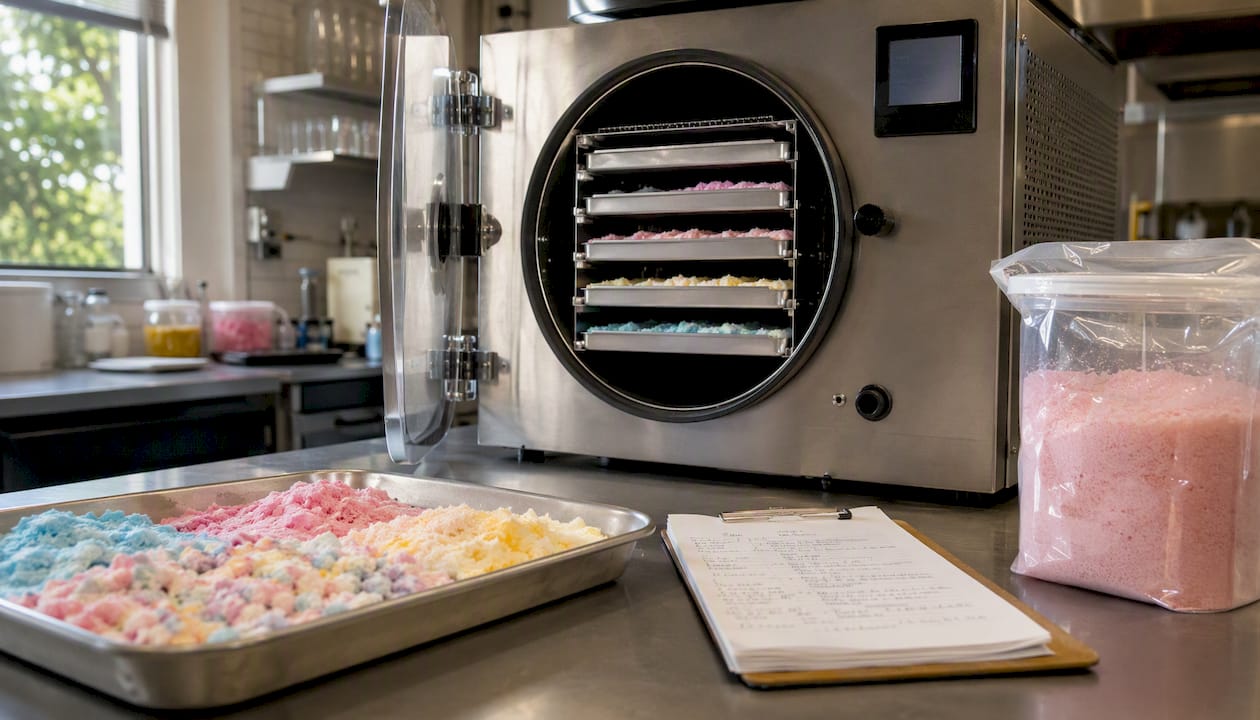
How does freeze-drying cotton-candy-flavored candy actually work?
Freeze-drying preserves flavor concentration and produces a crisp, airy texture. It is not the same as spun sugar, but it absolutely delivers the cotton-candy flavor profile, often more intensely than the original.
The process starts with formulation: you choose a candy or flavored syrup substrate that carries the cotton-candy flavor compounds. That substrate is frozen to a very low temperature, then placed in a vacuum chamber where ice sublimates directly into vapor (primary drying), followed by a secondary drying phase to remove residual moisture. The result is a shelf-stable, porous piece with concentrated flavor and a satisfying crunch. For a deeper look at why freeze-drying outperforms dehydration for candy, the freeze dryer vs. dehydrator comparison from Space-man covers the technical tradeoffs well.
Packaging is where most brands underinvest. Freeze-dried candy is moisture-sensitive. Without proper barrier pouches, nitrogen flushing, or oxygen scavengers, the crunch degrades and the flavor fades. The table below shows how your substrate choice affects texture and shelf expectations:
| Substrate | Texture after freeze-drying | Shelf life (sealed barrier pouch) | Notes |
|---|---|---|---|
| Pre-spun cotton candy | Inconsistent; prone to collapse | Short; highly variable | Not recommended for commercial runs |
| Formulated candy (gummies, chews) | Crisp, porous, uniform | Longer when properly packaged | Best for consistent production |
| Flavored syrup/substrate | Light, airy, concentrated flavor | Longer when properly packaged | Preferred for custom flavor development |
Request technical data sheets from your flavor supplier covering ethyl maltol stability at freeze-drying temperatures before finalizing your formulation.
What can Space-man provide for private-label co-packing?
Space-man offers private-label and co-packing services that cover the full production path for cotton-candy-flavored freeze-dried products: custom flavor runs, bagging, packaging, and retail display kits. For businesses that want to launch a branded freeze-dried candy line without building their own production facility, that is the practical path.
When evaluating any co-packer, ask for these specifics upfront:
- MOQs and lead times: Understand the minimum order quantity for a custom flavor run and the typical turnaround from approved formulation to finished product.
- Formulation assistance: Can they work with a flavor compound you supply, or do they have in-house flavor options?
- Packaging formats: Stand-up pouches, windowed retail bags, and bulk distributor kits are the standard options. Space-man’s wholesale display kits are a ready-made retail merchandising solution.
- Sampling policy: Always request a sample run before committing to a full production order.
- Shelf-life testing: Ask for water activity and moisture content data, plus accelerated shelf-life test results.
- Allergen controls: Confirm cross-contact protocols and whether the facility handles common allergens.
Space-man publishes product and service details on its website. Visit the co-packing services page for current specs, packaging options, and contact information.
FDA labeling and allergen rules for packaged cotton-candy candy
Every packaged candy sold in U.S. retail must comply with FDA food labeling requirements. Here is the practical checklist:
| Labeling element | Requirement |
|---|---|
| Ingredient statement | All ingredients listed in descending order by weight |
| Artificial flavor declaration | “Artificial flavor” must appear if synthetic flavor compounds are used |
| Allergen declaration (FALCPA) | Major allergens (milk, wheat, peanuts, tree nuts, soy, eggs, fish, shellfish, sesame) must be declared |
| Nutrition Facts panel | Required for most packaged foods; serving size must follow FDA reference amounts |
| Net quantity of contents | Required on principal display panel |
| Manufacturer/distributor name and address | Required |
For artificial colorants (common in cotton-candy products), FDA requires specific color additive declarations. If you are importing Amul-branded products, each shipment is subject to FDA entry review, and products not meeting U.S. labeling standards will be refused entry. The FDA food labeling guidance is the authoritative source; review it before finalizing packaging artwork.
Questions to ask before choosing a freeze-dry co-packer
The three deal-breakers are formulation expertise, predictable lead times and MOQs, and validated shelf-life testing. Ask about those first, before anything else.
- What is your minimum order quantity for a custom flavor run?
- Can you work with client-supplied flavor compounds, or do you require your own formulations?
- What is your standard lead time from approved sample to finished production run?
- Do you provide water activity and moisture content data with each batch?
- What accelerated shelf-life testing do you conduct, and can you share results?
- What packaging formats do you support (stand-up pouches, windowed bags, bulk)?
- What allergen controls are in place, and do you have a written cross-contact protocol?
- What is your sample policy, and what does a sample run cost?
- What QA certifications does your facility hold?
- What does the scale-up path look like from small run to full production volume?
Red flags to walk away from: a co-packer who cannot provide samples, has no documented traceability, lacks written allergen controls, or cannot produce shelf-life test data. Those gaps become your liability once the product is on shelf. For more on co-packing workflows and what to expect from a freeze-dried production partner, Space-man’s blog covers the operational side in detail.
Key Takeaways
No Amul cotton candy snack exists in U.S. retail; businesses seeking that flavor profile need a formulated freeze-dried product built with a U.S. co-packer.
| Point | Details |
|---|---|
| Amul cotton candy in the U.S. | Not a real U.S. retail product; Amul’s cotton candy references are regional Indian ice cream flavors only. |
| Spun sugar vs. flavor compound | For freeze-dried production, use a formulated substrate with cotton-candy flavor compounds, not loose spun sugar. |
| FDA compliance | Every packaged candy needs an ingredient statement, allergen declarations under FALCPA, and a Nutrition Facts panel. |
| Co-packer selection | Prioritize formulation expertise, documented shelf-life testing, and clear MOQs before signing with any co-packer. |
| Space-man | Offers private-label co-packing, custom flavor runs, and retail display kits for freeze-dried cotton-candy-flavored products. |
Why formulated substrates are the smarter call
Cotton-candy flavor is one of those profiles that sounds simple and turns out to be surprisingly tricky to execute well in a freeze-dried format. Loose spun sugar looks great at a fair, but it is essentially a humidity sponge. Put it through a freeze-drying cycle and you get inconsistent results, handling headaches, and a product that degrades fast without near-perfect packaging.
The brands that get this right start with a stable candy matrix, work with a flavor house to nail the ethyl maltol and vanillin balance, and then invest in proper barrier packaging. The cotton-candy nostalgia hits harder in a well-formulated freeze-dried bite than it ever does in a bag of spun sugar that went soft on the shelf. Chasing the Amul brand name for a U.S. cotton candy product is a dead end. Building your own version with the right formulation and a reliable co-packer is where the actual opportunity is.
Space-man makes your private-label launch straightforward
If you are a U.S. brand or distributor ready to launch a cotton-candy-flavored freeze-dried product, Space-man handles the production side so you can focus on the brand. Custom flavor runs, private-label bagging, retail display kits, and small-run sampling are all available through Space-man’s co-packing and private-label services.
The process is simple: request a sample run, confirm your MOQ and packaging format, approve the artwork, and go. Space-man’s starter packs and display kits give new brands a fast path to shelf without a massive upfront commitment. Reach out through the services page to get a quote and start the conversation.
Useful sources and further reading
- Cotton candy overview and flavor history — Wikipedia
- What flavor is cotton candy? — Sporked
- Amul sweets product catalog — Amul Shop
- Amul cotton candy ice cream (India market listing) — IndiaMart
- Flossing sugar and cotton candy flavor compounds — Nature’s Flavors
- Flavor compound chemistry references (ethyl maltol, vanillin) — Good Scents Company
- FDA food labeling and nutrition guidance — FDA.gov
- Space-man private-label and co-packing services
Review the FDA labeling page before finalizing any packaging artwork, and always request technical data sheets from your flavor house when developing a cotton-candy profile. Those two steps alone prevent most of the compliance and formulation problems that slow down a product launch.