

TL;DR:
- Ingredient sourcing in Canadian candy manufacturing is vital for product quality, consistency, and market competitiveness.
- High-quality ingredients require strict supplier qualification, traceability, and ongoing quality control processes.
- Strategic supplier relationships and private label sourcing can provide a competitive edge and brand differentiation.
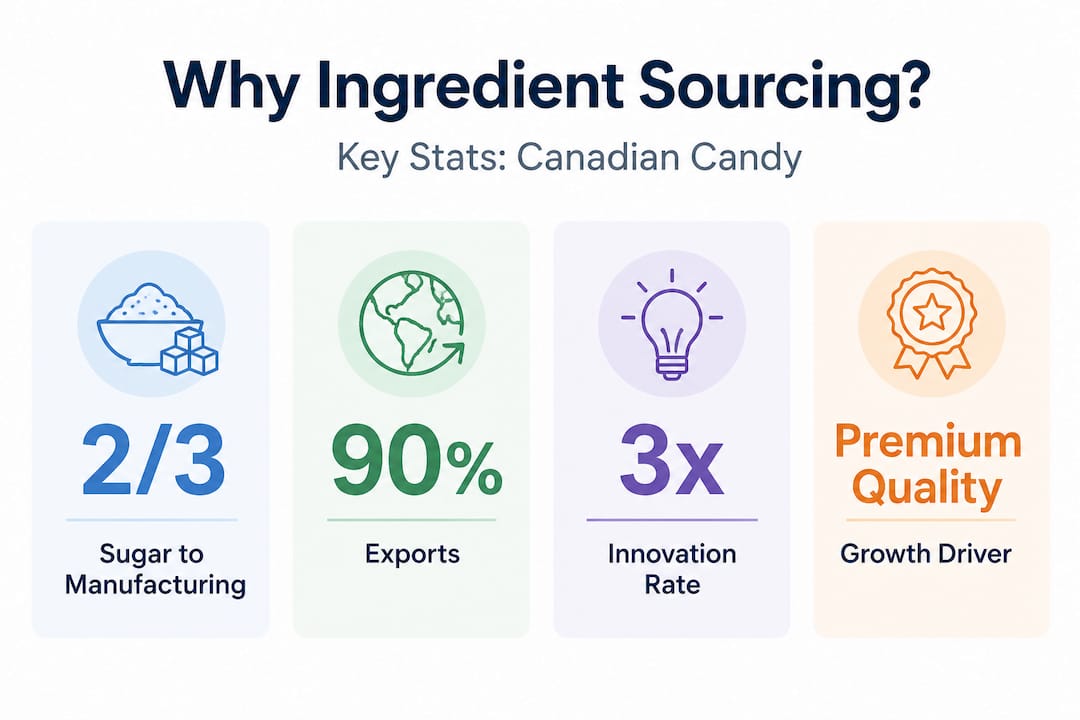
Roughly two-thirds of refined sugar produced in Canada flows directly into food manufacturing, with confectionery taking a major share. That single fact tells you everything about how ingredient-dependent this industry really is. For Canadian candy manufacturers, retailers, and specialty dessert shops, the question isn’t whether ingredient sourcing matters. It’s whether you’re treating it as a strategic function or an afterthought. The sourcing decisions you make upstream determine your product quality, your margins, your ability to launch private label lines, and ultimately how strongly your brand competes on shelf.
Table of Contents
- Understanding ingredient sourcing in the candy sector
- Key ingredient quality criteria every buyer should know
- Choosing the right suppliers: direct trade, brokers, and volume consistency
- Leveraging private label and sourcing for differentiation
- Why ingredient sourcing is your silent competitive edge
- Take your candy business further with sourcing and private label support
- Frequently asked questions
Key Takeaways
| Point | Details |
|---|---|
| Quality drives results | Top-quality ingredients directly impact taste, exportability, and brand reputation for Canadian candy businesses. |
| Supplier choice matters | Choosing between direct trade and brokers affects your ability to scale, differentiate, and control costs. |
| Certifications ensure trust | Sourcing from certified suppliers supports safety, traceability, and premium positioning. |
| Private label unlocks growth | Leveraging private label programs and unique ingredient sourcing fuels distinct, high-margin products. |
Understanding ingredient sourcing in the candy sector
Ingredient sourcing is the process of identifying, qualifying, and maintaining reliable suppliers for everything that goes into your product. For candy businesses, that means sugar, cacao, natural and artificial flavorings, fruit inclusions, acids, colors, and specialty coatings. None of these categories are simple. Sourcing the wrong sugar grade can ruin batch consistency. Sourcing cacao from an unverified supplier can expose you to quality or regulatory issues.
For Canadian manufacturers, there’s an added layer of complexity. Over 90% of confectionery sales in Canada come from exported products, meaning your ingredient quality has to hold up to international scrutiny. Export-grade candy demands tighter specification adherence, more thorough documentation, and supplier relationships that can scale without sacrificing consistency.
Canadian candy businesses also operate in a sector that has been rapidly innovating. A high percentage of confectionery companies launched new products between 2021 and 2023, which means sourcing teams are constantly evaluating unfamiliar ingredients, new formats, and novel flavor systems. Staying competitive requires more than just a reliable sugar supplier.
Here’s a quick look at the main ingredient categories and what makes sourcing each one uniquely challenging:
| Ingredient | Key sourcing challenge | Why it matters |
|---|---|---|
| Sugar | Granulation consistency, supply reliability | Texture, shelf life, process efficiency |
| Cacao | Origin traceability, fermentation quality | Flavor depth, regulatory compliance |
| Fruit inclusions | Moisture control, allergen management | Texture integrity, labeling accuracy |
| Natural flavors | Regulatory classification, potency consistency | Consumer trust, batch repeatability |
| Specialty coatings | Tempering behavior, ingredient purity | Appearance, mouthfeel, premium positioning |
A few things every sourcing buyer needs to track from day one:
- Supplier certifications and audit histories
- Ingredient traceability back to region or farm level
- Lead times and minimum order quantities at scale
- Allergen management protocols at the supplier’s facility
- Flexibility to accommodate product innovation requests
For a more step-by-step sourcing guide tailored to Canadian candy operations, there are frameworks specifically built for navigating domestic and import supplier options.
“The baseline for successful candy sourcing is not just price. It’s whether your supplier can deliver exactly what you need, every time, at the volume your business requires.”
Key ingredient quality criteria every buyer should know
Once you understand the landscape, knowing exactly what defines quality in each ingredient category becomes your most powerful buying tool. For freeze-dried candy and private label products especially, ingredient quality is a non-negotiable lever.
Cacao
For chocolate-based confections, cacao quality is the foundation. According to sourcing best practices for confectionery, buyers should look for bean uniformity, proper fermentation levels, moisture content in the 6 to 7 percent range, and a low defect rate. These aren’t cosmetic details. Improper fermentation means underdeveloped flavor. High moisture increases spoilage risk and shortens shelf life. Uneven bean size creates inconsistent roasting results that cascade through your entire production.
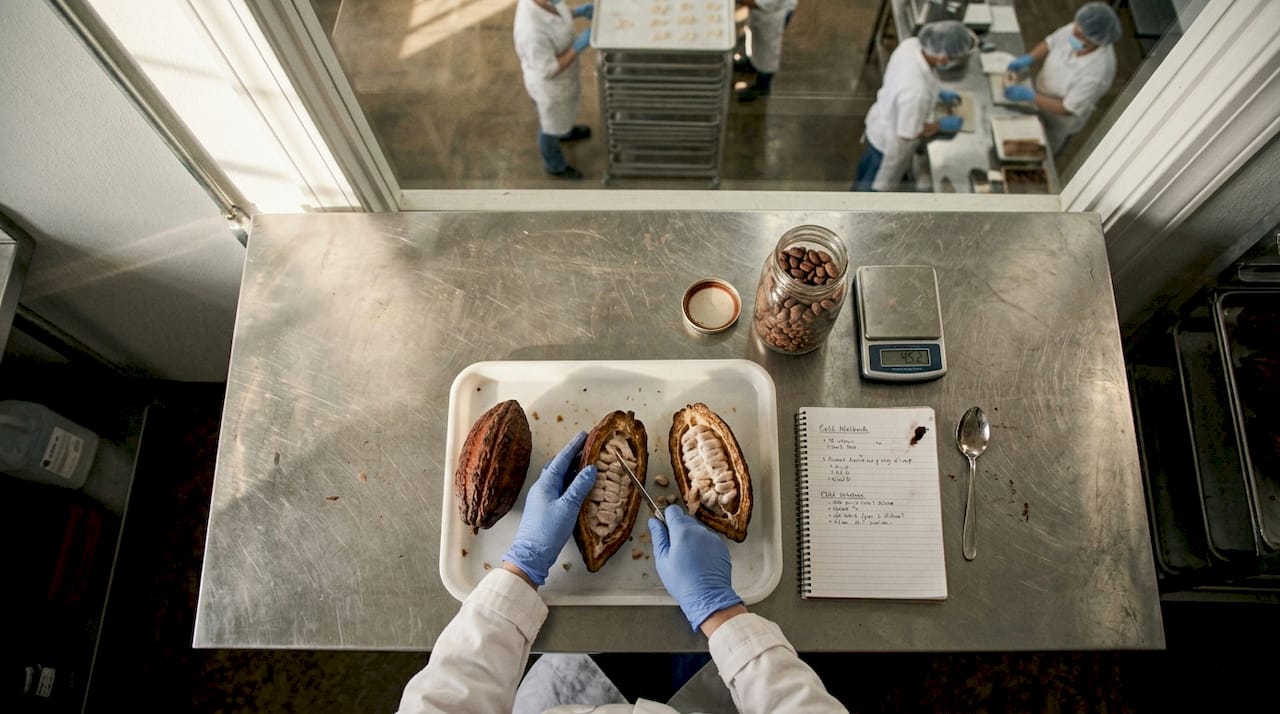
Certifications like Organic and Fair Trade signal that a supplier has been audited for both product integrity and ethical sourcing practices. These credentials also matter to retailers and end consumers who are making purchasing decisions based on values, not just taste.
Sugar
Sugar seems simple until you get into the specifics. Granulation size, purity percentage, and color consistency all affect how sugar behaves in candy production. Coarse sugar dissolves differently than fine sugar. Residual molasses content affects both color and flavor in ways that can throw off your recipe at scale. A reliable sugar supply is the backbone of any candy operation, because even minor fluctuations in incoming sugar quality can require costly formula adjustments.
Fruit and specialty inclusions
Fruit inclusions, nut pieces, and flavored coatings each carry their own set of quality variables. Moisture content is critical, especially for freeze-dried applications where the base ingredient’s water activity directly impacts the final crunch and texture. Allergen management is another major consideration. Cross-contamination risk at the supplier’s facility must be clearly documented and controlled, both for consumer safety and for accurate label claims.
Here’s a numbered checklist for implementing quality control on incoming ingredients:
- Request and review the supplier’s Certificate of Analysis (COA) for every batch.
- Conduct visual inspection for color consistency, particle size, and foreign matter.
- Run sensory evaluation including aroma and taste checks against your baseline standard.
- Test moisture content on arrival using a calibrated moisture analyzer.
- Cross-reference allergen declarations with your own product specifications.
- Document all findings in a batch tracking log for traceability.
Pro Tip: Build a supplier scorecard that tracks quality pass rates per shipment. After six months, you’ll have objective data to renegotiate terms or switch suppliers if performance is below standard. This also protects you during factory-level QA practices reviews or any third-party audits.
A useful comparison when evaluating ingredient tiers:
| Quality tier | Indicators | Best suited for |
|---|---|---|
| Premium | Certified, low defect, full traceability | Private label, export products |
| Standard | Compliant, consistent, cost-effective | High-volume mainstream lines |
| Commodity | Lowest price, minimal documentation | Bulk filler usage only |
Most Canadian candy businesses that compete on quality operate in the premium to standard range across their core ingredients, with commodity inputs reserved only for applications where the ingredient’s flavor contribution is minimal.
Choosing the right suppliers: direct trade, brokers, and volume consistency
Knowing what you need is only half the equation. Choosing the right type of supplier makes the quality promise real for your business at every volume level.
Direct trade
Direct trade relationships, where you source cacao or specialty ingredients directly from a producer or cooperative, offer the highest level of traceability. You know exactly where the ingredient came from, how it was processed, and what the farming conditions looked like. Scaling with direct trade offers blending consistency for flavor stability and command premium positioning in the market. The tradeoff is cost and logistics. Direct trade often requires larger minimum commitments and more active relationship management.
Brokers and importers
For most small to mid-sized Canadian candy businesses, working with established brokers or importers is a practical and scalable solution. Brokers aggregate supply from multiple origins, which means you get access to broader variety and more flexible order sizes. The downside is that you’re adding a layer between you and the original source, which means diligent quality checks on your end become even more important.
Here’s a direct comparison of the two models:
| Factor | Direct trade | Brokers and importers |
|---|---|---|
| Traceability | High, farm to facility | Moderate, depends on broker |
| Price | Premium, reflects relationship | Competitive, volume-based |
| Order flexibility | Lower, larger minimums | Higher, more flexible MOQs |
| Variety | Narrow, origin-specific | Broad, multi-origin access |
| Relationship depth | Deep, long-term | Transactional or partnership |
Key criteria for vetting any supplier, regardless of model:
- Current food safety certification (HACCP, SQF, or equivalent)
- Allergen management documentation for shared facilities
- On-time delivery track record over the past 12 months
- Willingness to provide references from similar-scale buyers
- Capacity to grow with your volume without compromising quality
For a more detailed framework on selecting candy suppliers, there are specific qualification questions that can help you filter out suppliers who look good on paper but can’t perform under pressure. For broader operational context, bulk supply chain strategies offer a useful look at how Canadian retailers structure their upstream sourcing to protect margin and shelf performance.
Pro Tip: Never single-source a critical ingredient. Maintain a backup supplier relationship even if you’re currently happy with your primary partner. Supply disruptions, port delays, and weather events affecting crop yields happen without warning, and your production schedule can’t afford to stop.
Leveraging private label and sourcing for differentiation
With the right suppliers in place, your sourcing strategy becomes a vehicle for brand growth and marketplace distinction. This is where the real opportunity lies for Canadian candy retailers and specialty shops.
The Canadian confectionery sector has seen high levels of product innovation in recent years, and private label is ideal for differentiation in retail precisely because it lets you capture that innovation energy under your own brand name. Instead of competing on price against nationally distributed products, you offer something exclusive.
Freeze-dried candy is a prime example. The format rewards exceptional base ingredients because the freeze-drying process concentrates flavor and amplifies texture in ways that standard processing doesn’t. Sourcing premium fruit pieces or specialty sour coatings gives you the raw material for genuinely unique products that can’t be easily replicated.
Here’s what a sourcing-driven private label strategy looks like in practice:
- Identify a trending flavor profile (for example, tropical fruit, spicy heat, or nostalgic candy formats) and source specialty inclusions that match.
- Work with your co-packer to develop small test batches using two or three different ingredient sources to compare results.
- Select the best-performing combination and lock in a preferred supplier agreement.
- Launch under your brand with clear label differentiation (allergen-free, natural flavors, Canadian-made, etc.).
- Monitor sell-through and customer feedback, then use that data to source your next iteration.
Diversifying your ingredient sources also reduces risk. If one supplier has a quality issue or supply gap, you can pivot without shutting down production. This resilience is especially valuable in fast-moving specialty retail environments where out-of-stock situations directly damage brand reputation.
“A private label line built on distinctive ingredient sourcing gives you a margin story and a brand story at the same time. That’s rare.”
Working with a co-packer who has established ingredient sourcing relationships can dramatically shorten your path to market. Learn more about private label benefits for Canadian retailers building exclusive candy lines.
Why ingredient sourcing is your silent competitive edge
Most Canadian candy businesses spend a lot of energy on packaging design, social media, and retail placement. These things matter. But the companies that consistently outperform their peers over five or ten years are almost always the ones with smarter sourcing structures underneath everything.
Here’s the uncomfortable truth. Most operators treat ingredient sourcing as a procurement task rather than a strategic function. They buy what’s available, accept what’s cheapest, and then wonder why their product consistency slips at volume or why their margins erode faster than expected. Sourcing isn’t just about finding the best price for sugar. It’s about building a supply architecture that lets you move fast when a trend emerges and hold steady when supply chains tighten.
The brands that weather inflation cycles better than their competitors usually have two things in common. First, they have documented supplier agreements with price stability clauses or volume commitments that buffer them from spot market swings. Second, they’ve diversified enough that no single supplier failure can halt production. These aren’t complex strategies. They’re disciplines that most small operators simply haven’t formalized.
There’s also a product innovation dimension that rarely gets discussed. When you have deep relationships with specialty ingredient suppliers, you often get early access to new materials before they hit the broader market. A supplier who knows your operation might alert you to a new freeze-dried fruit variety or a novel sour coating system six months before it becomes widely available. That lead time can be the difference between launching a trend and chasing one.
Treat your supplier relationships as long-term investments, not vendor transactions. Visit their facilities when possible. Pay on time. Communicate your growth plans. The suppliers who know your business will give you better service, faster responses, and occasionally better pricing when you need it most. Understanding private labeling cost savings in Canada often starts with recognizing how sourcing efficiency compounds into manufacturing cost advantages over time.
Take your candy business further with sourcing and private label support
If you’re ready to turn proven sourcing strategies into business growth, here’s how Spaceman can help.
Spaceman is a Canadian freeze-dried candy manufacturer and distributor with hands-on expertise in ingredient sourcing, private label development, and co-packing for retailers and specialty brands. Whether you’re building your first exclusive product line or scaling an existing one, our team understands what it takes to source smart and produce consistently at volume. We offer private label and co-packing services designed for candy businesses that want to compete on quality and brand distinction, not just price. If you want to see what’s possible before committing, our freeze-dried candy starter pack gives you a concrete look at the quality we deliver at wholesale volume. Let’s build something worth putting your name on.
Frequently asked questions
What certifications are important when sourcing ingredients for candy?
Key certifications include Organic, Fair Trade, HACCP, and allergen management labels. Verifying these certifications when sourcing cacao and other core ingredients protects your product integrity and builds consumer trust with safety-conscious buyers.
How can private label help me differentiate my candy brand?
Private label lets you offer exclusive flavors and dietary options that competitors can’t carry, giving your retail presence a unique identity. Given the high innovation rate in Canadian confectionery, there’s strong market appetite for products that stand apart from mainstream SKUs.
What’s the advantage of direct trade versus brokers for candy ingredient sourcing?
Direct trade delivers full traceability and premium quality while brokers offer broader variety, flexible minimums, and easier access to volume. The right choice depends on your scale, your quality requirements, and how much supplier relationship management your team can handle.
How critical is raw ingredient quality for freeze-dried candy production?
It’s essential. The freeze-drying process intensifies flavor and texture, which means high-quality base ingredients with proper uniformity, fermentation, and moisture control produce exceptional results, while flawed inputs become more obvious, not less, in the finished product.
Recommended
- Bulk candy supply chains in Canada: retail success guide – Spaceman
- How to Source Canadian Candy: A Complete Step-by-Step Guide – Spaceman
- Boost Candy Margins: Smart Sourcing and Pricing Strategies – Spaceman
- Candy distributor challenges in Canada: 2026 solutions – Spaceman
- Farm to Fork: Why Local Ingredients Make the Best Mexican Food in Canada – Burrito Splendido