

Contract manufacturing is a business arrangement where a hiring company pays a third-party manufacturer to produce goods to its exact specifications, so the hiring company avoids the cost of building its own factory. Firms turn to this model to scale production without sinking capital into equipment or floor space, using organizations known broadly as contract manufacturing organizations. Companies like Space-man apply the same logic to snacks: brands bring the recipe and packaging idea, and the manufacturer handles the rest, often under quality frameworks tied to standards like ISO.
TL;DR:
- The quality and reliability of the contract manufacturer depend heavily on their certifications like ISO 9001, and on clear, detailed contracts specifying quality standards and acceptance criteria.
- Selecting a manufacturer requires checking their capacity, lead times, raw material sourcing protocols, and whether they already produce similar products to ensure a good match.
- Outsourcing offers speed and capital savings, but risks include quality issues, intellectual property exposure, and supplier dependence that need proactive management.
- A typical process involves quoting, prototyping, sourcing materials, pilot runs, full-scale production, and rigorous quality inspections before shipment.
- Space-man offers turnkey and private-label contract manufacturing for snack brands, starting from small pilot batches to retail-ready packaging solutions.
Table of Contents
- What Is Contract Manufacturing? A Closer Look
- What Are the Main Types of Contract Manufacturing?
- How Does the Contract Manufacturing Process Work?
- What Are the Benefits and Risks of Contract Manufacturing?
- What Are Real Examples of Contract Manufacturing?
- How Do You Choose the Right Contract Manufacturer?
- How Does Space-man Approach Contract Manufacturing for Snack Brands?
- Should You Outsource or Keep Production In-House?
- Ready to Turn Your Snack Idea Into a Packaged Product?
- Where to Learn More About Contract Manufacturing Standards
- Sources
- FAQ
What Is Contract Manufacturing? A Closer Look
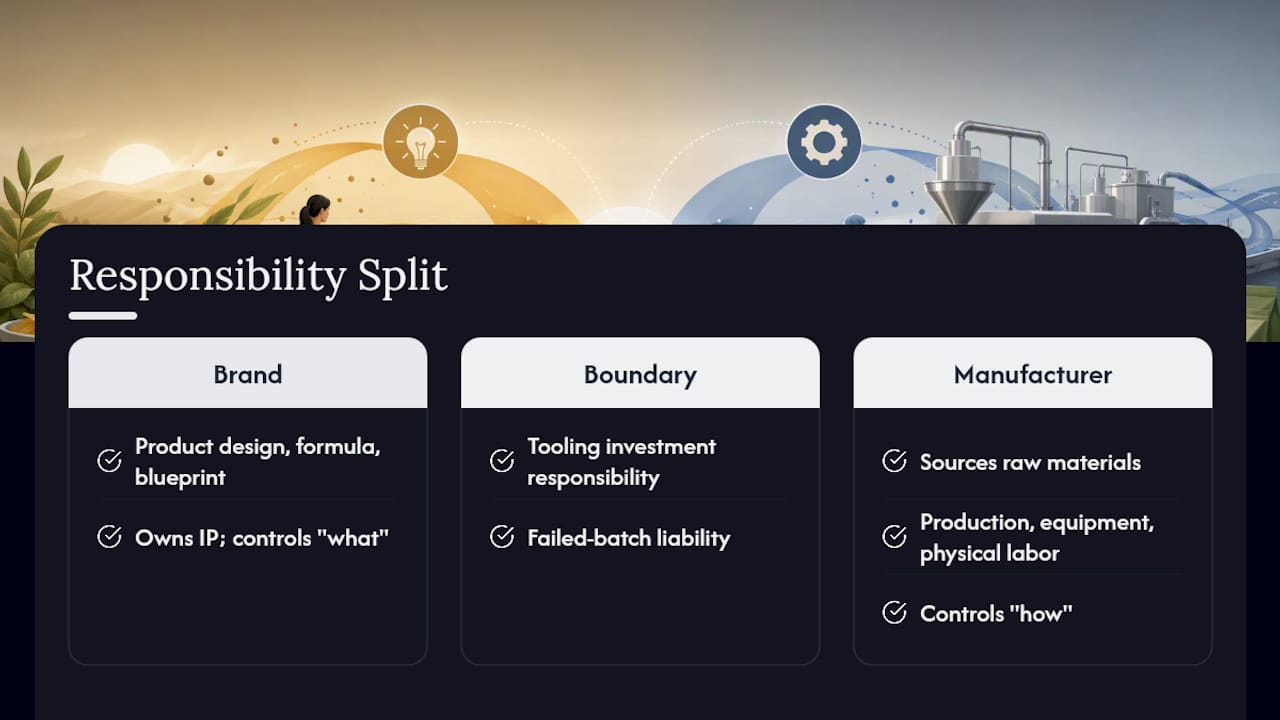
The definition above covers the basics, but the real value shows up in how responsibilities split between the two parties. The hiring company almost always retains ownership of the product design, formula, or blueprint. The contract manufacturer typically sources raw materials and runs production to those specifications, which means the brand controls the “what” while the manufacturer controls the “how.”
That division matters because it shapes everything downstream, from who pays for tooling to who’s liable if a batch fails inspection. A skincare startup might design a serum formula and hand off mixing, filling, and labeling entirely. A hardware company might design a circuit board and rely on a foundry to fabricate it at scale. In both cases, the brand keeps the intellectual property while outsourcing the physical labor and equipment investment.
What Are the Main Types of Contract Manufacturing?
Not every contract manufacturing deal looks the same. The model you pick depends on how much control you want to keep and how finished your product concept already is.
- Private label manufacturing: The manufacturer already has a formula or product design, and the brand simply applies its own packaging and label. This is common in cosmetics, supplements, and snack foods where speed to market beats originality.
- Turnkey or full-service manufacturing: The manufacturer handles nearly everything, from sourcing components to final assembly and sometimes even packaging design consultation. Electronics brands lean on this heavily because building an in-house assembly line for a single product run rarely pencils out.
- Component or toll manufacturing: The brand supplies some or all raw materials, and the manufacturer just processes them, charging a “toll” for the labor and equipment time. This shows up often in chemicals and specialty food ingredients.
- Co-packing (contract packaging): A co-packer takes a finished or semi-finished product and handles bagging, labeling, and sometimes secondary processing like freeze-drying. Food and beverage brands rely on this model constantly because packaging lines are expensive and highly specialized.
Industry patterns tend to hold up: electronics gravitates toward turnkey and foundry setups, pharma leans on dedicated contract manufacturing organizations, and consumer packaged goods split between private label and co-packing depending on how original the recipe is.
How Does the Contract Manufacturing Process Work?
The workflow follows a fairly predictable sequence, whether you’re ordering circuit boards or freeze-dried gummy bears. Oracle’s supply chain documentation frames contract manufacturing as an integrated flow touching procurement, manufacturing, and logistics, with clear handoffs at each stage.
- Request for quote (RFQ): You submit specs, target volume, and timeline; the manufacturer responds with pricing and lead time.
- Prototyping and sample approval: A small batch or prototype gets built and sent for sign-off before anything scales up.
- Material sourcing: The manufacturer secures raw materials, either from its own supplier network or ones you specify.
- Pilot run: A limited production run tests the process at slightly higher volume, catching issues before a full commitment.
- Full production: Once the pilot passes, the manufacturer runs at agreed volume and schedule.
- Quality control and inspection: Batches get checked against acceptance tests and buyer-supplied specifications before shipping.
- Packaging and shipping: Finished goods get packed, labeled, and routed to your warehouse or directly to retail.
Expect a paper trail throughout: spec sheets, acceptance test criteria, and packing lists all get referenced repeatedly, especially if a dispute comes up later. Most of the real negotiating happens around minimum order quantities, lead time guarantees, and who eats the cost of tooling if you switch manufacturers down the road.
Pro Tip: Ask upfront how tooling costs get amortized across your order volume. Some manufacturers bake it into unit price, others charge it as a separate line item that only makes sense once you hit a certain order size.
What Are the Benefits and Risks of Contract Manufacturing?
The upside is straightforward. You skip the capital expense of building a factory, you tap into equipment and expertise you don’t have in-house, and you can usually move faster than if you built production capacity from scratch.
- Lower capital costs: No factory lease, no equipment purchase, no hiring a production team.
- Speed to market: An established manufacturer already has the lines running; you’re slotting into existing capacity.
- Access to specialized skills: Freeze-drying, injection molding, and pharmaceutical compounding all require expertise most brands don’t want to build internally.
- Scalability: Ramping production up or down is a conversation with your manufacturer, not a capital project.
The risks are real too. Quality issues, IP loss, and supplier dependence top the list of things that go wrong in these partnerships, often stemming from vague contracts or a lack of oversight.
A useful benchmark: manufacturers holding a recognized quality certification like ISO 9001 give buyers a fast way to screen for baseline process discipline before diving into deeper vetting.
Mitigation isn’t complicated, but it does require discipline. Written service-level agreements with quality standards and financial penalties for missed specs go a long way. Periodic audits, whether done yourself or through a third party, catch drift before it becomes a recall. And dual sourcing, even if it costs a bit more, protects you from a single supplier holding your production hostage.
What Are Real Examples of Contract Manufacturing?
Contract manufacturing looks different depending on the industry, but the core logic stays the same: someone else runs the factory, you run the brand.
- Electronics: A consumer electronics company designs a device and hands fabrication to a foundry that runs a turnkey process, from component sourcing to final assembly.
- Pharmaceuticals: A drugmaker develops a formula and contracts a dedicated organization to handle compounding, filling, and packaging under strict regulatory oversight.
- Food and beverage: A snack brand designs a product and flavor profile, then hands production to a co-packer for bagging, labeling, and sometimes specialty processing.
Here’s how that food and beverage example plays out in practice. A small snack brand wants to launch a freeze-dried candy line but has no freeze-drying equipment and no packaging line. It partners with a co-packer for a small pilot batch, testing flavor and texture before committing to volume. Once the recipe is dialed in, the co-packer handles private-label bagging under the brand’s own packaging design. As demand grows, the brand adds retail display kits so stores can merchandise the product without extra shelving work. No factory purchase, no freeze-dryer sitting idle between runs, just a scalable path from concept to shelf.
How Do You Choose the Right Contract Manufacturer?
Picking a manufacturer is part due diligence, part relationship building. Get both wrong and you’ll spend more time firefighting than growing.
- Confirm capability fit: Does this manufacturer already produce something similar to what you need, or would you be their first attempt?
- Check capacity and minimum order quantities: A manufacturer built for massive runs might ignore a small brand’s pilot order, or price it punitively.
- Ask about lead times: Get this in writing, including what happens if they miss the date.
- Verify quality certifications: ISO or equivalent certifications signal a documented quality system, not just good intentions.
- Review the sample and testing process: How do they handle approval before scaling to full production?
- Nail down IP and confidentiality terms: Your formula or design needs contractual protection, not a handshake agreement.
- Understand the pricing model: Per-unit, tiered by volume, or cost-plus. Know which one you’re signing up for.
When you draft the contract, ask for specific acceptance-test language, meaning the exact criteria a batch must meet to be considered “accepted,” and what recourse you have if it doesn’t. Running a small pilot before committing to full volume is the cheapest insurance you’ll ever buy. It’s also worth applying the same scrutiny to raw material sourcing that food and beverage brands increasingly demand from their supply chains.
Pro Tip: Request a written spec sheet from the manufacturer before you send them yours. If their template looks thin or generic, that tells you something about how seriously they track quality across other clients.
How Does Space-man Approach Contract Manufacturing for Snack Brands?
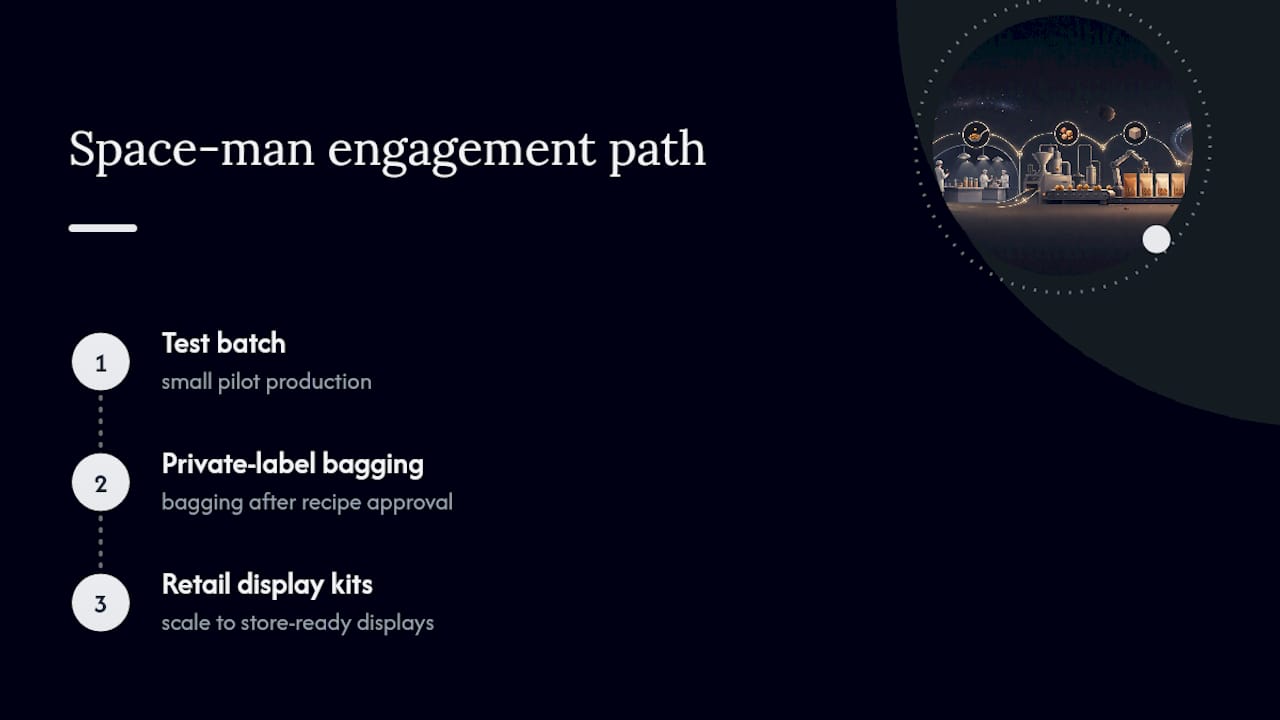
Space-man operates as both a freeze-dried candy manufacturer and a private label, co-packing, and packaging service provider based in Canada. Brands looking to launch a freeze-dried snack line without building their own production setup can work through the same pilot to packaging to display kit path outlined above. A typical engagement starts with a small test batch, moves into private-label bagging once the recipe is approved, and scales into retail-ready display kits as demand grows.
Should You Outsource or Keep Production In-House?
Outsourcing wins when speed and capital efficiency matter more than total control, especially for a new product where demand is unproven. Keep production in-house when your process is proprietary enough that IP exposure outweighs the cost savings, or when you need tight quality control that only direct oversight can guarantee. The honest takeaway: pick the model that matches your risk tolerance, not the one that sounds more impressive on a pitch deck.
— Chadi
Ready to Turn Your Snack Idea Into a Packaged Product?
If your snack brand needs a production partner without the overhead of building your own facility, a manufacturer handles private labeling, co-packing, and packaging for freeze-dried candy, chocolates, marshmallows, and ice cream sandwiches in Canada.

Whether you’re testing a small pilot batch, ready to move to private-label bagging, or looking to add retail display kits for store shelves, the private label, co-packing, and packaging services page walks through what’s available. If you’d rather see the finished product first, the starter pack of freeze-dried candy gives you a hands-on sense of the quality before committing to a bulk order. Reach out to request a quote or sample run and see how a pilot batch might fit your launch plan.
Where to Learn More About Contract Manufacturing Standards
For deeper reading on quality frameworks, the ISO standards library covers management-system certifications manufacturers commonly hold. For a broader definitional overview and typical risks, the Wikipedia entry on contract manufacturers is a solid starting point.
Sources
- Contract manufacturer — Wikipedia
- Overview of contract manufacturing — Oracle Cloud documentation
- Contract Manufacturing: Definition, Types, Examples, and Benefits — MRPeasy
- ISO standard — ISO
FAQ
What does contract manufacturing mean in simple terms?
It means a company pays another business to produce its goods to specified designs, so the hiring firm avoids building its own factory or buying production equipment.
What are the downsides of contract manufacturing?
The main risks are quality inconsistency, intellectual property exposure, and depending too heavily on a single supplier, all of which can be reduced with written quality agreements, audits, and dual sourcing.
Can you give an example of contract manufacturing?
A snack brand that designs a freeze-dried candy recipe and hires a co-packer to handle bagging, private-label packaging, and retail display kits is a working example of contract manufacturing in the food industry.
Is contract manufacturing risky?
It carries real risk around quality and IP, but the risk is manageable with clear contracts, defined acceptance tests, and periodic audits of the manufacturer’s process.
How is contract manufacturing different from in-house production?
In-house production means you own and operate the factory and equipment yourself, while contract manufacturing means a third party owns the production assets and you pay for output under agreed specifications.