

For shelf-stable, retail-ready freeze-dried candy, the right call is a high-barrier flexible pouch with a resealable zipper and a matte or metallic printable surface. Freeze-dried candy is extremely hygroscopic — it pulls moisture from the air quickly — so the packaging has to work as hard as the product itself. A high-barrier laminate using EVOH or metallized film, combined with an airtight heat seal, is what keeps that satisfying crunch intact from production line to retail shelf.
Three things to confirm with any supplier before you place an order:
- FDA food-contact compliance: substrate, inks, and adhesives must all be certified for direct food contact
- High-barrier laminate spec: EVOH laminates, metallized PET/PP, or foil layers — confirm the actual barrier rating, not just the marketing copy
- Airtight construction: heat-seal integrity or a degassing valve strategy appropriate for your fill weight
Space-man’s co-packing and private-label experience puts all three of these at the top of every spec sheet, and the rest of this guide explains exactly why.
Table of Contents
- What packaging formats work best for freeze-dried candy?
- Which materials actually protect freeze-dried candy?
- How does the custom packaging process actually work?
- How do you vet a packaging supplier?
- When does sustainable packaging actually make sense?
- Key Takeaways
- The barrier-first principle most brands learn the hard way
- Space-man handles the spec work so you can focus on the product
- Useful sources
What packaging formats work best for freeze-dried candy?
Custom food packaging for snack products comes in several physical formats, and each one serves a different channel and SKU type. Here is how the main options stack up for freeze-dried candy specifically.
Stand-up (doypack) pouches are the workhorse of retail confectionery. The wide bottom gusset lets them stand on shelf without a display fixture, and a resealable zipper keeps the product fresh after opening. They take full-surface print well, which means your branding gets maximum real estate. The tradeoff: they cost more per unit than flat pouches and carry a higher MOQ at most printers.
Flat pouches are leaner on cost and great for sample packs, subscription box inserts, or single-serve formats. No gusset means no self-standing ability, but for e-commerce and mailer fulfillment that rarely matters. They seal top or bottom and can still carry high-barrier film.
Custom-printed cartons add a premium, gift-ready feel and work well for multipacks or seasonal SKUs. Barrier protection comes from an inner liner or bag, not the carton itself, so you are essentially paying for two packaging components. Worth it for retail gifting; overkill for everyday DTC.
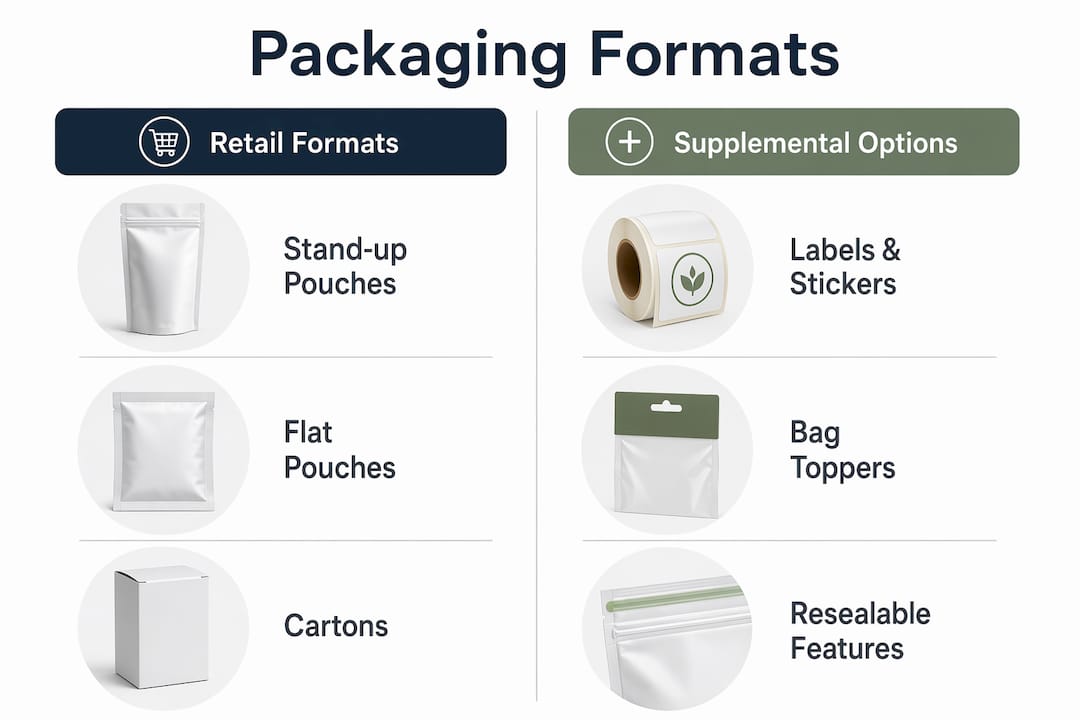
Labels and stickers are the fastest, lowest-cost way to brand a pre-formed container (glass jar, rigid canister, or sealed bag). They do not add barrier value, but for co-packers doing short private-label runs, a custom food label on an already-spec’d pouch is often the most practical starting point.
Bag toppers attach over the top of a pre-sealed flat bag. They are inexpensive, easy to swap for seasonal or private-label variants, and require no new pouch tooling. The catch: they look less polished than a fully printed pouch, and they add a manual application step.
| Format | Barrier potential | Resealable | Retail shelf presence | Unit cost tendency | Typical MOQ shape |
|---|---|---|---|---|---|
| Stand-up pouch | High (with EVOH/foil laminate) | Yes | Strong | Moderate–high | Medium–high |
| Flat pouch | High (with correct film) | Optional | Low | Low–moderate | Low–medium |
| Custom carton | Low (needs inner liner) | No | Strong | High | Medium–high |
| Label/sticker | None | N/A | Moderate | Very low | Very low |
| Bag topper | None | N/A | Low–moderate | Very low | Very low |
For most retail and e-commerce freeze-dried candy SKUs, the stand-up pouch wins. For sample runs and private-label pilots, flat pouches or labeled bags keep costs manageable while you validate the market. See the pouch format breakdown for a deeper look at pouch styles by use case.
Which materials actually protect freeze-dried candy?
The film you choose determines shelf life more than almost any other variable. Freeze-dried candy can lose its crunch within days in a poor-barrier bag, so this is not a place to cut corners for aesthetics.
High-barrier options:
- EVOH laminates: Ethylene vinyl alcohol co-polymer provides excellent oxygen and moisture barrier while allowing clear windows so the product is visible. EVOH and metallized films are the standard recommendation from flexible packaging suppliers for hygroscopic snacks.
- Metallized PET/PP: A thin aluminum layer deposited onto polyester or polypropylene film. Strong moisture and oxygen barrier, opaque finish, and excellent print surface. Slightly lower cost than foil laminates.
- Foil laminates: Aluminum foil layers offer the highest barrier rating of any flexible film. Best for products targeting 12+ month shelf life or harsh distribution environments.
Compostable and kraft options:
Kraft-based compostable films are available and some are FDA-approved for food contact, but they carry real limitations for freeze-dried candy. Certain kraft compostable materials have a structural life of roughly six months, which may fall short of your target shelf life. More importantly, their moisture vapor transmission rates are significantly higher than EVOH or foil laminates. If the product goes soft before the sell-by date, you have created more waste, not less.
FDA compliance checkpoints: The substrate, printing inks, and adhesives used in the laminate all need food-contact certification. This is not just a substrate question. Solvent-based inks and non-food-grade adhesives can migrate into the product even through the film. Always request the supplier’s food-contact declaration before you approve artwork proofs.
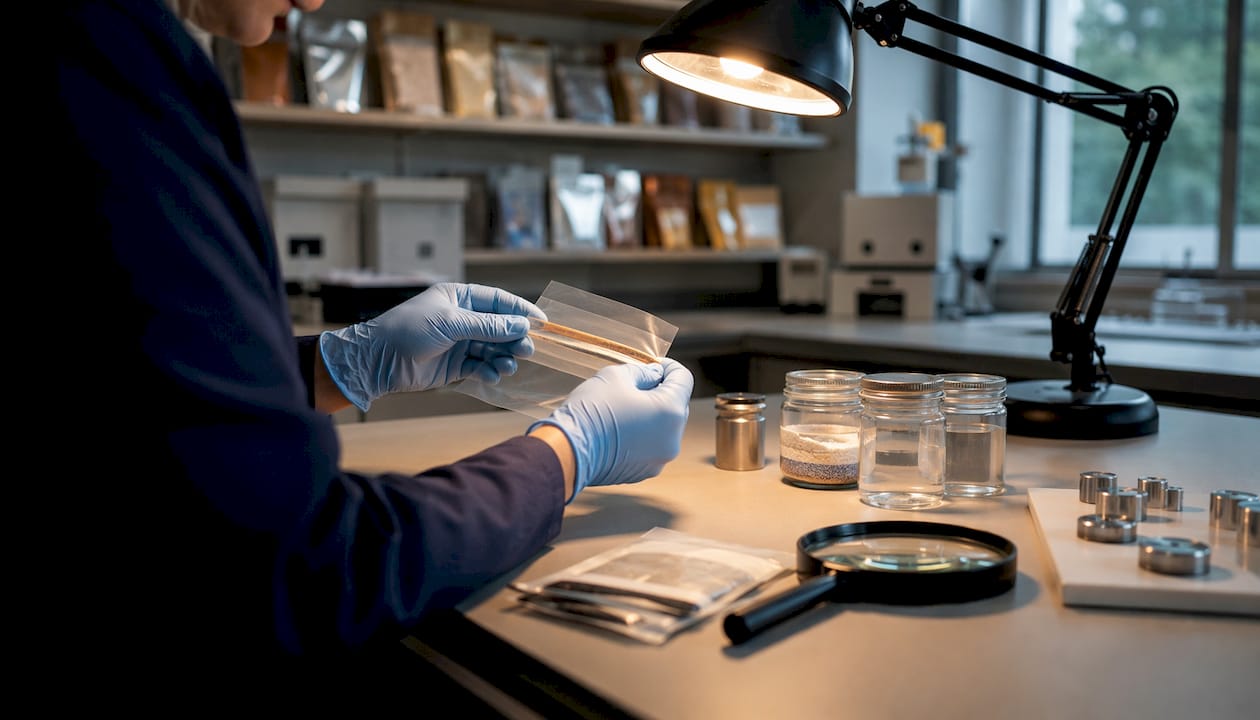
Pro Tip: Ask your supplier for the specific FDA 21 CFR citation covering their substrate and inks before you finalize the dieline. If they cannot produce it, that is your answer.
How does the custom packaging process actually work?
The five-step workflow below applies whether you are running 500 units for a private-label pilot or 50,000 units for a retail launch.
- Select your format and style. Decide on pouch type, size, and closure. Confirm the fill weight and headspace requirements with your production team before locking dimensions.
- Choose your material and barrier spec. Match the laminate to your target shelf life and distribution channel. Get the supplier’s barrier data sheet in writing.
- Submit artwork. Provide print-ready files to the supplier’s dieline template. CMYK color profiles are standard; if you have brand PMS colors, confirm whether the printer supports spot color or will convert to CMYK.
- Digital proofing and approval. Most suppliers now offer browser-based digital proofing tools that let you preview artwork on a 3D render before plates are made. Review carefully — color shifts between screen and print are common, especially on metallized surfaces.
- Production and shipping. Once you approve the proof, production begins. Plan for freight lead time on top of production time, especially for international suppliers.
Milestone timeline:
| Stage | Typical lead time |
|---|---|
| Artwork approval | 1 day |
| Sampling / pre-production run | 21 days |
| Full production run | 2 weeks |
| Freight (domestic US) | 3–10 days |
| Shelf-life bench testing | Run parallel with production |
Cost factors to budget for:
- Plate or digital setup fees (digital printing reduces or eliminates plate costs and lowers MOQs)
- Material premium for high-barrier films vs. standard PE
- Per-unit printing cost (decreases with volume)
- Freight and customs (if sourcing internationally)
- Sample and testing costs for shelf-life validation
Digital printing has changed the MOQ math significantly for short-run private-label orders. Where traditional flexographic printing required large plate runs to be cost-effective, digital setups let smaller brands test SKUs before committing to high-volume production.
How do you vet a packaging supplier?
A supplier who cannot answer basic compliance questions is a liability, not a partner. Use this checklist before you sign anything.
Request and verify:
- FDA food-contact declaration covering substrate, inks, and adhesives
- Laminate spec sheet with actual barrier ratings (MVTR and OTR values)
- Seal strength test data for your fill weight and closure type
- Pre-production samples for shelf-life bench testing
- Print quality proofs on the actual substrate (not just a screen render)
- MOQ and turnaround commitments in writing
- Spec management capability: on-file dielines, color profiles, and batch traceability for multi-SKU lines
Specification management matters more than most buyers realize. Co-packers running multiple SKUs need a supplier who keeps dielines and color profiles on file so reorders do not restart the artwork process from scratch.
Red flags:
- No food-contact paperwork, or vague references to “food-safe materials” without documentation
- Barrier specs described only in marketing language (“high barrier”) with no actual MVTR/OTR data
- Refusal to send pre-production samples before full run approval
- Inconsistent proofing process, or no digital proof step at all
Sample spec request template (paste into your RFP):
- Pouch style and dimensions (W x H x gusset depth)
- Target fill weight and product type (freeze-dried confectionery)
- Required barrier: MVTR ≤ [X] g/m²/day, OTR ≤ [X] cc/m²/day
- Closure type: resealable zipper / heat seal
- Print method: digital or flexographic; color profile: CMYK or PMS
- FDA 21 CFR food-contact declaration for substrate, inks, and adhesives
- MOQ and lead time for sampling and full production run
- Spec management: confirm on-file dieline and color profile retention
Pro Tip: Request a sealed, filled sample run of at least 10–20 units before approving full production. Open them at 30 and 60 days and check for moisture uptake. A supplier confident in their barrier spec will have no problem with this.
When does sustainable packaging actually make sense?
Sustainability and shelf life are not always at odds, but for freeze-dried candy they require careful sequencing. A poor barrier that leads to spoilage creates more total waste than a conventional package that keeps the product intact through its full shelf life. That is the core tension, and it is worth taking seriously before you commit to a compostable substrate.
Sustainable options and their practical limits:
- Industrial compostable kraft films: FDA-approved options exist, but structural degradation timelines and high moisture vapor transmission make them risky for hygroscopic products without shelf-life testing first
- Recyclable mono-polymer pouches (PE or PP): Better barrier performance than kraft composites, curbside-recyclable in many US municipalities, and a credible sustainability claim for retail buyers
- Recycled-content labels and cartons: Low risk, easy to implement, and a genuine environmental improvement with no barrier tradeoff
The practical recommendation: keep the functional barrier film as your primary packaging material and layer in sustainable packaging touches where they do not compromise protection. Branded tissue paper, recycled-content outer cartons, and low-volume printed inserts all reduce your environmental footprint without putting the product at risk.
Pro Tip: If you want to pilot a compostable pouch, run a parallel shelf-life test against your current high-barrier format before switching your full SKU line. Three months of bench testing is far cheaper than a recall or a wave of customer complaints about stale candy.
Key Takeaways
For freeze-dried candy, barrier-first packaging with verified FDA food-contact compliance is the non-negotiable foundation — everything else, including design and sustainability, builds on top of it.
| Point | Details |
|---|---|
| Format recommendation | Stand-up pouches with resealable zippers give the best combination of barrier, retail presence, and branding surface. |
| Two non-negotiables | FDA food-contact compliance for all materials and a verified high-barrier laminate (EVOH, metallized film, or foil). |
| Supplier vetting | Always request barrier spec sheets, food-contact declarations, and pre-production sealed samples before approving a full run. |
| Sustainability sequencing | Pilot compostable or recyclable formats with shelf-life bench tests before switching your full SKU line. |
| Space-man’s approach | Space-man handles spec management, short private-label runs, and barrier-first co-packing for freeze-dried candy in the US market. |
The barrier-first principle most brands learn the hard way
The most common mistake Space-man sees from new freeze-dried candy brands is this: they fall in love with a printed pouch design, approve the artwork, place the order, and only then ask whether the inks and substrate are FDA-certified for direct food contact. Sometimes the answer is no. That means disposing of an entire print run and starting over, which is an expensive and avoidable lesson.
The second most common mistake is choosing a packaging material based on aesthetics or sustainability credentials without running a single shelf-life test. A kraft compostable pouch that looks great on Instagram does nothing for your brand if the candy is chewy and stale by week four.
The checklist in this guide exists because these errors are predictable. Barrier spec first, compliance documentation second, design third. That order feels counterintuitive when you are excited about a new SKU, but it is the sequence that actually gets product to retail shelf without a costly detour. The brands that get this right the first time are the ones who treat packaging as a technical decision before they treat it as a creative one.
Space-man handles the spec work so you can focus on the product
Private-label and co-packing projects move faster when someone else is managing the barrier specs, dielines, and supplier compliance paperwork. Space-man offers private-label, co-packing, and packaging services built specifically for freeze-dried candy and consumer snack brands entering the US market.
What working with Space-man looks like in practice:
- Spec-managed SKUs with on-file dielines and color profiles for fast reorders
- Short-run sample packaging for shelf-life testing and retail buyer presentations
- Artwork proofing workflow with FDA-compliant film and ink confirmation
- Display kit options for distributors and retail floor placement
To get a quote, come prepared with your artwork dieline (or let the team build one), your preferred pouch style and fill weight, and an estimated run quantity. Space-man’s team will confirm barrier specs, compliance documentation, and lead times from there. Reach out through the services page to get the conversation started.
Useful sources
- UPrinting food packaging formats overview — stand-up pouches, flat pouches, bag toppers, and labels with barrier film notes
- Roastar custom food packaging — EVOH and metallized film specs, compostable kraft notes
- MDPI sustainable packaging study — circularity vs. barrier protection tradeoff analysis
- PakFactory custom food packaging — spec management and multi-SKU line guidance
- Restaurantware customization tools — low-MOQ digital proofing and short-run ordering
- Coffee Bags Direct: digital printing for flexible packaging — how digital printing reduces MOQs and speeds proofing
- Space-man sustainable packaging guide — practical tradeoffs for compostable and recyclable formats
- Space-man sweet pouch packaging guide — pouch styles and applications for snack brands
This article is general information for planning purposes. Confirm current FDA regulations and food-contact requirements with your supplier’s compliance documentation or a qualified regulatory professional before finalizing your packaging spec.