

Freeze-dried candy and freeze-dried snacks are a genuinely viable crunchy alternative to chips for U.S. retailers and private-labelers — provided you nail three things from the start:
- Sensory parity: The crunch is real, but it’s lighter and more porous than a fried chip. Consumers who expect oily, dense crunch need a moment to recalibrate. Most do, quickly.
- Sensory shelf-life vs. technical shelf-life: Freeze-dried products can technically last years, but moisture reabsorption kills crispness in months if packaging fails. The product’s sensory clock runs faster than its safety clock.
- Cost and price positioning: Barrier packaging, desiccants, and QA testing push unit costs above a standard chip bag. Plan for a premium price point from day one.
Before you place a purchase order, require these three things from any supplier: a water activity (a_w) reading below 0.3, a packaging spec sheet showing WVTR and OTR values, and a sensory shelf-life test result.
Key Takeaways
Freeze-dried snacks are a credible crunchy alternative to chips when packaging, QA, and pricing are handled correctly from the start.
| Point | Details |
|---|---|
| Packaging is the product | Require metalized pouches with WVTR below 1 g/m²/day; barrier failure kills crispness within months. |
| Sensory shelf-life window | Most formulations remain acceptable for 3–6 months; request sensory panel data, not just a technical date. |
| Safety documentation | Bacteria survive freeze-drying; require HACCP plan, CoA, and allergen controls before any RTE claim. |
| Pilot before scale | Run a 50–200 unit pilot with accelerated shelf-life testing before committing to full production. |
| Space-man as partner | Space-man offers private-label, co-packing, and QA support for U.S. retailers launching freeze-dried snack SKUs. |
Table of Contents
- 1. How freeze-drying actually creates chip-like crunch
- 2. Shelf-life reality and the packaging that keeps snacks crunchy
- 3. Microbiology, safety, and U.S. regulatory basics
- 4. Formats and formulation levers that deliver a chip-like experience
- 5. What retailers must know about private-label and co-packing
- 6. Supplier questionnaire and sample specs to request
- 7. How to merchandise and market freeze-dried snacks as a chip alternative
- 8. Simple tests to validate demand before scaling
- What the freeze-dried snack market actually rewards
- Space-man handles the hard parts of private-label freeze-dried snacks
- Sources
1. How freeze-drying actually creates chip-like crunch
Freeze-drying removes moisture through sublimation: the product is frozen, then placed in a low-pressure chamber where ice converts directly to vapor without passing through liquid. What is left is a light, porous matrix that shatters on contact with your teeth — that’s the crunch.
For candy specifically, the process sometimes uses vacuum expansion or low-pressure puffing rather than classic frozen sublimation. Equipment selection should match the product’s behavior, not just the chamber’s advertised size. A gummy candy behaves very differently from a fruit piece, and the wrong process produces a sticky, collapsed texture instead of a crisp one.
Key formula factors that influence crunch:
- Sugar and starch ratio: Higher sugar content tends to produce a glassier, snappier break.
- Gelatin or pectin inclusion: These biopolymers affect expansion rate and final porosity.
- Fat presence: Fat suppresses expansion and softens texture — lower fat formulas crunch harder.
- Piece thickness: Thinner pieces yield a chip-like snap; thicker chunks produce a puffed, airy bite.
The final moisture target matters as much as the process. A well-run freeze-dry cycle brings a_w below 0.3, which is the threshold that keeps the porous structure stable and crunchy.
Pro Tip: Ask your co-packer for the a_w reading at the end of the drying cycle AND after 48 hours of ambient exposure. The delta between those two numbers tells you how quickly the product reabsorbs moisture — and how demanding your packaging needs to be.
2. Shelf-life reality and the packaging that keeps snacks crunchy
Technically, freeze-dried products can last years. Practically, sensory shelf-life runs 3–6 months for most formulations before texture or color changes push consumer acceptance below acceptable thresholds. Some sweetener-optimized formulations held acceptable texture for six months; others declined by three.
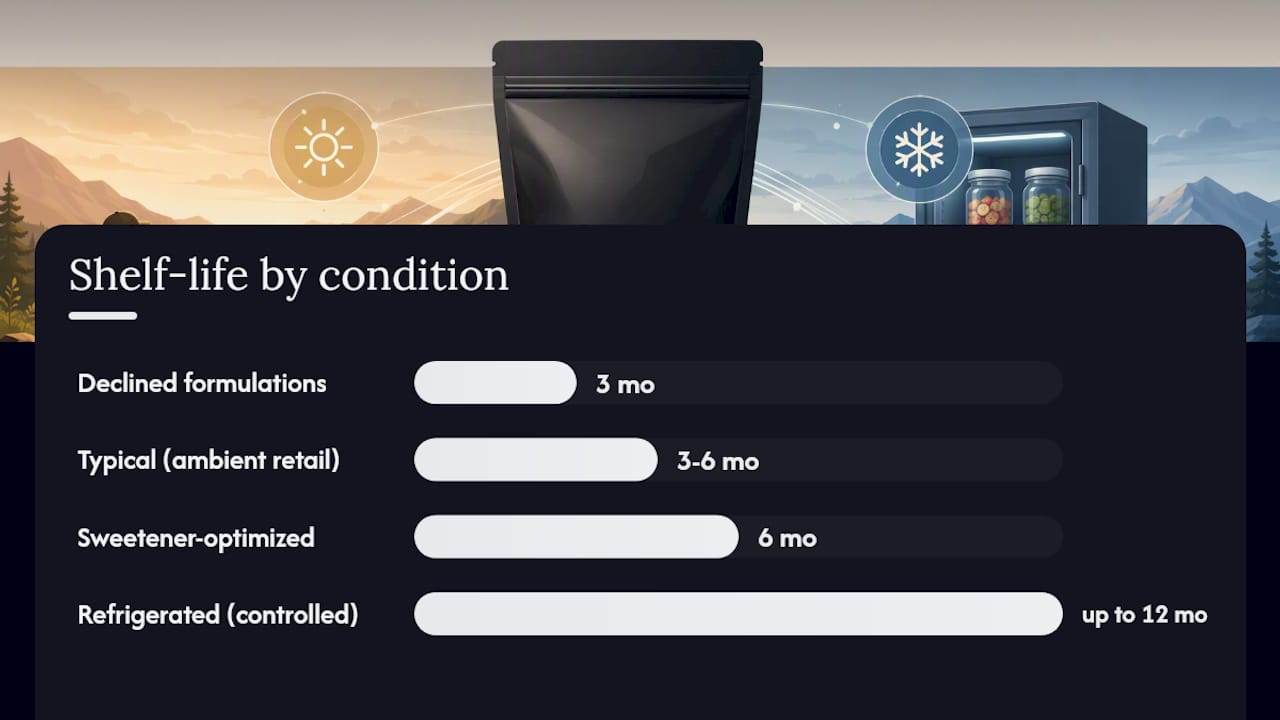
Storage temperature is a major lever. Research storing products at 4°C, 25°C, and 40°C found the best stability at refrigerated temperatures, with some formulations remaining stable for up to 12 months in controlled settings. Ambient retail conditions are the real test, and that’s where packaging does the heavy lifting.
Packaging checklist for retailers to require from suppliers:
- Film type: Metalized pouches (PET/AL/PE laminate) or equivalent high-barrier film
- WVTR: Target below 1 g/m²/day at 38°C/90% RH
- OTR: Target below 10 cc/m²/day
- Seam integrity: Heat-seal strength tested per ASTM F88
- Desiccant: Silica gel sachet sized to the bag volume
- Oxygen scavenger: Recommended for products with color-sensitive ingredients
- Storage temperature: 65–72°F, away from direct light and humidity
Pro Tip: Request a “moisture ingress challenge” test result from your supplier — not just a standard WVTR spec. This test exposes sealed bags to high humidity for an accelerated period and measures actual a_w change inside the package. A spec sheet tells you what the film is rated for; this test tells you whether the seal holds under real conditions.
For a deeper look at freeze-dried storage best practices, Space-man’s storage guide covers humidity control and handling protocols in practical detail.
3. Microbiology, safety, and U.S. regulatory basics
Freeze-drying does not kill bacteria. Microorganisms can survive the process and reactivate on rehydration. For a ready-to-eat product sold as a chip alternative, this means your supplier must treat it as an RTE food with full documentation.
Documentation to require from every supplier:
- HACCP plan and PCQI designation (FSMA Preventive Controls)
- Certificate of Analysis (CoA) covering total plate count, yeast/mold, and coliforms
- Water activity results per lot
- Allergen control program and cross-contact documentation
- Lot coding and traceability records
U.S. labeling basics for retail-ready freeze-dried snacks:
- Ingredient statement in descending order by weight
- Allergen declaration (Big 9 under FALCPA)
- Net weight in both U.S. customary and metric units
- Nutrition Facts panel compliant with FDA 21 CFR 101
- “Shelf-stable” and “ready to eat” claims require supporting documentation — not just marketing copy
For pilot runs, test every batch. At full production, a statistically valid sampling plan (e.g., every Nth lot) is acceptable, but never skip CoA testing entirely. Lab-based shelf-life testing should be completed before making any long-term shelf-life claim on packaging.
4. Formats and formulation levers that deliver a chip-like experience
The format shapes the occasion. Thin flat crisps read most directly as a chip replacement and work well in snack/pantry aisle placement. Puffed chunks and bite-size pieces feel more like a novelty snack and suit impulse displays near checkout. Dust-coated pieces — where seasoning is applied post-dry with a light oil or adhesive — photograph well and carry bold flavor identity.
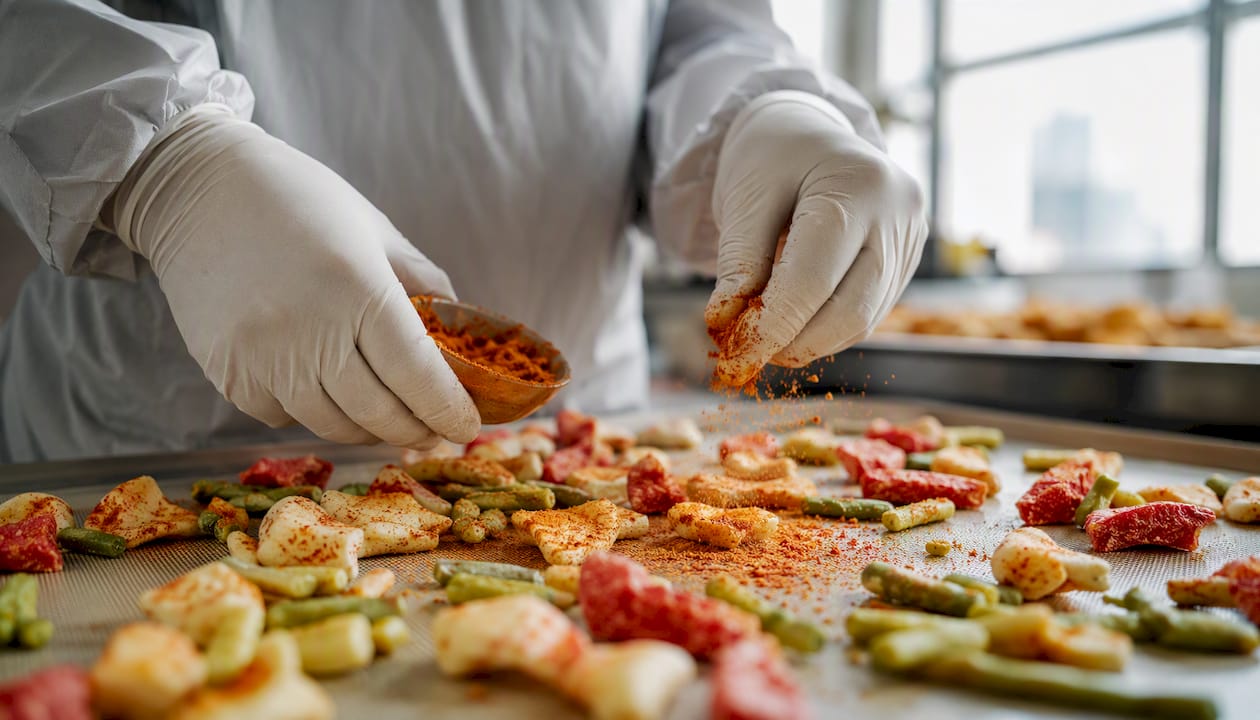
Flavor strategy matters more than most retailers expect. Savory seasoning systems (salt, umami salts, smoked paprika, chili-lime) shift consumer perception from “candy” to “snack” immediately. Bold coatings that create visible color also perform well in social content, where the visual contrast between the coating and the porous interior drives engagement.
Single-serve bags (1–1.5 oz) work for impulse and trial. Grab-bags (2.5–3.5 oz) compete directly with chip bags on shelf. Multi-packs suit club and e-commerce channels. For private-label, start with single-serve to minimize inventory risk during the pilot phase.
5. What retailers must know about private-label and co-packing
Production economics for freeze-dried candy differ from conventional snack manufacturing. Batch output per cycle matters more than chamber size — a smaller chamber running optimized cycles can outperform a larger one with poor loading protocols. Pilot testing is non-negotiable for candy formulas because expansion behavior varies significantly between products.
Numbered steps for a private-label engagement:
- Request a pilot run (typically 50–200 units) with full QA documentation
- Conduct accelerated shelf-life testing (minimum 3 months, ideally 6)
- Qualify packaging with a moisture ingress challenge test
- Run a sensory panel with your target consumer before committing to full production
- Negotiate formula ownership, lot coding, and recall plan in the contract
Contract checklist:
- Formula ownership and IP assignment
- Scale-up support obligations
- Defect allowance per lot (typical: 2–3%)
- Traceability and lot coding requirements
- Ingredient sourcing guarantees and substitution approval rights
- Recall plan and liability allocation
MOQ for private-label freeze-dried snacks typically starts at a few hundred units for pilot runs and scales to thousands for commercial production. Lead times vary by supplier but plan for 8–12 weeks from formula approval to first commercial shipment, including packaging qualification.
6. Supplier questionnaire and sample specs to request
When evaluating a co-packer, send a structured RFP. Here’s what to ask and what to require with each sample:
Supplier questionnaire:
- What facility certifications do you hold? (SQF, BRC, or equivalent)
- Describe your freeze-dry process for candy vs. fruit/veg snacks
- What is your validated shelf-life for this product category, and what test method supports it?
- What a_w method do you use (AquaLab, Rotronic, or equivalent)?
- What microbial testing do you run per lot, and which lab performs it?
- Provide your packaging material spec sheet including WVTR and OTR values
Sample spec template — request these with every test sample:
- Production date and lot code
- a_w reading at production and at 48 hours post-opening
- Packaging material spec sheet (film type, WVTR, OTR, seal strength)
- CoA (microbial, moisture)
- Sensory notes and recommended storage conditions
Pro Tip: On your first sample, ask for the product packed in two packaging formats: the supplier’s standard pouch and a lower-barrier alternative. Taste both after two weeks at ambient temperature. The difference in texture tells you exactly how much the barrier film is doing — and whether the supplier’s standard spec is adequate for your retail environment.
7. How to merchandise and market freeze-dried snacks as a chip alternative
Shelf placement is a positioning decision. Snack/pantry aisle placement signals chip-replacement intent and attracts the broadest audience. Candy aisle placement captures novelty buyers but limits repeat purchase from snack-occasion shoppers. Cross-merchandising near checkout — especially with bold display fixtures — drives impulse trial.
Social crunch content is the category’s most effective marketing tool right now. Short videos showing the crunch sound and the porous interior cross-section consistently outperform static product photography. Pair that with in-store sampling and you have a two-channel trial loop that converts.
Pricing considerations:
- Price 20–40% above the equivalent chip bag to signal premium quality
- Factor in barrier packaging cost, desiccant, CoA testing, and co-packer margin
- Use single-serve at a lower absolute price to reduce trial friction
- Avoid discounting in the first 90 days — it anchors the product as a value item
Merchandising tips:
- Use shelf talkers with “crunch” language and a QR code linking to a video
- Rotate stock every 30 days minimum; pull anything approaching 60% of shelf-life
- Test two flavor SKUs side by side before expanding to four or more
- Capture sell-through data weekly during the pilot period
For culinary and food trend context that supports flavor positioning decisions, Wild Foodz’s 2026 trend coverage is worth a read.
8. Simple tests to validate demand before scaling
A three-step pilot keeps risk low and generates real data fast.
- Limited SKU display: Launch one or two flavors in a single retail location or online channel. Use a dedicated display fixture with crunch-forward signage.
- Tracked sampling: Offer free samples with a simple one-question feedback card: “Would you buy this instead of your usual chip?” Track redemption rate and conversion to purchase.
- Two-week sell-through check: Pull sell-through data at day 14. A rate above 50% in two weeks signals strong demand. Below 30% means the price, placement, or flavor needs adjustment before you scale.
KPIs to watch:
- Sell-through percentage at 14 and 30 days
- Repeat purchase rate at 60 days
- Social engagement rate on crunch video content
- Customer texture feedback (specifically: “too light,” “just right,” or “not crunchy enough”)
- Return or complaint rate related to texture or freshness
A/B test price and flavor simultaneously if your channel allows it. Two flavors at two price points across four display positions gives you enough signal in 30 days to make a confident scale-up decision. If sensory feedback consistently flags softness or staleness, go back to your supplier with the a_w data and packaging challenge test results before ordering more inventory.
What the freeze-dried snack market actually rewards
The retailers who succeed with freeze-dried snacks as a crunchy chip alternative aren’t the ones who found the cheapest co-packer. They’re the ones who treated packaging as a product decision, not a cost line. A supplier who can’t provide a moisture ingress challenge test result or a sensory shelf-life study isn’t ready for retail — full stop.
The other thing most people underestimate: the “crunch” moment is a marketing asset, not just a texture attribute. A video of someone biting into a freeze-dried candy piece and hearing that snap travels further on social media than any health claim. Bold flavors, visible texture, and a confident premium price point are the formula. Health messaging is secondary for this category — experience is the hook.
One more thing worth saying plainly: don’t skip the pilot run to save time. A 200-unit pilot with proper QA costs a fraction of a failed 5,000-unit launch with packaging that let moisture in.
Space-man handles the hard parts of private-label freeze-dried snacks
If you’re a U.S. retailer or brand looking to launch a freeze-dried candy or snack SKU, Space-man offers private-label and co-packing services that cover the full process: pilot runs, QA documentation (water activity, CoA), packaging sourcing, and labeling support. You get a production partner who has already solved the barrier packaging and sensory shelf-life problems — not a facility you have to educate from scratch.
Space-man’s private-label and co-packing services are built for retailers who want a retail-ready SKU without building their own production infrastructure. If you want to test product before committing to a full private-label run, the 40-bag variety starter pack lets you run an in-store sampling pilot with real product. Contact Space-man to request a sample run, shelf-life documentation, and a packaging spec sheet.
Sources
- Influence of Storage Conditions on Physical Properties of Freeze-Dried Vegetable Snacks Packed in Pork Gelatin Films
- The Effect of Storage Time and Temperature on Quality Changes in Freeze-Dried Snacks Obtained with Fruit Pomace and Pectin Powders as a Sustainable Approach for New Product Development
- Sensory, physicochemical, and functional stability of freeze-dried blackcurrant (Ribes nigrum L.) Snacks. Effect of sweeteners
- Can I freeze dry that? A practical guide to safe and effective freeze-drying
- Shelf Life Testing for Freeze-Dried Foods: What You Need to Know - United Food Labs
- Freeze Dryer for Candy: Commercial Production Guide - Good Freeze Dryer