

Private labels and national brands operate on fundamentally different business models, and for manufacturers and business owners, that difference translates directly into margin, control, and growth potential. A private label product is manufactured by a third party and sold under the retailer’s or business owner’s brand name. A national brand owns both the manufacturing identity and the brand equity built around it. That gap in ownership is where the real strategic story begins.
Here is the core distinction at a glance:
- Brand ownership: Private labels belong to the retailer or business owner; national brands belong to the manufacturer.
- Pricing control: Private label owners set their own prices; national brand resellers typically cannot.
- Gross margins: Private-label products can carry about twice the gross margin of national brands.
- Speed to market: Private labels can pivot to trends faster, without the long development cycles national brands require.
- Brand loyalty: National brands carry deeper emotional resonance, especially in health and beauty categories.
Table of Contents
- How private labels deliver stronger margins and strategic flexibility
- Why national brands still win on emotional connection
- Practical ways manufacturers can grow with private labeling
- Why private labeling makes sense for U.S. manufacturers in 2026
- How consumer perception of private labels has shifted
- How private labeling reshapes supplier relationships and negotiation power
- Cost structure and pricing: where private labels pull ahead
- Distribution channel differences manufacturers need to understand
- Space-man’s private label services are built for manufacturers like you
- Key Takeaways
How private labels deliver stronger margins and strategic flexibility
The financial case for private labeling is hard to argue with. Private-label dollar sales rose 4.4% in the first half of 2025, compared to just 1.1% growth for national brands. Retailers have grown private label sales by more than $51 billion over the last four years, with store brands representing 25% of U.S. grocery product purchases in 2024.
“Private-label products can generate about twice the gross margin of national brands in many industries.” — McKinsey, cited by NetSuite
The margin advantage comes from a leaner cost structure. Private label owners skip the heavy advertising spend and third-party distribution fees that national brands absorb. Instead, they rely on shelf placement and retailer reputation to move product, which keeps overhead low and reinvestment potential high.
McKinsey’s retail strategy research adds another layer: U.S. private-brand penetration sits at 19%, compared to 38% in Europe, signaling enormous room for growth. The smartest retailers are now building tiered assortments with value, mid-tier, and premium private label lines, moving store brands from budget fillers to destination products.
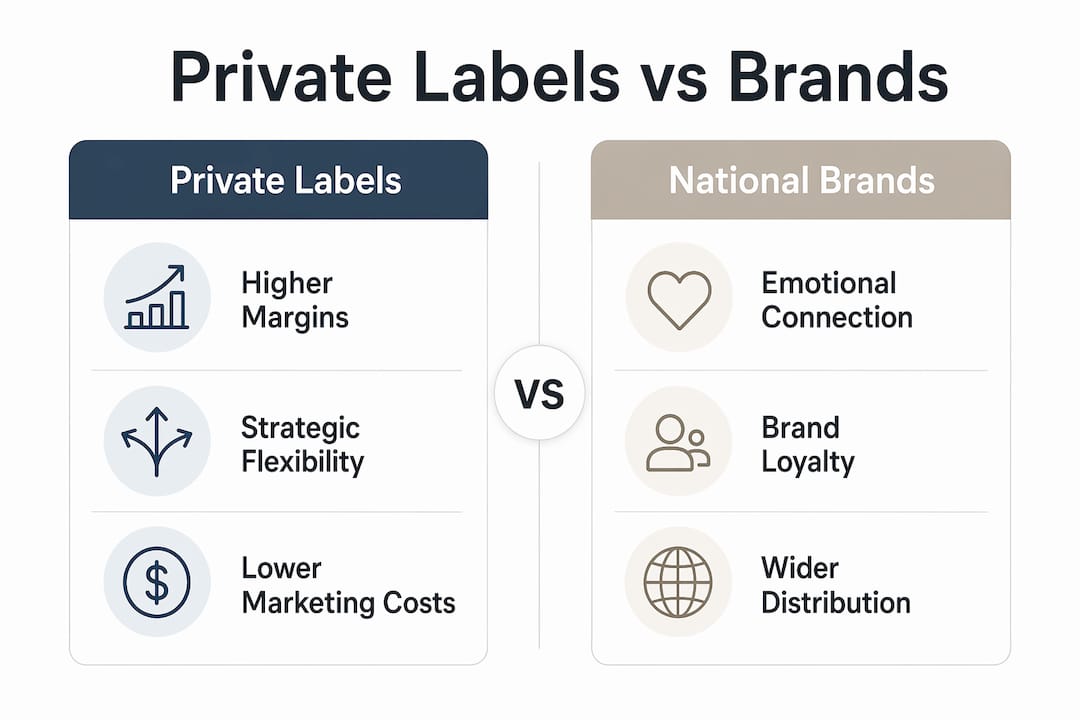
| Dimension | Private Labels | National Brands |
|---|---|---|
| Gross margin | about twice national brands | Lower, due to advertising overhead |
| Brand loyalty | Growing, but still developing | Strong, especially in health and beauty |
| Emotional connection | Moderate | about twice private labels |
| Speed to market | Fast, trend-responsive | Slower, longer development cycles |
| Market positioning | Flexible, tiered (value to premium) | Fixed, brand-defined |
Why national brands still win on emotional connection
Despite private labels’ momentum, national brands hold a psychological edge that numbers alone cannot erase. Consumers have about twice the emotional connection with national brands compared to private labels, driven by nostalgia, trust built over decades, and perceived product efficacy.

62% of U.S. shoppers still default to the national brands they know and trust, even as private label quality improves across the board.
This loyalty is especially sticky in health, beauty, and wellness categories, where shoppers are more cautious about what they put in or on their bodies. Brand attributes like heritage and aspirational appeal are more than twice as associated with national brands in these segments. National brands also perform better in omnichannel environments, where shoppers actively seek out trusted names online before buying.
That said, the gap is narrowing. 84% of shoppers now trust private labels’ quality at least as much as national brands, and 72% failed to correctly identify a private label product when shown it side by side with a national brand. The emotional advantage is real, but it is not permanent.
Practical ways manufacturers can grow with private labeling
Private labeling is not just a retailer’s game. Manufacturers can use it to fill excess production capacity, deepen distribution, and build new revenue streams without launching an entirely new brand from scratch.
“When a manufacturer starts supplying private labels to a retailer, its national brands enjoy a significant increase in relative distribution depth at that retailer.” — Journal of Marketing study, via AMA
National brand manufacturers sometimes produce private label products on the same lines, adjusting formulations to meet retailer price points. This dual-role approach strengthens shelf presence and gives manufacturers negotiating leverage they would not otherwise have.
Key strategies for manufacturers entering private labeling:
- Use excess capacity to produce private label runs without disrupting your core brand production.
- Customize packaging and formulations to meet specific retailer requirements, which builds stickier supplier relationships.
- Treat private label contracts as a distribution tool, not just a revenue line. More shelf presence for your private label often means more visibility for your own brands nearby.
- Prioritize quality control from the start. Inconsistent batches are harder to recover from under a retailer’s brand than under your own.
Pro Tip: Before signing a private label supply agreement, model the exit scenario. Terminating a private label arrangement with a retailer can hurt your national brand’s distribution depth just as much as starting one helps it.
Space-man specializes in private label and co-packing services for consumer goods, with particular depth in freeze-dried candy and snack categories. For manufacturers exploring private labeling in niche food segments, that kind of category-specific expertise shortens the learning curve considerably.
Why private labeling makes sense for U.S. manufacturers in 2026
The business case has never been cleaner. Private label sales are forecast to grow nearly 6% annually through 2030, and consumer acceptance is at an all-time high. For manufacturers and business owners, the advantages stack up fast:
- Higher gross margins with less advertising overhead
- Full control over pricing, packaging, and brand positioning
- Faster product launches without the bureaucracy of national brand development
- Retailer tiered assortment strategies that create demand for value, mid-tier, and premium private label options simultaneously
- Growing consumer willingness to switch, with loyalty to national brands dropping from 21% to 10% in under a year according to Zappi
The U.S. market is still well behind Europe’s private label penetration rate, which means the growth runway is long.
How consumer perception of private labels has shifted
Consumer trust in private labels has moved from skeptical to genuinely competitive. 75% of shoppers say private label products offer good value, and 72% view them as strong alternatives to national brands. The old stigma of generic, bland packaging is largely gone, replaced by store brands with premium aesthetics and consistent quality.
The shift is partly driven by better packaging design and partly by inflation pushing shoppers to experiment. Once they try a private label product and find the quality holds up, repeat purchase rates climb. That behavioral loop is what turns a price-driven trial into genuine brand loyalty for the retailer.
How private labeling reshapes supplier relationships and negotiation power
Private label contracts change the dynamic between manufacturers and retailers in ways that go beyond a single purchase order. Manufacturers who supply private labels gain leverage in shelf space negotiations, often securing better placement for their own national brands as a result.
The flip side is dependency risk. The more a manufacturer relies on a single retailer for private label volume, the more exposed they become to that retailer’s pricing pressure and contract terms. Diversifying across multiple retail partners is the standard hedge.
Cost structure and pricing: where private labels pull ahead
National brands carry costs that private labels simply do not. Marketing budgets, national advertising campaigns, slotting fees, and third-party distribution all compress national brand margins before a single unit sells. Private label owners redirect that spend toward product quality and packaging, or keep it as margin.
Private labeling gives businesses full control over branding, packaging, pricing, and marketing, unlike reselling national brands where pricing is often fixed. That pricing freedom lets manufacturers position products based on perceived value rather than competing on a price ladder set by someone else.
Distribution channel differences manufacturers need to understand
National brands typically move through multi-tier distribution: manufacturer to distributor to retailer to shelf. Each handoff adds cost and reduces margin. Private label products, by contrast, often move through tighter supply chains, with the retailer managing distribution directly.
For manufacturers, this means private label contracts can offer more predictable volume with fewer intermediaries. The tradeoff is exclusivity: private label products are sold only through the contracting retailer, which limits market reach but simplifies logistics. Understanding private label advantages for retailers helps manufacturers negotiate terms that work for both sides.
Space-man’s private label services are built for manufacturers like you
If you are a manufacturer or business owner looking to enter or expand in private labeling, Space-man offers end-to-end co-packing and packaging services designed specifically for consumer goods. The focus is freeze-dried candy and snack categories, where Space-man brings production expertise, packaging customization, and the kind of category knowledge that generic co-packers cannot match.
You get product customization, branded packaging, and production support without building your own facility. Get in touch with Space-man to discuss your private label project and see what a production partner with real category depth can do for your brand.
Key Takeaways
Private labels consistently outperform national brands on gross margin and speed to market, while national brands retain a measurable emotional advantage that manufacturers must account for in their category strategy.
| Point | Details |
|---|---|
| Gross margin advantage | Private-label products carry about twice the gross margin of national brands. |
| Market growth | Private-label dollar sales grew 4.4% in the first half of 2025, versus 1.1% for national brands. |
| Emotional connection gap | Consumers have a 2x emotional connection with national brands, strongest in health and beauty. |
| Consumer trust shift | 84% of shoppers now trust private label quality at least as much as national brands. |
| Space-man’s role | Space-man offers private label, co-packing, and packaging services for consumer goods manufacturers. |