

TL;DR:
- Canadian candy packaging must include bilingual labels, allergen declarations in regulated common names, and, if applicable, front-of-package nutrition symbols by 2026. Ensuring strict compliance during design avoids costly recalls, fines, and product delisting, making regulatory adherence a vital part of branding. Planning and verifying packaging details early streamlines production, builds consumer trust, and maximizes retail success.
Canadian candy retailers face a real problem: shelves are crowded, and a great product inside forgettable packaging loses to a mediocre product in packaging that turns heads. Personalized candy packaging is one of the most direct ways to change that equation, but in Canada, getting it wrong means more than a bad-looking bag. It means regulatory fines, product recalls, and reprints that eat your margin before a single unit sells. This guide walks you through exactly how to build packaging that stands out and holds up to scrutiny.
Table of Contents
- Understand Canadian labelling and compliance requirements
- Prepare your design and artwork for regulatory compliance
- Choose packaging formats and plan production timelines wisely
- Verify compliance and quality control to avoid costly errors
- Why prioritizing compliance in personalization unlocks retail success
- Boost your candy brand with Spaceman’s private label packaging services
- Frequently asked questions
Key Takeaways
| Point | Details |
|---|---|
| Comply with Canadian label laws | Ensure all mandatory packaging labels are bilingual and include required allergen and nutrition information. |
| Plan packaging design carefully | Design candy packaging to integrate front-of-package nutrition symbols and allergen info without obscuring branding. |
| Choose suitable packaging formats | Boxes offer easier compliance but higher MOQs; wrappers allow smaller runs but need more manual handling. |
| Verify print quality and compliance | Use checklists and version controls to prevent errors in bilingual labels and allergen declarations. |
| Embed compliance into workflows | Coordinated compliance and design processes reduce costly reprints and help launch new personalized packaging smoothly. |
Understand Canadian labelling and compliance requirements
Before you design a single custom candy wrapper, you need to know what the law requires. Canadian food packaging is not just a branding exercise. It is a regulated product, and the rules are specific.
The most immediate requirement for any prepackaged candy is bilingual labeling. Canadian federal food labelling rules require bilingual presentation of all mandatory label elements for prepackaged food sold anywhere in Canada. That means your ingredient list, allergen declarations, net quantity, and nutrition facts must appear in both English and French. Not a QR code linking to a French version. Not a bilingual insert card. On the package itself.
Allergen labeling is equally non-negotiable. Priority food allergens must be declared on pre-packaged candy labels using common names. That means “milk,” not “casein.” “Peanut,” not “groundnut.” The wording matters legally, and using casual or trade terms instead of the regulated common names is a compliance failure.
Then there is the 2026 change that most retailers are still scrambling to understand. Front-of-package nutrition symbol labeling is now mandatory for many prepackaged foods sold in Canada as of January 1, 2026. If your candy exceeds Health Canada’s thresholds for saturated fat, sugars, or sodium, a symbol must appear on the front panel. Not tucked beside the Nutrition Facts table. On the front.
Here is a quick summary of mandatory elements every personalized sweet packaging design must accommodate:
- Bilingual product name and net quantity
- Bilingual Nutrition Facts table
- Bilingual ingredient list with allergen declarations using regulated common names
- Front-of-package (FOP) nutrition symbol if nutrient thresholds are met (as of January 1, 2026)
- Dealer name and address
- Country of origin (where applicable)
For a deeper breakdown of what these rules mean for your specific product, review our candy packaging regulations in Canada guide and the full candy packaging compliance guide.
Non-compliance is not a paperwork problem. Missing allergen declarations and absent FOP symbols are grounds for recalls, retail delisting, and fines under the Safe Food for Canadians Act. One missed French translation on an ingredient can pull your product off shelves faster than any quality issue.
Having established why compliance matters, let’s cover what you need before designing your packaging.
Prepare your design and artwork for regulatory compliance
Food-labelling compliance directly constrains what you can put on personalized candy packaging. Regulated bilingual elements cannot be printed over, obscured, or moved off their required panels. Your designer needs to know this before they open a single file.
Here is a practical workflow for building a compliant design from the start:
- Map your panels first. Before any artwork goes in, decide which panels carry mandatory compliance text. Lock those zones. Treat them as untouchable real estate.
- Set your FOP symbol placement. The FOP nutrition symbol affects panel hierarchy, bilingual layout, and requires specific size and placement. Reserve the front panel space for it before your brand logo or product photography takes over.
- Build bilingual text blocks as locked layers. Your English and French Nutrition Facts table, ingredient list, and allergen declarations should be formatted as regulated blocks your designer cannot accidentally resize or reformat.
- Apply brand elements last. Once compliance zones are set, fill the remaining panels with your brand color, photography, and unique candy designs. This sounds counterintuitive but saves enormous revision time.
- Review against a compliance checklist before sending to print. Not after. Before.
Pro Tip: When working with a print vendor or co-packer, send them your compliance text blocks as locked PDF layers, not editable files. This prevents well-intentioned “formatting improvements” from breaking your legal requirements.
The choice between outer box personalization and wrapper personalization has significant implications for how much design flexibility you actually have.
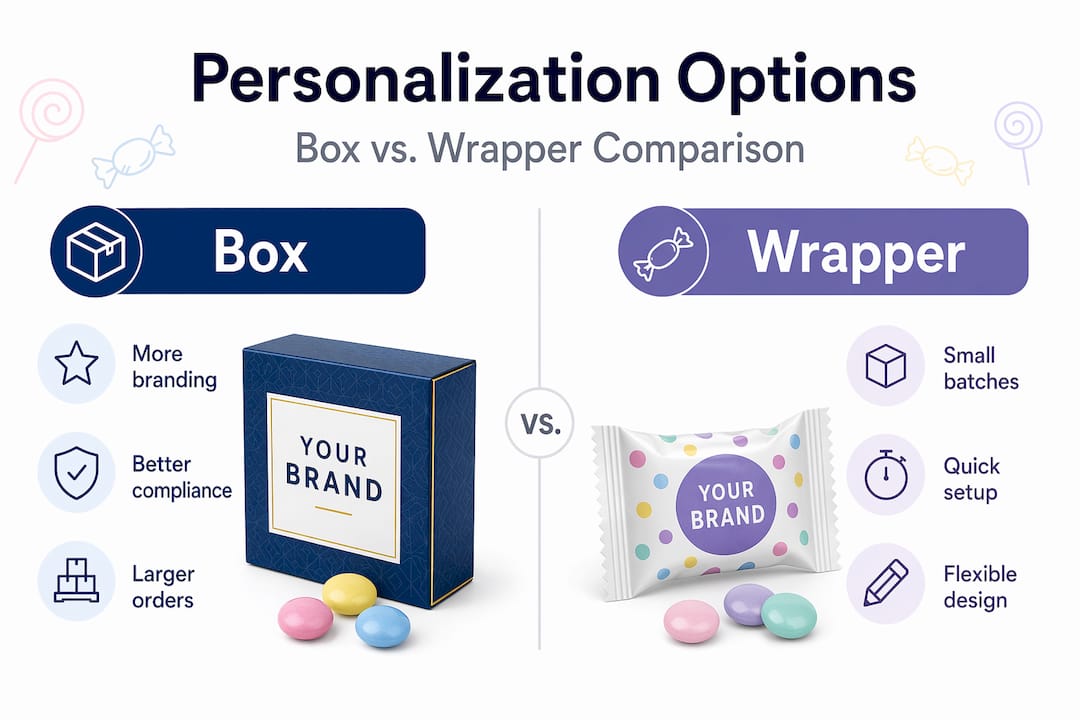
| Feature | Outer box personalization | Wrapper personalization |
|---|---|---|
| Branding surface area | Large, multiple panels | Limited, often single wrap |
| Compliance text placement | Easier to allocate separate panels | Must share surface with branding |
| FOP symbol integration | Straightforward front panel | Requires careful layout planning |
| Print quality consistency | High, offset or digital press | Variable, especially on foil or textured stock |
| Compliance complexity | Lower | Higher |
| Cost per unit | Higher at low volumes | Lower at low volumes |
| Best for | Gifting, retail shelf presence | Events, promotional runs |
The comparison makes clear why experienced retailers default to box formats for ongoing retail lines and use wrappers selectively for candy packaging for events or limited promotional runs. See our candy packaging best practices resource for format-specific design guidance.
With your design set up for compliance, let’s dig into choosing packaging formats and production considerations.
Choose packaging formats and plan production timelines wisely
The format you choose affects not just how your candy looks, but how fast you can get it to market and what it costs you per unit. These decisions compound quickly.
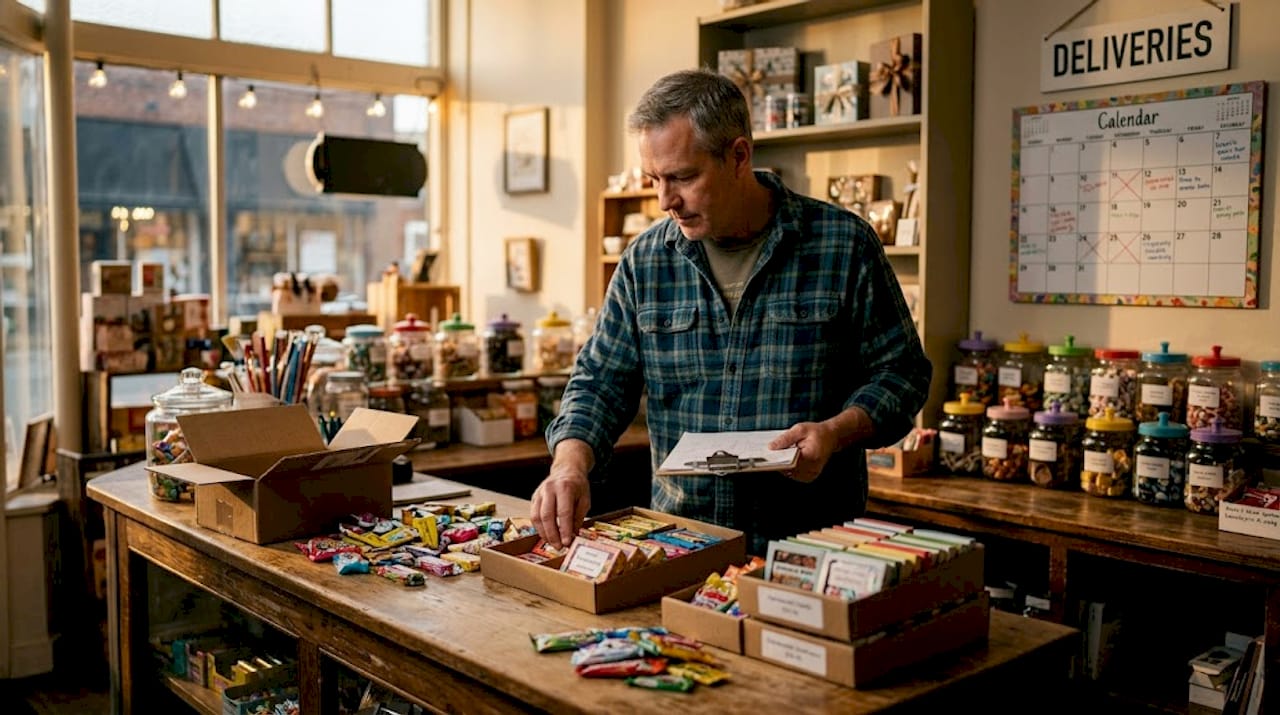
Boxes are the workhorse of retail candy packaging. They offer the most surface area for branding, make compliance text placement straightforward, and present well on shelves. The tradeoff is lead time and minimum order quantities. Custom candy box production timelines in Canada run approximately 7 to 14 business days with minimum orders around 100 units. For a retailer launching a new SKU or testing a seasonal line, that lead time needs to be built into your calendar well in advance.
Wrappers are more flexible at the low end. Some personalization services offer minimums as low as one dozen units, which makes them practical for weddings, corporate gifting, and event-specific runs. But the compliance trade-off is real. Wrappers leave less room for bilingual text, FOP symbols, and allergen declarations, and print quality on non-standard surfaces varies significantly.
Here is a format comparison to help you decide:
| Format | Typical MOQ | Production time | Compliance complexity | Retail shelf impact |
|---|---|---|---|---|
| Custom printed box | ~100 units | 7–14 business days | Low to medium | High |
| Candy wrapper | ~12 units | 3–7 business days | Medium to high | Medium |
| Poly bag with label | ~50 units | 5–10 business days | Medium | Medium |
| Outer sleeve over stock box | ~50 units | 5–10 business days | Low | High |
Key considerations when planning your production run:
- Order earlier than you think you need to. Seasonal windows close fast and rush production adds cost.
- Account for proof approval cycles. Compliance reviews on bilingual artwork take time.
- Build in a buffer for reformulation. If a recipe changes and a nutrient crosses a threshold, your FOP symbol requirement may change too, requiring a full artwork revision.
- Ask your supplier about digital printing options for shorter runs. Offset printing offers better cost-per-unit at higher volumes, but digital allows faster turnaround and lower MOQs.
Pro Tip: If you are planning a themed candy packaging line for a holiday or event, start your packaging design and compliance review at least six weeks out. Retailers who start eight weeks out almost never face a crunch. Retailers who start four weeks out almost always do.
Explore our guide on creating custom candy boxes for retail and learn which top candy packaging options perform best for freshness and shelf appeal.
After deciding format and production plans, let’s verify success with quality checks and compliance audits.
Verify compliance and quality control to avoid costly errors
Artwork approval is not the finish line. It is a checkpoint. The real quality control happens when you compare your printed proof against your compliance requirements systematically, not visually.
Build a review process around this checklist:
- Confirm both English and French versions of all mandatory elements are present and legible at final print size.
- Verify allergen declarations use Health Canada’s regulated common names in both languages.
- Confirm the FOP symbol is placed on the principal display panel at the required size.
- Check that the Nutrition Facts table is formatted to Health Canada specifications in both languages.
- Compare the printed proof against your locked compliance text files, not your memory.
Print-specific issues to check on physical proofs:
- Color shift on bilingual text panels (especially French, which tends to be deprioritized in layout and gets compressed into smaller type)
- Alignment gaps between compliance zones and branded artwork sections
- Coverage issues where background color bleeds into regulated text areas
- Any compression or rescaling of the FOP symbol
Packaging compliance text should be version-managed like regulated documents. That means each SKU has a controlled, dated file for its compliance text. When a formulation changes, you update that file, version it, and trigger an artwork review before the next production run.
Pro Tip: Keep a shared folder with one clearly named “master compliance text” file per SKU. Every time your recipe or supplier changes an ingredient, that file gets updated first. Your packaging artwork is always downstream of that file, never the other way around.
Missing a single allergen declaration or placing the FOP symbol incorrectly is not a minor formatting error. Under Canada’s Safe Food for Canadians Regulations, it is grounds for product removal from shelves and potential fines. The cost of a compliance reprint before launch is a fraction of the cost of a recall after it.
The candy packaging regulations resource and candy packaging best practices guide both include audit frameworks you can adapt directly into your internal review process.
Why prioritizing compliance in personalization unlocks retail success
Most retailers treat compliance as a box to check after the design is done. That is exactly backwards, and it is the single most expensive mistake in custom candy packaging projects.
Here is what we have seen repeatedly: a retailer invests in unique candy designs, sources quality freeze-dried candy, builds a brand story, and then discovers on proof approval day that the FOP symbol placement breaks the front panel layout, the French ingredient list is in 6-point type that does not meet minimum size requirements, or an allergen common name was swapped for a trade name somewhere in the translation. The result is not a small fix. It is a full artwork rebuild. Compliance failures increase scrap costs, relabeling expenses, and disrupt launch timelines in ways that cascade into missed seasonal windows.
The retailers who launch cleanly treat their compliance text as a controlled asset, not an afterthought. They version it. They align nutrition data updates with design changes. They choose outer box formats when possible to reduce handling risk and improve print quality consistency. They run allergen and bilingual checks at the design stage, not the proof stage.
Here is what that looks like in practice:
- Maintain one versioned compliance text file per SKU, updated before any artwork changes
- Schedule compliance review as part of your design brief, not as a final gate
- Align any recipe changes with your next packaging production cycle so you are not reprinting mid-run
- Choose formats that separate compliance panels from branded panels physically
- Run a bilingual readability check at actual print size, not on screen
The candy packaging compliance guide and our custom candy boxes branding guide both walk through how to build this process into your standard operating procedure without slowing your design cycles.
Retailers who do this well do not just avoid problems. They launch faster, spend less per unit over time, and build customer trust through packaging that is consistent, clear, and professional.
Boost your candy brand with Spaceman’s private label packaging services
If you want personalized candy packaging that is built for Canadian compliance from the start, not retrofitted at the last minute, Spaceman’s private label and co-packing services are designed specifically for that. We handle bilingual artwork, allergen declarations, and FOP symbol compliance as part of our packaging workflow, not as an add-on. That means fewer revision cycles, faster time to shelf, and packaging your customers will actually remember.
Whether you are looking to launch a new retail line with flexible order quantities or build out a seasonal themed run, we can match format and production timelines to your actual needs. Our freeze-dried candy products, including the popular freeze-dried candy retail display rack and the freeze-dried candy 10-pack bundle, come with packaging infrastructure already built for Canadian retail. Reach out early in your planning cycle and we will help you integrate compliance and branding from day one.
Frequently asked questions
Is bilingual labeling mandatory on all personalized candy packaging sold in Canada?
Yes, Canadian food labelling rules require bilingual presentation of all mandatory label elements for prepackaged food sold anywhere in Canada, including ingredient lists, allergen declarations, and nutrition information.
Do I need to include the front-of-package nutrition symbol on my candy packaging in 2026?
If your candy meets or exceeds Health Canada’s thresholds for saturated fat, sugars, or sodium, the FOP nutrition symbol is mandatory on packaging imported, manufactured, or packaged on or after January 1, 2026.
What are the typical minimum order quantities and production times for personalized candy packaging in Canada?
Custom candy boxes typically require minimum orders around 100 units with 7 to 14 business days production time, while some wrapper services offer minimums as low as one dozen units with shorter lead times.
How can I ensure allergen declarations on personalized candy packaging are compliant?
Use Health Canada’s regulated priority allergen common names in both English and French, and include any gluten sources or added sulphites used as ingredients in your formulation.
What are the risks of not managing packaging compliance properly in personalized candy products?
Compliance failures increase scrap and relabeling costs and disrupt launch timelines, and missing allergen or FOP information can lead to regulatory penalties, product recalls, and permanent damage to customer trust.