

TL;DR:
- Canadian snack distribution is regulated by federal, provincial, and municipal authorities depending on sales scope.
- Licensing, labeling, and traceability requirements vary across jurisdictions but are essential for compliance.
- Building strict documentation and labeling standards upfront helps prevent costly recalls and legal issues.
Selling snacks across Canada sounds straightforward until you realize that handing out free samples at a trade show can legally qualify as a “sale” under federal food regulations. Canadian snack distribution laws operate across three separate government layers, and the gaps between them catch even experienced operators off guard. Whether you manufacture freeze dried candy, distribute branded confectionery, or co-pack for retail clients, understanding exactly who regulates what and when will save you from costly audits, rejected shipments, and labeling recalls. This guide breaks down licensing, labeling, traceability, and regional rules so you can operate with confidence.
Table of Contents
- Who regulates snack distribution in Canada?
- Licensing and preventive controls: The federal foundation
- Essential labeling and packaging regulations
- Traceability and local distribution rules
- The uncomfortable truth about snack compliance most guides miss
- Make snack compliance simple with expert support
- Frequently asked questions
Key Takeaways
| Point | Details |
|---|---|
| Multiple regulatory layers | Snack distribution in Canada involves federal, provincial, and local rules. |
| Licensing matters | SFC licenses are essential for any snack trade across provincial lines or with imports/exports. |
| 2026 labeling update | Mandatory front-of-package nutrition symbols apply to many prepackaged snacks starting in 2026. |
| Traceability requirements | Maintain complete two-year supplier and customer records for every snack batch. |
| Exemptions exist | Some small snacks and retail bulk items are exempt from full labeling. |
Who regulates snack distribution in Canada?
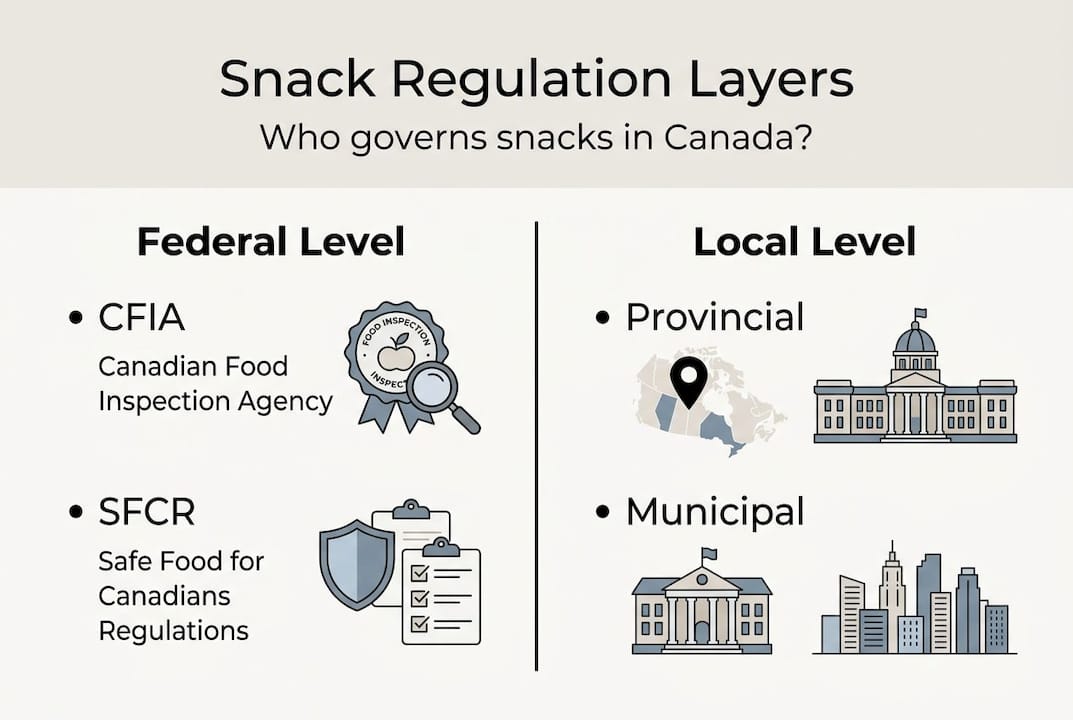
With the compliance challenge in mind, let’s clarify which regulatory bodies control what aspects of snack distribution. Three distinct layers of government share jurisdiction over snack foods, and each layer has different authority depending on where your product travels and how it’s sold.
Federal level (CFIA and SFCR) governs anything that crosses a provincial border or enters or exits the country. Snack foods, including confectionery, require an SFC licence for interprovincial trade, import, and export under the Safe Food for Canadians Regulations. This applies whether you’re shipping a pallet of candy from Ontario to Alberta or importing raw ingredients from the U.S.
Provincial and municipal levels step in for everything that stays within one province. Intra-provincial distribution falls under provincial and municipal health rules, which vary considerably from BC to Quebec. Your local health unit may require a separate food handler permit, a facility inspection, or a specific business license before you can even sell at a farmers market.
Here’s a quick reference table to map out who controls what:
| Distribution type | Primary regulator | Key requirement |
|---|---|---|
| Interprovincial sales | CFIA (federal) | SFC licence |
| Import/export | CFIA (federal) | SFC licence + customs docs |
| Within one province only | Provincial health authority | Provincial food permit |
| Local retail/vending | Municipal government | Business license + health permit |
| Online sales (national) | CFIA (federal) | SFC licence required |
Knowing your distribution footprint is the first step. If you sell exclusively at local farmers markets in one city, you may not need a federal SFC licence at all. But the moment you ship to a retailer in another province, federal rules apply immediately.
Key compliance actions by jurisdiction:
- Federal: Apply for SFC licence, develop a preventive control plan, register your facility
- Provincial: Check with your provincial health authority for local food permits and inspection requirements
- Municipal: Obtain a business license, confirm zoning rules for food manufacturing, and meet local health standards
Review Canadian snack compliance standards and look into snack food certifications to build a complete picture of your obligations before launching distribution.
Licensing and preventive controls: The federal foundation
Having defined the main regulators, it’s crucial to address the federal foundation underpinning most compliance obligations. For any snack business operating beyond its home province, the SFC licence is the cornerstone document.
The SFC licence is mandatory for manufacturing, importing, or trading snacks interprovincially. Here’s a simplified process for getting licensed:
- Register your business with the Canada Revenue Agency and obtain a business number
- Assess your activity type to confirm whether you need a licence (manufacturing, importing, or interprovincial trade all trigger the requirement)
- Develop your Preventive Control Plan (PCP) before submitting your application
- Apply through My CFIA, the online portal used for all CFIA food licensing
- Prepare for a facility inspection, which may be required before your licence is approved
- Renew annually, as SFC licences expire and must be kept current
The Preventive Control Plan is not optional paperwork. Preventive controls cover sanitary conditions, pest control, equipment maintenance, and employee hygiene. For a freeze dried candy operation, this means documenting your cleaning schedules, temperature logs, and staff training records. Inspectors can and do request this documentation on short notice.
Non-compliance consequences are real: CFIA inspectors can issue written warnings, suspend your licence, impose fines, or initiate a recall. A suspended licence effectively shuts down your interprovincial operations overnight.
Pro Tip: Digital food safety management systems make traceability and PCP documentation far easier to manage. Platforms that log supplier records and batch data automatically reduce your audit preparation time significantly.
One edge case worth knowing: free samples distributed at trade shows or events may still trigger regulatory obligations. If samples are pre-packaged and labeled, labeling rules apply. If you’re handing them across provincial lines, your SFC licence must be active. Review importing snacks legal requirements if you source ingredients internationally and check federal snack production standards for production-specific compliance detail.
Essential labeling and packaging regulations
With regulatory oversight and licensing defined, the next critical compliance layer is labeling and packaging. Getting labels wrong is one of the most common reasons snack products get pulled from shelves or flagged during import inspections.

Prepackaged snacks must include a common name, net quantity, ingredient list, allergen declarations, Nutrition Facts table, and front-of-package symbols if high in saturated fat, sugars, or sodium as of 2026. The front-of-package nutrition symbols requirement, which took effect January 1, 2026, applies to most large manufacturers and is now expanding to mid-size producers.
Here’s a quick-reference table:
| Label element | Required? | Notes |
|---|---|---|
| Common name | Yes | Must be accurate and clear |
| Net quantity | Yes | Weight or count |
| Ingredient list | Yes | Descending order by weight |
| Allergen declaration | Yes | Bold or separate statement |
| Nutrition Facts table | Yes | Standardized format |
| FOP nutrition symbol | Conditional | Required if high fat, sugar, or sodium |
| Manufacturer address | Yes | Canadian address required |
Exemptions do exist. One-bite confections, certain bulk snacks, and small packages may be exempt from full labeling requirements. Restaurant portions and products sold by weight at retail counters often fall into this category. However, relying on an exemption without confirming it with CFIA first is a risky move.
Common labeling pitfalls to avoid:
- Allergen omissions: Tree nuts, peanuts, sesame, and gluten sources must be clearly declared. Missing even one is a recall trigger.
- Bilingual requirements: English and French are both mandatory on labels for products sold nationally.
- FOP symbol placement: The symbol must appear on the front of the package within a specific size range. Placement errors count as non-compliance.
- Incorrect net quantity: Weight statements must reflect the actual contents, not a rounded number.
Pro Tip: Design your label template before you finalize packaging artwork. Changing label layouts after printing is expensive and delays launch timelines.
Packaging itself must also be tamper-evident and food-safe. Materials that contact the product must meet Health Canada standards for food contact materials. Review Canadian snack labeling requirements and candy packaging rules before you go to press.
Traceability and local distribution rules
Now that you know how to package and label, let’s ensure your records and local compliance can’t be challenged. Traceability is not just a best practice. It’s a legal obligation for federally licensed snack businesses.
Traceability records must document supplier and customer data, lot codes, quantities, and be retained for a minimum of two years. In practice, this means every batch of product you produce or receive needs a paper trail that links the raw ingredient to the finished product to the customer who bought it.
A basic traceability setup checklist:
- Assign unique lot codes to every production run
- Record the name and contact information of each ingredient supplier
- Log the quantity received, production date, and batch size
- Track every customer order with the lot code(s) shipped
- Store all records digitally or in physical files for a minimum of two years
- Test your recall procedure at least once per year to ensure the system works under pressure
For local and regional distribution, the rules get more specific. Vending machine placement, permit requirements, and location restrictions vary by province. Some provinces restrict the placement of snack vending machines near schools or community centers, particularly if products are high in sugar or sodium.
CFIA enforcement reminder: During a food safety investigation or recall, CFIA can request your full traceability records within 24 hours. If your records are incomplete, you face liability even if your product was not the source of the issue.
Provincial exemptions sometimes apply to very small-scale producers. Cottage food laws in certain provinces allow limited home-based production and local sales without full CFIA licensing, but these exemptions are narrow and product-specific. Confectionery and candy typically fall outside cottage food exemptions due to allergen and food safety risk factors. Check food packaging compliance details for guidance on how packaging intersects with local distribution rules.
The uncomfortable truth about snack compliance most guides miss
Most compliance guides walk you through the rules as written. What they don’t tell you is that enforcement in Canada is uneven, especially for niche and local snack producers. A small freeze dried candy brand selling at weekend markets is unlikely to face the same scrutiny as a national distributor. But that lower scrutiny disappears fast the moment you scale up or a product complaint surfaces.
The real trap for small operators is almost never licensing. It’s recordkeeping and packaging errors that create liability. A missing allergen declaration or a poorly maintained lot code log is what triggers action, not an expired licence.
The most practical strategy is to build to the strictest standard you’re likely to face, not the minimum you can get away with today. Federal-grade documentation and labeling make you audit-ready at every level, provincial or federal. That investment upfront costs far less than a product recall or a suspended licence mid-growth.
The federal and provincial overlap is genuinely confusing, even for experienced operators. The honest answer is that working with someone who has navigated certification deep dives before you hit a compliance wall will save you far more than it costs.
Make snack compliance simple with expert support
Regulatory hurdles don’t have to slow your business down. At Spaceman, we’ve built our operations around exactly the compliance standards this guide covers, from federal SFC licensing to proper labeling and batch traceability.
Whether you need private label and co-packing help or want a manufacturing partner who already meets CFIA standards, we can help you move faster and with less risk. Our co-packing and packaging services are designed for snack brands that want compliant, shelf-ready products without building a facility from scratch. Working with an experienced production partner means your labeling, traceability, and packaging are handled right from day one. Let us take the compliance complexity off your plate so you can focus on growing your brand.
Frequently asked questions
Do I need a federal license to sell snacks in just my province?
No, a Safe Food for Canadians licence is only mandatory for interprovincial, import, or export trade. Local distribution within a single province is regulated by provincial and municipal health authorities.
What are the new label rules for snacks in 2026?
As of January 1, 2026, prepackaged snacks must display front-of-package nutrition symbols if they are high in saturated fat, sugars, or sodium, in addition to existing ingredient and allergen declarations.
Are there snacks that don’t require labeling?
Yes, one-bite confections and certain bulk retail snacks may be exempt from full labeling requirements, but you should confirm any exemption directly with CFIA before relying on it.
How long do I need to keep traceability records?
Traceability records must be retained for at least two years, and must include both supplier and customer data linked to specific lot codes and quantities.