

TL;DR:
- Your packaging serves as the first salesperson for your product and must comply with Canadian legal and consumer expectations.
- Designing with both regulatory accuracy and emotional appeal ensures your product stands out, passes audits, and builds customer loyalty.
Your packaging is the first salesperson your product ever has, and in the Canadian candy market, it either closes the deal or gets ignored on the shelf. Freeze-dried candy is a genuinely exciting product category, but the competition is growing fast, and Canadian regulations add a layer of complexity that trips up even experienced brand owners. Get the design right and you build a brand that earns loyal customers, passes retail audits, and ships without damage. Get it wrong and you face costly reprints, compliance issues, or worse, dead inventory. This guide walks you through every stage.
Table of Contents
- Key requirements for effective packaging design in Canada
- Step-by-step: Creating standout packaging for freeze-dried candy
- Common mistakes and expert tips in packaging design
- Verifying compliance and maximizing consumer appeal
- Why packaging design is more than just compliance
- Ready to launch your packaging? Get expert support
- Frequently asked questions
Key Takeaways
| Point | Details |
|---|---|
| Meet Canadian rules | Labeling, bilingual text, and accurate info are required for freeze-dried candy packaging in Canada. |
| Follow a proven process | Step-by-step design, testing, and printing ensure your packaging stands out and meets legal needs. |
| Avoid common mistakes | Using compliant labels and time-saving tools prevents costly errors when launching your candy. |
| Test and verify | Always check packaging with a final checklist and consumer testing before going to market. |
Key requirements for effective packaging design in Canada
Before you sketch a single logo or choose a color, you need to know exactly what Canadian law demands and what your customers expect. Skipping this step is the number one reason brands end up reprinting thousands of bags at their own expense.
Mandatory labeling under Canadian law
The Consumer Packaging and Labelling Act sets clear, non-negotiable rules. Your freeze-dried candy package must include the product identity, net quantity displayed in metric units with bold type at a minimum height of 1.6mm, and the dealer name and address on the principal display panel. Both English and French are required. No claims on the package can be misleading in any way.
Understanding Canadian candy packaging compliance before you design saves you from expensive mistakes. A bilingual layout is not just a legal box to check. It actually opens your product to the full national market, including Quebec, which is one of Canada’s largest consumer markets.
Here is a quick overview of what belongs on each panel:
| Label element | Location | Requirement |
|---|---|---|
| Product identity | Principal display panel | Clear, accurate, not misleading |
| Net quantity | Principal display panel | Metric, bold, min 1.6mm type height |
| Dealer name and address | Principal display panel | Full legal name and address |
| Bilingual text | All required elements | English and French both present |
| Ingredient list | Information panel | Descending order by weight |
| Nutrition facts table | Information panel | Standard Health Canada format |
Solid food labeling requirements knowledge will also protect you from Health Canada scrutiny, which has tightened significantly over the past few years for novelty candy products.
Sustainability and shelf impact
Canadian consumers increasingly expect environmentally responsible packaging. Recyclable cardboard and paper materials are replacing plastic in many snack categories, and retailers like grocery chains and specialty candy stores are beginning to require sustainable options as a condition of listing. This is not just optics. It actively influences purchase decisions at shelf.
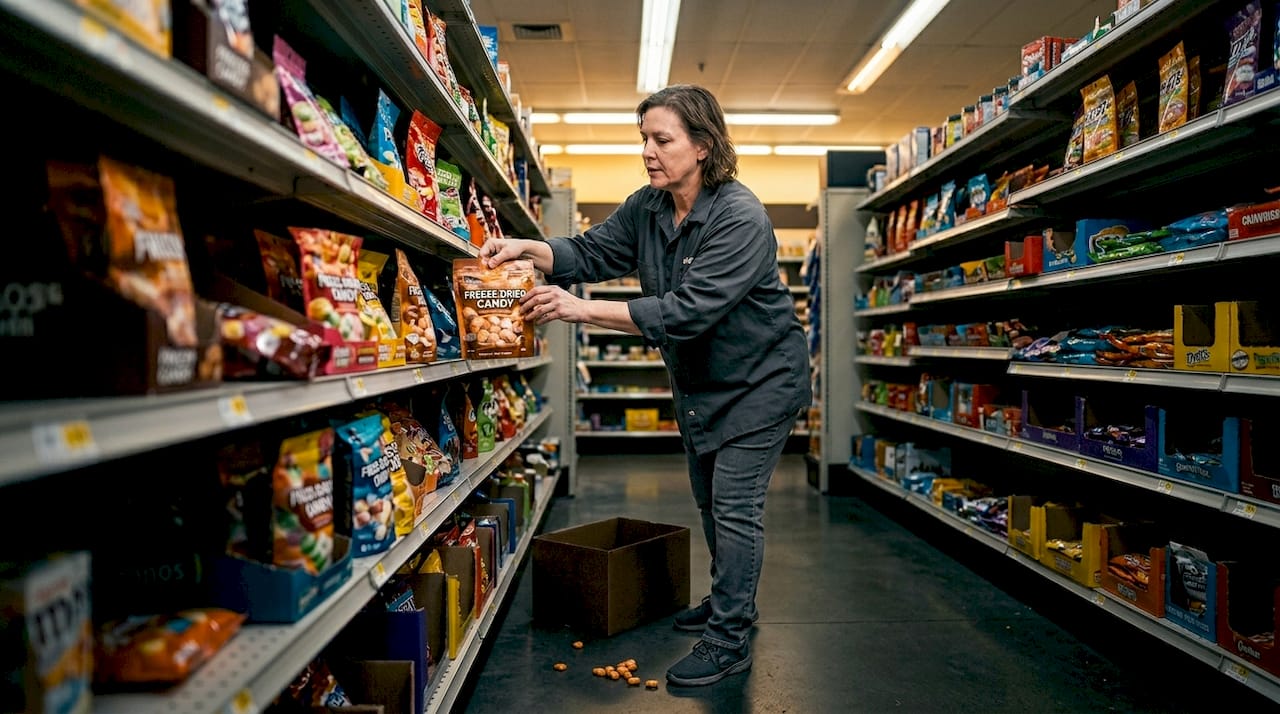
Beyond materials, your packaging must compete visually in a crowded retail fixture. Freeze-dried candy candy packaging best practices recommend bold color blocking, product photography that shows the actual candy texture, and clear flavor callouts that shoppers can read in under two seconds. You are competing against dozens of bags on the same fixture, and a shopper’s gaze lingers for about three seconds before moving on.
“Great packaging doesn’t whisper. It interrupts. In retail, invisible design is the same as no design at all.”
Step-by-step: Creating standout packaging for freeze-dried candy
A clear process keeps your project on time, on budget, and on-brand. Rushing any step is where rework happens.
The six-step packaging design process
Shopify’s product packaging design framework outlines a proven approach: define your product and customer, research the competition, identify all requirements, create your design concept, test the package, and prepare files for print.
Here is how each step applies specifically to freeze-dried candy in Canada:
-
Define your product and customer. Who is buying this? A teen buying impulse treats has different visual triggers than a parent buying a novelty gift. Get specific on age, shopping habits, and what drives their purchase. Freeze-dried candy skews heavily toward novelty and fun, so lean into that energy in your brief.
-
Research your competition. Walk into a Dollarama, a convenience store, and a specialty candy shop. Photograph every competing bag. Notice which colors are overused (often blue and red) and find the gap your brand can own. Bright yellow and neon green, for instance, are underused in most freeze-dried candy sets.
-
Identify all regulatory requirements. Pull the full list of mandatory elements from the Consumer Packaging and Labelling Act, Health Canada, and any provincial rules. Build a master checklist before any design work starts. This is where most first-timers skip ahead and pay for it later.
-
Create your design concept. Start with rough sketches or AI mockup tools. Use dieline templates that match your actual bag size and format. Tools like Canva, Adobe Illustrator, or AI-driven platforms like Pacdora let you visualize the full 3D package early. Strong food packaging shelf appeal comes from this stage, so invest time here.
-
Test the package. Print a short run of proofs and put them on an actual shelf or table next to competitors. Get honest feedback from people outside your business. Test the e-commerce version too: does it survive a drop test? Is the branding still readable in a small thumbnail image online?
-
Pre-press and print. Prepare print-ready files with correct bleed, color profiles (CMYK for print), and fonts embedded. Confirm with your printer that all technical specs match your file. Errors caught at pre-press are free. Errors caught after printing cost you the full run.
Pro Tip: Order a physical dieline sample before committing to a large print run. Seeing the flat template in real life reveals spacing issues that no screen preview will catch.
Retail vs. e-commerce packaging priorities
These two channels have genuinely different needs, and trying to design one package that fully serves both without compromise is harder than most owners expect.
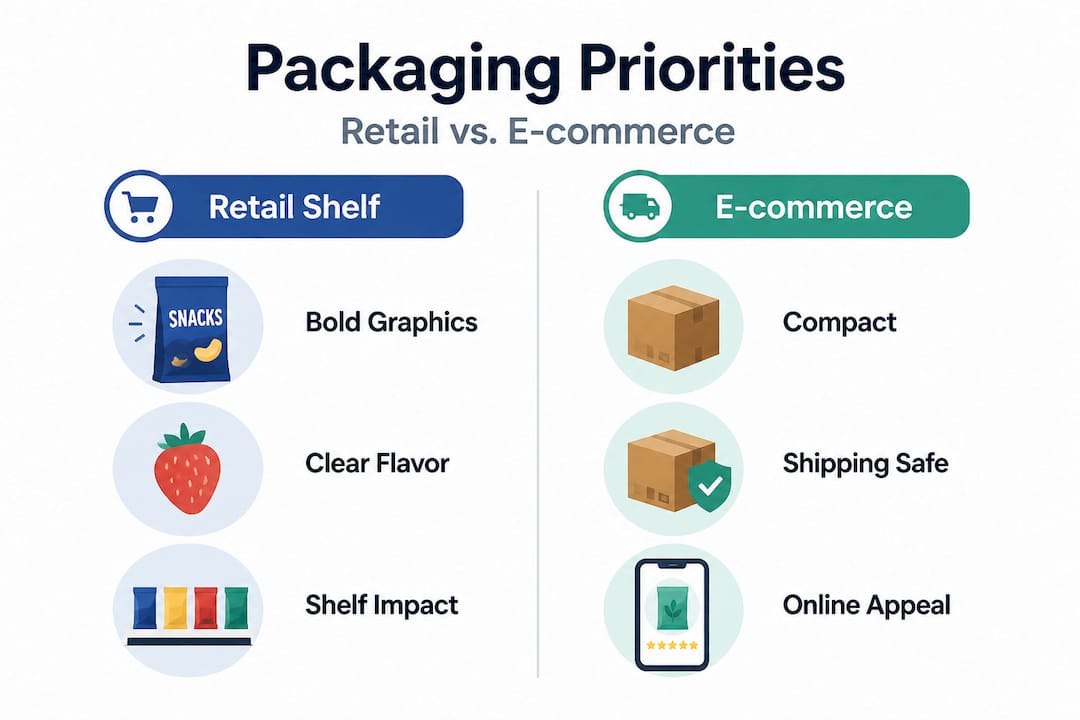
| Priority | Retail shelf | E-commerce |
|---|---|---|
| Visual impact | Bold graphics, readable at distance | Looks great in thumbnail images |
| Durability | Withstands shelf handling | Survives shipping and handling |
| Size | Standard fixture dimensions | Compact, lightweight to reduce shipping cost |
| Unboxing | Less relevant | Opportunity for brand storytelling |
| Bilingual display | Always prominent | Still required, but layout is more flexible |
Creative candy packaging solutions for Canadian brands often solve both by designing the primary bag for retail and adding a branded shipper mailer or box for online orders, so the unboxing experience feels premium without compromising retail shelf performance.
Common mistakes and expert tips in packaging design
Knowing the steps is one thing. Knowing where people trip and fall is just as valuable.
The most common compliance and design errors
Most new Canadian candy brands make the same handful of mistakes:
- Forgetting French text entirely, then reprinting all packaging when a Quebec retailer flags it
- Using net weight in ounces only, which violates the metric requirement
- Placing the dealer address on a side panel instead of the principal display panel
- Choosing a font size that technically meets the 1.6mm rule but is visually unreadable
- Overloading the front panel with text, leaving no room for the product to be the hero
- Designing for screen but never printing a physical proof before the full run
These are not rare edge cases. They happen constantly with first-time packagers and even with brands on their second or third SKU.
Technology that cuts design time significantly
AI-powered packaging tools like Pacdora now generate print-ready dielines directly, dramatically cutting revision cycles. The packaging design software market is growing at a CAGR of 12.2%, which tells you how fast brands are moving toward automated and AI-assisted workflows. The advantage is not just speed. These tools also flag structural errors before they reach a printer.
For small and mid-size candy brands, this matters enormously. You may not have an in-house graphic designer or a packaging agency on retainer. AI tools give you a professional starting point that you can refine rather than starting from a blank page.
“The brands winning in Canadian candy retail right now are not necessarily spending more. They are designing smarter and testing faster.”
Pro Tip: Use AI tools to generate three distinct concepts quickly, then bring your top choice to a human designer for final refinement and compliance review. This hybrid approach saves money and still produces retail-quality output.
Staying current with candy packaging innovations is also worth your time. Matte finishes, resealable zippers, and window cutouts that show the actual product are all performing well in the Canadian market right now. Explore creative food packaging ideas to find differentiators that fit your budget.
Verifying compliance and maximizing consumer appeal
Design approval is not the finish line. Verification is. This stage catches what creative work misses.
Your pre-launch compliance checklist
Use this numbered checklist before sending any files to print:
- Confirm product identity is accurate and not misleading
- Verify net quantity is in metric with minimum 1.6mm bold type
- Check dealer name and full address appear on the principal display panel
- Review that both English and French are present on all mandatory elements
- Cross-check ingredient list is in descending order by weight
- Confirm the Nutrition Facts table follows the current Health Canada format
- Review all claims (e.g., “natural,” “no artificial colors”) for accuracy
- Verify no mandatory element is obscured by a seam, fold, or graphic element
- Check that color contrast makes all required text readable
- Confirm file format, bleed, and color mode are correct for your printer
Testing for shelf appeal and durability
Once compliance is confirmed, test the real-world performance of your package.
| Test type | Method | Pass criteria |
|---|---|---|
| Shelf visibility test | Place among 10 competing bags at eye level | Noticed by 8 out of 10 observers in under 5 seconds |
| Drop test | Drop box from 1 meter height three times | No seal failure, no puncture |
| E-commerce readability test | View product thumbnail at 100px wide | Brand name and flavor still legible |
| Humidity test | Store filled bag at room temp for 7 days | No condensation, seal holds firmly |
| Customer review cycle | Share proofs with 5 real target customers | Positive feedback on flavor communication and appeal |
Getting food safety certifications in order before launch adds credibility and can be a requirement for some retail buyers. Understanding the full scope of Canadian packaging regulations will also prepare you for retailer audits. For a real-world example of how this all comes together, take a look at how established brands package their food products in Canada.
Why packaging design is more than just compliance
Here is something most packaging guides will not tell you: the brands that only design to meet minimum legal requirements almost never break through in retail. Compliance is the floor, not the ceiling.
We have seen this pattern repeatedly in the freeze-dried candy space. Two brands with nearly identical products, both fully compliant, perform wildly differently at retail. The differentiator almost always comes down to emotional resonance in the packaging design. Does the bag make you feel excited? Does it look like something you want to post on Instagram? Does it tell a story in under three seconds?
Emotional engagement in packaging design drives repeat purchases and, critically, social sharing. When a customer photographs your product and posts it, they become unpaid marketing. That kind of organic reach is worth far more than any ad spend, and it starts entirely with how the package looks and feels in someone’s hand.
The conventional industry wisdom says to nail compliance first, then focus on aesthetics. We think that is backwards. Start with the emotional response you want to create. What do you want someone to feel when they pick up your bag? Nostalgic? Excited? Playful? Build the creative concept around that feeling first, then ensure every compliance requirement is built into that creative vision. The two are not in conflict. They just need to be designed together.
Brands using innovative materials like holographic films, soft-touch matte coatings, and premium resealable closures are not just standing out. They are communicating quality before the customer even reads a word. That premium signal justifies a higher price point and builds the kind of brand trust that turns first-time buyers into repeat customers. As creative success stories from the Canadian candy market show, the most memorable packaging is always both legally sound and genuinely delightful.
Ready to launch your packaging? Get expert support
Creating packaging that is both legally compliant and visually compelling takes real expertise, and most retail and online candy brands do not have to figure it out alone.
At Spaceman, we work with Canadian retailers and online sellers every day to make sure their freeze-dried candy packaging hits every requirement while actually standing out. Our private label packaging solutions handle everything from design and compliance review to co-packing and final bagging, so you can focus on growing your business rather than managing production details. If you want to get products on shelves fast, our freeze-dried candy display kits are retail-ready and fully compliant. For smaller operations or those just starting out, the variety starter pack is a practical way to test the market before committing to a full custom run.
Frequently asked questions
What must go on a freeze-dried candy package in Canada?
You must include the product name, net quantity in metric units, dealer name and address, and both English and French on all mandatory elements, as required by the Consumer Packaging and Labelling Act. All claims must be accurate and not misleading.
How can I make my freeze-dried candy packaging stand out in stores?
Use bold graphics and clear flavor messaging that shoppers can read from a distance, while building in emotional appeal that earns a second look. Retail packaging specifically needs bold shelf impact to outperform competitors on a crowded fixture.
Are sustainable packaging materials required in Canada?
They are not always legally required, but recyclable cardboard and paper materials are increasingly expected by Canadian consumers and retail buyers, making them a smart business choice regardless of regulation.
What is the best process to design compliant packaging?
Follow a six-step process: define your product and customer, research competitors, identify all requirements, create your concept, test prototypes, and finalize print-ready files for your printer.
How can technology make packaging design easier?
AI tools like Pacdora generate print-ready dielines automatically, cutting revision cycles and reducing costly errors before files reach a commercial printer.