

Freeze drying sounds complicated and expensive, but it’s the secret behind premium snacks with unmatched quality and shelf life. You’ve probably wondered how those crunchy, flavorful freeze dried candies and fruits retain their shape and taste so perfectly. This guide breaks down the freeze drying process step by step, explores recent technological advances making it more efficient, and shows Canadian snack business owners exactly how to leverage this process for competitive advantage.
Table of Contents
- Understanding The Freeze Drying Process For Snacks
- Technological Advances Improving Freeze Drying Efficiency And Quality
- Benefits And Challenges Of Freeze Drying For Canadian Snack Businesses
- Practical Tips For Integrating Freeze Drying Into Your Snack Business
- Explore Spaceman’s Freeze Drying And Packaging Services For Your Snacks
Key takeaways
| Point | Details |
|---|---|
| Process overview | Freeze drying removes water through sublimation, preserving shape, color, and nutrients better than traditional drying methods. |
| Three main stages | Freezing below -40°C, primary drying to sublimate 90-95% moisture, and secondary drying to remove residual water under vacuum. |
| Technology advances | Hybrid systems using radiofrequency, microwave, and AI optimization reduce cycle times and energy consumption significantly. |
| Business benefits | Superior texture and flavor preservation justify premium pricing, though high equipment and energy costs require careful planning. |
| Practical application | Partner with co-packers or invest in scaled equipment while implementing strict hygiene protocols for food safety. |
Understanding the freeze drying process for snacks
The freeze drying process explained starts with understanding sublimation, where frozen water transforms directly into vapor without becoming liquid. This preservation method maintains structural integrity that traditional heat drying destroys.
Here’s how the three-stage process works:
-
Freezing stage: Snacks are rapidly frozen below -40°C, creating small ice crystals that preserve cellular structure. Quick freezing prevents large crystals from forming, which would damage texture and appearance.
-
Primary drying: The chamber pressure drops to create a vacuum while gentle heat is applied. Water sublimates directly from ice to vapor, removing 90-95% of moisture. This stage takes the longest, often 12-24 hours depending on product thickness.
-
Secondary drying: Temperature increases slightly under continued vacuum to remove moisture bound within the snack’s structure. This final step reduces water activity to 0.08-0.33, inhibiting microbial growth.
The sublimation process preserves original shape, vibrant colors, and nutritional content that heat-based methods destroy. Unlike air drying or dehydration, freeze drying maintains the snack’s porous structure. When consumers add moisture back, the texture and flavor return remarkably close to fresh.
Pro Tip: Product thickness directly impacts drying time. Slice snacks to uniform 6-10mm thickness to optimize cycle efficiency and reduce energy costs per batch.
This careful moisture removal extends shelf life to years when properly packaged, opening opportunities for Canadian businesses to create shelf-stable premium products without refrigeration.
Technological advances improving freeze drying efficiency and quality
Traditional freeze drying faced criticism for lengthy cycles and high energy demands. Recent innovations are changing that reality.
Hybrid freeze drying methods combine multiple technologies to accelerate moisture removal:
- Radiofrequency assistance: Electromagnetic waves heat products volumetrically, speeding sublimation by 30-40% compared to conventional methods
- Microwave integration: Targeted energy delivery reduces cycle times while maintaining product quality
- Ultrasound pretreatment: Creates microchannels in snack structure, facilitating faster moisture escape
- Controlled pressure drop: Rapid decompression enhances mass transfer during primary drying
These hybrid systems show synergistic benefits to drying kinetics and cost management. The combination approach reduces energy consumption per kilogram by up to 25% while cutting total processing time.
Artificial intelligence brings precision to process monitoring and control. Machine learning algorithms analyze real-time sensor data to adjust temperature, pressure, and heating rates dynamically. This optimization ensures consistent product quality across batches while minimizing energy waste.
Smart systems detect endpoint precisely, preventing over-drying that degrades texture or under-drying that compromises shelf life. AI-powered monitoring also predicts maintenance needs before equipment failure, reducing costly downtime.
Pro Tip: When evaluating equipment, prioritize models with integrated sensors and automation. The upfront premium pays back through reduced labor costs and improved batch consistency.
Sustainability concerns drive innovation too. Newer freeze dryers recover and reuse energy from condensers, cutting electricity consumption. Canadian businesses benefit from these advances through lower operational costs and reduced environmental footprint, important selling points for eco-conscious consumers.
The process of freeze drying guide details how these technologies integrate into production workflows, making commercial freeze drying more accessible for mid-sized operations.
Benefits and challenges of freeze drying for Canadian snack businesses
Freeze drying delivers unmatched preservation quality but requires realistic assessment of tradeoffs.
Key advantages for your snack business:
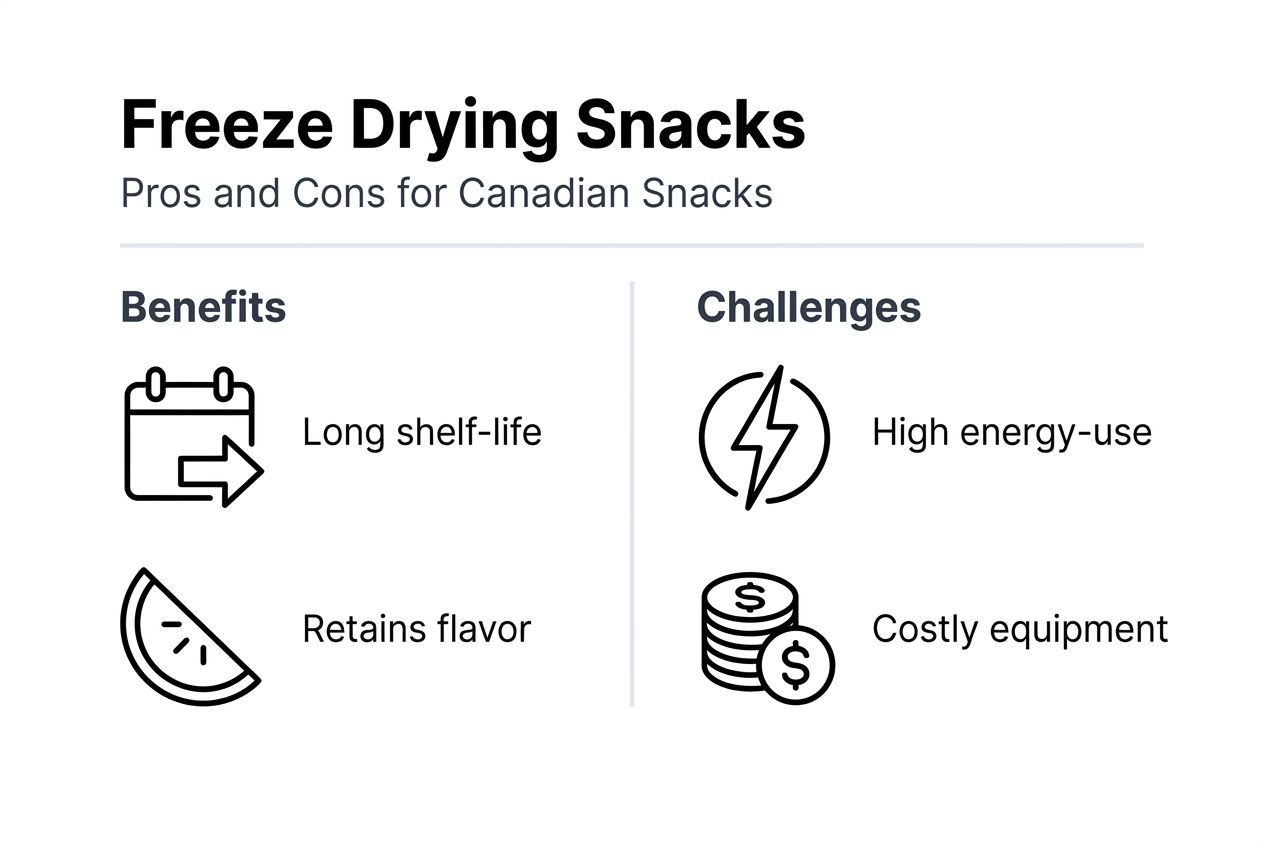
Superior flavor and texture retention creates products that stand out on crowded retail shelves. The porous, lightweight structure of freeze dried snacks offers a satisfying crunch consumers love. Nutrients remain largely intact, supporting health-focused marketing claims.
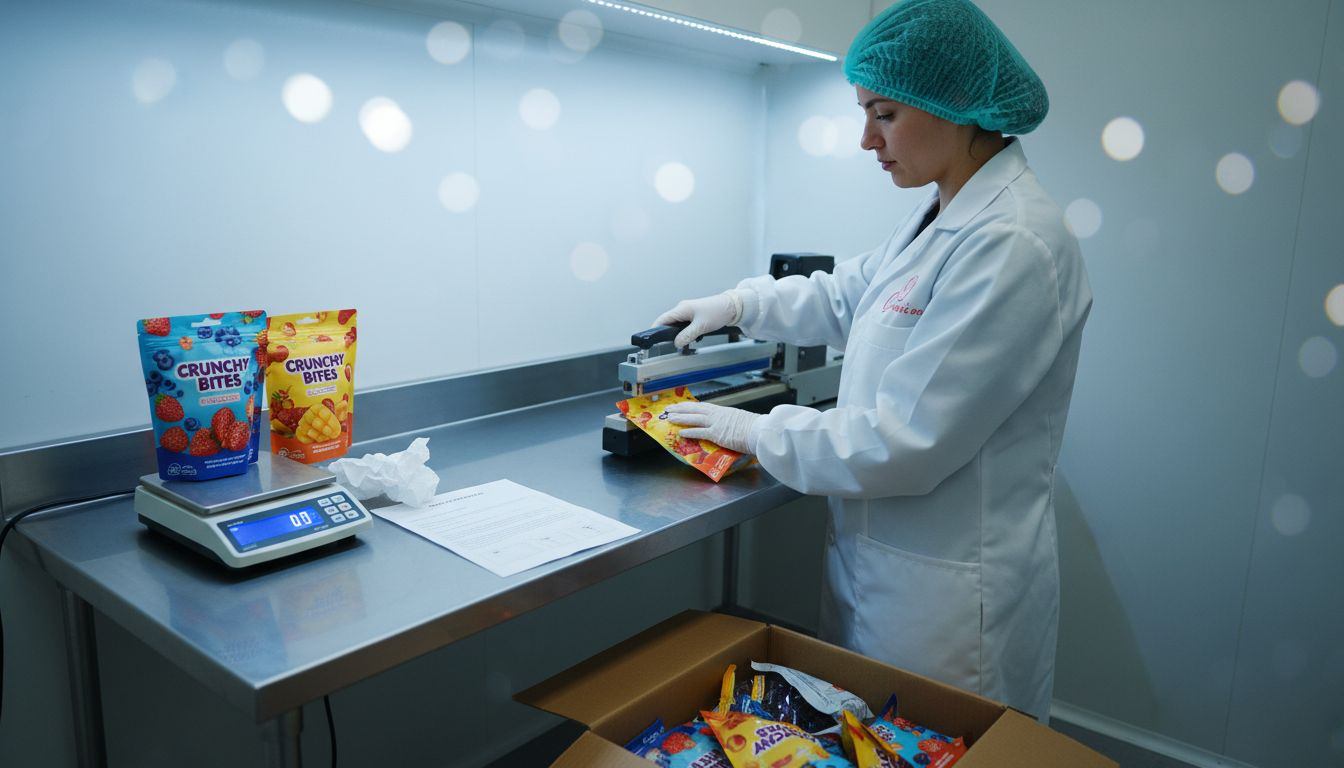
Extended shelf life eliminates refrigeration costs and reduces spoilage losses. Properly packaged freeze dried snacks last 12-24 months at room temperature. This stability simplifies distribution across Canada’s vast geography.
Freeze dried candy offers unique sensory appeal with amplified flavors, vivid colors, and novel textures that traditional candy lacks. This differentiation commands premium pricing, often 2-3 times conventional equivalents.
Challenges you’ll face:
High energy consumption remains the primary concern. Industrial freeze dryers require substantial electricity for vacuum pumps, refrigeration, and heating elements. Expect energy costs of $0.50-1.50 per kilogram of finished product depending on efficiency.
Equipment investment is significant. Commercial freeze dryer machines start around $15,000 for small batch units and exceed $250,000 for production-scale systems. Maintenance adds ongoing expense.
Lengthy cycle times limit throughput. A single batch may take 24-48 hours, restricting production volume compared to other preservation methods. This affects your ability to scale quickly during peak demand.
| Factor | Advantage | Challenge |
|---|---|---|
| Product quality | Preserves original flavor, color, nutrition, texture | Requires premium pricing to justify costs |
| Shelf stability | 12-24 months unrefrigerated | Must maintain strict packaging integrity |
| Market positioning | Unique products command higher margins | Limited consumer familiarity requires education |
| Production | Consistent batch quality | Long cycles and high energy use |
| Food safety | Low water activity inhibits pathogens | Doesn’t sterilize; strict hygiene essential |
Pro Tip: Calculate your break-even volume before investing. Factor equipment depreciation, energy, labor, and packaging against realistic wholesale or retail prices for your target market.
Freeze drying doesn’t kill microorganisms, only makes conditions unsuitable for growth. You must implement rigorous sanitation and source high-quality ingredients. This requirement actually becomes an advantage, as you can honestly market clean-label products.
The freeze drying benefits for snack business analysis shows that despite challenges, businesses achieving efficient operations and strong branding see returns within 18-30 months. Understanding what freeze dryer equipment looks like helps you plan facility space and utilities appropriately.
Practical tips for integrating freeze drying into your snack business
Turning freeze drying knowledge into profitable operations requires strategic planning and smart execution.
Start with financial modeling:
- Project realistic production volumes based on cycle times and equipment capacity
- Calculate total cost per unit including ingredients, energy, labor, packaging, and overhead
- Research competitor pricing and determine your premium positioning
- Identify break-even volume and timeline to profitability
Commercial freeze dryers demand significant capital and operational costs. Many Canadian startups find partnering with established co-packers more viable initially. This approach lets you test market demand without major equipment investment.
Equipment selection considerations:
- Match dryer capacity to realistic production targets, not aspirational ones
- Prioritize energy-efficient models with automated controls to reduce labor
- Ensure adequate electrical service and backup power for your facility
- Plan for proper ventilation and temperature control in the drying area
Implement good manufacturing practices rigorously. Since freeze drying doesn’t sterilize products, contamination during processing creates safety risks. Clean equipment between batches, train staff on hygiene protocols, and maintain detailed production records.
Innovation opportunities:
Experiment with unexpected flavor combinations and ingredient pairings. Freeze drying enhances natural flavors without adding sugars or artificial ingredients. This opens creative possibilities that differentiate your brand.
Test texture variations by adjusting slice thickness and drying parameters. Some customers prefer delicate, melt-in-mouth textures while others want aggressive crunch. Understanding your audience guides product development.
Consider seasonal and limited releases to build excitement. The extended shelf life means you can produce holiday items months in advance without quality degradation.
Pro Tip: Document everything during product development. Detailed batch records help you replicate successful results and troubleshoot issues. This documentation also supports regulatory compliance and quality certifications.
Packaging matters enormously for freeze dried snacks. Moisture reabsorption ruins texture instantly. Use multilayer moisture barrier pouches with oxygen absorbers. Proper packaging maintains quality throughout the distribution chain and on retail shelves.
The nutritional benefits of freeze dried food provide marketing angles emphasizing health and wellness. Many consumers don’t realize freeze drying preserves vitamins and minerals better than cooking or heat drying.
Learn from the comprehensive freeze drying benefits guide to understand how leading snack companies position these products effectively. Study their messaging, packaging design, and distribution strategies for insights applicable to Canadian markets.
Explore Spaceman’s freeze drying and packaging services for your snacks
Ready to launch freeze dried snacks without the equipment investment and learning curve?
Spaceman offers complete private label co-packing and packaging services designed specifically for Canadian snack businesses. We handle the entire freeze drying process while you focus on branding and sales.
Our freeze dried candy starter packs let you test market response with minimal commitment. Choose from proven flavor assortments that attract customers, packaged and ready for your label.
Scaling up? Our wholesale retail display kits include eye-catching merchandising that drives impulse purchases. The turnkey solution gets your products shelf-ready fast.
Whether you need small batch custom development or full production runs, our Canadian facility delivers consistent quality and reliable timelines. Let’s discuss how freeze drying can differentiate your snack offerings.
FAQ
What snacks are best suited for freeze drying?
Fruits like strawberries, mangos, and apples freeze dry exceptionally well, maintaining flavor intensity and appealing texture. Vegetables, candies, and heat-sensitive items also excel. Products with high initial moisture content and firm structure typically produce the best results. Understanding the freeze drying process explained helps you identify which products will deliver the texture and appearance customers expect.
How long does the freeze drying process take for snacks?
Freeze drying cycles range from several hours to multiple days depending on product thickness, moisture content, and equipment capacity. Typical snack batches require 24-48 hours. This extended processing time impacts production throughput and energy costs, making batch planning essential for profitability.
What are the main costs associated with freeze drying snacks?
Equipment investment, high energy consumption, maintenance, and labor represent the primary costs. Commercial freeze dryers start at $15,000 and can exceed $250,000 for production units. Electricity costs typically run $0.50-1.50 per kilogram of finished product. Smart process optimization and production scaling help manage these operational expenses effectively.
How does freeze drying affect the nutritional value of snacks?
Freeze drying retains most vitamins, minerals, and beneficial compounds exceptionally well compared to heat-based preservation. However, some heat-sensitive nutrients like vitamin C may degrade during prolonged cycles or if temperatures climb too high during secondary drying. Proper process control minimizes nutrient loss. Learn more about nutritional value in freeze dried food to support marketing claims accurately.
Does freeze drying kill bacteria and pathogens in snacks?
No, freeze drying reduces water activity to inhibit microbial growth but doesn’t sterilize products. You must start with high-quality, properly handled ingredients and maintain strict hygiene during processing. The low moisture environment prevents bacterial multiplication, but existing pathogens may survive in dormant states. This makes good manufacturing practices absolutely essential for food safety compliance.