

TL;DR:
- Freeze dryer sizing involves matching machine capacity to weekly production goals, cycle schedules, and growth plans.
- Proper sizing ensures optimal output without bottlenecks or excess capital investment, especially with modular options.
Freeze dryer sizing is the process of matching a machine’s batch capacity to your weekly finished product goals, cycle schedule, and growth plans. Get it wrong and you either bottleneck your production in month three or tie up capital in a machine that runs half empty. The freeze dryer sizing tips in this guide walk you through the actual math, the technical specs that matter beyond chamber size, and the modular design options that let you scale without starting over. Brands like Harvest Right and EnWave build machines across a wide capacity range, and the right choice depends on your output targets, not just your budget.
How to size a freeze dryer based on your weekly output goals
Sizing starts at the end. Decide how much finished, dried product you need to ship each week, then work backward.
Fresh products lose 60–90% of their weight during freeze drying. That weight loss is the most important number in your sizing calculation. A target of 50 kg of finished product per week means you need to process 150–500 kg of fresh input, depending on the moisture content of what you are drying. Candy and fruit sit at the high end of that loss range. Meat and vegetables vary.
The basic sizing formula
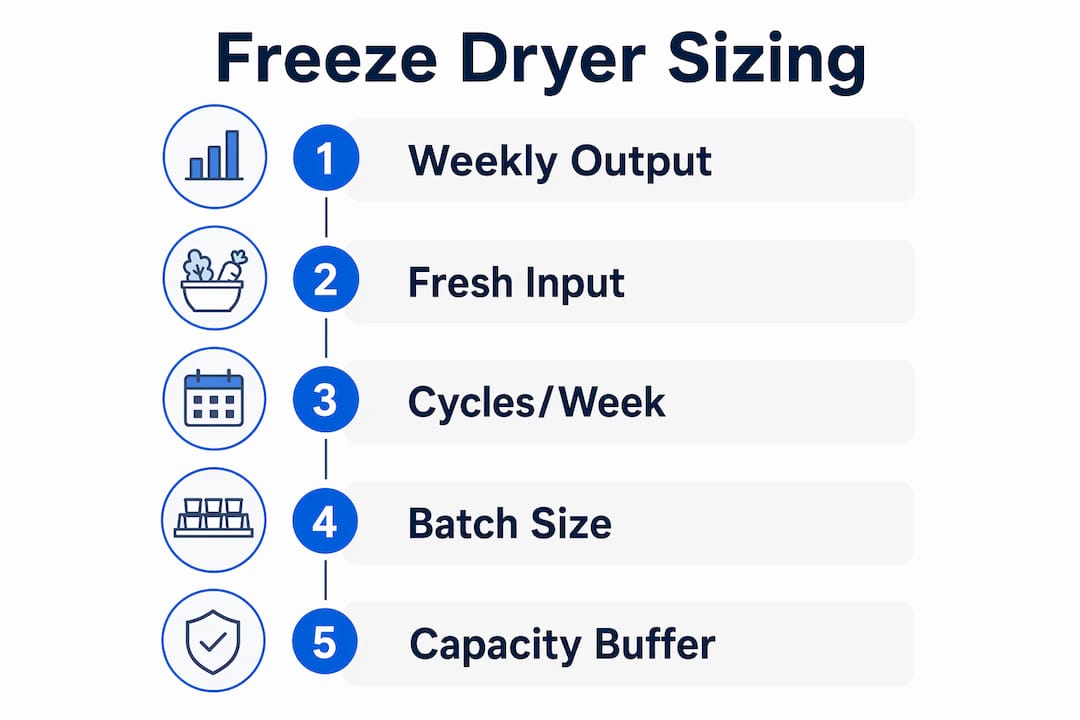
Three numbers drive the calculation: your weekly finished product target, your fresh input requirement, and the number of cycles your machine can complete each week.
Most commercial freeze dryers run 2–3 cycles per week, with each cycle taking 18–36 hours including loading and unloading time. Divide your total weekly fresh input by the number of cycles to get your required batch size. That batch size tells you the minimum chamber capacity you need.
For example: 300 kg of fresh input per week at 2 cycles per week means 150 kg per batch. A machine rated for 100 kg per batch will not keep up. A machine rated for 200 kg per batch will handle it with room to spare.
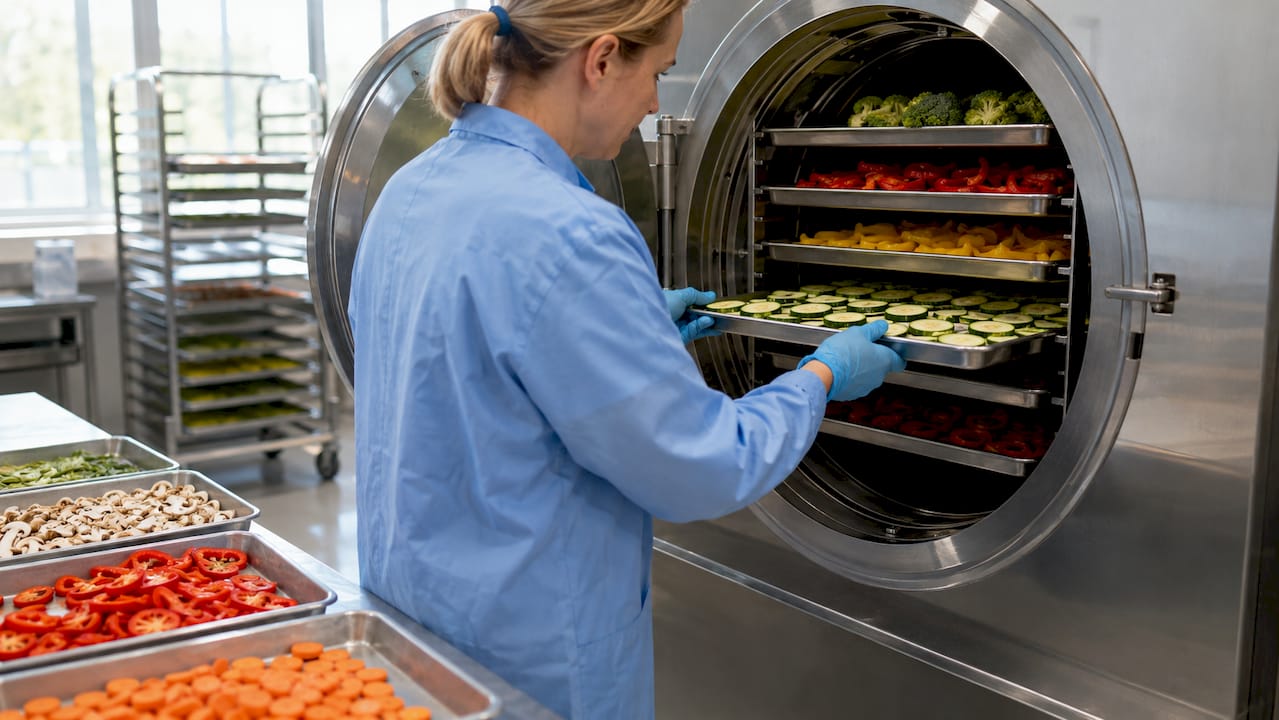
| Business stage | Weekly finished product target | Estimated fresh input needed | Suggested batch capacity |
|---|---|---|---|
| Testing / market validation | Under 10 kg | 30–100 kg | Small home or starter unit |
| Early growth | 10–50 kg | 100–500 kg | Mid-size commercial unit |
| Established production | 50–200 kg | 500–2,000 kg | Large commercial or modular system |
| Scaling / multi-SKU | 200 kg+ | 2,000 kg+ | Modular or multi-unit setup |
Pro Tip: Size your machine at roughly 70% of its rated capacity when you start. That growth headroom prevents bottlenecks and avoids the cost of running a second machine before you are ready.
What technical specs beyond size actually affect output?
Chamber size is the headline number, but actual production capacity depends more on condenser capacity, vacuum system quality, cycle length, and shelf area than on tray count alone. Buyers who skip these specs often end up with a machine that underperforms on paper.
Here are the specs that matter most:
- Condenser capacity. The condenser traps moisture pulled from your product. If it is undersized for your batch, vacuum loss and batch spoilage follow. Match condenser capacity to the moisture load of your heaviest batch, not your average batch.
- Vacuum system quality. A weak vacuum pump extends cycle times and produces inconsistent drying. Vacuum depth and pump reliability directly affect throughput and product quality.
- Cycle length. High-moisture products like fresh fruit can take 30+ hours per cycle. Low-moisture products like candy may finish in 18 hours. Shorter cycles mean more cycles per week and higher effective output from the same machine.
- Shelf area and loading practices. Usable shelf area determines how much product fits per cycle. Overloading shelves reduces airflow and extends drying time, which cuts your effective weekly output.
- Temperature range. Vacuum depth and temperature range are critical for matching equipment to your specific product recipe. A machine with a narrow temperature range limits the product types you can run.
“The best freeze dryer aligns with your product recipe and business model, not just size or price.” — yourequipmentsuppliers.com
Ignoring these specs is the most common mistake first-time buyers make. A machine with a large chamber but an undersized condenser will fail on high-moisture batches. Always ask for the condenser rating alongside the chamber volume when comparing models.
Fixed units vs. modular designs: which scales better?
The choice between a fixed large unit and a modular system is really a question of when you want to spend your capital.
Small and mid-size fixed units
Small starter units, including Harvest Right’s home and Pro models, suit testing and early market validation. Harvest Right’s medium home units process around 1,800 lbs of fresh product per year, while their large Pro models handle up to 5,000 lbs per year at four cycles per week. Those numbers work well for a business proving its product before committing to commercial-scale equipment.
Mid-size commercial units are the right fit for businesses that have validated demand and need consistent weekly output. They cost more upfront than home units but deliver the cycle reliability and condenser capacity that commercial production requires.
Modular systems for growing businesses
Modular system designs let you add capacity over time as sales grow, rather than buying a machine sized for a future you have not reached yet. EnWave builds modular freeze drying systems specifically for this use case. You start with one unit, prove your volume, and add capacity without replacing your existing equipment.
The operational benefit is real. Modular setups let you run one unit for R&D and a second for production, which keeps your testing separate from your revenue-generating batches.
Pro Tip: When you add a second unit, align the control logic between your R&D and production machines. Shared control systems cut the learning curve when you scale recipes from small batches to full runs.
Common freeze dryer sizing mistakes and how to avoid them
Most sizing errors fall into one of five categories. Knowing them in advance saves you from an expensive lesson.
-
Underestimating moisture load. Buyers calculate batch size by weight but forget that high-moisture products push the condenser to its limit. Always check condenser capacity against your wettest product, not your driest.
-
Buying too small. A machine that maxes out at your current volume leaves no room for a good month. Production bottlenecks at peak demand are costly and frustrating. Size for where you expect to be in 12–18 months, not where you are today.
-
Buying too large. A machine running at 30% capacity wastes energy and ties up capital. The optimal freeze dryer balances product needs, production goals, and facility constraints. Bigger is not always better.
-
Ignoring vacuum system specs. A weak or poorly matched vacuum pump extends every cycle. Over a year, that adds up to dozens of lost production hours.
-
Skipping test runs. Every product dries differently. Run test batches before committing to a machine size. Test runs reveal actual cycle times and moisture loads that spec sheets cannot predict.
The fix for most of these mistakes is the same: know your production goals before you shop, and treat the sizing calculation as a real math exercise, not a rough guess.
Key Takeaways
The right freeze dryer size comes from calculating your weekly finished product target, working backward through moisture loss and cycle counts, and then matching those numbers to condenser capacity and vacuum system quality.
| Point | Details |
|---|---|
| Start with finished product goals | Calculate fresh input needs using the 60–90% weight loss range before choosing a machine. |
| Factor in cycle frequency | Most commercial machines run 2–3 cycles per week; divide total input by cycles to find required batch size. |
| Check condenser capacity | Condenser size must match your highest-moisture batch to prevent vacuum loss and spoilage. |
| Size at 70% capacity | Leaving growth headroom avoids bottlenecks and delays the need for a second machine. |
| Consider modular designs | Modular systems let you add capacity incrementally, protecting capital while supporting growth. |
Sizing from experience: what the numbers do not tell you
I have seen small business owners make the same call over and over: they buy the biggest machine they can afford, assuming more capacity equals more profit. It almost never works that way at the start.
The machine that fits your business is the one you can actually fill consistently. Running a large commercial unit at 30% capacity is not a sign of ambition. It is a drain on your energy bill and your cash flow. The smarter move is to start with a unit sized for your current realistic volume, build your customer base, and then expand. Modular systems exist precisely because this is how most successful small producers actually grow.
The other thing spec sheets will not tell you is how much your product’s moisture content matters. Two businesses with identical weekly output targets can need very different machines if one is drying candy and the other is drying fresh berries. The freeze dryer features guide on the Space-man blog goes deep on this. Read it before you finalize any purchase.
My honest advice: do the math, run a test batch, and size for 12 months from now, not today. That single habit will save you from the two most expensive mistakes in this business.
— Chadi
Space-man’s freeze drying services for every production stage

Space-man works with businesses at every stage of freeze drying production, from early-stage operators validating their first product to established brands looking to scale volume without building their own facility. If you are still working through your sizing calculations, the Space-man team can help you match capacity to your actual output goals.
For businesses that want to skip the equipment decision entirely, Space-man’s co-packing and packaging services cover private labeling, bagging, and packaging for freeze dried consumer goods. You bring the product concept. Space-man handles the production. It is a practical option for brands that want to move fast without a major capital commitment upfront.
FAQ
How do I calculate the right freeze dryer size?
Start with your weekly finished product target, then multiply by 2.5–10x to estimate fresh input needs, accounting for 60–90% weight loss during drying. Divide total fresh input by your planned cycle count to find the batch size your machine must handle.
What is the best freeze dryer for home or small business use?
Harvest Right’s medium and large Pro models are widely used entry points, processing 1,800–5,000 lbs of fresh product per year. The best choice depends on your specific product, moisture content, and weekly output goals, not just machine size.
Why does condenser capacity matter for freeze dryer sizing?
An undersized condenser cannot trap the moisture load from high-moisture batches, which causes vacuum loss and ruins the batch. Always match condenser capacity to your wettest product, not your average load.
What is a modular freeze dryer system?
A modular system lets you add freeze drying units incrementally as your production volume grows. EnWave builds modular systems designed for small and growing businesses that need flexible capacity without replacing existing equipment.
How often can a commercial freeze dryer run per week?
Most commercial freeze dryers complete 2–3 cycles per week, with each cycle running 18–36 hours including loading and unloading. High-moisture products extend cycle times and reduce weekly throughput.