

TL;DR:
- Choosing the correct freeze dryer size is critical for balancing batch capacity, footprint, and electrical needs to optimize production. Oversizing can lead to excessive energy costs and inefficient operation, while undersizing may cause bottlenecks and limited growth potential. Planning for future demand, considering product type, and following recommended capacity guidelines ensure sustainable and cost-effective freeze drying.
Freeze dryer size comparison is defined by three core metrics: tray capacity, physical footprint, and batch throughput. Get any one of these wrong and you either run out of production capacity in six months or spend $15,000 on a machine that sits half-empty. Whether you are preserving food at home or scaling a commercial freeze dried product line, picking the right unit size is the single decision that shapes everything downstream. This guide breaks down the numbers, the models, and the real-world logic behind choosing the right freeze dryer dimensions for your operation.
What are the key factors to compare when evaluating freeze dryer sizes?
Freeze dryer size comparison starts with five measurable factors. Each one affects how much product you can run, how often you can run it, and what it costs to operate.
- Tray count and tray dimensions: These two numbers together define your usable surface area per batch. A Harvest Right small unit ships with 4 trays. The XL ships with 7. More trays mean more product per cycle, but also a larger footprint and higher energy draw.
- Footprint dimensions and weight: Physical space is a real constraint. Small units measure roughly 17.4" W × 21.5" D × 26.8" H. Large commercial units can reach 33.5" W × 37.25" D × 70" H. Weight matters too, especially if you need to move or reposition the unit.
- Batch throughput: This is how many pounds or kilograms of fresh food you process per cycle. A small home unit handles about 6–9 lbs per batch. An XL handles 38–45 lbs. That difference compounds fast when you run multiple cycles per week.
- Electrical requirements: Home units typically run on standard 110V outlets. Larger commercial models may need dedicated 20A circuits or industrial 3-phase power. Failing to plan for this leads to expensive retrofits or tripped breakers.
- Duty cycle: Running a freeze dryer at 100% capacity continuously shortens its lifespan and creates production bottlenecks. Professionals recommend keeping load at roughly 70% of rated capacity for sustainable throughput.
Pro Tip: Size for where your production will be in two to three years, not where it is today. Upgrading machines mid-growth is far more expensive than buying one size up at the start.
How do popular freeze dryer models compare in capacity and footprint?
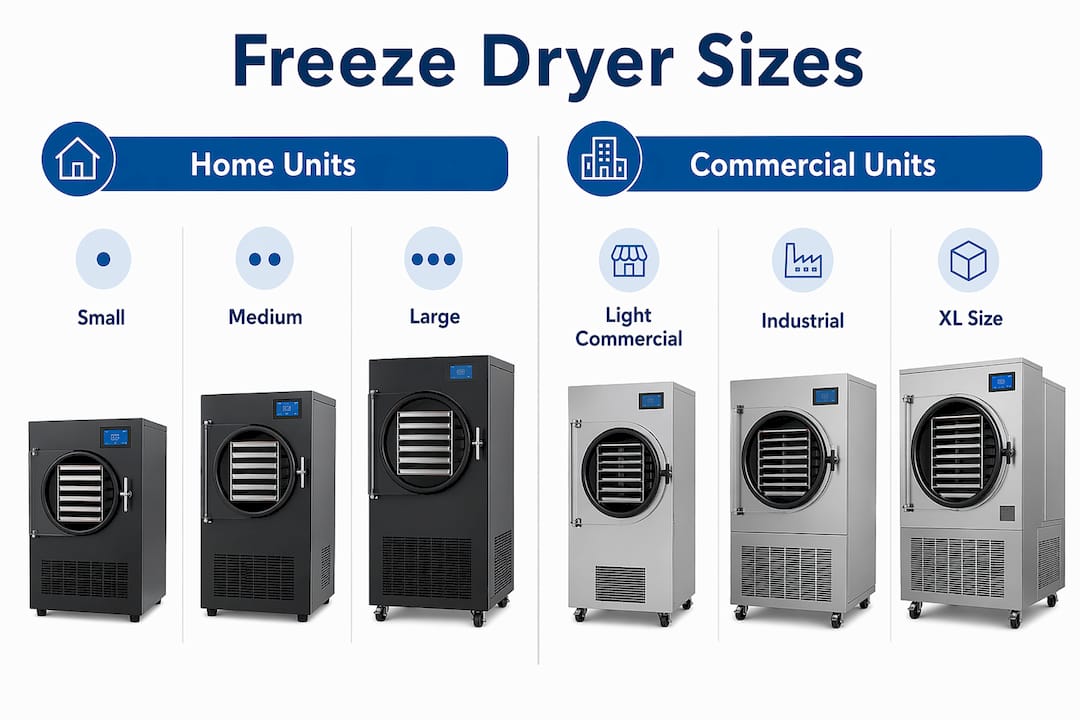
The table below covers the most commonly referenced models across home, light commercial, and industrial categories. These specs give you a direct freeze dryer size chart for side-by-side evaluation.
| Model | Trays | Batch Capacity | Footprint (W × D × H) | Power | Approx. Price |
|---|---|---|---|---|---|
| Harvest Right Small | 4 | 6 lbs | 17.4" × 21.5" × 26.8" | 110V | ~$2,495 |
| Harvest Right XL | 7 | 38–45 lbs | 24.3" × 37.4" × 35.6" | 110V | ~$4,995 |
| LIO 140 | 7 | ~12 kg/day | 800 × 800 × 1,100 mm | 230V, 2,850W | Contact vendor |
| LIO 280 / LIO-130-D | Multiple | Up to 130 kg/batch | Industrial floor space | 3× 400 VAC | Contact vendor |
The Harvest Right XL is the ceiling for home use. It handles 38–45 lbs of fresh food per batch, which translates to a meaningful weekly output for small food businesses or serious home preppers. The jump to the LIO 140 represents a shift in category. The LIO 140 processes up to 12 kg per day with touchscreen controls and CE certification, making it the entry point for light commercial production. At the industrial end, the LIO-130-D processes up to 130 kg per batch, weighs over 360 kg, and requires three separate 400 VAC power supplies. That is a different conversation entirely.
One thing the table does not show is yield after drying. Starting with 10 kg of fresh food can leave you with as little as 1–4 kg of dry product depending on moisture content. That ratio matters enormously when you are planning production targets.
Pro Tip: If floor space is tight, compare tray surface area per square foot of footprint rather than raw batch weight. Some compact commercial units deliver surprisingly high tray density relative to their physical size.
What practical considerations should businesses and individuals make when choosing freeze dryer sizes?
Choosing the right size is not just about matching today’s output. It requires thinking through your full production context. Here is a step-by-step approach that works for both home users and commercial operators.
- Calculate your weekly dry product target. Decide how many pounds or kilograms of finished, dry product you need per week. Work backward from sales projections or household consumption, not forward from machine specs.
- Apply the moisture loss factor. Raw-to-dry weight conversion is critical. A 10 kg batch of fresh strawberries may yield only 1–2 kg dry. Herbs lose less. Meats fall somewhere in the middle. Your actual output depends heavily on what you are processing.
- Estimate required batch frequency. Divide your weekly dry product target by your expected yield per batch. This tells you how many cycles per week you need to run. Factor in the duty cycle recommendation of 70% capacity to protect the machine.
- Check your electrical infrastructure. Home units work on standard household outlets. Once you move into commercial territory, electrical planning becomes a pre-purchase requirement, not an afterthought. Get an electrician involved before you finalize a model.
- Match the machine to your product type. Fragile herbs and botanical extracts benefit from smaller, temperature-controlled units with precise vacuum management. Bulk produce and meats need larger tray capacity for efficiency. Pharmaceutical-grade applications require specialized controls that go beyond standard food-grade units entirely.
- Build in a growth buffer. Industry guidance recommends sizing for 2–3 years of anticipated growth. A machine that fits your current output perfectly becomes a bottleneck the moment demand picks up.
For a deeper look at how these factors play out with specific food types, the Space-man blog covers freeze drying meat at home with model-specific recommendations worth reading before you commit.
How does freeze dryer size affect operational efficiency and cost?
Bigger is not automatically better. The relationship between machine size and operational efficiency is more nuanced than most buyers expect.
- Energy consumption scales with size. A Harvest Right small unit draws significantly less power than a commercial LIO 140 at 2,850W. Running a machine that is oversized for your current output means paying for energy you are not converting into product.
- Cost per pound improves with scale, up to a point. Larger machines spread fixed costs (energy, labor, depreciation) across more product per cycle. But if you are only filling 30% of a large machine’s capacity, your cost per pound is worse than running a smaller unit at 70%.
- Running near 70% capacity is the operational sweet spot. This maximizes throughput while protecting the machine from wear. It also gives you headroom to absorb demand spikes without running the unit into the ground.
- Modular tray configurations add flexibility. Some commercial units allow you to run fewer trays during low-demand periods, which reduces energy draw and extends machine life. This is worth asking about when comparing freeze dryer dimensions across commercial models.
- Precision temperature and vacuum control varies by model. Entry-level home units offer basic controls. Commercial units like the LIO 140 include touchscreen interfaces and tighter process management. For specialty products like botanicals or extracts, that precision is not optional.
If you want a broader look at what freeze drying equipment actually delivers for your operation, the Space-man guide on freeze dryer machine benefits covers the operational case in plain terms.
Key takeaways
Freeze dryer size selection is determined by tray capacity, footprint, throughput, and electrical requirements working together, not any single spec in isolation.
| Point | Details |
|---|---|
| Tray capacity defines batch output | Small units handle 6 lbs per batch; XL home units reach 38–45 lbs per batch. |
| Moisture loss shrinks your yield | 10 kg of fresh food may yield only 1–4 kg dry, so plan production targets around dry weight. |
| Run at 70% capacity for efficiency | Operating near 70% load maximizes throughput and protects machine longevity. |
| Electrical planning is non-negotiable | Commercial units may need dedicated circuits or 3-phase power before installation. |
| Size for future growth | Industry guidance recommends buying for 2–3 years of anticipated demand, not current output. |
Why I always tell people to size up, but not blindly
People ask me all the time whether they should buy the largest freeze dryer they can afford. My answer is always the same: size up thoughtfully, not reflexively.
The mistake I see most often is buying based on maximum batch capacity without thinking about duty cycle. A machine rated for 45 lbs per batch sounds impressive until you realize you are running it at 100% load every cycle and burning through components faster than expected. The 70% capacity rule exists for a reason.
The second most common mistake is ignoring electrical requirements until after the purchase. I have seen businesses order a commercial unit, get it delivered, and then discover their facility needs a $3,000 electrical upgrade before they can even plug it in. That is a painful and avoidable surprise.
What I actually recommend is this: map out your realistic weekly production target, apply the moisture loss factor for your specific products, and then find the machine that hits 70% of its rated capacity at that output level. That machine is your right size. If you are processing delicate herbs or botanical extracts, do not just look at capacity. Look at temperature control precision and vacuum management, because those features vary significantly between models.
The freeze dryer size guide on the Space-man blog walks through this calculation in detail if you want a structured framework to follow.
— Chadi
How Space-man supports your freeze dried production at any scale

Once you have the right freeze dryer in place, the next challenge is packaging, labeling, and getting your product to market efficiently. Space-man specializes in exactly that. As a Canadian freeze dried candy manufacturer with hands-on experience across batch sizes from startup to commercial scale, Space-man offers private label, co-packing, and packaging services designed for freeze dried food producers. Whether you are running a Harvest Right XL out of a home kitchen or scaling up with a commercial LIO unit, Space-man can handle the downstream workflow so your production does not stall at the packaging stage.
FAQ
What size freeze dryer do I need for home use?
A Harvest Right medium or large model covers most home preservation needs, handling between 15 and 30 lbs of fresh food per batch. If you process large harvests or run frequent cycles, the XL at 38–45 lbs per batch is worth the upgrade.
How do I read a freeze dryer size chart?
A freeze dryer size chart compares tray count, batch weight capacity, physical footprint dimensions, and power requirements side by side. Always check the dry yield, not just the fresh weight input, since moisture loss can reduce output by 60–90%.
What is the difference between home and commercial freeze dryer dimensions?
Home units like the Harvest Right small start at roughly 17.4" × 21.5" × 26.8" and weigh under 100 lbs. Commercial units like the LIO 140 measure around 800 × 800 × 1,100 mm and require dedicated electrical circuits, representing a fundamentally different installation footprint.
Why does running at 70% capacity matter for freeze dryers?
Running a freeze dryer at 70% of its rated capacity balances throughput with machine longevity. Operating at 100% load continuously accelerates wear and creates production bottlenecks when demand spikes.
Does product type affect which freeze dryer size I should choose?
Yes. Fragile herbs and botanical extracts benefit from smaller units with precise temperature and vacuum control. Bulk produce and meats need larger tray capacity to process efficiently. Pharmaceutical applications require specialized controls beyond standard food-grade models.