

TL;DR:
- Freeze dryer features such as vacuum level, cold trap temperature, and shelf design directly impact product quality and production efficiency. Automation, data logging, and sanitation design are essential for compliance and operational reliability in commercial settings. Selecting a machine based on your specific product, batch size, and regulatory needs ensures optimal performance and long-term cost savings.
Freeze dryer machine features are the technical and operational characteristics that determine what a lyophilizer can actually do, how well it preserves food, and whether it fits your production scale. Whether you are comparing home units from Harvest Right or evaluating commercial systems from Blue Alpine, the specs that matter most are vacuum capability, cold trap temperature, shelf design, condenser capacity, and automation level. These features directly control preservation efficiency, product quality, and long-term cost of ownership. Getting them right before you buy saves you from expensive regret later.
What are the core freeze dryer machine features to know?
A freeze dryer’s performance starts with four foundational specifications: vacuum level, cold trap temperature, shelf design, and condenser capacity. Understanding each one tells you whether a machine can handle your product and your volume.
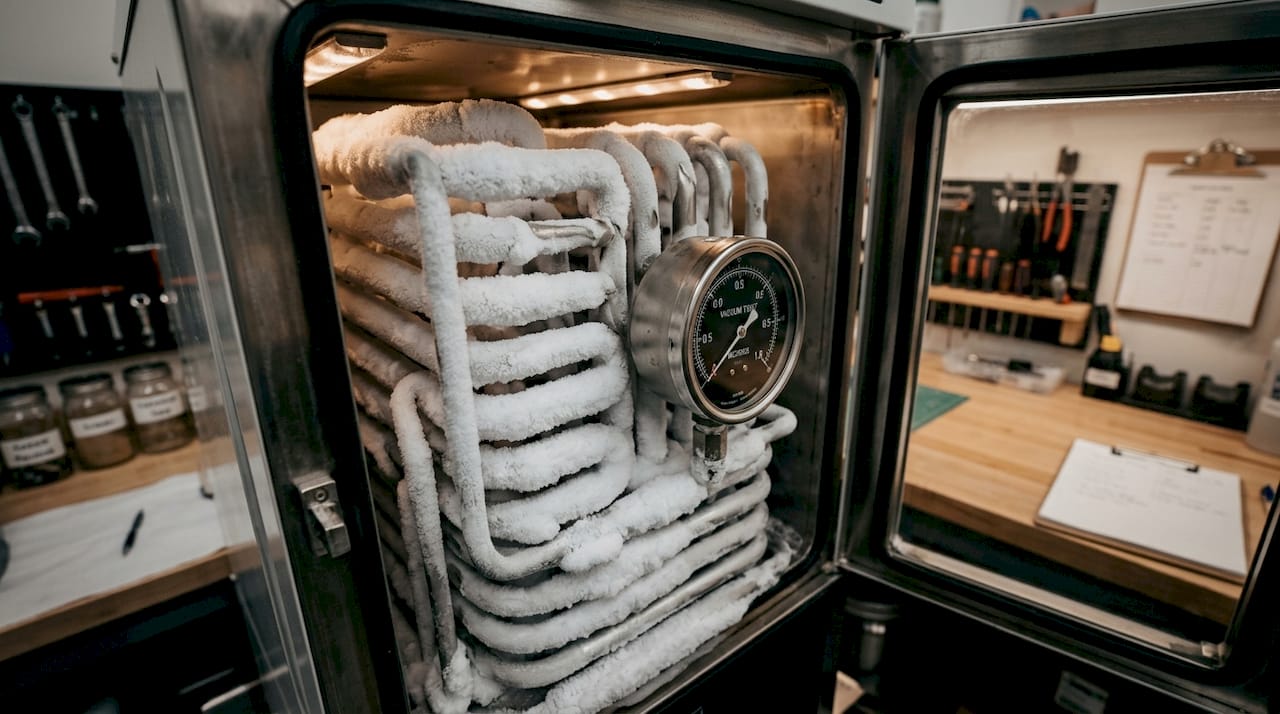
Vacuum level is the most critical spec. The system must pull the chamber pressure low enough for sublimation to occur. High-performance units achieve ultimate vacuum ≤2 Pa, with premium lab and industrial systems reaching ≤1 Pa. Lower pressure means faster, more complete moisture removal, which directly improves shelf life.
Cold trap temperature determines how effectively the condenser captures water vapor before it reaches the vacuum pump. Most commercial units operate between -55°C and -80°C. Units with condenser temperatures to -60°C are standard for food applications, while pharmaceutical-grade machines often require -80°C for heat-sensitive compounds. A warmer trap means moisture escapes capture and degrades pump performance over time.
Shelf design covers material, size, number of shelves, and temperature range. Stainless steel shelves are standard for food-grade applications. The number and total area of shelves set your batch capacity. One well-specified commercial unit, for example, offers 4.95 m² of shelf area with a 75 kg batch capacity, which is a meaningful throughput benchmark for mid-scale production.
| Specification | Typical Range | Why It Matters |
|---|---|---|
| Ultimate vacuum | ≤1 to ≤2 Pa | Controls sublimation rate and drying completeness |
| Cold trap temperature | -55°C to -80°C | Determines moisture capture efficiency |
| Shelf area | 0.1 m² to 5+ m² | Sets batch size and throughput capacity |
| Installed power | 1.5 kW to 9.5 kW | Affects operating costs and facility requirements |
| Batch capacity | 5 kg to 75+ kg | Scales from home use to commercial production |
Pro Tip: When comparing freeze dryer specifications, always check the installed power rating alongside the batch capacity. A unit rated at 9.5 kW installed power processing 75 kg per batch is efficient. A smaller machine drawing similar wattage for a 10 kg batch is not.
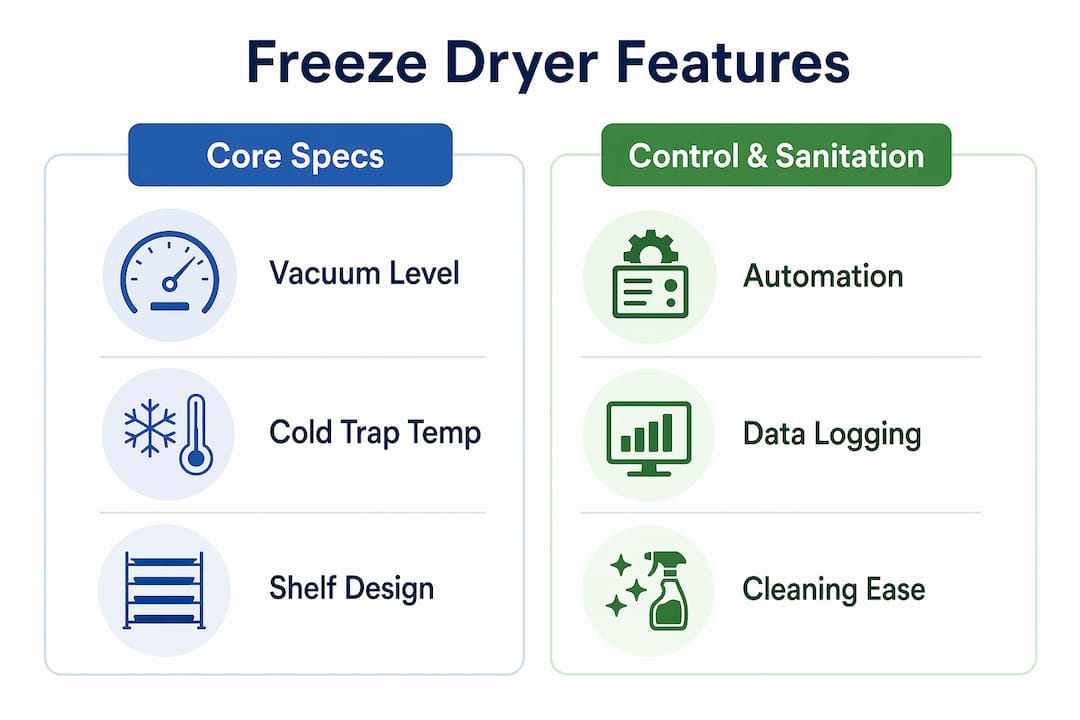
How do automation and control features affect performance?
Automation is where modern freeze dryers separate themselves from basic units. The ability to program, monitor, and log a drying cycle is not a luxury feature. For commercial food producers and regulated industries, it is a requirement.
Touchscreen controls allow operators to set precise shelf temperatures and vacuum targets at each phase of the cycle. This matters because freeze drying has three distinct stages: freezing, primary drying (sublimation), and secondary drying (desorption). Each stage requires different temperature and pressure conditions, and manual adjustment across a 20-hour cycle is both impractical and inconsistent.
Real-time monitoring and freeze-drying curve recording give operators a visual record of how the cycle progressed. If a batch fails or a product comes out with residual moisture, the logged curve shows exactly where the process deviated. This is the difference between fixing a problem and guessing at it.
Data logging is non-negotiable for businesses operating under regulatory oversight. FDA 21 CFR Part 11 compliance requires electronic records and audit trails for pharmaceutical and certain food applications. Machines with built-in data export capabilities satisfy this requirement without additional software workarounds.
Alarm systems protect both the product and the equipment. A well-designed alarm function alerts operators to vacuum leaks, temperature deviations, or compressor faults before they cause batch loss. Advanced units include alarmed freeze-drying curves that flag anomalies automatically, which is particularly valuable for overnight or unattended runs.
Pro Tip: Before purchasing any commercial unit, ask the manufacturer to demonstrate the data export function. If the machine cannot produce a clean, timestamped log file, it will create compliance headaches later.
What cleaning and sanitation features should you look for?
Sanitation is the freeze dryer feature most buyers underestimate, and it is the one that causes the most operational problems after purchase. Freeze drying does not kill bacteria. It removes water, which means any contamination present before or during the process stays in the finished product. Machine design either makes sanitation easy or turns it into a daily ordeal.
The most important design choice is shelf type. Liquid-filled shelves circulate a heat transfer fluid through internal channels, which means they can be pressure washed and chemically cleaned using industry-standard foam wash protocols. Electric heating pads, by contrast, cannot be submerged or pressure washed without risking damage to electrical components. For operations that switch between product types, this difference is significant. Cross-contamination between a savory product and a sweet one, for example, is a real quality issue in multi-product facilities.
| Feature | Liquid-Filled Shelves | Electric Pad Shelves |
|---|---|---|
| Cleaning method | Pressure wash, foam wash, chemical | Wipe-down only |
| Cross-contamination risk | Lower | Higher |
| Sanitation speed | Faster | Slower |
| Maintenance complexity | Moderate (fluid system) | Lower |
| Best for | Multi-product, commercial use | Single-product, lower volume |
Chamber accessibility also matters. Wide-opening doors, removable shelf assemblies, and smooth interior finishes without crevices all reduce cleaning time and the risk of residue buildup. Purge valves allow operators to introduce dry nitrogen or air at the end of a cycle, which helps prevent moisture reabsorption during unloading. For food safety compliance, understanding sanitation preventive controls relevant to your operation is worth reviewing before finalizing a machine purchase.
Pro Tip: If you plan to run multiple product types through the same machine, prioritize liquid-filled shelves and a chamber design with no exposed fasteners or grooves. Cleaning time adds up fast, and a machine that takes three hours to sanitize properly will quietly kill your throughput.
How do freeze dryer features influence efficiency and cost?
Operational efficiency comes down to cycle time, power consumption, and how much product you can move through the machine per week. These three variables determine your real cost per kilogram of finished product.
Cycle time is the biggest variable. Standard commercial freeze dryers run 12 to 20-hour cycles for most food products. Some high-performance units claim significantly shorter cycles through better refrigeration capacity and shelf temperature control. Shorter cycles mean more batches per week, which directly multiplies your output without adding equipment.
Power consumption is the operating cost you pay every single day. Removing water through freeze drying typically requires 10 to 15 kWh per kilogram of water removed. That number compounds quickly at commercial scale. A machine drawing 1,440W continuously over a 20-hour cycle consumes roughly 29 kWh per batch. At industrial scale, energy costs can add 20 to 30% beyond the initial purchase price when you factor in utilities, installation, and maintenance over the machine’s lifespan.
Here is a practical way to think about total cost of ownership:
- Calculate your target weekly output in kilograms.
- Divide by the machine’s batch capacity to get required cycles per week.
- Multiply cycles by average power draw per cycle to get weekly kWh.
- Add estimated maintenance costs (typically 5 to 10% of purchase price annually for commercial units).
- Compare this total across machines, not just the sticker price.
Refrigeration system quality drives both cycle time and long-term reliability. A compressor sized correctly for the condenser load maintains cold trap temperatures consistently throughout the cycle. Undersized refrigeration causes the cold trap to warm during heavy sublimation, reducing moisture capture and extending cycle time. This is a specification most buyers never ask about, and it is one of the clearest indicators of machine quality.
How to select the right freeze dryer for your application
Matching freeze dryer specifications to your actual use case is the step most buyers skip, and it is the reason so many machines end up underperforming. Choosing based on price or size alone is the most common and most costly mistake in this category.
Start with your product, not the machine. Ask these questions before looking at any spec sheet:
- What is the thermal sensitivity of your product? Heat-sensitive items like probiotics or enzymes require lower shelf temperatures and tighter vacuum control.
- What batch size do you need? Home users processing a few kilograms per week have completely different needs than a co-packer running 50 kg batches daily.
- How many product types will you run? Multi-product operations need superior sanitation features and ideally liquid-filled shelves.
- Do you operate in a regulated environment? If yes, 21 CFR Part 11 data logging and alarm documentation are not optional.
- What are your facility constraints? Power supply, floor space, and ventilation all limit which machines are physically viable for your location.
One practical step that experienced operators recommend is running a validation cycle with bread before processing any valuable product. This “bread run” removes manufacturing odors, confirms vacuum performance, and gives you a baseline cycle to compare against. It costs almost nothing and tells you a great deal about the machine’s actual behavior.
Pro Tip: After each batch, weigh trays before and after an extended drying period to confirm moisture removal is complete. Timer-based endpoints are a starting point, not a guarantee. Weight-based verification is the professional standard.
Key takeaways
The right freeze dryer machine features are determined by your product, your volume, and your compliance requirements, not by price or brand name alone.
| Point | Details |
|---|---|
| Vacuum and cold trap specs | Prioritize ≤2 Pa vacuum and -55°C to -80°C cold trap for reliable moisture removal. |
| Automation and data logging | Cycle programming and 21 CFR Part 11-compatible logging are required for regulated commercial use. |
| Shelf and sanitation design | Liquid-filled shelves enable pressure washing and reduce cross-contamination in multi-product operations. |
| Total cost of ownership | Energy and maintenance add 20 to 30% beyond purchase price; calculate cost per kilogram, not just sticker price. |
| Application-first selection | Match vacuum level, thermal range, and batch capacity to your specific product before evaluating any machine. |
Why most buyers get freeze dryer selection backwards
I have seen this pattern repeat itself more times than I can count. Someone walks in focused on price, picks the most affordable unit that fits their space, and then spends the next six months frustrated by long cycle times, inconsistent results, or a cleaning process that eats up two hours between every batch.
The machines that perform well long-term are the ones selected product-first. If you are freeze drying candy, for example, sugar products behave differently under vacuum than proteins or vegetables. The shelf temperature range and vacuum precision that work beautifully for strawberries may not give you the texture and snap you want in a freeze dried candy product. These are details that only surface when you think about your product before you think about the machine.
Automation is the other thing I would push buyers to take seriously, even at smaller scales. The ability to log a cycle and replay it exactly is what turns a good batch into a repeatable process. Without it, you are essentially cooking without a recipe every single time.
My honest advice: read the freeze dryer buying guide before you talk to any sales rep. Know your product’s thermal sensitivity, your target batch size, and whether you need compliance documentation. Walk in with those answers and the right machine becomes obvious.
— Chadi
Explore Space-man’s freeze drying expertise

Space-man has spent years perfecting the freeze drying process for candy and confectionery products, and that hands-on experience informs everything from product development to packaging. If you are a business looking to bring freeze dried products to market without investing in your own equipment, Space-man’s private label and co-packing services cover the full production workflow, from freeze drying to bagging and branded packaging. For consumers who want to experience the results directly, the 10-pack candy bundle ships free across Canada and showcases what the right machine features actually produce in the finished product.
FAQ
What vacuum level should a freeze dryer machine have?
A quality freeze dryer should achieve an ultimate vacuum of ≤2 Pa for food applications, with premium units reaching ≤1 Pa. Lower vacuum pressure accelerates sublimation and produces more thoroughly dried product.
How long does a typical freeze drying cycle take?
Most commercial freeze dryers run cycles of 12 to 20 hours depending on product type, batch size, and machine refrigeration capacity. Some high-performance units reduce this significantly through better compressor and shelf temperature management.
Does freeze drying kill bacteria in food?
Freeze drying does not sterilize food. It removes water, which inhibits bacterial growth, but any contamination present before drying remains in the finished product. Proper sanitation of the machine and immediate packaging after drying are both required for food safety.
What is the difference between liquid-filled and electric pad shelves?
Liquid-filled shelves circulate heat transfer fluid and can be pressure washed and chemically sanitized, making them better for multi-product commercial operations. Electric pad shelves require wipe-down cleaning only and carry a higher cross-contamination risk when switching between product types.
How do I know when a freeze drying cycle is complete?
The most reliable method is to weigh trays before and after an extended drying period and confirm no further weight loss occurs. Timer-based endpoints are a useful starting point, but weight-based verification is the professional standard for confirming complete moisture removal.