

TL;DR:
- Canadian candy distributors face strict regulations, including SFCR compliance and traceability requirements.
- Operational challenges include managing temperature-sensitive inventory and seasonal demand fluctuations.
- Building strong relationships, agility, and proactive communication are key to long-term growth.
Candy distribution in Canada sounds like a fun business on the surface. Pick great products, find the right buyers, and watch sales roll in. The reality hits differently. Canadian candy distributors operate inside a web of strict federal regulations, volatile import markets, and a consumer base that keeps shifting toward healthier choices. The industry generated $1.6 billion in 2026 across 117 manufacturers, with exports accounting for more than half of total revenue. If you want to compete and grow in this space, you need more than good taste. You need operational clarity, compliance readiness, and a real strategy.
Table of Contents
- Understanding the regulatory landscape: SFCR and compliance essentials
- Operational hurdles: logistics, supply chain, and inventory management
- Adapting to market trends and navigating fierce competition
- Mitigating risk: recalls, traceability, and staff training
- A distribution expert’s take: What most guides miss about thriving in Canadian candy
- Next steps with Spaceman: Streamline your candy distribution
- Frequently asked questions
Key Takeaways
| Point | Details |
|---|---|
| Regulatory readiness | Mastering SFCR compliance is non-negotiable for candy distributors in Canada. |
| Operational agility | Efficient inventory and supply chain management are essential for staying profitable in a fast-moving market. |
| Competitive adaptation | Adapting to health trends and differentiating from competitors can unlock lasting growth. |
| Proactive risk management | Design robust recall systems and invest in staff training to protect your business long-term. |
Understanding the regulatory landscape: SFCR and compliance essentials
With an understanding that distribution is highly regulated, let’s explore exactly what compliance under SFCR really means for your operation.
The Safe Food for Canadians Regulations (SFCR) is the federal framework that governs how food businesses, including candy distributors, must operate. It is not optional, and it covers far more ground than most newcomers expect. Think of SFCR as a rulebook that runs from your supplier’s dock all the way to your customer’s shelf.
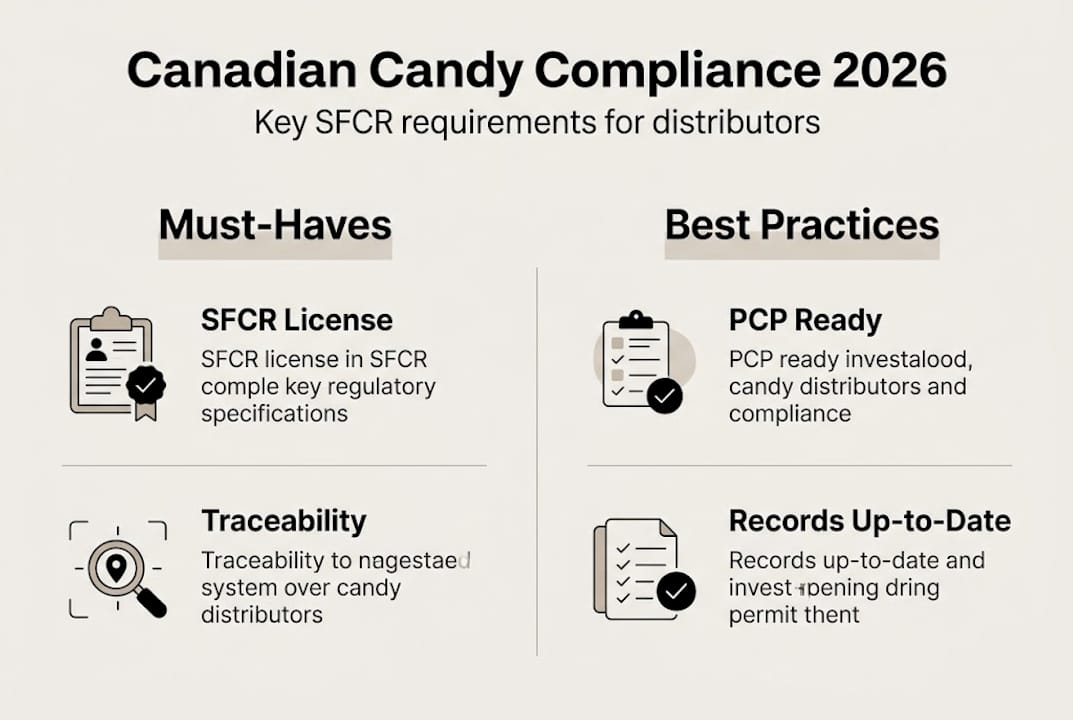
Under SFCR, distributors must implement Preventive Control Plans (PCPs). These are documented systems that identify hazards, control risks, and prove your operation is consistently safe. The CFIA requires preventive controls covering hazard identification and analysis, sanitation and pest control, equipment maintenance, proper storage and loading procedures, and staff hygiene and competency training. Recall procedures must also be documented and tested.
Here are the core compliance areas every distributor must address:
- Hazard analysis: Identify biological, chemical, and physical risks in your product flow
- Sanitation protocols: Scheduled cleaning logs for all contact surfaces and equipment
- Pest control: Contracted programs with documented inspections
- Traceability records: Lot codes linked to both supplier and customer records
- Recall readiness: Written procedures with clear chain of command
- Staff training: Documented hygiene and food safety competency for every employee
Digital traceability is where most distributors either gain or lose ground fast. Lot codes attached to every incoming shipment and every outgoing delivery are the backbone of a functional recall system. Without them, a single contamination event can shut down your entire operation.
“Traceability is not just a regulatory checkbox. It is your first line of defense when something goes wrong, and in this industry, something eventually goes wrong.”
If you are handling imported confections, understanding the full import compliance picture matters even more. The legal requirements for importing snacks into Canada go beyond labeling and include licensing and country-of-origin documentation. Water quality in your facility is also a silent compliance risk. Poor water purity affects food safety outcomes in ways that auditors will catch even when operators miss them.
Pro Tip: If you are a small to mid-size distributor, bring in a certified food safety consultant to build your PCP from scratch. It costs less than a single compliance fine, and good software tools can automate traceability logs so your team focuses on operations instead of paperwork.
Operational hurdles: logistics, supply chain, and inventory management
Once regulatory requirements are in place, the next major headache is day-to-day operations.
Candy seems shelf-stable, but temperature sensitivity is real. Chocolate blooms, gummies melt, and freeze dried candy absorbs moisture if storage conditions are off. Managing shelf life across a mixed product portfolio means your warehouse environment must be actively monitored, not just assumed to be fine.

Seasonality compounds the problem. Halloween, Valentine’s Day, Easter, and Christmas each create massive demand spikes followed by inventory lulls. If you order too heavy heading into a season, you are sitting on tied-up capital and products with shrinking shelf windows. Order too light, and you lose shelf space to a competitor who showed up with stock.
Here is a snapshot of the current Canadian candy market landscape:
| Metric | 2026 Value |
|---|---|
| Total industry revenue | $1.6 billion |
| Number of manufacturers | 117 |
| Revenue CAGR (past 5 years) | 6.5% |
| Export share of revenue | Over 50% |
| Primary competitive pressure | Health trends, high imports |
The Canadian candy manufacturing sector has grown at 6.5% annually over the past five years, but that growth is not evenly distributed. Large players with efficient supply chains capture disproportionate gains. Smaller distributors often struggle with minimum order quantities from manufacturers and freight costs that erode margins.
Strategies that actually help:
- Lock in freight contracts during slow seasons to get better rates during peak demand
- Use warehouse slotting to keep fast-moving SKUs close to loading docks
- Build direct relationships with at least two backup suppliers for your top five products
- Track weekly sell-through rates by product category, not just monthly totals
Understanding the broader wholesale candy supply chain helps you see where bottlenecks hide. Specific bulk candy supply chain strategies can help you structure inventory systems that reduce waste without sacrificing fill rates.
Pro Tip: Just-in-time inventory works well for freeze dried and specialty candy SKUs that have predictable reorder cycles. Pair it with a 10% safety stock buffer on your top seasonal items to avoid stockouts during promotion windows.
Adapting to market trends and navigating fierce competition
After addressing internal hurdles, it is vital to look outward at what the market expects and how competitors are reacting.
Health consciousness has reshaped the Canadian confection market in real and measurable ways. Consumers are reading labels, questioning sugar content, and reaching for alternatives. This does not mean candy is dying. It means the type of candy that sells is shifting. Distributors who cling to legacy SKUs without evaluating category health risk watching their margins shrink while more agile competitors scoop up shelf space.
| Segment | Traditional candy market | Health-conscious candy market |
|---|---|---|
| Growth trend | Slowing in sugar-heavy categories | Growing in better-for-you formats |
| Price sensitivity | High | Moderate to low |
| Retail placement | Mass market, discount | Specialty, natural, online |
| Distributor opportunity | Volume play, tight margins | Premium pricing, loyalty |
| Example product | Bulk gummies, hard candy | Freeze dried, functional, reduced sugar |
Despite health headwinds, the Canadian candy industry maintains strong export momentum, with exports representing over 50% of total revenue and a 6.5% CAGR over the past five years.
Here are four numbered strategies distributors can use to stand out:
- Private labeling: Offer retailers a branded product at a competitive price point without forcing them to source independently. This creates stickiness and margin improvement for both sides.
- Exclusive distribution agreements: Lock in geographic exclusivity with innovative manufacturers before competitors do.
- Curated display programs: Show retailers how to merchandise effectively with planograms and display kits. Most retail buyers love a supplier who makes their job easier.
- Product mix diversification: Add functional, freeze dried, or premium SKUs alongside your core range to capture shoppers across the health spectrum.
The economics of private labeling reveal compelling cost advantages that many distributors still overlook. And if you want to understand where domestic production capacity sits, knowing the landscape of candy factories in Canada helps you identify the right manufacturing partners.
Mitigating risk: recalls, traceability, and staff training
Having explored competitive strategies, it is equally important not to overlook operational risks that demand readiness.
A recall is not just a reputational problem. It is a cash flow crisis, a logistics emergency, and a staff readiness test all at once. Distributors who have never run a mock recall are the ones who discover their system’s gaps in the worst possible moment.
Building a functional Preventive Control Plan takes a structured approach:
- Map your full product flow from supplier intake to final delivery
- Identify every point where contamination, mislabeling, or temperature deviation could occur
- Assign specific control measures to each risk point with documented monitoring
- Test your recall system at least twice per year with documented drills
- Review and update your PCP whenever you add a new product line or supplier
Digital traceability is what makes recalls fast and contained. SFCR-compliant traceability requires that lot codes connect every batch you receive to every customer you ship to. Without that chain of custody, a recall can spiral from one SKU into your entire inventory.
Key staff competencies every candy distributor should prioritize:
- Allergen awareness: Candy is a high-allergen category. Staff must know cross-contact risks cold.
- Temperature monitoring: Anyone handling product needs to log and report deviations immediately
- Label verification: Catching a mislabeled case before it ships prevents regulatory and liability exposure
- Recall role clarity: Everyone on your team should know their specific job during a recall without needing to ask
Water quality in processing and cleaning areas also feeds into overall food safety. Understanding why purification matters in food safety at the facility level can protect you from contamination sources that auditors flag regularly.
Pro Tip: Run a tabletop recall drill quarterly. Give your team a fictional lot code and walk through the entire isolation, notification, and documentation process. The goal is to reduce your hypothetical recall response time to under four hours.
If you are still evaluating which type of distribution partner fits your business model, reviewing what separates good from great when choosing a candy distributor gives you a useful benchmark.
A distribution expert’s take: What most guides miss about thriving in Canadian candy
Most articles about candy distribution stop at compliance checklists and logistics frameworks. That information matters, but it misses what actually drives long-term growth in this industry: relationships and agility.
We have seen distributors with perfect PCPs and airtight supply chains still lose major retail accounts simply because their communication was slow or reactive. The buyers who keep coming back are the ones who feel like their distributor gets them, knows their seasonal needs before they ask, and brings new product ideas before the competition does.
Frontline staff training is the most underinvested asset in distribution operations. Your warehouse team’s allergen awareness and your sales rep’s product knowledge are the two touch points that build or break retailer trust. No software solves for a rep who cannot explain why a freeze dried SKU commands a premium price.
The real game-changer is combining compliance technology with proactive customer communication. When supply chain optimization is working well, it frees up time for your team to actually talk to their accounts. That combination, operational precision plus genuine service, is what separates the distributors who grow from those who just survive.
Next steps with Spaceman: Streamline your candy distribution
Ready to turn insight into action? Here is how Spaceman can help you stay ahead.
At Spaceman, we manufacture and distribute freeze dried candy in Canada with a direct understanding of the compliance, logistics, and market differentiation challenges you face daily. We do not just sell product. We offer private label and co-packing services that help distributors launch branded lines without building production infrastructure.

Our wholesale candy display kits give you a turnkey retail merchandising solution built for distributor margins. Whether you need co-packing, custom packaging, or a scalable freeze dried candy program for your retail accounts, Spaceman has the manufacturing and distribution depth to make it work.
Frequently asked questions
What is the biggest compliance challenge for Canadian candy distributors?
Meeting SFCR preventive control requirements and maintaining thorough traceability records is the most significant compliance hurdle, particularly for distributors handling multiple product lines and suppliers simultaneously.
How does seasonality affect candy distribution in Canada?
Seasonal spikes around major holidays create intense inventory pressure, and Canada’s $1.6 billion candy market amplifies those swings because supply chains are already running lean to stay competitive on margins.
How can small distributors afford SFCR compliance?
Many small operations rely on food safety consultants and specialized software to implement preventive control plans affordably, avoiding the cost of hiring full-time compliance staff.
How important is export for Canadian candy distributors?
Exports exceed 50% of revenue in the Canadian candy sector, making international channels a critical part of any distributor’s long-term growth plan, not just an optional add-on.