

TL;DR:
- Candy stores in Canada typically aim for gross margins of 45-60% and net margins of 10-25%.
- Accurate margin calculations involve monthly revenue, COGS, operating expenses, and inventory management.
- Consistent review and strategic product placement are essential for maximizing profits and controlling costs.
Running a candy store in Canada feels rewarding until you realize that strong sales don’t always mean strong profits. Rising supplier costs, seasonal swings, and a mix of high and low-margin products can quietly erode your bottom line. Many candy retailers price by gut feel rather than by formula, leaving real money on the table every month. This guide gives you the exact formulas, Canadian benchmarks, and practical steps to calculate your candy profit margins accurately, so you can price smarter, stock better, and actually keep more of what you earn.
Table of Contents
- Understanding profit margins for candy stores
- Essential formulas: Calculating your candy store’s margins
- Key benchmarks and what they mean for your store
- Improving candy profit margins: Practical tips that work
- What most candy retailers miss about margin optimization
- Take your candy profits further with Spaceman solutions
- Frequently asked questions
Key Takeaways
| Point | Details |
|---|---|
| Know the formulas | Use gross and net profit margin formulas to accurately measure your candy store’s profitability. |
| Track your benchmarks | Benchmark your store’s costs and revenues against industry averages to spot trouble areas. |
| Focus on high margins | Prioritize bulk and self-serve candy to boost blended gross margins above 55%. |
| Monitor costs closely | Keep labor below 25% and rent under 15% of revenue to preserve healthy net profits. |
| Review regularly | Check inventory, sales, and shrink each week to prevent margin erosion before it starts. |
Understanding profit margins for candy stores
Before you can improve your margins, you need to know what they are and what they mean. Two numbers matter most: gross profit margin and net profit margin.
Gross profit margin measures how much money remains after subtracting the cost of goods sold (COGS) from your revenue. COGS covers what you paid for the candy itself, including shipping and packaging. The formula is: (Revenue - COGS) / Revenue x 100. For candy stores, gross margins range 45-60% overall, with bulk candy hitting 60-75%, packaged chocolate landing at 45-50%, and novelty or gift items sitting between 50-65%.
Net profit margin goes further. It subtracts every operating expense, including labor, rent, utilities, and taxes, from revenue before dividing by revenue. This is the number that tells you what you actually take home.
Understanding gross profit margin basics is the foundation of smart retail pricing. Without it, you’re flying blind.
Here’s a quick look at what shapes your margins:
- Cost of goods sold (COGS): The single biggest lever. Buying smarter or switching to higher-margin products directly improves this.
- Shrink and spoilage: Candy that expires, melts, or disappears through pilferage is pure margin loss.
- Labor costs: Staffing is often the second-largest expense after product cost.
- Rent and occupancy: Fixed costs that eat into net margin regardless of sales volume.
- Product mix: Selling more bulk candy versus branded packaged goods shifts your blended margin significantly.
For context, general retail gross margins run 30-50%, which means candy stores that hit 55%+ are actually outperforming the broader retail average. Shopify also recommends tracking GMROI (Gross Margin Return On Investment), calculated as Gross Profit divided by Average Inventory Cost. A GMROI above 1.0 means your inventory is generating more gross profit than it costs to hold.
| Product type | Typical gross margin |
|---|---|
| Bulk/self-serve candy | 60-75% |
| Novelty and gift items | 50-65% |
| Packaged chocolate | 45-50% |
| Branded packaged candy | 40-48% |
Knowing where each product category sits on this table helps you make smarter pricing candy for profit decisions every time you reorder.
Essential formulas: Calculating your candy store’s margins
Now that you understand the concepts, here’s how to run the actual numbers. Follow these steps every month without exception.
- Add up your total revenue. Include every sale, whether in-store or online, for the period.
- Calculate your COGS. Add your opening inventory value, plus all purchases made during the period, then subtract your closing inventory value.
- Subtract COGS from revenue. This gives you gross profit in dollars.
- Divide gross profit by revenue, then multiply by 100. That’s your gross profit margin percentage.
- List all operating expenses. Labor, rent, utilities, marketing, insurance, and taxes.
- Subtract COGS and all operating expenses from revenue. Divide by revenue and multiply by 100 for your net profit margin.
Worked example:
Suppose your candy store brings in $22,000 in monthly revenue. Your COGS is $7,000.
Gross Profit = $22,000 - $7,000 = $15,000 Gross Profit Margin = $15,000 / $22,000 x 100 = 68.2%
Now subtract operating expenses: $4,500 in labor, $2,200 in rent, $800 in utilities, and $600 in taxes. Total operating expenses: $8,100.
Net Profit = $15,000 - $8,100 = $6,900 Net Profit Margin = $6,900 / $22,000 x 100 = 31.4%

That’s a strong result. Well-run candy stores target net margins of 10-25%, so hitting above 25% means you’re doing something right. Most stores land closer to 15-20% after all costs.
| Margin type | Formula | Example result |
|---|---|---|
| Gross profit margin | (Revenue - COGS) / Revenue x 100 | 68.2% |
| Net profit margin | (Revenue - COGS - Expenses - Taxes) / Revenue x 100 | 31.4% |
Pro Tip: Always calculate margins over the same time frame, whether weekly or monthly. Mixing a two-week revenue figure with a full-month COGS number will give you misleading results and lead to bad decisions.
Once you’re comfortable with these formulas, you can start applying pricing strategies for freeze-dried candy and other high-margin specialty items to push your blended gross margin even higher.
Key benchmarks and what they mean for your store
Formulas only help if you know what good looks like. Here are the benchmarks that matter for Canadian candy retailers.
| Cost category | Benchmark range |
|---|---|
| Monthly revenue | ~$22,000 average |
| COGS | 25-35% of revenue |
| Labor | 15-25% of revenue |
| Rent and occupancy | Under 15% of revenue |
| Shrink and spoilage | 2-5% of revenue |
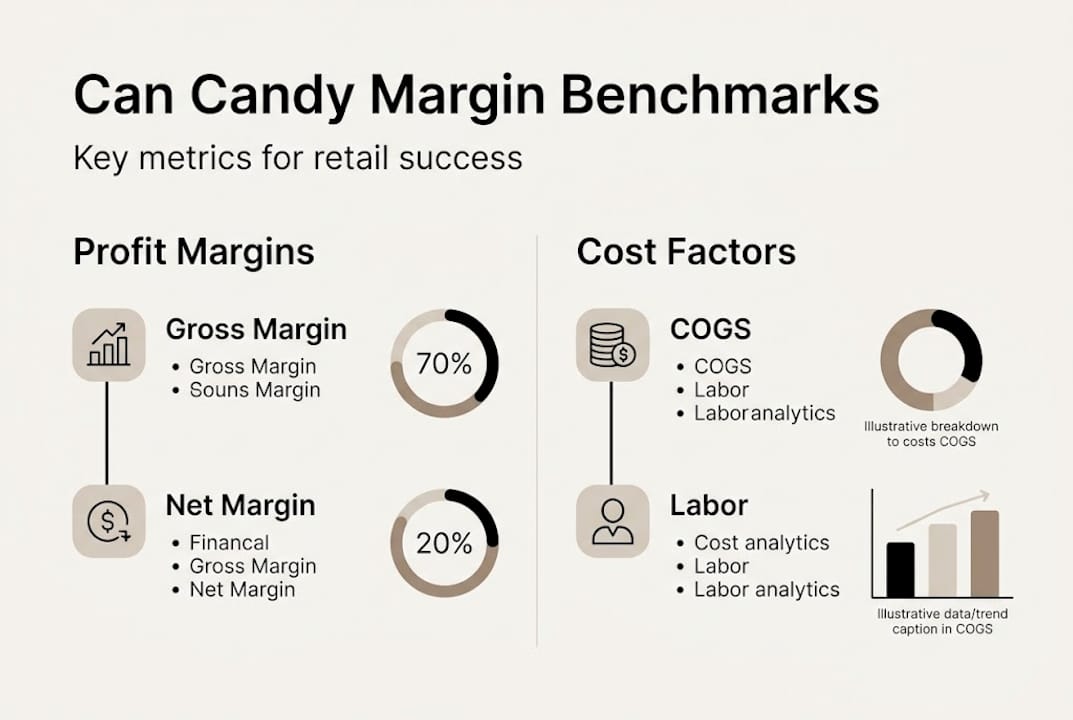
These candy store revenue benchmarks give you a realistic baseline. If your rent is eating 20% of revenue, that’s a red flag worth addressing through higher sales volume or renegotiating your lease.
Seasonal spikes are real and worth planning for. Revenue can jump 15-25% during peak seasons like Halloween, Valentine’s Day, and Easter. But those same periods often bring higher shrink from impulse purchases that go unsold, so the net margin gain is smaller than the revenue bump suggests.
Watch for these warning signs in your monthly numbers:
- COGS creeping above 35%: Usually signals supplier price increases or product mix drift toward low-margin items.
- Shrink above 5%: Points to spoilage, theft, or poor inventory rotation. Learning to control shrinkage is one of the fastest ways to recover margin.
- Blended gross margin below 50%: Means your product mix is too heavy on branded packaged goods.
- Labor above 25%: Often a scheduling problem, not a staffing problem.
- Flat or declining sales per square foot: A sign that your display strategy needs work.
If you want to maximize candy sales per square foot, the product mix and display layout decisions you make today directly affect next month’s margin report.
Improving candy profit margins: Practical tips that work
Benchmarks tell you where you stand. These tactics move the needle.
- Expand your bulk and self-serve candy section. Bulk candy delivers 60-75% gross margins versus 45-50% for branded packaged goods. Every square foot you shift from branded to bulk improves your blended margin.
- Limit shelf space for low-margin items. If a branded product pulls below 45% gross margin and doesn’t drive significant foot traffic, it’s costing you opportunity.
- Renegotiate supplier contracts annually. Even a 3% reduction in COGS on your top sellers can add thousands to annual net profit.
- Audit your bulk candy supply chain regularly. Sourcing inefficiencies compound over time and quietly shrink your margins.
- Review your wholesale purchasing approach before every major buying cycle. Buying smarter is often faster than selling more.
Pro Tip: Position your highest-margin items at eye level and near the checkout counter. Display placement directly influences which products customers grab, and that choice has a measurable impact on your blended margin at the end of the month.
“The stores that consistently outperform on margin aren’t the ones with the most products. They’re the ones tracking inventory turnover, sales per square foot, and GMROI every single week.”
Tight cost control is non-negotiable. Keep labor under 25% of revenue, occupancy under 15%, and shrink under 5%. Those three ratios alone, when managed consistently, separate profitable candy stores from ones that are busy but barely breaking even. Use inventory performance insights to benchmark your turnover against category norms.
What most candy retailers miss about margin optimization
Here’s the uncomfortable truth: most candy store owners who struggle with margins aren’t missing knowledge. They’re missing consistency. They run the numbers once after a bad month, make a few changes, and then stop tracking until the next crisis.
The stores we see outperforming their peers aren’t necessarily stocking better candy. They’re reviewing their blended margin weekly, not quarterly. They notice when a bestselling branded item quietly drops from 52% to 44% gross margin because of a supplier price increase, and they act on it within days, not months.
Another overlooked issue is the obsession with top-line sales. Selling more of a low-margin product doesn’t fix your profitability. It actually makes it worse by tying up cash in inventory that returns less per dollar. Focusing on effective candy display strategies that spotlight high-margin items is worth more than a storewide sale that moves volume but crushes net margin.
True margin optimization is a weekly habit, not a one-time project. Build the review into your routine and the numbers will tell you exactly where to focus.
Take your candy profits further with Spaceman solutions
Understanding your margins is step one. Acting on them is where the real gains happen.

At Spaceman, we work directly with Canadian candy retailers to make margin improvement practical and achievable. Our wholesale candy display kits are built around freeze-dried candy, a category that consistently delivers higher gross margins than most packaged alternatives. If you want to go further, our private label and co-packing services let you build a branded product line that commands premium pricing and protects your margins from direct price comparison. Explore the full range of Spaceman Canada solutions and find the right fit for your store’s growth goals.
Frequently asked questions
What is a good profit margin for a candy store in Canada?
Gross profit margins range 45-60% overall for candy stores, with bulk candy reaching 60-75%. A net profit margin of 10-25% is the target for a well-run operation after all expenses.
How do I calculate gross profit margin on a candy item?
Subtract the item’s COGS from its sale price, divide by the sale price, and multiply by 100. The gross margin formula is (Revenue - COGS) / Revenue x 100.
What costs should I include in my operating expenses?
Include labor, rent, utilities, supplies, marketing, insurance, and taxes. The net profit formula accounts for all costs beyond your direct product purchase price.
How do seasonal sales impact candy store profit margins?
Seasonal peaks can lift revenue by 15-25%, but they also raise shrink and spoilage risk, so net margin gains are often smaller than the revenue increase suggests.
What is GMROI and why does it matter for candy stores?
GMROI stands for Gross Margin Return On Investment. Shopify recommends tracking it as Gross Profit divided by Average Inventory Cost to measure whether your inventory is actually generating profitable returns.
Recommended
- How to Price Retail Candy for Consistent Profitability – Spaceman
- 7 Proven Tips to Maximize Sales in Your Candy Display Store – Spaceman
- Candy Distribution Canada: Boost Margins 50% Freeze-Dried – Spaceman
- Master Convenience Store Candy Display for Higher Sales – Spaceman
- Market Basket Analysis Guide: Boost Your Sales Effectively - Affinsy Blog | Affinsy