

CPG stands for consumer packaged goods, the everyday, packaged, repeat-purchase items you buy on autopilot: cereal, shampoo, dish soap, dog food. In business terms, CPG describes companies that make these products and sell them through high-volume retail channels. What separates CPG analysis from ordinary retail math is velocity, not price. A brand’s success gets measured by how fast product moves off the shelf, not by what’s printed on the price tag.
TL;DR:
- The success of a CPG brand mainly depends on product velocity, not retail price, with trade spend often consuming a large portion of revenue.
- Margins shrink significantly after retailer cuts, distribution fees, and trade spend are deducted, making contribution margin more important than top-line sales.
- FMCG refers to fast-moving items like bottled water or bread, while CPG includes a broader range of products with longer shelf lives and higher prices.
- Operating the industry involves strategic decisions between in-house manufacturing and co-packing, influenced by capital, scale, and flexibility needs.
- Technological advances and sustainability pressures are reshaping CPG business models, requiring brands to prioritize analytics, packaging efficiency, and multichannel margin strategies.
Table of Contents
- What Counts as a CPG? Product Categories and Examples
- How Do CPG Companies Make Money?
- CPG vs FMCG and CPG vs Retailers: What’s the Difference?
- How Do CPG Companies Actually Operate?
- What’s Reshaping the CPG Industry Right Now?
- A Co-Packer’s View on Packaging, Private Labeling, and Vendor Selection
- What I’ve Learned Watching CPG Brands Win and Lose on the Shelf
- Where to Learn More About the CPG Industry
- Sources
What Counts as a CPG? Product Categories and Examples
If you can picture yourself tossing it in a cart without thinking twice, it’s probably CPG. Industry primers define the category as everyday packaged products people buy and replace on a regular cycle, and that regularity is the whole point. Nobody agonizes over which paper towels to buy for twenty minutes. They grab, they buy, they repeat the purchase in three weeks.
The category breaks down into a handful of recognizable buckets:
- Food and beverage: snacks, cereal, soda, coffee, packaged meals
- Personal care: shampoo, deodorant, toothpaste, razors
- Household goods: laundry detergent, cleaning sprays, paper products
- Pet products: kibble, treats, litter
- Supplements and vitamins: gummies, powders, capsules
- Beauty: cosmetics, skincare, nail products
Freeze-dried candy sits comfortably in the food and confectionery slice of that list. It’s a packaged, shelf-stable product bought on impulse or habit, which is precisely the profile that makes something CPG rather than, say, a durable good.
Borderline cases exist, and they matter more than they seem. A $40 bottle of premium olive oil is still CPG because it’s consumed and repurchased. A blender is not, because you buy one and use it for a decade. Durables live outside the category entirely; the repurchase cycle is what draws the line, not the price point.
Within CPG sits a faster-moving subset called FMCG, or fast-moving consumer goods. FMCG emphasizes the quickest-turning, lowest-cost items, things like fresh bread or bottled water that turn over in days rather than weeks. CPG is the broader umbrella; FMCG is the sprint inside it.
How Do CPG Companies Make Money?
Here’s the part that trips up a lot of newcomers: the price on the shelf tag is not the money the brand keeps. Not close, in most cases.
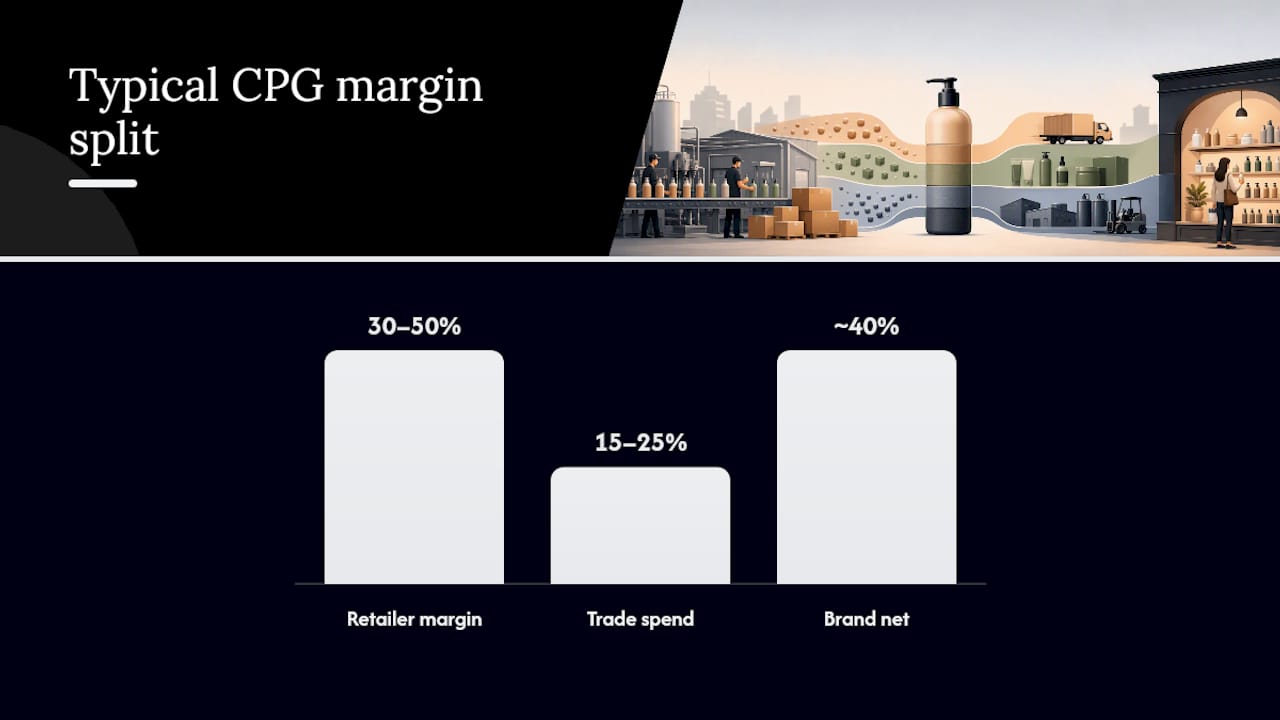
Between the shelf price and the brand’s actual revenue sits a chain of deductions. The retailer takes a margin for stocking the product, typically landing somewhere in the 30 to 50 percent range. Distributors, if the brand uses them instead of selling direct to retail, take their own cut for warehousing and delivery. And then there’s trade spend, the payments brands make to retailers for end-cap placement, promotional pricing, or just to keep the item on the shelf at all.
Trade spend for growing CPG brands routinely runs 15 to 25 percent of revenue. That’s not a rounding error. It’s often the single largest line item a young brand fights to control, according to CPGScout’s breakdown of CPG unit economics.
Add retailer margin and trade spend together, and a product that rings up at $5 might net the brand somewhere closer to $2, before it even covers manufacturing. That gap is why so many founders get blindsided when a “successful” retail launch still bleeds cash.
This is also why practitioners obsess over a specific set of metrics instead of top-line sales:
- Velocity: how fast units sell per store, per week
- Distribution: how many stores actually carry the product
- Sell-through: the percentage of shipped inventory that actually sells to consumers
- Contribution margin: what’s left after variable costs, distribution fees, and trade spend
Contribution margin, not headline revenue, is the number that actually tells you whether a brand is healthy. A brand can look enormous on paper, with big retail placements and rising unit sales, and still be losing money on every case sold once the real costs get stripped out.
Pro Tip: Before you get excited about a new retail placement, ask what the net price is after trade spend and distributor fees, not the wholesale price on the purchase order. That’s the number that determines whether the deal is actually worth doing.
Brand managers watching these levers day to day tend to track a short, consistent list: velocity by store, weeks of supply on hand, promotional lift versus baseline sales, and the trend line on trade spend as a percentage of gross revenue. If you want a deeper walkthrough of how the margin math shakes out for a specific product category, this breakdown of candy profit margins in retail is a good place to see the numbers applied to a real example.
CPG vs FMCG and CPG vs Retailers: What’s the Difference?
Two mix-ups come up constantly, and clearing them up will save you an awkward moment in a meeting or a job interview.
- CPG vs FMCG. These terms overlap heavily, and people often use them interchangeably, but they’re not identical. FMCG is the fast-turnover subset of the broader CPG category: think fresh dairy or bottled beverages that move in days. CPG includes those items plus things with a slightly longer shelf life or higher price point, like a premium skincare serum. If you’re in the UK or continental Europe, you’ll hear FMCG far more than CPG. In North America, CPG is the dominant term. Same industry, different regional habit.
- CPG company vs retailer. A CPG company manufactures and brands the product; a retailer sells it to the end consumer. The retailer’s customer is the shopper walking the aisle. The CPG company’s customer, in a wholesale relationship, is actually the retailer itself, since that’s who writes the purchase order. This distinction changes who negotiates shelf placement, who owns the customer data, and who absorbs the cost of a promotional markdown.
Getting this language right matters beyond trivia. In a contract, “CPG manufacturer” and “retail partner” describe two different parties with different obligations. On a résumé or job posting, “CPG brand manager” signals you work for the company that makes the product, not the store that sells it. Mixing these up in a business plan or investor deck is a small thing that makes a founder look like they haven’t done the homework.
How Do CPG Companies Actually Operate?
Behind every bag of chips or bottle of shampoo sits an operating model with more moving parts than most shoppers ever consider.
It starts with R&D and formulation: getting the recipe, ingredient list, or chemical formula right, then locking down packaging design and managing the SKU lineup so retailers have the right sizes and flavors on the shelf. From there, a brand faces one of the bigger strategic forks in the industry: build manufacturing in-house, or hand production to a co-packer.
In-house manufacturing gives you full control over quality and formulation, but it demands serious capital, real estate, and staff before you’ve sold a single unit. Co-packing, where a third-party manufacturer produces and often packages your product under your label, lets a brand scale without that upfront investment. The tradeoff is less day-to-day control and a dependency on your partner’s capacity and lead times.
Decision factors usually come down to:
- Capital availability: can you afford your own production line, or does that cash belong in marketing and distribution instead?
- Scale: are you shipping pallets or truckloads? Co-packers often make more sense until volume justifies your own facility.
- Flexibility: do you need to pivot flavors or formats quickly? Some co-packers handle that better than in-house lines built around a single process.
Once product exists, it has to move somewhere. Retail (grocery, mass, club stores), distributors (who warehouse and deliver to smaller accounts), and D2C e-commerce are the three main channels, and most established brands run some blend of all three to balance margin capture against reach. Trade marketing, the function that negotiates placement, promotions, and retailer relationships, sits at the center of making retail distribution actually work.
One newer wrinkle worth knowing: some larger CPG organizations are restructuring into what’s called “fusion teams,” where marketing, supply chain, and product development report into a single integrated brand owner instead of separate departments. The goal is shortening the time between an idea and a shelf-ready product.
Pro Tip: If you’re evaluating a co-packer for the first time, ask about their minimum order quantities before you fall in love with their sample. A perfect product with a 50,000-unit minimum isn’t useful to a brand that’s only ready to sell 5,000.
What’s Reshaping the CPG Industry Right Now?
Three forces are rewriting the CPG playbook, and none of them are slowing down.
Technology tops the list. Roughly half of CPG executives now name technology as the top driver of operating-model change, according to consulting analysis from EY. That shows up as AI-driven demand forecasting, analytics platforms that predict which SKUs will stall on shelf, and digital tools that shorten the feedback loop between sales data and reformulation decisions.
Sustainability is no longer a side project. Scope 3 emissions and packaging waste rank among the sector’s toughest structural challenges, and consulting analysis from BCG argues that meeting climate targets will require CPG companies to rethink business models, not just swap materials. Expect more pressure on brands to justify packaging choices with real data, not just a recyclable logo.
Channel shifts are squeezing margins from a different angle. D2C e-commerce gives brands direct access to customer data and a bigger cut of the sale price, but it comes with its own fulfillment costs and rarely replaces the scale that retail distribution provides. Brands balancing both channels tend to fare better than ones that bet everything on one lane.
Margin compression ties all three trends together. McKinsey’s research on CPG cost strategy recommends combining quick operational wins, like renegotiating freight contracts, with bigger structural moves, like restructuring the supply chain itself, to protect margins without gutting the brand.
What this means for planning purposes:
- Budget for analytics tools, not just marketing spend, if you want to catch demand shifts early
- Treat packaging sustainability as a cost-of-doing-business line item, not a future nice-to-have
- Build channel strategy around margin capture, not just top-line reach
A Co-Packer’s View on Packaging, Private Labeling, and Vendor Selection
Working on the packaging and co-packing side of the freeze-dried candy business gives you a front-row seat to what actually breaks a launch. A co-packer or private label partner manufactures, and often packages, product under a brand’s own label, which lets a young brand hit retail shelves without building a factory first.
When you’re vetting a partner, a few line items separate the good ones from the ones that’ll cost you a launch window:
- Minimum order quantities: match your current sales volume, not your five-year projection
- Lead times: ask for real numbers, not “typically”
- QA and traceability systems: batch tracking matters the moment there’s ever a recall question
- Regulatory documentation: nutrition labeling, allergen statements, and country-specific compliance paperwork
Packaging material choices carry real logistics consequences too. Barrier properties that keep candy crisp during shipping also affect box weight, pallet count, and freight cost, so the “prettier” bag isn’t always the cheaper one to ship.
Pro Tip: Ask any prospective co-packer for a sample run at your actual order size before committing to a full production cycle. A perfect 100-unit sample tells you nothing about how their line performs at 10,000.
What I’ve Learned Watching CPG Brands Win and Lose on the Shelf
The brands that struggle most aren’t the ones with bad products. They’re the ones who fell in love with packaging that looked incredible in a photo shoot and terrible on a moving pallet. I’ve watched founders choose a beautiful box that crushed under its own shipping weight, then wonder why their damage claims ate their entire quarterly margin.
My rule of thumb: pick packaging for the truck before you pick it for the camera. If it survives the freight, the shelf, and a kid’s backpack, you can make it look good after. Do it backward, and you’ll be reprinting boxes by month three, which costs a lot more than a slightly less flashy design would have in the first place.
— Chadi
Where to Learn More About the CPG Industry
For deeper research beyond this overview, a few sources stand out. EY’s operating model analysis covers technology’s role in reshaping CPG organizations. McKinsey’s cost strategy research digs into margin recovery tactics. BCG’s sustainability analysis tackles Scope 3 and packaging challenges. For quality and packaging standards that intersect with food CPG, Wild Foodz’s food quality primer is worth a read.
If you’re building a CPG brand and weighing whether to manufacture in-house or bring in a partner, Space-man’s private label, co-packing, and packaging services page walks through how that partnership actually works, from minimum orders to packaging specs.
Sources
- CPGScout — What is CPG?
- IE University — FMCG industry primer
- EY — Three ways CPG can create an operating model that reignites growth
- NetSuite — Consumer Packaged Goods overview