

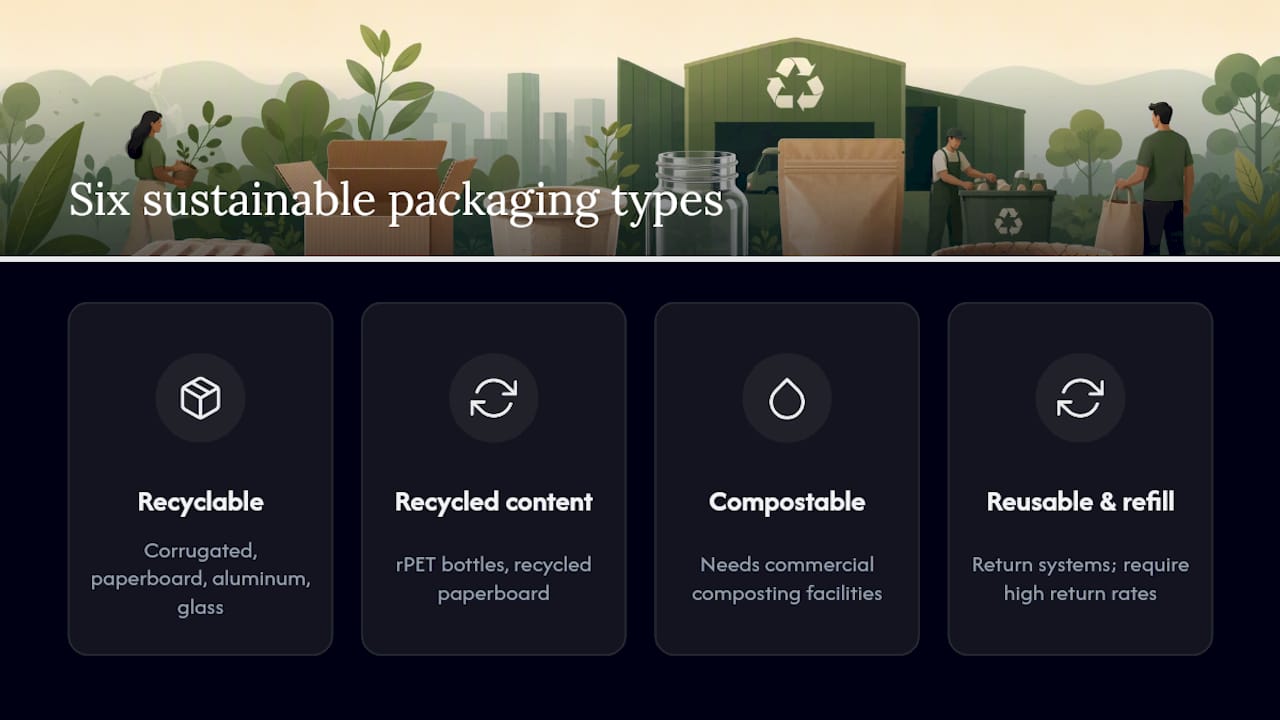
The main types of sustainable packaging fall into six families: paper and fiber, recyclable metal and glass, recycled-content plastics, compostable bioplastics, reusable systems, and emerging biomaterials. The priority order matters more than the material itself: reduce what you use first, reuse where logistics allow it, then design whatever remains for recovery infrastructure that actually exists in your customers’ area. Chasing a trendy material that nobody nearby can recycle or compost defeats the purpose.
TL;DR:
- Recycled-content plastics and paperboard reduce virgin material use, but require certification verification to confirm actual recycled content levels.
- Industrial compostable bioplastics often need commercial facilities for proper breakdown, limiting their environmental benefit in residential waste streams.
- Reusable packaging systems only offer environmental benefits when return rates are high, making them effective primarily for established, dedicated reuse programs.
- Basing packaging decisions on local recycling and composting capabilities, along with clear certification proof, ensures sustainable choices that will actually be recovered or composted.
Table of Contents
- Types of Sustainable Packaging: A Breakdown by Material
- Comparing Sustainable Packaging Materials at a Glance
- How to Choose Sustainable Packaging for Your Product
- What Switching Packaging Actually Costs and How Long It Takes
- Certifications and Labels That Actually Mean Something
- Space-man’s Approach: Packaging a Freeze-Dried Candy SKU
- Our Take: Skip the Trend, Follow the Infrastructure
- Get Help Choosing and Packaging Your Product Sustainably
- Sources
Types of Sustainable Packaging: A Breakdown by Material
Every packaging decision starts with a blunt question: what happens to this box, bag, or jar after someone opens it? The Sustainable Packaging Coalition frames sustainable packaging around five principles, including sourcing renewable or recycled feedstocks and designing specifically for recovery, not just for the shelf. That framework is a good filter for sorting through the options below.
Recyclable materials cover corrugated cardboard, paperboard, aluminum, and glass. Corrugated is the safest default for shipping boxes because curbside recycling programs almost universally accept it. Aluminum cans and glass jars work well for anything with a longer shelf life or a premium feel, though both carry higher shipping weight and cost than fiber.
Recycled-content packaging includes rPET bottles and recycled paperboard cartons. These reduce virgin material demand without asking your customer to change behavior. The catch is sourcing: recycled-content claims need verification, which is where certifications like the Global Recycled Standard come in (more on that later).
Compostable materials, mainly PLA and bagasse (sugarcane fiber), sound great on paper but come with a real catch. Industrial compostable materials need commercial composting facilities to break down properly, and most residential trash streams do not have access to one. Home-compostable materials are rarer and held to a different standard entirely.
Reusable and refill systems shift packaging from a disposable cost to a durable asset. Think returnable glass jars, refillable pouches, or deposit-based tins. These only pay off environmentally and financially when return rates stay high, since a reusable container that gets used once is worse than a single-use one.
Novel biomaterials like mycelium (mushroom-root packaging), seaweed-based films, and molded pulp are gaining traction in niche categories. Molded pulp is already mainstream for egg cartons and electronics cushioning. Mycelium and seaweed remain mostly limited to specialty runs and pilot programs, but they’re worth watching.
Minimalist strategies often beat any material swap. Lightweighting, switching to a single mono-material instead of a laminate, and cutting unnecessary inserts or void fill can lower environmental impact faster than any fancy new substrate. A Design Deluxe industry analysis points to mono-material design as one of the most practical wins available to brands right now, since it keeps packaging inside existing recycling streams instead of routing it around them.
For food-specific formats, brands can also look at high-barrier fiber options coated with a repulpable dispersion layer, which hold up against moisture and grease while still recycling like standard paperboard.
Comparing Sustainable Packaging Materials at a Glance
Here’s how the major options stack up when you’re weighing protection, disposal, and practicality against each other.
| Material | Best For | End-of-Life Pathway | Typical Pros | Typical Cons |
|---|---|---|---|---|
| Corrugated cardboard | Shipping boxes, outer cartons | Curbside recycling | Widely accepted, strong, cheap | Weak against moisture |
| Paperboard/kraft | Retail boxes, food wraps | Curbside recycling | Lightweight, printable | Limited barrier without coating |
| Aluminum | Cans, foil pouches, tins | Curbside recycling, infinitely recyclable | Long shelf life, premium feel | Higher production carbon cost |
| Glass | Jars, bottles | Curbside recycling | Inert, reusable, recyclable indefinitely | Heavy, breakable, costly to ship |
| PCR plastics | Bottles, clamshells | Curbside recycling (varies by resin) | Cuts virgin plastic use | Recycled content quality varies |
| Compostable bioplastics (PLA/bagasse) | Food service ware, cutlery | Industrial composting (mostly) | Renewable feedstock | Needs facility access; won’t break down in landfill |
| Molded pulp | Cushioning, egg cartons, trays | Curbside recycling or home compost | Biodegradable, low cost | Limited moisture resistance |
| Mycelium/seaweed | Niche cushioning, specialty wraps | Home compost or industrial compost | Very low footprint, novel appeal | Limited supply, higher unit cost |
Corrugated cardboard is recycled at a rate near 93.6% in industry summaries, according to the Design Deluxe materials guide, which makes it the closest thing to a safe bet in this entire list. That said, recovery infrastructure is not uniform. A material that recycles easily in one city might get incinerated or landfilled a few hundred miles away, so always check local recovery rates rather than assuming a national average applies to your customer base.
How to Choose Sustainable Packaging for Your Product
Picking the right packaging is less about finding the “greenest” material and more about matching material to product, market, and honesty. Run through this checklist before you commit to anything:
- Protection first. Does the material survive your actual shipping conditions, temperature swings, and shelf time without failing?
- Distribution reality. Are you shipping direct-to-consumer, through retail, or both? Weight and bulk change the math fast.
- Recovery infrastructure. Can your typical customer actually recycle or compost this where they live? Don’t guess. Check.
- Cost over time. Factor in tooling, minimum order quantities, and certification fees, not just per-unit material cost.
- Branding fit. Does the packaging communicate your sustainability claim clearly, or does it need an explanation nobody will read?
When talking to a supplier, ask direct questions: What certifications back this material? What percentage is genuinely recycled content, not just “contains recycled material”? Can they provide an Environmental Product Declaration or life-cycle assessment? Vague answers here are a red flag.
Watch for warning signs too: unqualified “biodegradable” claims with no standard attached, multilayer laminates that look recyclable but aren’t accepted anywhere, and suppliers who can’t trace where their material actually comes from.
Pro Tip: Run a small pilot before switching your whole line. Track actual return, recycling, or composting rates among a sample of real customers, then scale only what the data supports.
What Switching Packaging Actually Costs and How Long It Takes
Sustainable swaps rarely cost nothing. Expect premiums in three places: material (recycled and compostable substrates often run higher per unit than virgin plastic), tooling (new die-cuts or mold changes for a different format), and certification (third-party testing and labeling fees add up).
Operationally, watch for:
- Lead times that stretch when switching to a newer or less commodity-scale material.
- Machine compatibility. Your existing filling or sealing line might not handle a new substrate without adjustment.
- Shelf-life shifts, especially with fiber-based barrier alternatives replacing multilayer plastic.
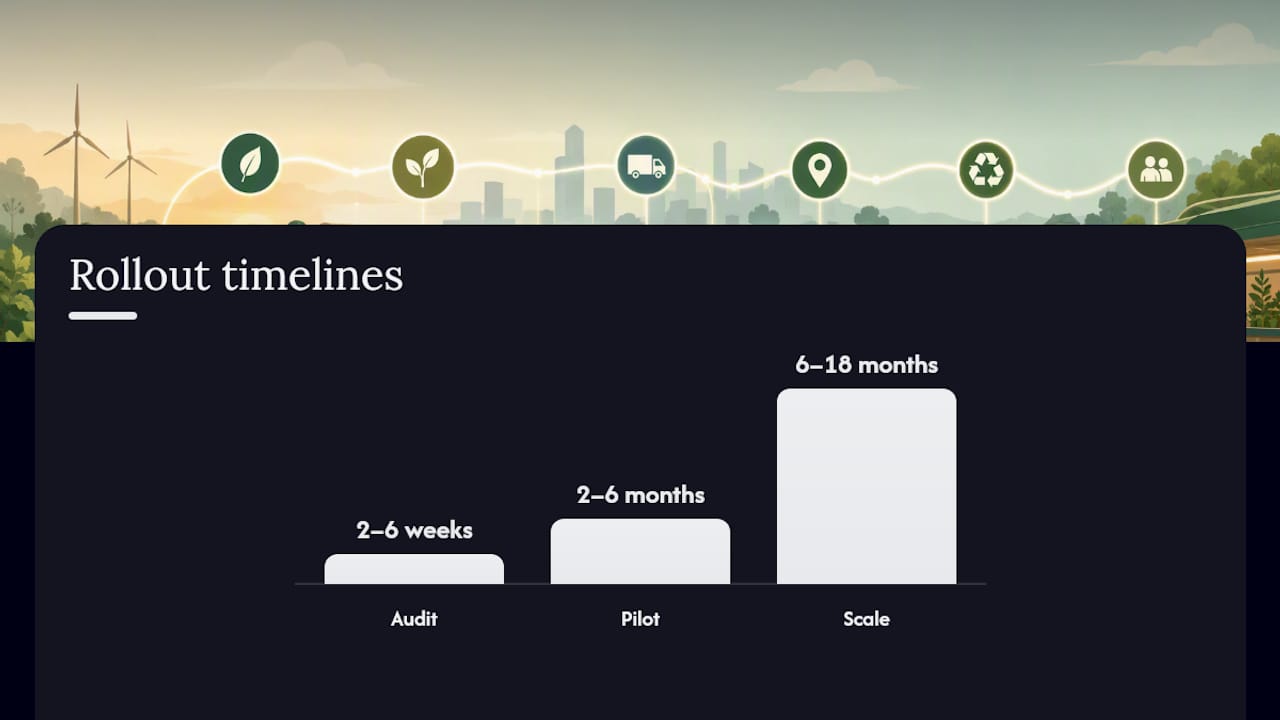
A realistic rollout runs in three phases: an audit (2 to 6 weeks) to map current packaging and its true end-of-life outcomes, a pilot (2 to 6 months) on one SKU or region, then scale (6 to 18 months) once the numbers hold up.
The upside isn’t just environmental. Consumer pressure is real, with 61% of UK consumers reporting they’ve cut back on single-use plastics according to Greenpeace polling, and regulatory exposure from plastic bans and extended producer responsibility laws keeps growing in multiple markets.
Certifications and Labels That Actually Mean Something
Not every “eco” claim on a package is backed by anything real, which is exactly why certifications exist. Here’s what to trust:
- How2Recycle labeling tells consumers precisely how to dispose of a specific package, cutting down on wishful recycling.
- ASTM D6400 and EN 13432 are the standards behind legitimate compostability claims, though BPI certification distinguishes industrial compostable from home-compostable, a distinction most shoppers never think about.
- GRS (Global Recycled Standard) verifies recycled content claims through supply chain documentation, not marketing copy.
- Back every claim with supplier paperwork you can produce on request. If you can’t show it, don’t say it.
Space-man’s Approach: Packaging a Freeze-Dried Candy SKU
Space-man ran into this exact decision with a freeze-dried candy line: a fully recyclable kraft paperboard box with a repulpable barrier liner, or an industrial-compostable pouch. The paperboard box won for this SKU. It ships lighter, survives distribution better, and recycles in nearly any curbside program, while the compostable pouch would have required customers to find a facility most don’t have nearby.
Private-label and co-packing capability shaped the decision too. Standard board substrates meant no new tooling and a shorter lead time than a niche compostable film would have needed. The cost delta landed in the low single digits per unit, with no measurable change to shelf life. For a related look at how packaging choices affect cold-chain products, see sustainable ice cream packaging.
Our Take: Skip the Trend, Follow the Infrastructure
Most brands overcorrect toward whatever material sounds greenest instead of whichever one their customers can actually recycle or compost. The smarter move is boring but effective: pick mono-materials, verify recycled content with real documentation, and treat reuse pilots as an experiment rather than a mandate. Run an audit this quarter and commit to a three-month pilot before scaling anything.
— Chadi
Get Help Choosing and Packaging Your Product Sustainably
Space-man is a practical partner for brands trying to make this shift without guessing their way through it. Beyond freeze-dried candy, chocolate, and ice cream sandwiches sold direct to consumers, Space-man offers private label, co-packing, and bagging and packaging services for other consumer goods manufacturers who need help executing a packaging change.
That means you can bring a product to Space-man, work through material options with a team that already handles packaging at scale, and pilot a run without building out your own production line first. Whether you need a small trial batch in recyclable kraft board or a scaled co-packing run in a new format, the groundwork is already in place. Check out Space-man’s private label, co-packing, and packaging services to get a quote and start planning your pilot.
Sources
- Definition of Sustainable Packaging — Sustainable Packaging Coalition (SPC)
- Sustainable Packaging Materials Guide — Design Deluxe
- BPI — Compostability and certification information