

TL;DR:
- Green packaging choices depend on actual recovery infrastructure and specific product needs to minimize environmental harm.
- Regulations like the EU PPWR and UK Packaging Pact are driving companies toward transparent, circular, and verified sustainability practices.
Green packaging has become one of the most searched topics among retailers and manufacturers, and for good reason. Consumer expectations are shifting, regulations are tightening, and the stakes for getting your packaging wrong are higher than ever. But here is the thing: a lot of what gets marketed as green packaging is either oversimplified or just not accurate. Not all eco-friendly claims are created equal, and choosing the wrong material for the wrong context can actually cause more environmental harm than you intended. This guide cuts through the noise and gives you the real picture.
Table of Contents
- Key takeaways
- Green packaging types and what they actually deliver
- Regulations and what consumers expect from you now
- The uncomfortable truth about compostable packaging
- How to actually choose and implement green packaging
- My honest take on green packaging decisions
- How Space-man can help with your packaging needs
- FAQ
Key takeaways
| Point | Details |
|---|---|
| Green is not one-size-fits-all | Compostable, recyclable, and reusable packaging each serve different contexts with different real-world outcomes. |
| Infrastructure determines impact | The greenest choice is the one your customers can actually recover using accessible local systems. |
| Regulations are raising the bar | PCR content mandates and extended producer responsibility rules are reshaping what compliance looks like by 2030. |
| Compostable has real limits | Without access to industrial composting, compostable packaging often ends up in landfill and creates methane. |
| Design decisions ripple outward | Changing one material layer affects coatings, recyclability, and protection. Test before you commit. |
Green packaging types and what they actually deliver
Not all green packaging materials work the same way, and treating them as interchangeable is how businesses end up making expensive mistakes. Let’s break down the main categories.
Recyclable packaging is the most widely understood option. The key variable that actually matters is post-consumer recycled (PCR) content. Packaging made with high PCR content closes the loop on materials that have already existed in the system, rather than pulling in virgin resources. The EU’s Packaging and Packaging Waste Regulation mandates 30% PCR for beverage bottles by 2030, rising to 50 to 65% by 2040 across most plastic packaging. If you are selling into European markets or anticipate those requirements spreading, designing for recyclability with verified PCR content is a forward-thinking move.
Compostable packaging sounds ideal on paper. It breaks down, it returns to the earth, and it feels like doing the right thing. The reality is that it only delivers those benefits inside a certified composting facility. Without that facility in the picture, compostable packaging typically goes to landfill where it produces methane instead. It also carries a 20 to 80% price premium over conventional options. Those are not small tradeoffs.
Reusable packaging systems are where the math gets interesting. Reusable packaging reduces emissions by 40 to 70% compared to single-use alternatives, but only when reused at least 20 times. For certain product categories and supply chain setups, this makes reusable systems the strongest environmental choice by a wide margin.
Fiber-based packaging is gaining real traction as a plastic alternative. Fiber packaging is evolving from basic protection to precision-formed, high-performance applications that can compete with plastics in multiple industries. Advances in water-based coatings and bio-based treatments now improve both barrier performance and recyclability. Cost is still a consideration, and a phased adoption approach tends to work better than an all-in switch.
Here is a quick comparison to orient your decision-making:
| Material type | Best use case | Main limitation | End-of-life |
|---|---|---|---|
| Recyclable (high PCR) | Broad consumer products | Depends on local recycling access | Widely recoverable |
| Compostable | Specific food service contexts | Needs industrial composting | Often landfill |
| Reusable | Closed-loop supply chains | Requires returns infrastructure | High if reused 20x+ |
| Fiber-based | Dry goods, shipping, retail | Moisture sensitivity | Recyclable/compostable |
Pro Tip: When evaluating recyclable packaging design options, always verify that the materials you are using are accepted by the recycling programs your customers actually have access to. A technically recyclable package that your customer cannot recycle locally is just well-branded waste.
Regulations and what consumers expect from you now
The regulatory environment around green packaging has moved from optional guidance to mandatory compliance in several major markets. Businesses that plan ahead have a real advantage here.

The EU PPWR is the most detailed framework in play right now. Beyond the PCR content requirements already mentioned, it is pushing extended producer responsibility programs across member states. That means brand owners are increasingly accountable for the end-of-life fate of their packaging, not just how it looks on a shelf.
The UK is taking a similarly coordinated approach. The UK Packaging Pact brings together over 100 signatories from retail to waste management with goals around material reduction, increased reuse, infrastructure investment, and data harmonization. What makes this model interesting is that it acknowledges no single company can fix packaging systems alone. The focus is genuinely shifting toward a circular packaging system that includes reduction, reuse, and refill at scale rather than just recyclability in isolation.
On the consumer side, the expectations are real and growing. Shoppers are reading labels more carefully, and “eco-friendly” claims without verification are increasingly viewed with skepticism. Greenwashing is a reputational risk, not just a PR inconvenience. The businesses winning on sustainability are the ones making specific, provable claims. Things like “made with 40% recycled content” or “designed to be recycled in curbside programs” land far better than vague statements about caring for the planet.
Here is what businesses should monitor and act on:
- Bans on problematic single-use plastics expanding into more categories and regions
- Extended producer responsibility schemes requiring financial contributions and reporting
- Recycled content mandates increasing over 2026 to 2040 across the EU and influencing other markets
- Growing consumer demand for packaging transparency and third-party certifications
- Retail buyers and distributors adding sustainability criteria to supplier scorecards
The businesses that treat these as external pressures tend to scramble. The ones that treat them as design inputs from the start build better products and face fewer costly reformulations later.
The uncomfortable truth about compostable packaging
There is a version of the compostable packaging story that sounds great: buy a product, toss the packaging in your compost bin, done. That story is missing a lot of important context.
Here is what the reality looks like in practice:
-
Infrastructure access is severely limited. Only about 35.9% of UK residents have access to food waste compost collection. In many North American markets, access to certified industrial composting is even more fragmented. Without that facility, the packaging goes to landfill.
-
Landfill disposal defeats the purpose. When compostable packaging ends up in landfill, it does not break down cleanly. It produces methane, a greenhouse gas significantly more potent than CO2 over a short time horizon. The compostable packaging often contaminates recycling streams because it cannot be processed with traditional plastics.
-
Contamination creates downstream problems. Compostable packaging mixed into conventional plastic recycling streams degrades material quality and can jam sorting machinery. This is a real operational problem for waste processors and a hidden cost for the broader recycling system.
-
Performance tradeoffs are real. Compostable films typically offer less moisture resistance and barrier protection than their plastic counterparts. For food products, that can mean shorter shelf life, more product waste, and ultimately more environmental impact from spoilage.
-
Cost carries significant weight. That 20 to 80% price premium for compostable materials is not trivial, especially for businesses operating on thin margins or scaling volume.
The expert consensus is becoming clearer. Designing for accessible recovery infrastructure produces better real-world sustainability outcomes than selecting packaging based on compostability alone. That does not mean compostable is never the right choice. For specific closed-loop food service operations with verified industrial composting access, it can be ideal. But it should not be treated as a default green option.
Pro Tip: Before choosing compostable packaging, map your actual distribution area and find out what percentage of your customers have access to industrial composting. If that number is below 40%, a recyclable packaging design with verified PCR content will almost certainly deliver better environmental outcomes.
How to actually choose and implement green packaging
Selecting green packaging is part materials science, part supply chain coordination, and part honest communication with your customers. Here is how to approach it without overcomplicating things.
Start with what the product actually needs. Barrier protection requirements, shelf life, temperature exposure, and transport conditions all influence which materials are viable. Sustainable packaging design requires integrated testing of materials, coatings, and inks to maintain both product protection and recyclability. Removing a plastic lamination layer, for example, often means reformulating coatings to maintain strength and foldability. Do not skip this testing phase.
Evaluate your customers’ recovery options. The best green packaging is the kind your customers can actually recover. Check with your major retail partners to understand what end-of-life options exist in their markets. For Canadian and US markets, look for materials that are accepted in curbside recycling programs rather than requiring drop-off locations most consumers will never visit.
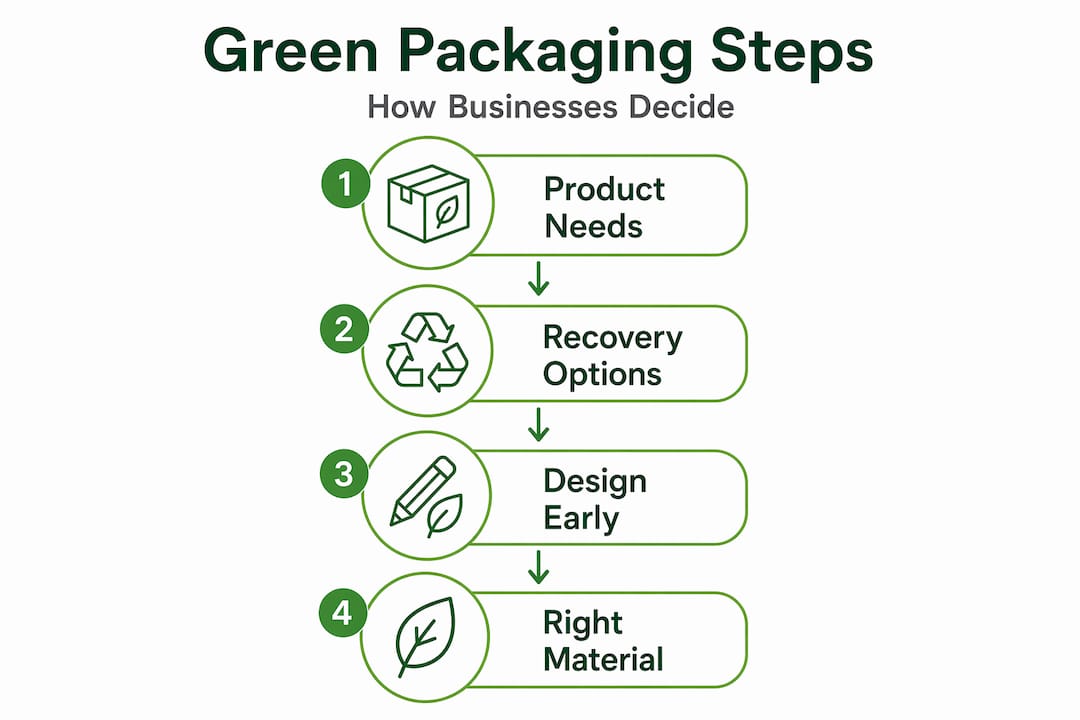
Build sustainability into your design process early. Tacking on green credentials at the end of a product development cycle costs more and works less well. When recyclable packaging design is built into the material selection phase from the start, you reduce iterations, avoid reformulation costs, and end up with a more coherent sustainability story.
Communicate honestly and specifically. Vague environmental claims create skepticism. Specific claims backed by verified data build trust. Learn more about attracting eco-conscious shoppers through transparent sustainability messaging that your customers can verify.
Practical steps worth prioritizing:
- Audit your current packaging volume and identify which items have the highest environmental footprint
- Prioritize recycled content increases in your highest-volume SKUs first
- Reduce unnecessary packaging layers, including over-packaging that adds no protective value
- Partner with suppliers that provide verified material certifications and lifecycle data
- Review your packaging waste reduction approach annually as regulations and materials evolve
The compostable packaging benefits that actually materialize require matching the right material to the right context. That specificity is what separates businesses that make genuine sustainability progress from ones that spend money on green optics.
My honest take on green packaging decisions
I have seen businesses spend significant money switching to compostable packaging because it felt like the most visible green commitment they could make. A few months later, some of them discovered their end customers were putting it in the blue bin, or worse, the trash, because they had no idea what to do with it. All that money, all that earnest intention, and the real-world environmental outcome was no better than what they started with.
What I have found actually works is starting with systems thinking. What materials can your specific customers recover? What does your distribution geography look like? What regulations are you likely to face in your key markets over the next five years? Those questions should be driving your packaging decisions, not which buzzword sounds best in your sustainability report.
I am also a firm believer that durable packaging reducing product damage and spoilage is an underrated sustainability win. Every unit of product that makes it to the consumer intact is a unit whose production emissions were not wasted. Compostable packaging benefits can be real, but they have to be weighed against shelf life performance and what happens if the product arrives damaged.
The businesses I respect most on this topic treat green packaging as a continuous improvement practice. They make the best decision available today, track outcomes honestly, and revise as better options and infrastructure become available. That is a more defensible position than betting everything on one material trend.
— Chadi
How Space-man can help with your packaging needs
Getting green packaging right takes more than good intentions. You need materials expertise, reliable supply partners, and the flexibility to adapt as regulations change. At Space-man, we work with businesses across Canada on private label, co-packing, and packaging services designed to meet both performance and sustainability requirements.

Whether you are sourcing eco-friendly bags, planning a retail display rollout, or need co-packing support with sustainable materials, Space-man brings hands-on experience to the table. We understand the pressure Canadian retailers and distributors face to align with consumer expectations and evolving compliance requirements. Our team helps you select materials that actually work in real recovery systems, not just ones that look good on a label. Reach out to discuss your packaging project and find out how our services can support your sustainability goals without sacrificing product protection or margin.
FAQ
What is green packaging?
Green packaging refers to materials and designs that minimize environmental impact across their full lifecycle, including production, use, and end-of-life recovery. It includes recyclable, compostable, reusable, and fiber-based formats, each with different benefits depending on the context.
Are compostable packaging benefits real?
Compostable packaging delivers genuine environmental benefits only when it reaches a certified industrial composting facility. Without that infrastructure, it typically ends up in landfill and produces methane, which negates the environmental advantage.
What is recyclable packaging design?
Recyclable packaging design refers to packaging created specifically to be recovered by existing curbside or drop-off recycling systems, often using high post-consumer recycled content. The EU mandates 30% PCR content for beverage bottles by 2030, with higher targets to follow.
How do I choose between compostable and recyclable packaging?
Choose based on your customers’ actual recovery access. If your distribution area has limited composting infrastructure, recyclable packaging with verified recycled content typically delivers better real-world sustainability outcomes.
What regulations affect green packaging in 2026?
The EU PPWR is the most active framework, with recycled content mandates taking effect and extended producer responsibility requirements expanding. The UK Packaging Pact is aligning over 100 industry signatories around reduction, reuse, and data harmonization goals.