

Market research for developing new products gives you the evidence to decide whether to build, how to price, and what to prioritize before you spend real money. The first move is simple: write down the exact business decision you’re trying to make and the metric that will tell you if you got it right. Everything else, including the seven-step process below, exists to answer that one question faster and with less guessing.
TL;DR:
- Conducting early customer interviews and using social listening can provide quick directional insights at a low cost, especially for startups or initial concept tests.
- Matching research methods to specific questions, such as qualitative for understanding the why behind customer needs and quantitative for measuring demand, ensures more accurate decision-making.
- Proper sample screening and piloting instruments before large-scale data collection can prevent biased results and improve data quality, saving time and resources later.
- Combining active feedback from surveys and interviews with passive data like sales trends reveals the true market signals that influence product success.
- Continuing research through iterative cycles and building a shared insights library helps teams make better-informed decisions and reduces reliance on guesswork.
Table of Contents
- What Is Market Research for New Product Development?
- Why Run Market Research Before You Build?
- Qualitative, Quantitative, Primary, and Secondary: Which Do You Need?
- The 7-Step Research Process for New Product Decisions
- Getting Sampling, Screeners, and Instruments Right
- Turning Data Into Decisions Your Team Can Act On
- Validating the Concept, the Prototype, and the Price
- Matching Your Research Budget to Your Timeline
- Practitioner Notes: Pairing Market and Technical Research for Food and Candy
- Building Research Into a Team Habit, Not a One-Off Project
- Need Production Support After Your Research Validates?
- Sources
- FAQ
What Is Market Research for New Product Development?
Market research for new product development is the systematic collection of consumer evidence that tells a team whether an idea deserves resources, and how to shape it if it does. It’s not brand tracking, and it’s not a customer satisfaction survey you run once a year. It’s the specific work of testing demand, positioning, and price for something that doesn’t fully exist yet.
People often use “market research” and “marketing research” interchangeably, but there’s a real distinction worth knowing. Market research studies a market, a category, or a customer segment in general. Marketing research is the broader umbrella that includes market research plus everything about how you promote and sell. Product development research sits inside both: it’s the applied slice focused on one specific product decision, at one specific point in the product’s life.
That’s the part most guides skip. Research isn’t a single event, it’s a thread that runs through five stages: discovery (what problem matters and to whom), concept (which idea resonates and why), development (does the prototype actually deliver), validation (will people buy it at this price), and post-launch (did it perform the way the data said it would). A product development research playbook built around this arc gives a team a shared checklist instead of a scramble every time a new idea shows up.
Skip a stage and you don’t save time, you just move the risk downstream, where it costs more to fix. A concept that never got discovery interviews often ends up needing three pricing pivots after launch instead of one before it.
Why Run Market Research Before You Build?
Research earns its cost by cutting the two most expensive mistakes in product development: building something nobody wants, and building the right thing for the wrong price. It supports four decisions specifically: whether real demand exists, how to position the product against alternatives, what price the market will bear, and which channels actually reach the buyer.
Skip it and you’re guessing with the company’s budget. Roughly 80% of companies skip early conversations with real customers about pricing and features, which is the single most avoidable mistake in this entire process. Talking to ten actual prospects before you build anything usually surfaces more useful friction than a month of internal debate.
The failures that undo good intentions tend to repeat across teams:
- Skewed samples. Surveying your existing customers about a product meant for a new segment tells you almost nothing useful.
- Skipping qualitative discovery. Jumping straight to a quantitative survey means you’re asking people to rate options you never confirmed actually matter to them.
- Stopping at concept screening. A concept that tests well on paper can still fail once someone tastes, touches, or uses the real thing.
- Treating research as a one-time gate. Teams that research once before launch and never again miss the signals that would have caught a slow start early.
None of these are exotic mistakes. They’re the default outcome of rushing, and every one of them is avoidable with a plan.
Qualitative, Quantitative, Primary, and Secondary: Which Do You Need?
Every research method answers a different question, and the trick is matching the method to what you actually need to know, not to what’s fastest or cheapest.
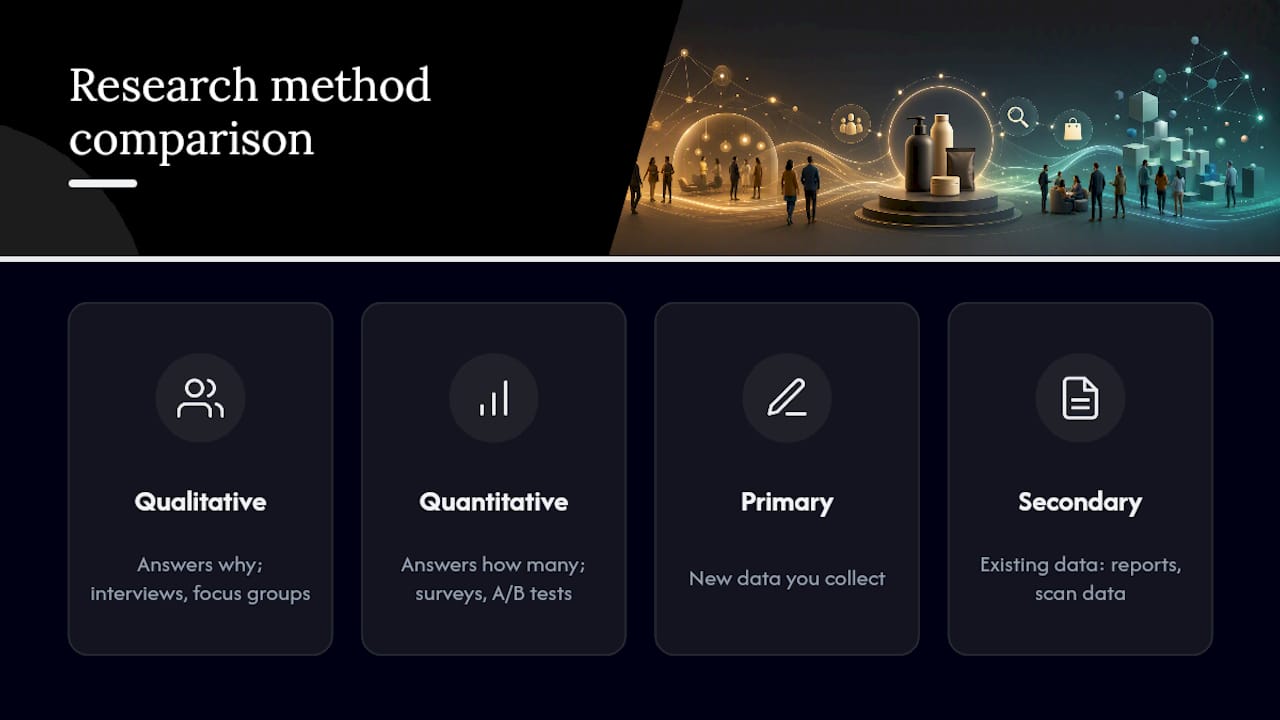
Qualitative research tells you the why. Depth interviews, focus groups, and in-home usage tests surface language, objections, and emotional reactions you’d never catch in a survey. If you’re still not sure why customers care about a problem, start here.
Quantitative research tells you the how many. Surveys, A/B tests, and conjoint studies measure prevalence, and preference at scale. Use quantitative work once you already have a hypothesis and need to know if it holds across a bigger, more representative group.
Primary research is data you collect yourself for this specific question. Secondary research is data that already exists: category reports, competitor pricing pages, retail scan data, government trade statistics. A guide to market research methods recommends starting with secondary data before spending a dollar on primary work, because it frames sharper questions and often answers the easy ones for free.
Then there’s the split between active and passive data. Active research is anything where a person directly tells you something, an interview answer, a survey response, a rating. Passive data is behavioral: social listening, point-of-sale scan data, panel purchase histories, search trends. The strongest programs combine both. Circana’s guidance on pre-launch research is blunt about this: triangulating active feedback with passive behavioral signals catches the gap between what people say and what they actually do, which is where a lot of concept testing quietly lies to you.
A quick example from the packaged food world: a team studying Canadian candy retail trends might pair scan data showing a spike in sour-flavor sales with interviews explaining that shoppers are chasing novelty, not just sourness. Neither data source alone tells the full story.
The 7-Step Research Process for New Product Decisions
Here’s the actual sequence, in the order that avoids the most rework. Each step produces a specific deliverable that feeds the next one.
1. Define the business decision and success metric. Before you pick a single method, write a one-page brief stating the decision you need to make (launch, price, kill, pivot), who needs to sign off, and the metric that will settle it. This single document is what keeps a study from ballooning into “let’s just learn everything about the market,” which is how research budgets die.
2. Identify your target audience and sampling strategy. Define the segment that actually matters for this product, not your whole customer base. If you’re launching a snack aimed at younger shoppers who buy on impulse at checkout, surveying your loyal 45-year-old repeat buyers tells you about the wrong population entirely.
3. Choose your methods and design the instruments. Pick qualitative, quantitative, or both based on what you still don’t know. Draft your discussion guide or survey, then pilot it. This step matters more than people give it credit for.
4. Recruit participants and collect data with quality checks. Screen carefully, track completion time to catch speeders, and build in at least one attention check if you’re running an online survey. Bad data collected fast is worse than good data collected slowly.
5. Analyze, triangulate, and write insight statements. Don’t stop at charts and word clouds. Cross-reference what the qualitative work explains against what the quantitative work measures, and write down the actual decision-relevant conclusion, not just the finding.
6. Validate concept-to-product and test pricing. A concept score is not a purchase intent guarantee. Run a real product test, and pair it with a pricing method suited to the decision at hand.
7. Turn insights into roadmap decisions and a measurement plan. Every study should end with a decision (go, no-go, revise) and a plan for what you’ll track post-launch to confirm the research was right.
This sequence tracks closely with the structured six-step research process SurveyMonkey outlines for business decisions generally: define, design, collect, analyze, and act, with the design phase split into method selection and instrument-building for product-specific work. A related framework from Koji adds the piece most teams underweight: right-sizing your sample and building in quality controls before you scale collection.
Pro Tip: Write your research brief before you touch a survey tool. A tight brief that names the decision, the audience, the success metric, and the deadline prevents scope creep better than any amount of analysis discipline after the fact.
Getting Sampling, Screeners, and Instruments Right
Your sample needs to represent the people who’d actually buy this specific product, not your category’s average shopper. A candy brand testing a new sour freeze-dried line needs opinions from people who already buy novelty snacks impulsively, not a general population panel that skews toward occasional candy buyers.
Screener design is where most studies quietly go wrong. A weak screener asks “do you like candy?” A strong one asks “how many times in the last month did you buy a snack on impulse at checkout, and what was it?” The second question filters for actual behavior instead of a vague self-image.
Before you launch anything at scale, piloting your instrument with five to ten target respondents reveals confusing wording, biased phrasing, or a survey that runs too long, all before you’ve burned your real sample. It’s a cheap insurance policy that most teams skip because it feels like a delay.
A few practical quality checks worth building into every instrument:
- Completion time. Flag responses finished suspiciously fast; they’re usually low-quality.
- Attention checks. A simple “select option B” instruction catches inattentive respondents.
- Screener depth. Ask about recent behavior, not general preference, to filter for real category buyers.
- Pilot first. Run the instrument on a handful of people before scaling to the full sample.
Recruitment options range from your own email list and social channels for a low-cost first pass, up to professional panels when you need statistical confidence across a bigger, more representative group.
Turning Data Into Decisions Your Team Can Act On
Raw data doesn’t make decisions, synthesis does. Qualitative analysis means coding interview transcripts into themes and pulling representative quotes that illustrate each one, not cherry-picking the loudest opinion in the room.
Quantitative analysis goes further than a topline number. Cross-tabs break results out by segment, so you can see if your enthusiastic average score is hiding a lukewarm reaction from your actual target buyer. Basic significance testing tells you whether a difference between two concepts is real or just noise, and simple market sizing math (category size times addressable share times expected penetration) turns a preference score into a revenue estimate leadership can actually use.
The synthesis step is where multiple sources get reconciled into one clear recommendation. If your qualitative work says people want “bold flavor” and your quantitative survey ranks a milder option highest, that’s not a contradiction to bury, it’s a finding worth a follow-up question. Write your final output as an insight statement paired with a recommendation: what you found, what it means for the decision on the table, and what you’d do next. Skip the temptation to hand leadership a slide deck of charts with no verdict attached.
Validating the Concept, the Prototype, and the Price
A concept that scores well on paper can still flop once it’s a real product in someone’s hand or mouth. That gap between concept and finished product is one of the most common ways product development research derails, and a practitioner’s guide to NPD research points to it directly: concepts that test well often fail once the actual product doesn’t deliver on the promise. Closing that gap requires prototype testing, in-context usage studies, and for food products specifically, sensory and packaging fit checks that no written description can substitute for.
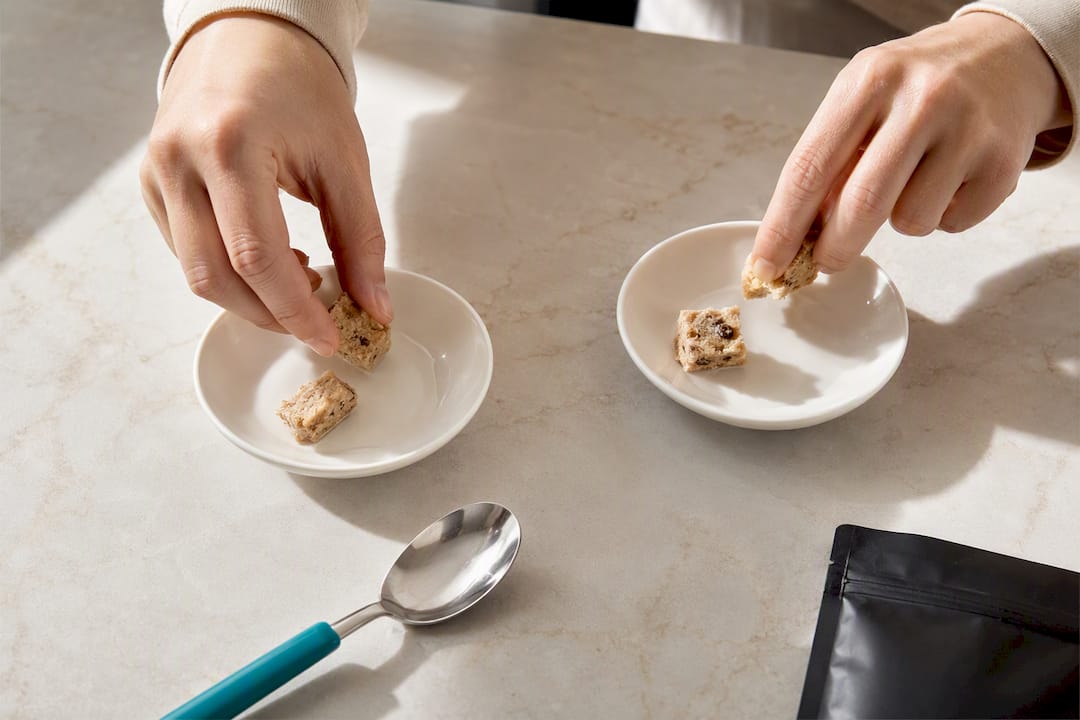
For packaged food and candy, that means running small-batch sensory panels alongside the concept work, and checking how the packaging performs on shelf before you commit to a full production run.
Pricing needs its own dedicated method, and the right choice depends on what you’re trying to learn:
| Method | Best for | What it tells you |
|---|---|---|
| Van Westendorp | Early-stage price sensitivity | The range customers see as acceptable, cheap, or too expensive |
| Gabor-Granger | A single product, narrowing to one number | Demand at specific, discrete price points |
| Conjoint/choice modeling | Multiple features plus price together | How price trades off against features people actually value |
Van Westendorp works well when you have no price anchor yet. Gabor-Granger is faster when you already have a shortlist of prices to test. Conjoint analysis takes more setup but earns its keep when price is just one of several features competing for the customer’s attention.
Matching Your Research Budget to Your Timeline
A founder testing a first concept doesn’t need the same toolkit as an enterprise team running a national launch, and pretending otherwise wastes money on one end or risk on the other.
Low-cost tactics get you surprisingly far early on: direct customer interviews, social listening on relevant hashtags and forums, and a DIY survey tool for quick directional reads. Upgrade to professional panels or a research lab once you need statistically reliable numbers to justify a bigger spend, or once internal stakeholders start asking “how confident are we in this?”
Timelines vary by stage, but discovery interviews typically run about one to two weeks for scheduling and analysis, quantitative concept validation takes several weeks depending on sample size, and full pre-launch pricing and positioning studies require multiple weeks when testing multiple variables.
Modern platforms have compressed a lot of that. AI-enabled research tools now run automated interview moderation and thematic coding that used to take analysts days, cutting some study cycles from months to days without losing conversational depth. The trade-off is that automated analysis still benefits from a human reviewing the themes it surfaces, especially for nuanced or emotionally loaded feedback where an algorithm might flatten the interesting part.
Practitioner Notes: Pairing Market and Technical Research for Food and Candy
Market research alone can’t tell you if a product will hold its texture on a shelf for six months, and technical research alone can’t tell you if anyone wants the flavor you engineered. For food and candy products, these two research streams have to run in parallel or you end up validating a product that changes between the taste panel and the store shelf. Research on product development streams makes this explicit: market information (what to build) and technical information (how to build it) have to be managed together for the best outcomes, not handed off sequentially.
A practical checklist for a CPG pilot looks something like this: concept test with the target segment, sensory panel on the actual formulation, shelf and pack fit review, a small-batch production run to catch what changes at real scale, and a regulatory and labeling review before anything ships. That last step matters more than people expect. Reviewing labeling requirements for food products early avoids a redesign after your concept has already tested well with consumers.
Building Research Into a Team Habit, Not a One-Off Project
Most teams treat research like a project instead of a muscle, and that’s the real gap between companies that keep launching winners and ones that keep guessing. The fix isn’t more research, it’s faster, smaller cycles that get shared instead of buried in a slide deck nobody reopens.
Keep a running insights library so last quarter’s pricing study still informs this quarter’s flavor decision. Run monthly touchpoints with a handful of target customers, and reserve a full validation push for quarterly go/no-go moments. If you’re just getting started, don’t try to build the whole system at once, pick one high-impact product decision, run it end-to-end, and let that first win build the case for doing it again.
— Chadi
Need Production Support After Your Research Validates?
Once your data says a flavor or format is ready, the next bottleneck is usually production, not more research. We are a Canadian manufacturer of freeze-dried candy and other treats, and also provide private label, co-packing, and packaging services for other consumer goods brands, making us a practical partner for teams that just finished validating a concept and now need someone to actually make it.
If your research pointed to a specific flavor profile or format, Space-man’s private label and co-packing services can take that validated concept into small-batch production without you needing to build a manufacturing line from scratch. That matters most right after validation, when you need real product in real packaging to run a limited retail test before committing to a full run. For teams testing shelf and display performance specifically, a 72-bag wholesale display kit gives you a way to see how the packaging actually performs in a retail setting.
If you’re earlier in the process and want to understand the finished product category before you finalize your own concept, a 10-pack freeze-dried candy bundle is a low-cost way to see what’s already working in the category. Reach out about co-packing once your concept and pricing are validated, that’s the point where a production partner saves the most time.
Sources
For deeper process detail, SurveyMonkey’s marketing research process guide covers the six-step framework this article builds on. Circana’s pre-launch research guidance expands on triangulating active and passive data, and Qualtrics’s product research tools overview details current AI-enabled research platforms.
- Marketing research process: 6 steps to better business decisions — SurveyMonkey
- How to Do Market Research Before Launching New Products — Circana
- How to conduct market research — Koji docs
- Monday
- Product innovation research tools — Qualtrics
FAQ
How do I do market research for a new product?
Start by defining the business decision and success metric, then move through sampling, method selection, instrument design, data collection, analysis, and concept-to-product validation before you finalize pricing and launch plans.
What are the 7 stages of new product development?
Common frameworks include idea generation, screening, concept development, business analysis, product development, market testing, and commercialization, with research feeding every stage rather than just the front end.
What are the 5 P’s of product marketing?
The 5 P’s are usually listed as product, price, place, promotion, and people, though some frameworks swap in “packaging” or “positioning” depending on the industry; definitions vary by source, so check which version your team is using before applying it.
What are the 7 types of marketing research?
Common categories include qualitative research, quantitative research, primary research, secondary research, exploratory research, descriptive research, and causal research, each answering a different kind of question about your market or product.
How long does market research take for a new product?
Discovery interviews typically take one to two weeks, quantitative validation runs two to four weeks, and full pre-launch pricing and positioning studies often need four to six weeks depending on the number of variables tested.