

Do market research first: run a targeted study tied to the specific product decision you’re about to make. Skip that and you’re funding a launch with a guess dressed up as a plan. Your immediate next step is simple: write down the one decision this research needs to answer, whether that’s “should we launch flavor A or B” or “what price kills demand.” Get that right, and everything downstream, from sample size to method, gets easier.
TL;DR:
- Conduct targeted research at each product development stage, from idea screening to post-launch, to minimize risk and uncover market opportunities early.
- Use a mix of secondary sources, qualitative interviews, and quantitative surveys in a cost-effective sequence tailored to the decision’s certainty needs.
- Ensure research objectives are specific and decision-linked, with well-defined audience segments, success criteria, and pilot testing to avoid bias and misinterpretation.
- Leverage low-budget techniques like blind taste tests, shelf mockups, and social listening to gather meaningful insights without large expenses.
- Focus on small test batches and real product testing for validation, especially in food products, before committing to full-scale production or expanding to multiple markets.
Table of Contents
- What Is Market Research for New Product Development?
- Quantitative vs Qualitative, Primary vs Secondary: Choosing Your Mix
- How Do You Run Market Research for a New Product?
- How Do You Design Research That Avoids Bias?
- Low-Budget Tools and Tactics for Product Testing
- Competitive Analysis and Market Sizing: Where’s the Opportunity?
- Concept Testing and Prototype Validation: What the Numbers Mean
- Turning Research Into a Roadmap: KPIs, Gates, and Launch Planning
- How Long and How Much Does Product Research Cost?
- The Space-man Playbook for Low-Budget CPG Validation
- Lessons From Running Product Research in the Real World
- Space-man’s Manufacturing Support for Product Validation
- Sources
- FAQ
What Is Market Research for New Product Development?
Market research for new product development is the structured process of gathering and analyzing information about customers, competitors, and market conditions to guide decisions on what to build, how to price it, and how to position it. The common sequence runs: set objectives, identify your audience, choose methods, collect data, analyze it, then act on what you find. That’s not a bureaucratic ritual. It’s a systematic process for turning uncertainty into a decision you can defend in front of a boss, a board, or a bank.
Here’s why it matters in plain terms. Research does three jobs at once. First, it reduces risk. Most product failures don’t come from bad manufacturing. They come from building something nobody wanted, at a price nobody would pay, sold in a channel nobody shops. Second, it surfaces opportunity you’d otherwise miss. A gap in shelf assortment, an underserved dietary need, a flavor trend picking up steam on social platforms before your competitors notice. Third, it sharpens positioning and pricing. Knowing what a customer will actually pay, and why, beats guessing based on your cost-plus spreadsheet.
Where does this fit in the product lifecycle? Research isn’t a single gate you pass through once. It shows up at every stage: idea screening (is this worth pursuing at all?), concept development (which version resonates?), prototype testing (does the real thing hold up to the promise?), and post-launch (is it performing as predicted?). Skipping research at the idea stage and only doing it before launch is like proofreading a book after it’s printed. You can still learn something, but the expensive mistakes are already locked in.
For CPG teams specifically, this cycle moves faster than most industries. A snack or candy concept can go from napkin sketch to store shelf in months, not years, which means research has to be lean and fast without becoming careless.
Quantitative vs Qualitative, Primary vs Secondary: Choosing Your Mix
Every research method falls into two overlapping pairs, and mixing them wrong is the most common budget-waster in early product work.
Quantitative research tells you how many and how much. Surveys, panel data, and sales tracking give you numbers you can act on with confidence: 62% preferred flavor A, purchase intent scored 7.2 out of 10. Qualitative research tells you why. Interviews, focus groups, and open-ended survey responses reveal the reasoning behind the numbers, the kind of nuance that explains why a product tested well but still flopped at retail.
Primary and secondary research split along a different axis: who collected the data. Primary research means you go get the data yourself through interviews, surveys, focus groups, or usability and sensory tests. It’s more expensive and slower, but it answers your exact question. Secondary research means someone else already collected it, industry reports, trade statistics, retail panel data, and you’re analyzing existing information. It’s cheaper, faster, and a smart place to start before you spend a dollar on primary work.
A practical breakdown of common methods:
- Surveys: fast, scalable, good for validating demand across a large group, weak on depth
- Interviews: slow, small sample, but rich on the “why” behind behavior
- Focus groups: useful for reaction and group dynamics, but prone to groupthink if not moderated well
- Sensory/usability tests: essential for food products, where taste and texture drive the purchase decision more than any stated preference
- Secondary sources (trade reports, POS/panel data, social listening): cheap, fast, and useful for framing your primary questions before you spend real money
The tradeoff is always cost against certainty. If you need a quick gut check before committing budget, lean secondary and light qualitative. If you’re about to greenlight a production run, you need primary quantitative data with a real sample. A workable minimal mix for most product decisions: start with secondary sources to sharpen your hypothesis, run a handful of qualitative interviews to catch blind spots, then validate at scale with a quantitative survey or in-market test before you commit real capital.
How Do You Run Market Research for a New Product?
A research process only earns its keep if it ends in a decision, not a slide deck nobody reads. Here’s a sequence that works whether you’re testing a new candy flavor or a full private-label program.
1. Define a decision-linked objective. Before you write a single survey question, answer this: what will you actually decide because of this research? “Understand consumer preferences” is not an objective. “Decide whether to launch the mango variant nationally or keep it regional” is. Every method, sample size, and analysis choice flows from that one sentence.
2. Identify your audience and build a sample plan. Who exactly needs to answer your questions? Existing customers, lapsed buyers, or a category’s heavy users behave differently, and mixing them muddies your read. For a regional candy launch, that might mean 200 survey respondents split evenly across three test markets, not a convenience sample of whoever answers an email blast.
3. Choose your methods and instruments, and set success criteria upfront. Decide what “good” looks like before you see any data. If purchase intent needs to hit 70% top-two-box to justify a national rollout, write that number down now. Deciding after you see the results is how teams talk themselves into weak data.
4. Pilot the instrument before you field it. Run your survey or discussion guide past five to ten people first. You’ll catch confusing questions, technical glitches, and biased wording before they contaminate your real sample. This step gets skipped constantly, and it’s the cheapest insurance in the whole process.
5. Field the study with quality controls in place. Watch for straight-lining (respondents clicking the same answer repeatedly), speeders who finish a ten-minute survey in ninety seconds, and sample quotas that drift off target. Clean data beats a bigger sample every time.
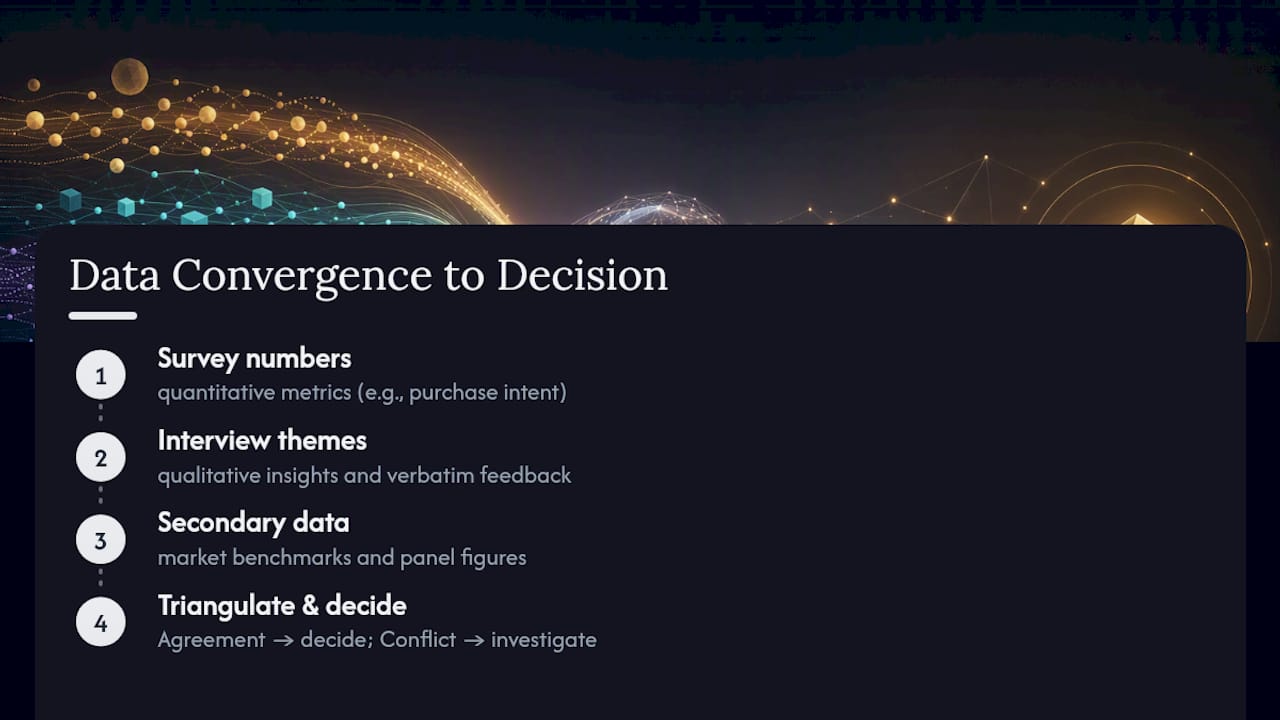
6. Analyze and triangulate. Don’t let one method carry the whole decision. Cross-check your survey numbers against interview themes, and against whatever secondary or panel data you have. If three methods point the same direction, you can move with confidence. If they conflict, that’s valuable information too, it means you’re not done digging.
7. Run concept or prototype tests on your shortlist. Once secondary and exploratory research narrows your options, test the finalists directly with real prototypes, sensory panels, or shelf mockups. This is where you separate what sounds good on paper from what actually sells.
8. Translate findings into prioritized requirements and make the gate decision. Turn insights into specific, buildable requirements (“reduce sweetness by 15%, add a resealable pouch”) and take them to whoever owns the go/no-go call. Research that doesn’t end in a decision was a research project, not a business tool.
Pro Tip: Keep a running “decision log” for every research project: the question asked, the method used, and the decision made. Six months later, when someone asks “why did we launch that flavor,” you’ll have a real answer instead of institutional memory.
How Do You Design Research That Avoids Bias?
Good research design isn’t about fancy tools. It’s about discipline in three places: objectives, sampling, and question wording.
Start with SMART objectives, specific, measurable, achievable, relevant, and time-bound, but anchor every one of them to an actual decision. “Explore consumer sentiment” fails the specificity test. “Determine whether at least 60% of target buyers rate the new packaging as more appealing than the current design, within three weeks” passes.
Sampling rules of thumb matter more than people admit. A sample that skews toward your existing customer base will overstate enthusiasm for anything you show them, because they already like your brand. Segment your sample deliberately: split by usage frequency, demographic, or region, and look at each segment separately before you average everything into one misleading number.
Question design is where most bias sneaks in unnoticed:
- Avoid leading questions (“How much do you love this new flavor?”) in favor of neutral framing (“What’s your reaction to this new flavor?”)
- Use open-ended questions to catch things your multiple-choice options didn’t anticipate
- Randomize answer order where possible to avoid primacy bias
- Pre-test every instrument on a small group before fielding it broadly
Experts consistently recommend triangulating quantitative and qualitative methods, pairing a survey with a handful of follow-up interviews, or checking stated preference against social listening data, because any single method has blind spots the others can catch. A survey tells you 70% liked the concept. An interview tells you they liked it because it reminded them of a childhood treat, which is either a marketing goldmine or a red flag depending on your brand positioning.
Low-Budget Tools and Tactics for Product Testing
You don’t need an enterprise research budget to get usable signal. You need the right tool for the right question, and a little creativity.
Survey platforms split into two useful categories: broad-reach tools built for scale (good for validating demand across hundreds of respondents fast) and deeper analytics platforms that pair survey data with behavioral tracking. Well-designed surveys remain one of the most cost-effective ways to collect scaled feedback on a concept, provided the questions are pre-tested and the sample isn’t just whoever happens to open your email.
For food products specifically, cheap sensory and shelf tests punch well above their cost:
- Set up a blind taste test at a farmers market or community event, five flavors, no branding visible, just a scorecard
- Recruit testers through local parent groups, college campuses, or employee break rooms instead of paying a panel service
- Build a mock shelf display with three packaging variants and time how long it takes shoppers to pick one
- Run a “pay what you think it’s worth” table at a pop-up to get real pricing signal instead of hypothetical survey answers
Social listening and review mining deserve more attention than most teams give them. Scanning reviews on competitor products for repeated complaints (“too sweet,” “packaging falls apart,” “wish it came in smaller bags”) hands you a free list of unmet needs before you’ve spent a cent on primary research. Frontline staff and customer service logs work the same way: they’re sitting on hypotheses worth testing, and they cost nothing to mine.
Once you’ve got early signal, set up a rapid feedback loop: small test batch, quick survey or in-person reaction, adjust, repeat. Space-man’s own low-budget CPG validation tactics walk through exactly this kind of lean testing cycle for candy and snack concepts, useful if you want a template rather than starting from scratch.
Competitive Analysis and Market Sizing: Where’s the Opportunity?
Competitive analysis only earns its place in your process if it changes something. If your competitive mapping doesn’t lead to a specific shift in positioning or roadmap, the exercise wasn’t research, it was homework.
A lightweight competitor map covers four columns: features, price point, distribution channel, and marketing claims. Lay ten competitors across those four dimensions and patterns jump out fast, gaps in price tiers, channels nobody’s using, claims everyone makes (which means they’ve stopped differentiating anyone).
Market sizing works two directions, and you should sanity-check with both:
- Top-down: start with total category sales (from trade reports or panel data) and estimate your realistic share based on comparable launches
- Bottom-up: build up from unit economics, how many stores, how many units per store per week, at what price, to reach a revenue estimate independent of the top-down number
For any product with export or multi-market ambitions, combining trade data, import statistics, and country-level reports helps assess opportunity and landed cost before you commit, and testing three to five markets initially keeps early expansion manageable rather than chaotic.
POS and panel data tell you more than sales totals. Watch velocity (units sold per store per week) and repeat purchase rate. A product that sells fast once but shows weak repeat purchase has a trial problem, not a distribution problem, and that distinction should change what you fix next.
Concept Testing and Prototype Validation: What the Numbers Mean
Four metrics carry the weight in most concept and prototype tests: purchase intent, perceived uniqueness, value-for-price, and likelihood to recommend. These measures, especially purchase intent and perceived uniqueness, are strong predictors of how a product will actually perform once it hits shelves.
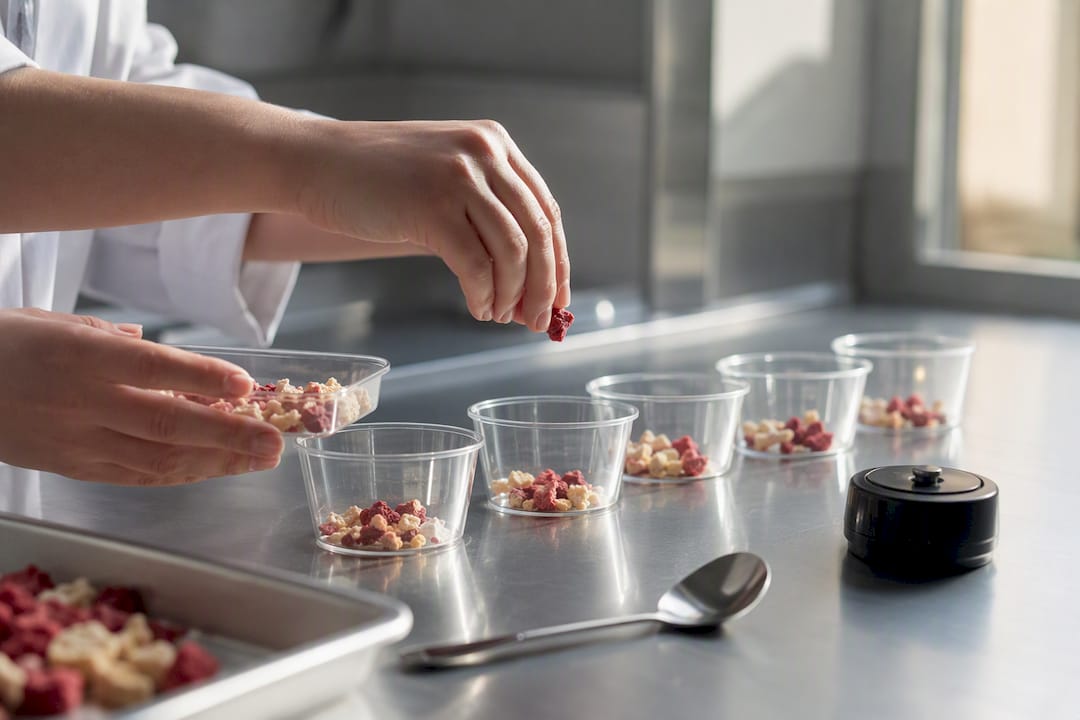
Prototype test formats vary by what you’re validating. Sensory panels work when taste or texture is the make-or-break attribute, which for candy and confectionery is almost always the case. In-home tests suit products people need to experience over days, not seconds. Shelf mockups answer a narrower but critical question: does this package get picked up at all, regardless of what’s inside it.
Mixed results are where judgment matters most. High purchase intent paired with low perceived uniqueness usually means you’ve built something fine but forgettable, worth iterating on differentiation before you spend on a launch. Low purchase intent with high uniqueness scores can mean you found something genuinely new that needs better explanation, not abandonment. The pattern tells you which lever to pull.
For pricing and feature tradeoffs specifically, basic purchase-intent surveys start to strain. Discrete choice modeling, where respondents pick between bundled combinations of price and features rather than rating one concept in isolation, gives you a cleaner read on what people would actually give up for a lower price, which matters enormously once you’re setting a shelf price against a real competitor.
Pro Tip: Don’t treat a single weak metric as a stop signal on its own. A concept with mediocre uniqueness but strong purchase intent and price tolerance can still be a smart, profitable line extension, it’s just not going to be your headline innovation story.
Turning Research Into a Roadmap: KPIs, Gates, and Launch Planning
Insight that stays in a report is wasted money.
Connect every major finding to a roadmap gate with a measurable KPI attached.
Small-scale test-and-control pilots reduce risk further before a full launch. Run the new product in twenty stores against a matched set of twenty control stores with the old lineup, and you get a real read on incremental lift instead of a hopeful guess. Scenario planning, modeling a strong case, a moderate case, and a soft-launch case, keeps the team from being blindsided when actual results land between your best and worst assumptions.
Set a learning cadence after launch, not just before it. Weekly velocity checks for the first month, then monthly repeat-purchase tracking, catch problems while you can still fix packaging, pricing, or distribution. Treating research as a continuous loop rather than a one-time gate keeps product development aligned as customer needs shift, and that ongoing discipline separates teams that iterate well from teams that launch once and hope.
How Long and How Much Does Product Research Cost?
Budget and timeline scale with how far you’re pushing from what already exists. A quick validation check, testing a flavor variant of an existing product, typically runs a few weeks and a modest budget: a handful of interviews plus a survey fielded to a few hundred people. Full concept testing for a genuinely new product line takes longer, often a couple of months, because it usually involves prototype development, sensory panels, and iterative rounds. Disruptive innovation, something with no direct category precedent, can stretch past six months once you factor in multiple rounds of concept refinement and possibly test markets.
The main budget drivers are sample size, method complexity (a discrete choice study costs more than a simple survey), and how many rounds of iteration you build in before locking the concept. If your budget is tight, prioritize secondary research and internal frontline input first; a well-planned research effort often starts with these cheaper sources before committing to costly primary work, which sharpens your primary questions and shrinks the sample you need later.
The Space-man Playbook for Low-Budget CPG Validation
Running validation on a candy or snack concept without a corporate research budget is a familiar problem, and it’s one the freeze-dried category deals with constantly, since taste and texture make-or-break decisions can’t be predicted from a survey alone.
A workable quick-test template looks like this: five to eight flavor or format variants, a blind scorecard rating sweetness, texture, and overall appeal on a simple 1 to 5 scale, tested with fifteen to twenty people pulled from a farmers market table or a retail demo day. That’s enough signal to cut your options from eight down to two or three worth real production investment, without spending on a formal panel study.
For teams working through private label or co-packing, a typical role in this process includes producing small test batches so you can run real sensory and shelf tests with actual product, not a mockup. That matters because a rendering never tells you how a freeze-dried marshmallow actually crunches, and reactions to real product consistently diverge from reactions to a concept description. Space-man’s six-step framework for food and FMCG product research walks through exactly this kind of staged validation, built for teams that need to move fast without a big research department behind them.
This week’s action items, if you’re starting from zero: pick your top three variant ideas, book fifteen minutes with ten potential customers, and set your purchase-intent threshold before you show anyone anything.
Lessons From Running Product Research in the Real World
The most common mistake isn’t a bad survey question. It’s starting research without deciding what decision it’s supposed to inform, which means every result gets interpreted to fit whatever the team already wanted to do. Vague objectives produce vague action, every time.
The second mistake is trusting a single data source. A concept that scores well on a survey but gets lukewarm reactions in five interviews is telling you something the survey alone missed. Triangulating catches that gap.
Small experiments consistently outperform their cost. A blind taste test at a local market with twenty strangers has told teams more about a product’s real potential than a properly commissioned study delivered three weeks too late to matter.
— Chadi
Space-man’s Manufacturing Support for Product Validation
A practical next step once your research points toward a real production run, not just another survey, is running small test batches so your sensory panels and shelf tests use real freeze-dried candy, chocolate, marshmallow, or ice cream sandwich product instead of a mockup.
The services map directly onto what this guide covers. Private label and co-packing let you move from a validated concept to a pilot batch without building your own production line first, which is exactly the kind of low-risk, small-scale step this article recommends before a full launch commitment. Pouch packaging and commercial freeze drying round out the support for teams testing packaging formats alongside product formulation, since a shelf-appeal test needs real packaging to mean anything. If you’re a retailer, distributor, or entrepreneur ready to move a validated flavor from spreadsheet to shelf, browse the current freeze-dried candy and treats collection for a sense of finished product quality, then reach out through the private label and co-packing page to scope a test run.
Sources
- How to Do Market Research - Methods, Examples & Templates
- How to Use Market Research Surveys for New Product Development
- Conducting market research
FAQ
What Are the Main Stages of New Product Development?
New product development generally moves through idea screening, concept development, prototype building, testing, and launch, with research feeding decisions at every stage rather than just at the end. The process typically follows a sequence of setting objectives, gathering data, and applying findings to decisions at each stage.
How Do You Do Market Research for a New Product?
Start by defining the specific decision the research needs to answer, then choose methods that match your budget and timeline, starting with cheaper secondary sources before committing to primary research like surveys or interviews. Pilot your instruments, field the study with quality controls, and triangulate results across at least two methods before making a call.
Is R&D Different From Product Development?
Yes. R&D focuses on discovering or engineering new technology, ingredients, or formulations, while product development takes that work (or an existing capability) and shapes it into a market-ready item with defined packaging, pricing, and positioning. Market research typically sits closer to the product development side, validating what customers want, though it can inform early R&D direction too.
What Should a Small Food Brand Budget for Concept Testing?
Costs scale with sample size and method: a lean flavor or packaging test using informal recruiting and a scorecard can run on a modest budget, while formal concept testing with a fielded survey and a larger sample costs more but delivers more confidence. Space-man doesn’t publish fixed research pricing since it centers on manufacturing support; current production and packaging service pricing is available directly on its private label and co-packing page.
How Many Test Markets Should You Start With?
For products expanding beyond a home market, a small number of test markets is a reasonable starting range, since it’s enough to catch regional variation without spreading a validation budget too thin to draw reliable conclusions.