

Integrated market research, conducted before, during, and after development, is the decision engine that determines whether a new product succeeds commercially. Done right, it validates the opportunity, screens weak concepts before they burn budget, guides development with real feedback, and confirms the product is ready before launch day. Skip a stage, and you’re basically guessing with better spreadsheets.
TL;DR:
- Continuous market research across all product development stages improves prioritization, reduces costly missteps, and boosts post-launch sales and customer satisfaction.
- Combining qualitative and quantitative methods, along with passive data sources, provides a layered evidence foundation that supports better decision-making and reduces bias.
- Tiering competitors into primary, secondary, and emerging groups helps allocate research focus efficiently based on their impact on buyer choice.
- Validating concepts at multiple points, including pre-launch checks and post-launch tracking, prevents failures caused by relying on isolated or early-stage data.
- An effective research program starts with clear decision-driven objectives, targeted samples, and ongoing sequencing rather than one-time studies.
Table of Contents
- What Is Market Research for New Product Development?
- Why Does Market Research Matter for Product Development?
- How Does Research Support Each Stage of Product Development?
- Which Research Methods Should You Use, and When?
- How Do You Design a Research Program That Builds Real Evidence?
- How Should You Prioritize Competitors in a Product Analysis?
- What Are the Most Common Market Research Mistakes?
- Which KPIs Actually Tell You a Product Is Ready to Launch?
- A Six-Step Playbook You Can Copy for Your Next Launch
- Why Iterative Research Beats One-Off Studies
- Sources
- FAQ
What Is Market Research for New Product Development?
Market research for new product development is the structured process of gathering and interpreting evidence about customers, competitors, and market conditions to guide decisions at every stage of building a product, not just before you build it. That distinction matters more than most product teams realize. A lot of companies treat “market research” as a single checkbox they tick during the concept phase, then never touch again until launch. That’s not research. That’s a survey with a nice PDF.
Real market research for new product development spans a few key distinctions worth knowing before you plan anything:
Primary vs. secondary research. Primary research is data you collect yourself, like surveys, interviews, or in-home use tests. Secondary research is existing data someone else already gathered, such as industry reports or government market studies.
Qualitative vs. quantitative. Qualitative methods (focus groups, one-on-one interviews) tell you why people feel a certain way. Quantitative methods (surveys, conjoint studies) tell you how many people feel that way and by how much.
Active vs. passive. Active research means you’re asking questions directly. Passive research means you’re watching behavior unfold on its own, through social listening, point-of-sale data, or retail panel tracking.
Think of these distinctions as building what I’d call a consumer evidence foundation. Every study you run should add a layer to that foundation rather than standing alone as an isolated data point. According to methodology guidance from the OECD, research design should be iterative, starting from a hypothesis and refining the approach as evidence accumulates, not locked into a single study format from day one.
Why Does Market Research Matter for Product Development?
Because the alternative is expensive guessing. Companies that weave research through the entire product lifecycle, rather than treating it as a pre-launch formality, report better-prioritized roadmaps, smarter pricing decisions, and stronger returns on their innovation spend, according to the OECD’s analysis of market study methodologies.
Here’s what that actually looks like in practice. A prioritized roadmap means you stop building features nobody asked for and start building the ones tied to actual purchase behavior. Pricing insight means you’re not pulling a number out of thin air and hoping the market agrees with you. And launch ROI improves because you’re not finding out about a fatal flaw in the concept three weeks before the shelf date.
Statistic Callout: Research that spans the full product lifecycle, from early opportunity identification through post-launch tracking, consistently correlates with better-prioritized customer needs and stronger innovation ROI, per the OECD’s methodology review. Companies that only research at the front end lose that compounding benefit.
The cost of skipping research isn’t abstract, either. It shows up as wasted manufacturing runs, packaging redone after launch, or a product that tests great in a boardroom and dies quietly on a retail shelf. A practitioner’s guide to NPD research frames this well: research should establish opportunity, screen concepts, guide development, and validate before launch, as four connected goals, not four separate projects you run because a template told you to.
How Does Research Support Each Stage of Product Development?
Every NPD milestone needs a different kind of evidence. Treating all research the same way, running one big survey and calling it done, is how good concepts die in development. Here’s the staged sequence that actually holds up.
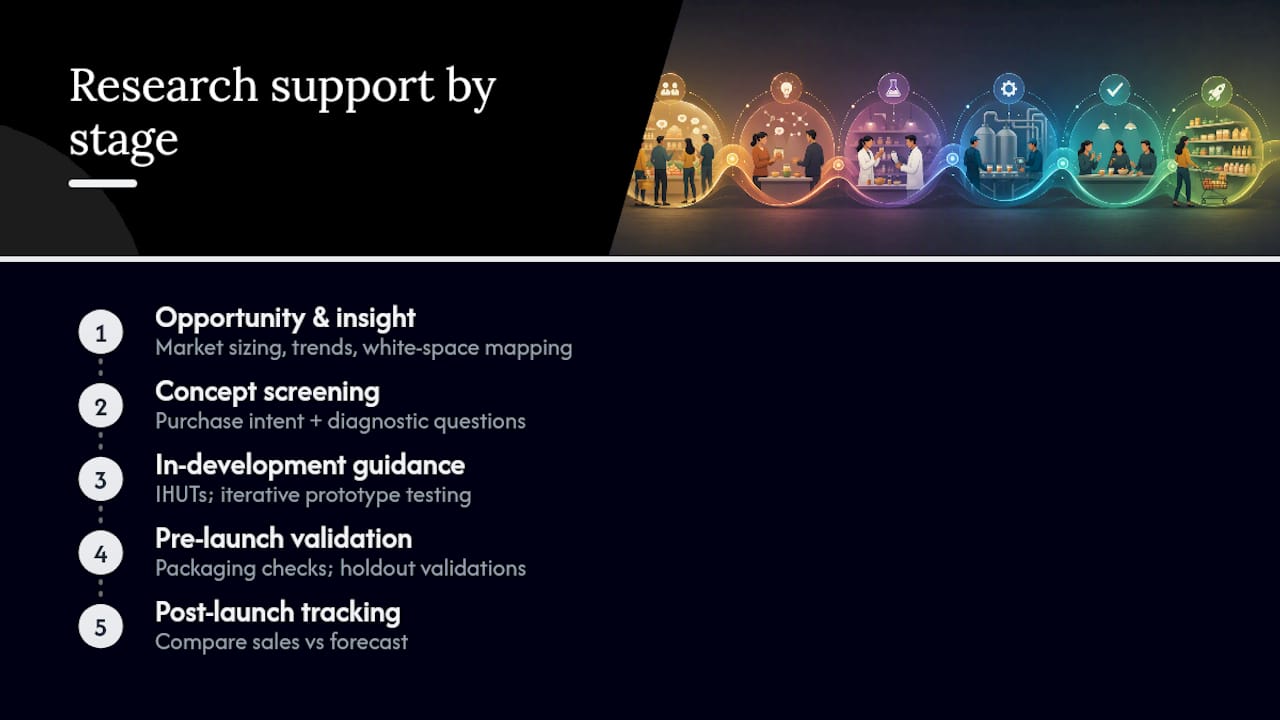
1. Opportunity and insight research. This is where you figure out if there’s a real gap worth filling. Market sizing tells you whether the opportunity is big enough to justify the investment. Trend analysis (industry reports, consumption pattern shifts, category growth rates) tells you whether you’re early, on time, or hopelessly late. White-space identification, essentially mapping what exists against what consumers say they want, tells you where an underserved need actually sits. Standard market analysis practice treats this step, alongside competitive landscape review and barrier-to-entry assessment, as the foundation everything else builds on.
2. Concept screening. Once you have a handful of product ideas, you need to know which ones deserve real investment. This stage runs on purchase intent metrics, basically asking a representative sample “would you buy this?”, paired with diagnostic questions that dig into why the intent score landed where it did. A concept that scores well on intent but poorly on uniqueness is a different problem than one that scores poorly on both. According to the PulseAI Research practitioner’s guide, skipping the diagnostic layer and stopping at a simple pass/fail score is one of the more common ways good concepts get shelved for the wrong reasons.
3. In-development guidance. This is the messy middle, where prototypes get tested, refined, and tested again. In-home use tests (IHUTs) let real people interact with an actual product in their actual kitchen, not a sterile focus group room. Iterative feedback loops, small rounds of testing followed by tweaks followed by more testing, catch problems that a single big study would miss entirely. This is also where taste, texture, or usability issues surface before they become expensive manufacturing changes.

4. Pre-launch validation. Before anything ships, you need concept-to-product checks: does the actual packaging communicate what the concept promised? Does the finished product deliver on the claims made in early concept testing? Skipping this validation step is one of the most common sources of launch failure, because a concept that tested beautifully on paper can fall apart once it’s a physical object on a shelf with real packaging and a real price tag. Holdout validations, where you compare a test market or limited release against a control group, add another layer of confidence here.
5. Post-launch tracking. The research doesn’t stop at launch. Comparing actual sales against forecast tells you fast whether you nailed the demand estimate or missed it. Sentiment tracking (reviews, social mentions, customer service tickets) tells you how the product is actually landing emotionally. Retention and repeat-purchase data tell you whether people liked it enough to buy it again, which, for a lot of consumer products, is the number that actually matters.
Pro Tip: Don’t wait until a stage is “finished” to start planning the next one’s research. Draft your concept screening questions while you’re still doing opportunity research. It keeps the evidence connected instead of feeling like five separate projects stitched together with duct tape.
Which Research Methods Should You Use, and When?
Method selection comes down to one question: what decision does this data need to inform? Get that backwards, running a big quantitative survey when you actually need to understand why people feel a certain way, and you’ll end up with a report full of numbers and no explanation for any of them.
Qualitative methods earn their keep early, when you need depth over breadth. Focus groups and in-depth interviews (IDIs) are built for hypothesis generation, for understanding the emotional or practical “why” behind a behavior before you’ve locked in a direction. If you’re not sure what problem you’re actually solving yet, qualitative research is where you start, not quantitative.
Quantitative methods take over once you need to measure something at scale. Screening a concept across a representative population, forecasting demand, or testing price sensitivity all require enough respondents to trust the numbers. A common heuristic is a minimum of a few hundred completed responses per key segment for a screening study, though the exact number depends on how granular your subgroup analysis needs to be.
A few things worth knowing about the toolkit beyond the basics:
- Passive data sources, like social listening platforms and point-of-sale or retail panel data, capture behavior as it happens without asking anyone anything, which removes a layer of self-reported bias.
- Passive data works best paired with primary research, not instead of it. Panel data can tell you a category is growing; it can’t tell you why your specific concept will or won’t capture that growth.
- When you need pricing or sales-trend inputs, prefer transaction-level data over published price lists. Third-party transaction data reduces the reporting bias that standard price lists tend to introduce, which matters a lot when you’re building a forecast someone’s budget depends on.
- Conjoint analysis and discrete choice modeling let you isolate exactly which product attributes (price, flavor, packaging, size) actually drive a purchase decision, rather than just asking people to rank preferences, which people are notoriously bad at doing honestly.
Statistic Callout: Methodology guidance from the OECD recommends combining background research, stakeholder interviews, and transaction data rather than relying on any single source. That layered approach shows up again and again as the difference between research that holds up under scrutiny and research that just confirms what the team already believed.
Advanced techniques like conjoint studies cost more and take longer to design properly, so they’re usually worth it only when a pricing or feature-tradeoff decision has serious financial weight behind it, like setting a price point for a product line that will scale across dozens of retail locations.
How Do You Design a Research Program That Builds Real Evidence?
A research program falls apart when each study gets planned in isolation, disconnected from the one before it and the one after. Here’s a practical structure for keeping the whole thing connected.
- Start with a decision, not a topic. Before you write a single question, ask: what decision will this study actually change? “Understand the market” isn’t a decision. “Decide whether to launch in three flavors or five” is.
- Define your sample and recruitment criteria around the segment that matters. A general population sample tells you very little if your product targets a specific buyer, like parents of school-age kids or grocery buyers in a specific price tier. Screening criteria should filter for the exact behavior or demographic your product depends on, not just “adults 18 to 65.”
- Decide between a vendor and doing it in-house. Specialized panels, conjoint software, and experienced moderators cost money, but they also save you from the much bigger cost of a poorly designed study that produces unusable data. A good rule: if the decision on the line involves a significant capital commitment (a new production line, a large ad buy), bring in outside expertise.
- Build a realistic timeline. Qualitative rounds typically move faster than large quantitative screens, and IHUTs need enough calendar time for real product usage, not just a rushed weekend.
- Set up reporting and governance before the data comes in. Decide who reviews results, what threshold triggers a go, iterate, or kill decision, and how findings get translated into the actual roadmap or funding request. A brilliant study that sits in a shared drive nobody opens has zero impact on your launch.
Pro Tip: Write the decision your study needs to inform at the very top of the research brief, in plain language, before you draft a single survey question. It’s a small step that keeps scope creep out of your questionnaire and keeps stakeholders aligned on what “done” actually looks like.
How Should You Prioritize Competitors in a Product Analysis?
Not every competitor deserves the same amount of your attention, and treating them all equally is a fast way to burn a research budget on companies that barely matter to your buyer’s decision.
A workable approach starts by selecting somewhere between five and ten key competitors, a mix of direct rivals and indirect substitutes, for deep analysis, while monitoring the rest of the category lightly through periodic scans rather than full teardown reviews.
From there, sort them into tiers:
- Primary competitors compete for the same buyer with a similar solution. These get full analysis: pricing, features, positioning, distribution.
- Secondary competitors solve an adjacent problem or serve an overlapping but distinct segment. Light tracking is usually enough here.
- Emerging competitors are newer entrants or category disruptors worth watching but not yet worth a full deep dive.
Once you’ve tiered them, evaluate the primary group across the dimensions that actually influence a buyer’s choice: features, user experience, pricing, positioning, and distribution reach. Structured competitive product analysis should turn these findings into concrete outputs, not a static slide nobody references again.
The most useful output here is a simple parity map: where you clearly win, where you clearly lose, and where it’s a genuine toss-up. That “toss-up” category is often the most strategically interesting one, because it’s where a small positioning or pricing shift can tip a buyer’s decision in your favor.
What Are the Most Common Market Research Mistakes?
The biggest failure mode is treating research as a one-and-done event instead of a continuous thread through development. A single concept test, run once and never revisited, tells you almost nothing about how a product will actually perform once real packaging, real pricing, and real shelf placement enter the picture.
Other frequent problems worth watching for:
- Wrong sample. Testing a product concept on a general population when your actual buyer is a narrow, specific segment produces numbers that feel solid but mean very little.
- Skipping qualitative groundwork. Jumping straight to a large quantitative survey without first understanding the “why” behind consumer behavior often means you’re measuring the wrong thing precisely.
- Treating screening as final. A concept that passes an initial screen still needs the optimization diagnostics and concept-to-product validation that come later in the sequence. A pass at stage two is not a pass at stage five.
Before trusting any result enough to greenlight development spend, run a quick quality check: does the finding hold up under convergent validation (do two different methods point the same direction)? Was the survey phrasing blinded to avoid leading respondents toward the “right” answer? Was there a holdout group to compare against? Is the sample actually representative of your buyer, not just easy to recruit?
Which KPIs Actually Tell You a Product Is Ready to Launch?
Not every metric deserves equal weight in a go or no-go decision. A few core KPIs consistently separate products that succeed from products that quietly disappoint everyone involved.
| KPI | What it tells you | When to use it |
|---|---|---|
| Purchase intent | Likelihood a target buyer will actually buy the product | Concept screening and pre-launch validation |
| Willingness-to-pay / pricing sweet spot | The price range where value perception and margin both hold up | Concept screening and in-development pricing tests |
| Satisfaction vs. expectation | Whether the delivered product matches what the concept promised | In-development testing and post-launch tracking |
| Projected market share | Estimated slice of category demand the product can capture | Opportunity research and forecast modeling |
Setting a threshold for these numbers matters more than the numbers themselves. A purchase intent score means little without a benchmark from comparable past launches to measure it against. The same logic applies to satisfaction versus expectation: a gap between the two, even a small one, is often an early warning that development needs another iteration before launch, not a green light to push forward anyway.
These KPIs feed directly into forecast models. Purchase intent and market share estimates translate into projected sales volume, while pricing sweet-spot data shapes projected margin, together giving the commercial team the inputs they need to build a defensible launch forecast instead of an optimistic guess dressed up in a spreadsheet.
A Six-Step Playbook You Can Copy for Your Next Launch
Here’s a sequence that keeps every research stage connected instead of scattered across disconnected projects, with a real owner and deliverable at each step.
- Opportunity scan (Owner: Product/Insights). Deliverable: a market sizing and trend brief that names the gap you’re targeting. This is where secondary research on category trends, like broader shifts happening in food and gastronomy, gets combined with early primary interviews.
- Concept screen (Owner: Insights/Research). Deliverable: purchase intent scores plus a diagnostic readout on the top two or three concepts.
- Development feedback loop (Owner: Product/R&D). Deliverable: prototype iteration notes from IHUTs and small qualitative rounds.
- Pre-launch validation (Owner: Marketing/Insights). Deliverable: a concept-to-product checklist covering packaging, claims, and pricing communication.
- Launch readiness review (Owner: Cross-functional leadership). Deliverable: a go/iterate/kill decision backed by the accumulated evidence, not a single study.
- Post-launch tracking (Owner: Commercial/Insights). Deliverable: a sales-vs-forecast and sentiment dashboard reviewed on a recurring cadence.
A few templates worth having on hand: a screener that filters for actual category buyers (not just demographic boxes), a short list of top concept diagnostic questions (“What’s the one thing you’d change?” beats a five-point scale every time), and a quick IHUT protocol that captures usage occasion, not just a final rating.
We’ve walked teams through versions of this exact sequence for food and packaged goods, including how category trend data and consumer research combine to shape a new product line, and how packaging decisions hold up (or don’t) once a concept becomes a physical product on a real shelf. If you’re earlier in the process, our playbook-style breakdown of market research for product development walks through the same staged approach in more depth.
If your research points toward a product you want to bring to market but you don’t have the manufacturing or packaging capacity to execute it, that’s a separate problem worth solving early rather than after you’ve locked in a launch date. Space-man’s private label, co-packing, and packaging services exist for exactly that gap, turning a validated concept into a real, shelf-ready product without you having to build manufacturing infrastructure from scratch.
Why Iterative Research Beats One-Off Studies
Most teams treat market research like a permit they need to file before development starts, one big study, one green light, done. That’s backwards. The products that actually perform well in market come from teams who keep gathering evidence, stage after stage, and let each round sharpen the next decision instead of just confirming the last one.
The harder call isn’t which method to run. It’s whether to build that research capability internally or lean on outside partners who’ve run the sequence before. Either path works, as long as the evidence keeps accumulating instead of resetting to zero with every new project. If you want a fuller walkthrough of how that sequencing plays out for a food product from concept to shelf, our market research playbook is a good next stop.
— Chadi
Sources
- Methodologies for Market Studies (OECD)
- Market research for new product development: A practitioner’s guide (PulseAI Research)
- Competitive analysis example (Asana)
- Competitive product analysis (NIQ)
FAQ
What Is Market Research for New Product Development?
It’s the structured process of gathering evidence about customers, competitors, and market conditions to guide decisions at every NPD stage, from opportunity identification through post-launch tracking, not just a single pre-launch survey.
How Many Competitors Should I Analyze for a New Product?
Most frameworks recommend selecting five to ten key competitors for deep analysis, mixing direct and indirect rivals, while monitoring the rest of the category with lighter, periodic tracking.
What’s the Biggest Mistake Teams Make in NPD Research?
Treating research as a one-and-done event instead of an ongoing sequence. Skipping the concept-to-product validation step before launch is a particularly common source of failure once real packaging and pricing enter the picture.
When Should I Use Qualitative Research vs. Quantitative Research?
Use qualitative methods like interviews and focus groups early, when you need to understand why people behave a certain way. Move to quantitative methods once you need to measure purchase intent, pricing sensitivity, or demand at scale across a representative sample.
What KPIs Matter Most Before a Product Launch?
Purchase intent, willingness-to-pay or pricing sweet spot, satisfaction versus expectation, and projected market share are the core KPIs that should inform a go, iterate, or kill decision before launch.