

U.S. retailers can source jelly-style freeze-dried candy through two clear paths: private label (you use the manufacturer’s stock formula, get to market faster, and pay less upfront) or co-packing/contract manufacturing (you own the recipe, control the flavor profile, and build a defensible SKU). Both are available today if you arrive at vendor conversations prepared. Before you pick up the phone, have your target SKU list, projected first-run quantity, allergen and ingredient information, and preferred packaging format ready. Vendors quote faster and more accurately when you walk in with specifics.
- Target piece weight and desired bag/serving size per SKU
- Flavor list and target UPC/unit counts per display or case
- Declared allergens and ingredient deck in descending weight order
- Whether you need a full Nutrition Facts panel or will commission lab analysis
- Target first-run quantity, reorder cadence, and retail price target
- Preferred packaging format: stand-up pouch, tube, or jar
Key Takeaways
Getting jelly-style freeze-dried candy into U.S. retail requires regulatory compliance, a vetted co-packer, and retail-ready packaging, with private label being the fastest path for most first-run retailers.
| Point | Details |
|---|---|
| Choose your path first | Private label (4–6 weeks, lower MOQ) suits test SKUs; co-packing suits proprietary formulas and long-term retail. |
| Regulatory floor is non-negotiable | Every retail SKU needs FALCPA allergen declarations, a Nutrition Facts panel, net weight, and an FDA-registered facility. |
| Pilot runs are a quality gate | Require moisture/water activity COAs, visual inspection, and UPC scanning validation before any full PO. |
| Packaging timing is the critical path | Confirm packaging supplier lead times in writing before production starts to avoid post-run delays. |
| Space-man as a direct partner | Space-man offers private-label, co-packing, packaging coordination, and retail display kits for freeze-dried candy. |
Table of Contents
- What should retailers prepare before contacting a co-packer?
- Private label vs. co-packing: which path fits your retail goal?
- U.S. regulatory requirements for retail-ready freeze-dried candy
- Retail-ready packaging that actually sells freeze-dried candy
- How to vet a co-packer and run a pilot that protects your launch
- What do typical costs, MOQs, and lead times look like?
- How do you evaluate a vendor’s financial stability and scalability?
- Quality assurance checklist for freeze-dried jelly-style candy
- What does the timeline from vendor contact to first retail delivery look like?
- Private-label branding vs. white-label purchasing: what’s the strategic difference?
- Cross-border and international regulatory considerations
- Post-sale support, contingency planning, and dispute resolution
- What the freeze-dried candy category actually teaches you
- Space-man offers private-label, co-packing, and retail display kits
- Sources
What should retailers prepare before contacting a co-packer?
Get your commercial and regulatory inputs organized before the first call. Vendors who receive a complete brief quote accurately; those who receive a vague inquiry quote conservatively (read: expensively).
- SKU basics: piece weight, bag fill weight, serving size, flavor count, and target UPC structure
- Regulatory inputs: allergen declarations, ingredient deck, and whether you’ll request a third-party Nutrition Facts analysis or use the vendor’s existing COA
- Commercial inputs: first-run quantity, reorder frequency, target shelf price, and packaging format preference
- Vendor questions for call one: FDA facility registration number, QA lab access, MOQ ranges, and standard lead times
Pro Tip: Ask for the pilot run cost in writing and confirm whether packaging procurement (pouches, labels, films) is vendor-managed or your responsibility. Misaligned packaging timelines are the single most common cause of launch delays.
Private label vs. co-packing: which path fits your retail goal?
For most retailers testing a new freeze-dried jelly-style candy SKU, private label is the faster, lower-cost starting point. You use the manufacturer’s proven stock formula, skip formulation testing, and can be on shelf in as little as 4–6 weeks. Co-packing makes sense when you have a proprietary flavor, a long-term retail commitment, or a brand story that depends on a unique product no competitor can copy.
The practical difference comes down to who owns the recipe. With private label, the factory owns the formula; you own the brand and packaging. With co-packing or contract manufacturing, you supply or develop the spec, and the manufacturer produces to it. That distinction shapes your MOQ, your lead time, and your negotiating leverage.
| Factor | Private Label | Co-Packing / Contract Mfg. |
|---|---|---|
| Formula ownership | Manufacturer | Brand owner |
| Typical first-run MOQ | Lower (stock formula) | Higher (validated spec required) |
| Lead time | 4–6 weeks (stock packaging) | 6–16+ weeks (custom formula/packaging) |
| Per-unit cost | Lower at small volumes | Higher initially, scales down |
| Channel defensibility | Lower (formula is shared) | Higher (proprietary recipe) |
Two risks worth flagging: stock formulas can be picked up by any competitor willing to slap their label on the same bag, and price erosion follows. If you’re building a brand for the long term, negotiate an exclusivity term or IP clause into your co-packing agreement from day one.
U.S. regulatory requirements for retail-ready freeze-dried candy
Non-negotiables for selling freeze-dried jelly-style candy in U.S. retail: a FALCPA-compliant allergen declaration, an accurate Nutrition Facts panel, net weight statement, and manufacturer or distributor contact information on every package. These are the floor, not the ceiling.
Freeze-drying facilities are subject to Current Good Manufacturing Practices and, unless exempt, the Preventive Controls rule under FSMA (21 CFR Part 117). State cottage-food exemptions almost never cover industrial freeze-drying operations, so most vendors need a licensed commercial facility and active FDA registration.
Who does what:
- Co-packer’s responsibility: FDA facility registration, CGMP compliance, Preventive Controls documentation, sanitation audits, and COAs for moisture/water activity
- Brand owner’s responsibility: label accuracy, allergen declarations, Nutrition Facts panel, and net weight statement
- Request from every vendor: FDA registration number, recent third-party audit report, COAs, and proof of allergen-segregated production runs
Label development workflows that align with FALCPA and FDA panel requirements are covered well by Navigate Food’s label compliance resources. For cross-state or cross-border distribution plans, verify your regulatory scope with a food-safety consultant or legal counsel before committing to packaging artwork.
Retail-ready packaging that actually sells freeze-dried candy
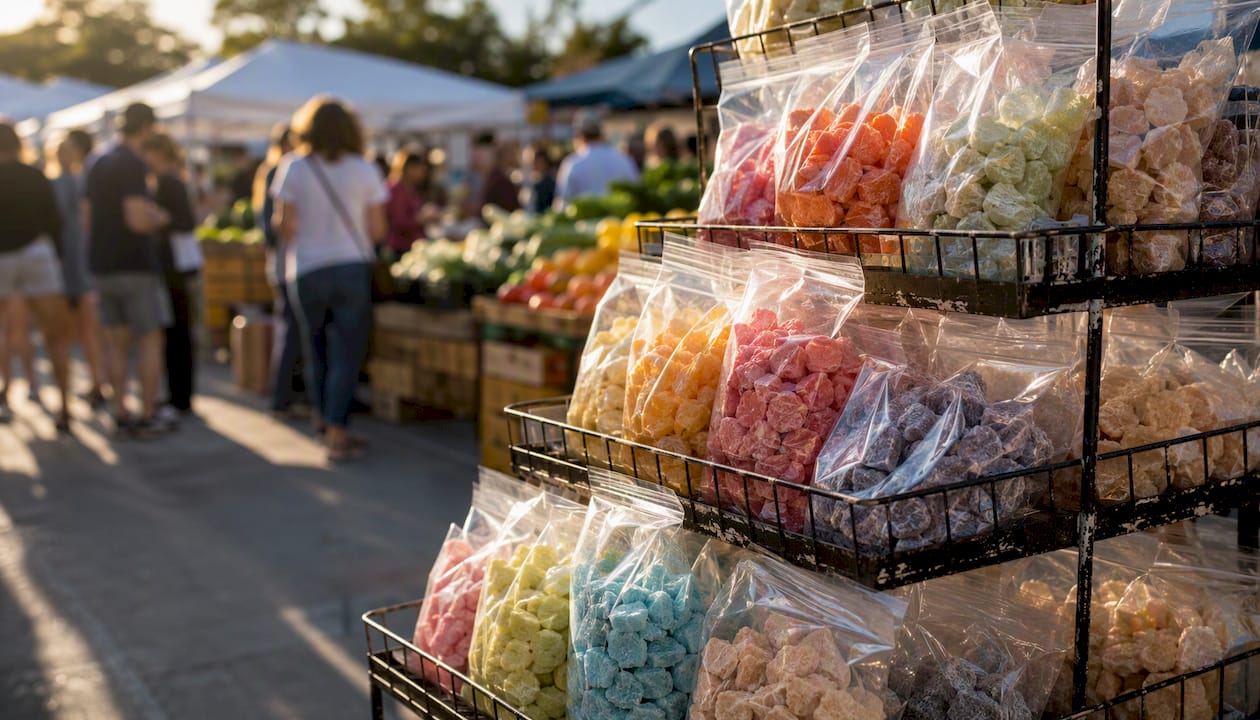
Packaging must do three things: protect the texture (freeze-dried candy is fragile and moisture-sensitive), show the product visually, and read clearly from three feet away on shelf. A high-barrier aluminum-lined stand-up pouch with a resealable zipper and a clear window hits all three. Choosing the right pouch format affects both shelf impact and cost per unit.
Critical specs:
- Film barrier: high-barrier metallized or aluminum-lined film to block moisture and oxygen
- Resealable zipper: standard for multi-serve bags; consumers expect it
- Clear window: lets the product sell itself; critical for impulse categories
- UPC placement: flat panel, away from seams, scannable from standard fixture angles
- Net weight and contact info: front-of-pack net weight, back-of-pack distributor contact
For e-commerce, size your unit case pack so it ships efficiently. Freeze-dried candy is volume-bulky relative to its weight, so carton cube drives freight cost more than weight does. Include shelf-life and storage guidance on the product page (“store in a cool, dry place; best by date on back”) to reduce returns and customer service contacts.
Display kits with counter racks or small-footprint floor displays work well for impulse placement near checkout. POS messaging that calls out the texture (“crunchy, melt-in-your-mouth”) outperforms generic “new flavor” signage in impulse categories.
How to vet a co-packer and run a pilot that protects your launch
Require facility proof and a sample pilot run before any full purchase order. That’s the short version. The longer version is a checklist.
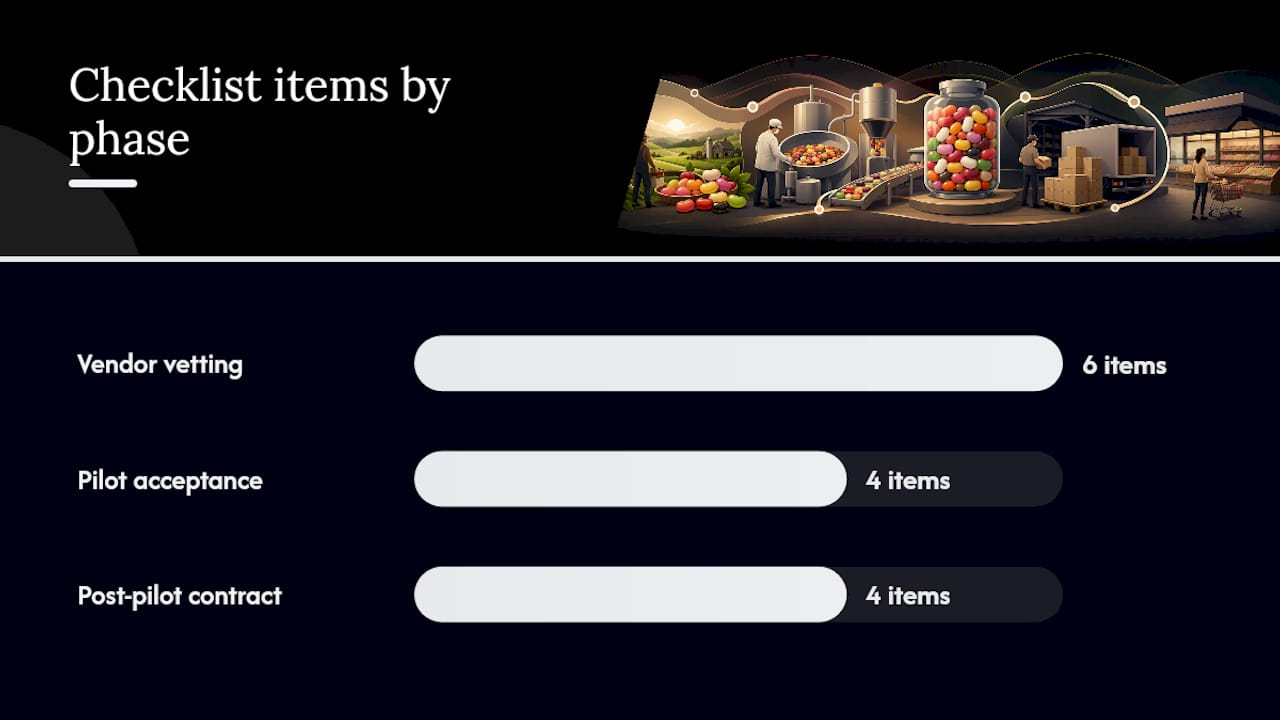
Vendor vetting checklist:
- FDA facility registration number (verify on the FDA’s public database)
- Recent sanitation or third-party audit report
- COAs for moisture content and water activity on current production runs
- Proof of freeze-dry equipment capacity (batch size, cycle time, number of units); understanding what equipment a vendor actually runs matters more than their marketing claims
- In-house or third-party lab access for microbiology and shelf-life testing
- Insurance limits and references from current retail accounts
In-house lab access and documented pilot trials reduce variability on first runs and give you documented evidence of product performance before you commit to a full order.
Pilot run acceptance criteria:
- Moisture/water activity within spec
- Visual integrity (no crumbling, color consistency)
- Flavor acceptance by a small internal tasting group
- UPC scanning validation on actual retail fixtures
Pro Tip: Insist the vendor confirms packaging supplier lead times in writing before the pilot. A production run that finishes on time but waits three weeks for pouches to arrive is a launch delay nobody budgets for.
Post-pilot contract points: define defect allowances, rework fees, lead-time penalties, and include a right-to-audit clause. These terms are standard in well-run contract manufacturing agreements and protect you if quality slips after the first run.
What do typical costs, MOQs, and lead times look like?
Stock private-label runs typically carry lower MOQs and 4–6 week lead times. Custom co-pack or contract manufacturing runs commonly fall in the 6–16+ week range, depending on formulation testing and packaging procurement. The binding cost factor for small brands is usually the packaging print run, not the production run itself.
Cost drivers to budget for:
- Packaging print minimums (digital-print pouches can reduce this constraint for sub-5,000-unit first orders, at a higher per-unit cost)
- Tooling and setup fees for custom packaging formats
- Pilot testing and lab analysis fees
- Per-unit fill rate and ingredient sourcing margin
Freeze-dried candy typically carries a shelf life of about one to two years when properly packaged in high-barrier film and stored in a cool, dry environment. Request moisture/water activity COAs and ask whether the vendor has conducted accelerated shelf-life testing on the specific SKU you’re ordering.
| Run Type | Typical Lead Time | MOQ Profile | Per-Unit Cost |
|---|---|---|---|
| Stock formula, label-only pouch | 4–6 weeks | Lower | Lower |
| Stock formula, custom-printed pouch | 6–10 weeks | Moderate | Moderate |
| Custom formula, custom packaging | 10–16+ weeks | Higher | Higher initially |
How do you evaluate a vendor’s financial stability and scalability?
Beyond food-safety credentials, a vendor’s operational health determines whether they can grow with you. Ask for current production capacity utilization, whether they have backup equipment or co-manufacturing agreements, and how they handle demand spikes.
Sustainability practices are increasingly a retail buyer requirement. Ask vendors about ingredient sourcing transparency, packaging recyclability options, and whether they have any third-party environmental certifications. You may not need these for your first PO, but retail buyers at regional chains often ask.
Quality assurance checklist for freeze-dried jelly-style candy
Consistency is harder to maintain in freeze-dried confectionery than in conventional candy because small variations in moisture, cycle time, or incoming ingredient quality produce visible and textural differences in the finished product.
- Incoming ingredient COAs (sugar, flavoring, base candy) reviewed per lot
- Freeze-dry cycle parameters documented per batch (temperature profile, cycle time, final moisture)
- Water activity target confirmed per batch (typically below 0.60 for shelf stability)
- Visual inspection: color uniformity, piece integrity, no clumping
- Allergen changeover verification: ATP swab results or equivalent sanitation check documented
- Finished-product COA issued per production lot
- Retain sample held per lot for shelf-life reference
Ask vendors for their documented scheduling protocol for allergen-siloed production runs. Freeze-dried lines often run multiple SKUs, and cross-contact risk is real if changeover procedures aren’t formalized.
What does the timeline from vendor contact to first retail delivery look like?
A realistic timeline for a first retail launch runs roughly 10–16 weeks from initial vendor engagement to product on shelf, assuming no major formulation changes.
- Weeks 1–2: Vendor outreach, RFQ, facility verification, and NDA signing
- Weeks 2–4: Sample request, pilot run brief, and packaging format selection
- Weeks 4–6: Pilot run production, lab testing, and label artwork development
- Weeks 6–8: Pilot review, label compliance check, and packaging procurement kickoff
- Weeks 8–12: Full production run (stock formula) or extended testing (custom formula)
- Weeks 12–16: Quality review, shipping, and retail setup (fixture, UPC activation, POS)
Custom formulas and custom-printed packaging each add time. The most common delay is packaging component lead times arriving after production is complete. Having the co-packer manage packaging supplier coordination cuts that risk significantly.
Private-label branding vs. white-label purchasing: what’s the strategic difference?
White-label purchasing means buying a finished, pre-packaged product and reselling it as-is or with minimal customization. Private label means the product carries your brand, your packaging, and your positioning, even if the formula underneath is the manufacturer’s stock. The strategic difference is brand equity.
White-label is faster and requires less upfront investment, but you’re building the manufacturer’s brand recognition, not yours. Private label builds an asset. Every repeat purchase, every social share, every shelf placement reinforces your brand name, not a generic product description. For retailers building a long-term candy category, private label is the better investment even at slightly higher initial cost.
The middle path: start with a white-label or stock-formula private-label run to validate the market, then invest in a proprietary formula and custom packaging once you have proof of sell-through.
Cross-border and international regulatory considerations
If you’re sourcing from a Canadian manufacturer (like Space-man) or planning to sell into Canadian or other international markets, the regulatory picture shifts. Canada’s food labeling requirements under the Safe Food for Canadians Regulations (SFCR) differ from FDA requirements in bilingual labeling obligations, serving size conventions, and allergen declaration formats. Products manufactured in Canada for U.S. retail must meet FDA labeling standards, not SFCR standards, on the U.S.-market label.
For export into the EU or UK, additional requirements apply: QUID (quantitative ingredient declaration), different allergen threshold rules, and country-of-origin labeling. Verify the specific requirements for each target market with a food-safety consultant before printing packaging artwork. Reprinting packaging after a compliance issue is expensive and delays launch.
Post-sale support, contingency planning, and dispute resolution
A vendor relationship doesn’t end at the first delivery. Build contingency terms into the contract before you sign.
Define in writing: acceptable defect rates per lot, the process for rejecting a non-conforming shipment, rework fees and who pays them, and lead-time penalties for late delivery. A right-to-audit clause lets you or a third party inspect the facility without advance notice, which is standard in professional co-packing agreements.
For order adjustments, establish a change-order window (typically 30–45 days before scheduled production) and a process for scaling volume up or down. Vendors who can’t accommodate reasonable volume adjustments are a supply-chain risk as your business grows.
Dispute resolution: specify the governing state law and whether disputes go to mediation before arbitration. Most food manufacturing disputes resolve at mediation; having the clause in place keeps both parties focused on resolution rather than escalation.
What the freeze-dried candy category actually teaches you
The conventional wisdom says “get your regulatory docs in order and the rest follows.” That’s not wrong, but it’s incomplete. The brands that launch cleanly and hold shelf space aren’t just compliant. They’re the ones who treated the pilot run as a real quality gate, not a formality.
The most common launch failure isn’t a labeling error or an FDA issue. It’s a production run sitting in a warehouse waiting for pouches that are three weeks late because nobody confirmed the packaging supplier’s lead time before the production schedule was set. Having the co-packer own that coordination is the single most effective fix, and it’s a term you can negotiate before you sign anything.
Glossy marketing materials from a vendor mean nothing if they can’t show you a recent third-party audit, a moisture COA, and a documented allergen changeover protocol. Ask for those three things on the first call. The vendors who send them without hesitation are the ones worth talking to.
Space-man offers private-label, co-packing, and retail display kits
If you want a direct partner rather than a vendor search, Space-man offers private-label and co-packing services for freeze-dried candy, including packaging coordination, food-safety documentation on request, and retail-ready display kits designed for quick in-store rollouts. The difference from sourcing through a broker: Space-man handles packaging procurement as part of the service, which cuts the most common cause of launch delays out of your critical path.
Retailers can start with a 40-bag starter pack to validate assortment before committing to a full private-label run, or go straight to a 72-bag display kit for immediate shelf presence. Request a quote or contact the Space-man sales team directly through the private-label services page to discuss pilot run options, MOQs, and packaging formats.
Sources
- NCR FSMA: Frozen and Dehydrated Foods (guidance document)
- Food Private Label Sourcing Guide | Private Label Supply
- Food Labelling & FSANZ Compliance | Navigate Food