

TL;DR:
- Frozen meal providers prepare, freeze, and deliver nutritious, ready-to-eat meals with advanced preservation methods for convenience. They use flash-freezing and quality packaging to lock in nutrients and flavor, offering variety for health needs and portion control for minimal waste. Buyers should prioritize ingredient transparency, proper packaging, flexible ordering options, and testing small orders to ensure quality.
Frozen meal providers are companies that prepare, freeze, and deliver ready-to-eat meals designed for convenience, nutrition, and variety, using advanced preservation methods and flexible purchase options. The industry has moved well beyond the sad, soggy TV dinners of the 1980s. Modern providers use flash-freezing technology, medically tailored meal plans, and build-your-own ordering systems to serve everyone from busy individuals to large food service operations. Whether you are sourcing meals for a healthcare facility or just tired of cooking on a Tuesday night, understanding how these providers work helps you choose wisely.
What do frozen meal providers actually offer?
Frozen meal providers supply fully prepared, portioned meals that require only reheating before eating. The core value is time. A meal that takes three minutes in the microwave beats a 45-minute cooking session on any weeknight. Beyond speed, the best providers offer dietary variety, covering high-protein options, low-sodium plans, GLP-1 friendly bowls, and medically tailored meals for chronic condition management.
The range of ready-to-eat frozen options on the market today is genuinely impressive. Providers now serve individuals managing weight loss, seniors with specific nutrient needs, athletes tracking macros, and food service buyers stocking institutional kitchens. That breadth is not accidental. It reflects real demand for meals that fit specific health goals rather than generic “diet” labels.
Portion control is another underrated advantage. Portioned frozen meals help individuals avoid cooking excessive quantities, which reduces food waste and supports weight management goals. For someone living alone, this is a practical win that fresh meal kits rarely match.
How frozen meal providers preserve quality and nutrition
Flash-freezing is the technology that separates quality providers from mediocre ones. Flash-freezing preserves nutrients and texture far better than standard home freezing, which forms large ice crystals that damage cell walls and degrade flavor. Industrial flash-freezing locks meals at peak freshness within minutes of preparation, extending shelf life without spoilage.
The “frozen on purpose” model takes this further. Rather than treating freezing as a last resort, quality providers freeze at peak freshness to maintain high-quality meals available any time without the spoilage risk that plagues fresh meal kits. This approach gives consumers real flexibility. A box of frozen meals sitting in your freezer does not expire on Thursday whether you are ready for it or not.
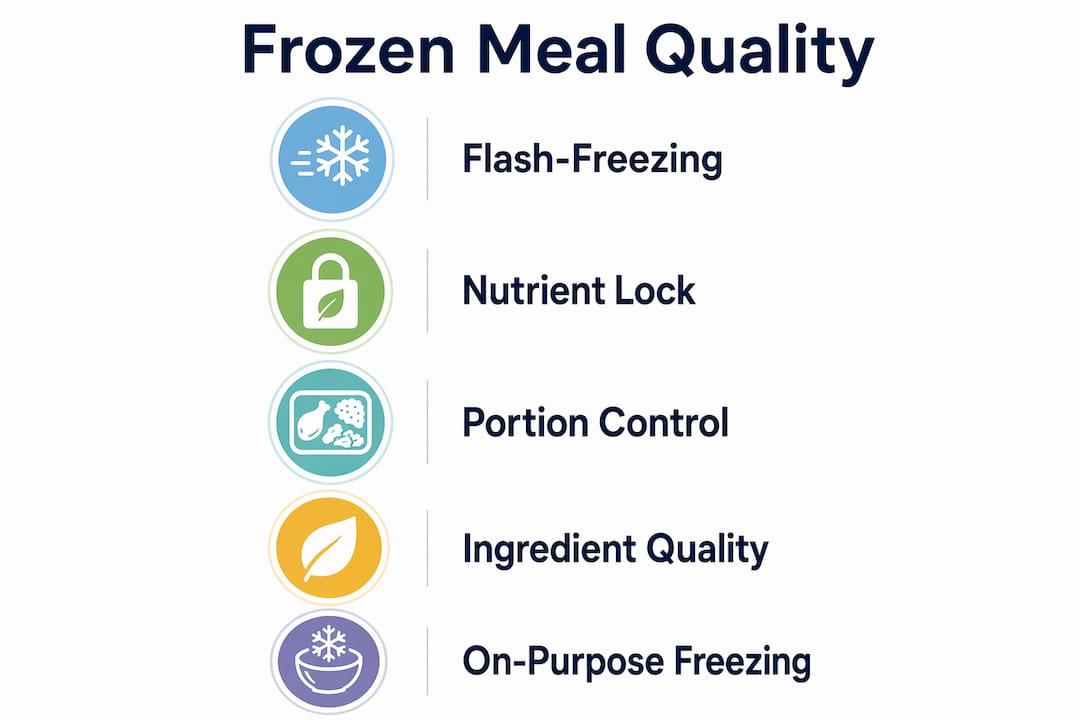
Packaging innovation matters just as much as freezing technique. Vacuum-sealed trays and modified atmosphere packaging prevent freezer burn, which is the main enemy of frozen food quality over time. Providers investing in better packaging deliver meals that taste closer to freshly cooked, even after weeks in storage.
Key preservation advantages that quality providers prioritize:
- Flash-freezing locks in nutrients and texture at the point of peak freshness
- Vacuum-sealed trays block oxygen and prevent freezer burn during storage
- Modified atmosphere packaging extends shelf life without artificial preservatives
- Portion-controlled containers reduce waste and maintain consistent serving sizes
Pro Tip: When evaluating a provider, check whether they specify flash-freezing on their packaging or website. Providers who mention it are signaling a genuine quality commitment. Those who do not may rely on slower conventional freezing.
What nutritional considerations do modern frozen meal providers address?
Nutrition is where the frozen meal market has made its biggest leap. Medically tailored meals designed for dietary restrictions and chronic condition management now represent a growing segment of the industry. These are not just low-calorie options. They are meals engineered for specific health outcomes, with controlled sodium, targeted fiber content, and precise protein levels.
Registered dietitians consistently recommend focusing on ingredient lists rather than diet labels. A meal labeled “light” can still contain excessive sodium and ultra-processed fillers. The better standard is to look for whole foods over fillers, with protein, fiber, and controlled sodium as the primary nutritional benchmarks.
Modern gourmet frozen dinners now include options like high-protein bowls with 22g of protein per 9.5 oz serving, designed specifically for GLP-1 medication users and weight management programs. That level of nutritional specificity was unthinkable in the frozen food aisle a decade ago. It reflects how seriously providers now treat the health-conscious consumer.
Nutritional priorities that well-designed frozen meals address:
- Protein targets of 20g or more per serving to support muscle retention and satiety
- Fiber content from whole grains, legumes, and vegetables rather than refined carbohydrates
- Sodium limits that align with American Heart Association guidelines for daily intake
- Minimal ultra-processed ingredients, with recognizable whole foods making up the majority of the ingredient list
- Portion accuracy that matches labeled calorie counts without hidden serving-size tricks
Pro Tip: Flip the package and read the ingredient list before the nutrition label. If the first five ingredients include a whole protein, a vegetable, and a grain, the meal is likely built on real food. If you see modified starch and flavor enhancers in the top five, put it back.
Frozen meal services also function as a practical alternative to fast food for people managing weight or living alone who want to avoid cooking for one. The convenience factor is real, but the nutritional quality is what keeps people coming back rather than defaulting to a drive-through.
Pricing models and purchasing options offered by frozen meal providers
Pricing structures across the frozen meal market vary widely, but the most consumer-friendly models share a few common traits: volume discounts, no mandatory subscriptions, and transparent checkout pricing.

Build-your-own meal plans offer volume discounts that reduce the per-unit cost as order size increases. A starting price of $8.99 per meal for a 10-meal order drops with a 10% discount at 20 meals and a 20% discount at 30 meals. That pricing structure rewards buyers who plan ahead, making bulk ordering genuinely worthwhile for households and small food service operations alike.
Subscription fatigue is a real problem in the meal delivery space. Many consumers have been burned by services that are easy to sign up for and nearly impossible to cancel. The better providers now offer no-subscription ordering, allowing buyers to place orders on demand without recurring charges or schedule pressure. Volume discounts apply automatically at checkout, so buyers get the savings without the commitment.
| Ordering model | Best for | Key benefit |
|---|---|---|
| Build-your-own box | Individuals and households | Full meal selection control with volume discounts |
| No-subscription on-demand | Occasional buyers | No recurring charges, order when needed |
| Subscription plans | Regular weekly users | Predictable delivery and potential cost savings |
| Institutional bulk ordering | Food service professionals | Lowest per-unit cost, consistent supply |
For food service professionals, bulk ordering with free shipping and no hidden fees simplifies budgeting significantly. Volume-based pricing combined with automatic discounts at checkout removes the guesswork from cost planning. Knowing exactly what 30 meals will cost before you click “order” is a small thing that makes a real operational difference.
How to select the best frozen meal provider for your needs
Choosing the right provider comes down to five practical criteria. Work through each one before committing to a supplier.
-
Ingredient transparency. The provider should list every ingredient clearly on the packaging and website. Vague terms like “natural flavors” without further detail are a yellow flag. The best providers publish full ingredient lists and nutritional panels for every meal.
-
Meal variety and dietary fit. Check whether the catalog covers your specific dietary requirements. A provider with 40 meals that all contain gluten is not useful if you are sourcing for a celiac-friendly menu. Look for variety across protein sources, cuisine styles, and dietary categories.
-
Packaging quality. Vacuum sealing and freezer-burn-resistant trays are non-negotiable for quality. Ask providers directly about their packaging standards if the information is not on their website. Poor packaging destroys a good meal before it ever reaches the table.
-
Reheating instructions and results. Proper reheating technique matters more than most buyers realize. Microwaving for 3–5 minutes with a stir halfway through ensures even heating and prevents cold spots. Providers who include clear, specific reheating instructions on packaging are signaling that they have tested their meals and care about the eating experience.
-
Customer support and customization. For food service buyers, the ability to customize meal selections and access responsive support is critical. A provider that goes silent after the first order is not a long-term partner. Look for clear contact channels and a track record of handling institutional orders reliably.
You can also explore modern build-your-own meal plan options to compare how different providers structure their ordering systems and pricing tiers before making a final decision.
Pro Tip: Order a small trial box before committing to bulk. Taste the meals, check the packaging integrity on arrival, and test the reheating instructions. A provider that performs well on a 10-meal trial is almost certainly reliable at scale.
Key Takeaways
The best frozen meal providers combine flash-freezing technology, transparent nutrition standards, and flexible no-subscription pricing to deliver consistent quality for both individual buyers and food service professionals.
| Point | Details |
|---|---|
| Flash-freezing is the quality benchmark | Providers using flash-freezing preserve nutrients and texture better than conventional methods. |
| Nutrition labels require scrutiny | Focus on whole-food ingredients and protein, fiber, and sodium levels rather than diet marketing labels. |
| No-subscription models reduce risk | On-demand ordering with volume discounts gives buyers flexibility without recurring charge commitments. |
| Reheating technique affects quality | Stirring halfway through microwave cooking prevents cold spots and maintains meal texture. |
| Trial orders before bulk commitment | Testing a small order first reveals packaging quality, taste, and delivery reliability before scaling up. |
What I have learned after years of watching the frozen food industry evolve
The biggest misconception I see, even among food service professionals, is that frozen automatically means lower quality. That assumption made sense in 1995. It does not hold up in 2026. The technology gap between a well-executed flash-frozen meal and a mediocre fresh meal kit has closed dramatically, and in some cases reversed.
What I find most interesting is how the “frozen on purpose” framing has shifted buyer psychology. When providers lead with the idea that freezing is a deliberate quality choice rather than a preservation compromise, buyers respond differently. They stop apologizing for eating frozen meals and start treating them as a legitimate food strategy. That shift matters for food service buyers too. Institutional kitchens that once dismissed frozen options are now sourcing medically tailored frozen meals because the quality and consistency justify it.
The pricing evolution is equally significant. The move away from mandatory subscriptions toward build-your-own volume pricing is genuinely consumer-friendly. It removes the friction that made so many people cancel meal delivery services in frustration. When a buyer can order 30 meals, get a 20% discount, and pay nothing until they choose to order again, the value proposition becomes much cleaner.
My honest advice: stop evaluating frozen meal providers by the category and start evaluating them by the technology and ingredient standards they actually use. The gap between the best and worst providers in this space is enormous. The best ones are worth every dollar.
— Chadi
How Space-man supports frozen food packaging and private label needs
Food businesses working in the frozen meal space know that packaging and private labeling are as critical as the product itself. Space-man offers private label and co-packing services designed for consumer goods manufacturers and distributors who need reliable, high-quality packaging solutions at scale.
Whether you are launching a new frozen product line or scaling an existing one, Space-man’s Canadian-based packaging operation handles bagging, labeling, and co-packing with a focus on quality and consistency. The team works with food businesses of all sizes, from startups building their first SKU to established distributors managing high-volume runs. If your product needs professional packaging that holds up in frozen storage and on retail shelves, Space-man is worth a conversation.
FAQ
What are frozen meal providers?
Frozen meal providers are companies that prepare, portion, and freeze fully cooked meals for delivery or retail sale, designed to be reheated and eaten with minimal preparation time.
How do frozen meal providers keep meals nutritious?
Quality providers use flash-freezing at peak freshness to lock in nutrients and texture, which preserves nutritional content better than conventional freezing methods.
Do frozen meal providers require a subscription?
Many providers now offer no-subscription, on-demand ordering with volume-based discounts applied automatically at checkout, so buyers can order without recurring charges.
What should I look for in healthy frozen meals?
Registered dietitians recommend prioritizing meals with whole-food ingredients, at least 20g of protein per serving, adequate fiber, and controlled sodium levels rather than relying on diet marketing labels.
How long do frozen meals last in the freezer?
Shelf life varies by provider and packaging method, but flash-frozen meals in vacuum-sealed trays typically maintain quality for several months when stored at a consistent freezer temperature.