

TL;DR:
- Freeze dried sweets are highly concentrated, sugar-rich snacks that look like healthy treats but often aren’t.
- Reading labels carefully helps distinguish between pure fruit with natural sugars and candy with added sugars and additives.
- Enjoy freeze dried sweets mindfully by serving small portions and understanding their nutrition facts to avoid overconsumption.
A small handful of freeze dried sweets can pack as much sugar as three or four pieces of fresh fruit, yet many Canadian snackers reach for them believing they’re making a smarter choice. The crunch, the bold flavor, and the “fruit” branding all suggest something wholesome. But calorie-dense candy with concentrated sugar is still candy, no matter how it was processed. This guide breaks down the real nutritional facts behind freeze dried sweets, compares fruit versus candy varieties, and shows you exactly how to read a Canadian Nutrition Facts label so you can snack with your eyes wide open.
Table of Contents
- What are freeze dried sweets and why are they so popular?
- Breakdown of nutritional facts: Calories, carbs, and sugar content
- Freeze dried fruit vs. freeze dried candy: What’s the real difference?
- How to read Canadian Nutrition Facts labels for freeze dried sweets
- A smarter way to enjoy freeze dried sweets: What most people overlook
- Where to find quality freeze dried sweets in Canada
- Frequently asked questions
Key Takeaways
| Point | Details |
|---|---|
| High sugar content | Freeze dried sweets pack a lot of sugar and calories into small servings, so moderation is key. |
| Fruit beats candy | Pure freeze dried fruit is usually a healthier choice than candy-based options with added sugars. |
| Read labels smartly | Use Canadian Nutrition Facts to check % Day Value and ingredient lists for informed snack decisions. |
| Retained nutrients | Freeze drying keeps most nutrients intact, but energy density and overconsumption risk go up. |
What are freeze dried sweets and why are they so popular?
Freeze drying is a preservation method that removes nearly all moisture from food by freezing it solid and then slowly pulling the water out using a vacuum. What’s left is a lightweight, crunchy product that keeps for months without refrigeration. You can learn more about how freeze drying works to understand why the texture changes so dramatically.
The result is a snack that looks and tastes intensely like the original, but with a satisfying crispness that’s completely different from the fresh version. That novelty is a big part of the appeal. Social media has amplified this, with videos of freeze dried candy going viral for the dramatic puffed-up shapes and the loud crunch.
Freeze dried sweets cover a wide range of products:
- Pure freeze dried fruit: Strawberries, mango, raspberries, and blueberries with no added ingredients
- Candy-coated or sugar-added varieties: Gummies, sour belts, and chocolate-covered pieces that have been freeze dried
- Fruit and candy blends: Mixed products that combine real fruit with added sugars, coatings, or flavoring
- Novelty treats: Items specifically designed for the freeze dried format, like puffed caramel or freeze dried ice cream
The freeze dried treats benefits include long shelf life, no need for refrigeration, and intense flavor concentration. Those are real advantages. But up to 90% of nutrients are retained during the process, which sounds great until you realize the sugars are also concentrated in that same small package.
Pro Tip: When shopping for freeze dried sweets, look for a “no added sugar” label on the front of the package. This usually means the product is pure fruit with only naturally occurring sugars, which is a much better starting point nutritionally.
The popularity of freeze dried sweets in Canada has grown steadily, driven by convenience, novelty, and the perception of being a “better” snack. Understanding what’s actually inside the bag is the first step to making that perception match reality.
With the basics of freeze dried sweets in mind, let’s explore their nutritional makeup.
Breakdown of nutritional facts: Calories, carbs, and sugar content
Now that you know how freeze dried sweets are made, let’s dig into the numbers that matter for your snack choices.
The core issue with freeze dried candy is calorie and sugar density. Because water is removed, you’re eating a much more concentrated product than you might realize. A 30g serving contains roughly 120 calories, 0g protein, 0.5g fat, and 28g of carbohydrates, most of which come from sugar. That’s a lot of energy in a very small volume.
To put that in perspective, here’s how common freeze dried sweets stack up:
| Product | Serving size | Calories | Total sugar | Protein | Fat |
|---|---|---|---|---|---|
| Freeze dried candy (generic) | 30g | 120 | 25g | 0g | 0.5g |
| Freeze dried candy (generic) | 56g | 224 | 47g | 0g | 1g |
| Freeze dried strawberries | 30g | 105 | 16g | 1.5g | 0.5g |
| Fresh strawberries | 30g | 10 | 1.5g | 0.2g | 0g |
The comparison to fresh strawberries is striking. A 30g serving of fresh strawberries has about 1.5g of sugar. The freeze dried version of the same fruit has over 10 times that amount in the same weight. That’s not because anything was added. It’s simply because the water is gone and the sugar remains.
Here’s how to make sense of these numbers on a Canadian nutritional value breakdown label:
- Find the serving size first. Everything on the label is calculated per serving, and serving sizes for freeze dried snacks are often small, like 28g to 30g.
- Look at total carbohydrates. For most freeze dried candy, carbs are almost entirely sugar.
- Check the sugars line. Both total sugars and added sugars are listed. If added sugars are high, the product has been sweetened beyond its natural state.
- Note the calories. Even 30g can deliver 120 calories or more, which adds up fast if you’re snacking from the bag.
- Scan for fiber and protein. Most freeze dried candy has almost none, which means it won’t keep you full.
The retailer nutrition benefits of these products are real for shelf life and flavor, but from a pure nutrition standpoint, freeze dried candy is a high-sugar, low-fiber snack. Knowing that helps you decide when and how much to enjoy.
Freeze dried fruit vs. freeze dried candy: What’s the real difference?
Understanding overall nutrition numbers is helpful, but what you choose, fruit or candy, matters a lot, too.
Pure freeze dried fruits often have no added sugars, while candy versions are much higher in sugar. That’s the core difference, but the details go deeper than just sugar content.
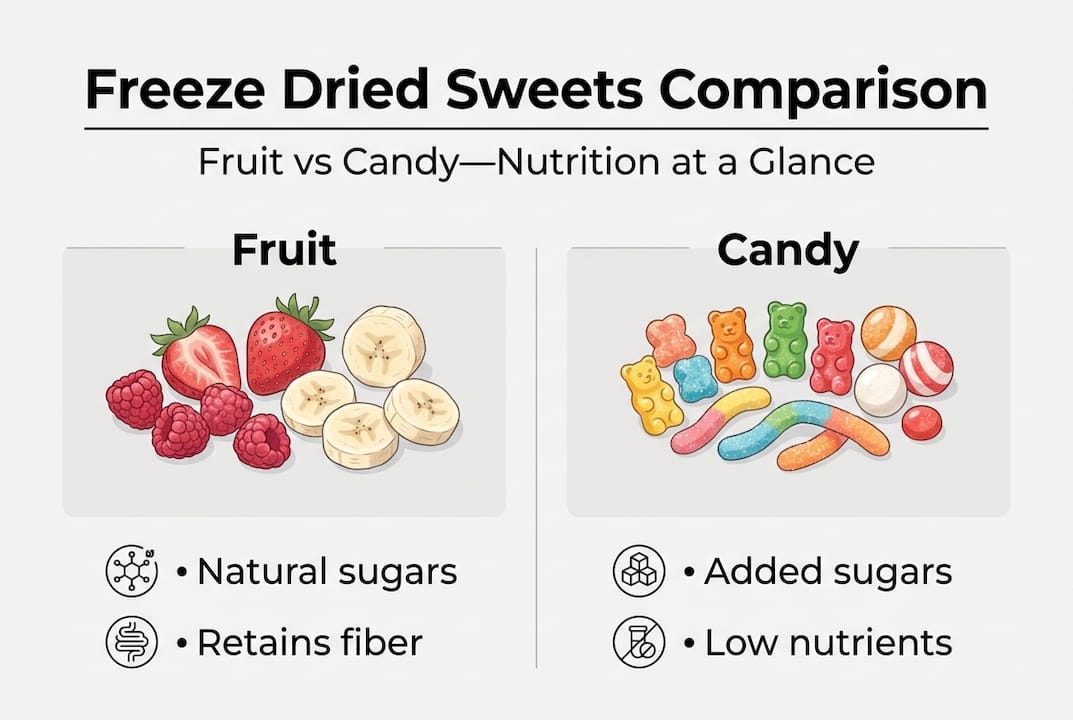
Pure freeze dried fruit retains vitamins, minerals, and some fiber from the original fruit. It has no artificial colorants, no coating agents, and no flavor enhancers. The ingredient list is typically one item: the fruit itself. You can explore the full freeze dried fruit benefits to see why pure fruit options are worth prioritizing.
Freeze dried candy, on the other hand, starts as a sugar-heavy product and becomes even more concentrated. Candy forms are higher risk for overconsumption because the light, airy texture makes it easy to eat far more than one serving without realizing it.
| Feature | Freeze dried fruit | Freeze dried candy |
|---|---|---|
| Added sugar | None (naturally occurring only) | Often high |
| Vitamins retained | Yes, significant | Minimal |
| Fiber content | Low to moderate | Very low |
| Artificial additives | Rarely | Common |
| Typical sugar per 30g | 10 to 18g | 20 to 28g |
“Check %DV: 5% is a little, 15% or more is a lot.” Use this rule every time you pick up a new freeze dried product to instantly gauge whether the sugar or sodium content is worth a second look.
For mindful snacking, here’s a quick guide to which products deserve a spot in your rotation:
- Best choice: Single-ingredient freeze dried fruit with no added sugar
- Occasional treat: Freeze dried candy enjoyed in a measured portion
- Read carefully: Any product labeled “fruit snack” or “fruit blend,” as these often contain added sugars
- Limit or avoid: Products with artificial colors, multiple coatings, or ingredients you can’t pronounce
The benefits of freeze dried snacks are real, but they depend heavily on which type of product you’re choosing. Pure fruit and candy are not the same category, even if they sit on the same shelf.
How to read Canadian Nutrition Facts labels for freeze dried sweets
Label reading is key to making empowered choices. Here’s how to do it in seconds.
Canadian Nutrition Facts panels follow a standardized format, which makes it easier to compare products once you know what to look for. The most important rule: check % Daily Value because 5% is a little and 15% or more is a lot. This applies to sugars, sodium, and saturated fat.
Here’s a step-by-step process for evaluating any freeze dried sweet at a glance:
- Start with the serving size. If the bag holds three servings and you eat the whole thing, multiply every number by three.
- Go straight to sugars. Look at both total sugars and added sugars. For a treat, you expect sugar, but added sugars above 10g per serving is a significant amount.
- Check total carbohydrates. In freeze dried candy, carbs and sugars are nearly the same number. Little fiber means fast digestion and a quick energy spike.
- Scan the % Daily Value column. A sugar %DV above 15% in a single small serving is a signal to portion carefully.
- Read the ingredient list. Ingredients are listed by weight, so the first two or three tell you what the product is mostly made of.
Pro Tip: If the ingredient list starts with sugar, corn syrup, or glucose-fructose, you’re holding a candy product regardless of how it’s marketed. If it starts with the fruit name, you’re in better shape.
For a deeper look at what Canadian labels must include, check out the Canadian Nutrition Facts breakdown and the Canadian food label standards that govern what manufacturers are required to disclose.
Red flags to watch for on any freeze dried sweet label:
- Artificial colors like Red 40, Yellow 5, or Blue 1
- Multiple types of sugar listed separately (a way to push each one lower on the ingredient list)
- “Natural and artificial flavors” with no specifics
- Coatings or glazing agents not clearly identified
A smarter way to enjoy freeze dried sweets: What most people overlook
Here’s the thing most snack articles won’t tell you: freeze dried sweets are not a health food, and they were never meant to be. Treating them as one is where people go wrong.
The real opportunity is to enjoy them as what they are: an intensely flavored, satisfying treat that happens to be shelf-stable and fun to eat. The mistake is buying a bag of freeze dried candy and convincing yourself it counts as fruit. It doesn’t. But that doesn’t mean you can’t enjoy it.
Mindful snacking with freeze dried sweets means pouring out a measured portion, actually tasting it slowly, and not eating straight from the bag while watching TV. The concentrated flavor means a small amount genuinely satisfies in a way that a handful of fresh fruit might not. That’s a real advantage if you use it intentionally.
We’ve seen a pattern with Canadian consumers who get the most value from freeze dried snacks: they use pure fruit versions as a pantry staple and treat candy varieties as an occasional indulgence. That balance works. For practical guidance on building that approach, freeze dried snacking advice for Canadian shoppers is a useful starting point. Don’t let novelty packaging or buzzwords like “real fruit” distract you from the sugar numbers. Enjoy the crunch. Just know what’s in it.
Where to find quality freeze dried sweets in Canada
You’ve done the work of understanding what’s in freeze dried sweets. Now you can shop with confidence instead of guessing at the shelf.

At Space-Man, we manufacture and distribute freeze dried candy and fruit snacks across Canada, with full transparency on ingredients and serving sizes. Whether you’re a consumer looking for a 10-pack freeze dried candy bundle to try a variety of flavors, a retailer interested in wholesale display kits for your store, or a business exploring private label and co-packing options, we have solutions built for the Canadian market. Use your new label-reading skills to compare and choose what fits your goals.
Frequently asked questions
Are freeze dried sweets a healthy snack option?
Freeze dried sweets are calorie-dense and high-sugar and are best enjoyed in moderation as a treat, not a daily staple.
How do freeze dried fruits compare to freeze dried candy?
Pure freeze dried fruit usually contains no added sugar and more retained nutrients, while candy versions are significantly higher in sugar and lower in nutritional value.
What should I look for on the Nutrition Facts label when choosing freeze dried sweets?
Check sugar and carbohydrate amounts per serving, use the %DV guide where 5% is a little and 15% is a lot, and prefer options with no added sugar in the ingredient list.
Do freeze dried sweets retain vitamins and nutrients?
Yes, freeze drying retains up to 90% of nutrients, but the removal of water also concentrates sugars and calories into a much smaller volume.