

Custom gummy packaging for freeze-dried candy is not the same animal as standard candy packaging. Freeze-dried gummies are hygroscopic — they pull moisture from the air aggressively — which means the wrong bag turns a crunchy, airy product into a sticky, chewy disappointment within days. The right packaging solves three problems simultaneously: it blocks moisture and oxygen, it survives the distribution chain, and it tells your brand story on a crowded retail shelf.
Here is what effective packaging for freeze-dried gummies actually requires:
- Barrier performance: Oxygen transmission rate (OTR) and moisture vapor transmission rate (WVTR) specs matched to your product’s sensitivity
- Functional closures: Resealable zippers, child-resistant locks, and tamper-evident seals
- Branding real estate: High-definition print surfaces, premium finishes, and clear windows that show off the product
- Regulatory compliance: FDA-aligned labeling and food-contact material standards for the US market
Space-man, a freeze-dried candy manufacturer and co-packer, works with brands at every stage of this process — from material selection through private label production.
Table of Contents
- What packaging materials actually protect freeze-dried gummies?
- How do you make your gummy packaging stand out on the shelf?
- How to choose the right packaging solution for your operation
- Space-man brings freeze-dried candy packaging expertise to your brand
- Key Takeaways
What packaging materials actually protect freeze-dried gummies?
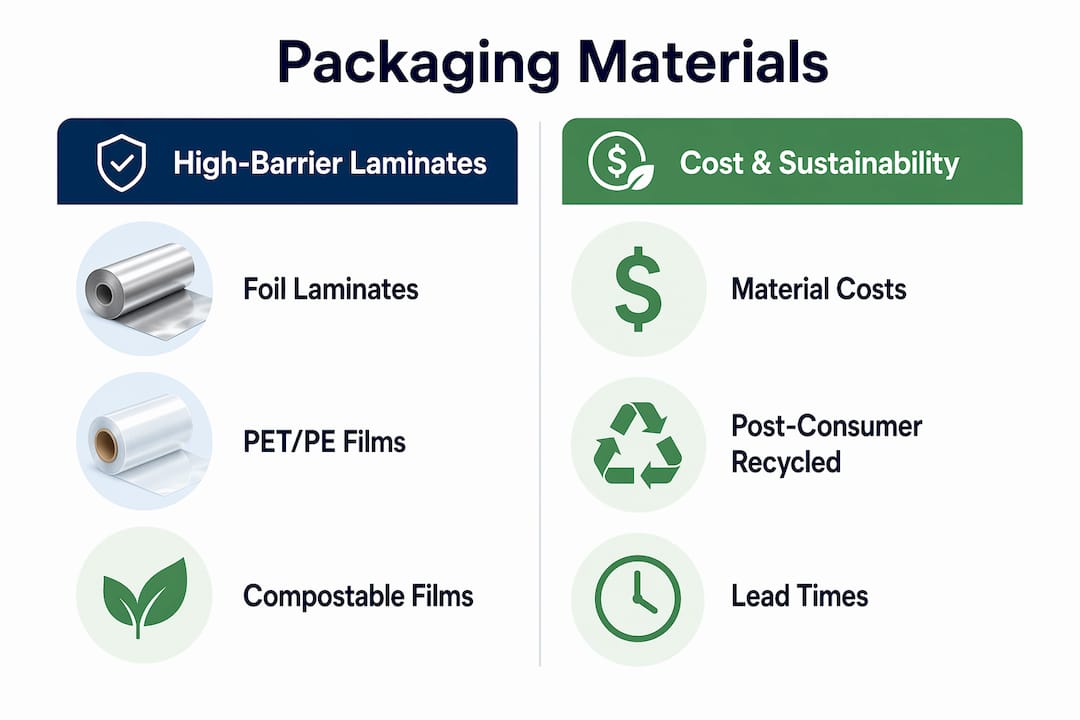
The laminate structure of your bag is the single biggest variable in shelf life. Three constructions dominate the market for freeze-dried candy packaging: PET/PE, PET/VMPET/PE, and PET/AL/PE. Each adds layers of protection, with PET/AL/PE (foil laminate) delivering the strongest barrier against moisture, oxygen, and light.
High-barrier film layers worth knowing:
- EVOH (ethylene vinyl alcohol): Outstanding oxygen barrier, often sandwiched inside a laminate
- MET-PET (metallized polyester): Reflects light and resists moisture; lighter than foil
- Aluminum foil: The gold standard for complete light and gas blocking
- ALOX (aluminum oxide coated film): A transparent foil alternative with good barrier and recyclability potential
- Nylon: Adds puncture resistance and structural integrity for heavier fills
Freeze-dried gummies are far more moisture-sensitive than conventional gummies. The porous, airy structure created during freeze-drying re-absorbs ambient humidity rapidly, softening texture and shortening shelf life. High-barrier films like EVOH, MET-PET, and foil are not optional upgrades for this product category — they are baseline requirements.
Beyond the film itself, functional features matter just as much. Resealable zippers paired with tear notches protect the product after first open — a tear notch that is missing or poorly placed frequently causes consumers to rip through the zipper track, exposing the contents to humidity. Child-resistant zipper closures are required for cannabis-infused and certain supplement gummy products under US regulations, and they are increasingly expected by retailers for any gummy product that could be mistaken for candy by children.
Pro Tip: Always request the actual OTR and WVTR data sheets from your packaging supplier before committing to a material. A film marketed as “high barrier” can vary widely in performance — verified specs protect your shelf-life claims and your brand reputation.
Sustainability is a real consideration in 2026. Post-consumer recycled (PCR) material blends, compostable films, and mono-material structures that qualify for recycling streams are all available from specialty converters. The trade-off is typically a modest reduction in barrier performance, so match the material to your actual distribution environment rather than defaulting to the most sustainable option regardless of fit.
How do you make your gummy packaging stand out on the shelf?
Packaging is the last salesperson your product has before a consumer decides. High-definition digital printing combined with finishes like matte or holographic effects is what separates a forgettable bag from one that gets picked up. For freeze-dried candy specifically, the visual contrast between a bold exterior and the product’s unusual texture is a genuine selling point — use it.
Print finish options worth considering:
- Matte lamination: Clean, premium feel; hides fingerprints well
- Gloss lamination: Vivid color pop; strong on fruit-forward flavor graphics
- Soft-touch matte: Tactile, velvety surface that signals premium positioning
- Spot UV: Selective gloss over matte base for logo or pattern highlights
- Foil stamping: Metallic accent for flavor names or brand marks
- Holographic film: High-impact shelf presence; works especially well for novelty and seasonal SKUs
Packaging that combines two finishes — a matte base with spot UV highlights — consistently outperforms single-finish bags in retail attention studies. The contrast creates a visual hierarchy that guides the consumer’s eye to the brand name and flavor first.
A clear window is one of the most cost-effective trust signals you can add. For freeze-dried candy, showing the actual product texture — the airy, crunchy pieces — communicates quality and novelty in a way that no copy line can replicate. Die-cut windows in custom shapes (a star, a bear silhouette) add another layer of differentiation.
Format choices shape how your product lives at retail. Stand-up pouches in K-style or W-fold configurations maximize shelf footprint and are the default for resealable gummy bags. Flat pouches work for single-serve or sample formats. Specialty silhouettes — a bag die-cut to a bear shape, for instance — are a higher-cost option that earns attention in gift and specialty retail.
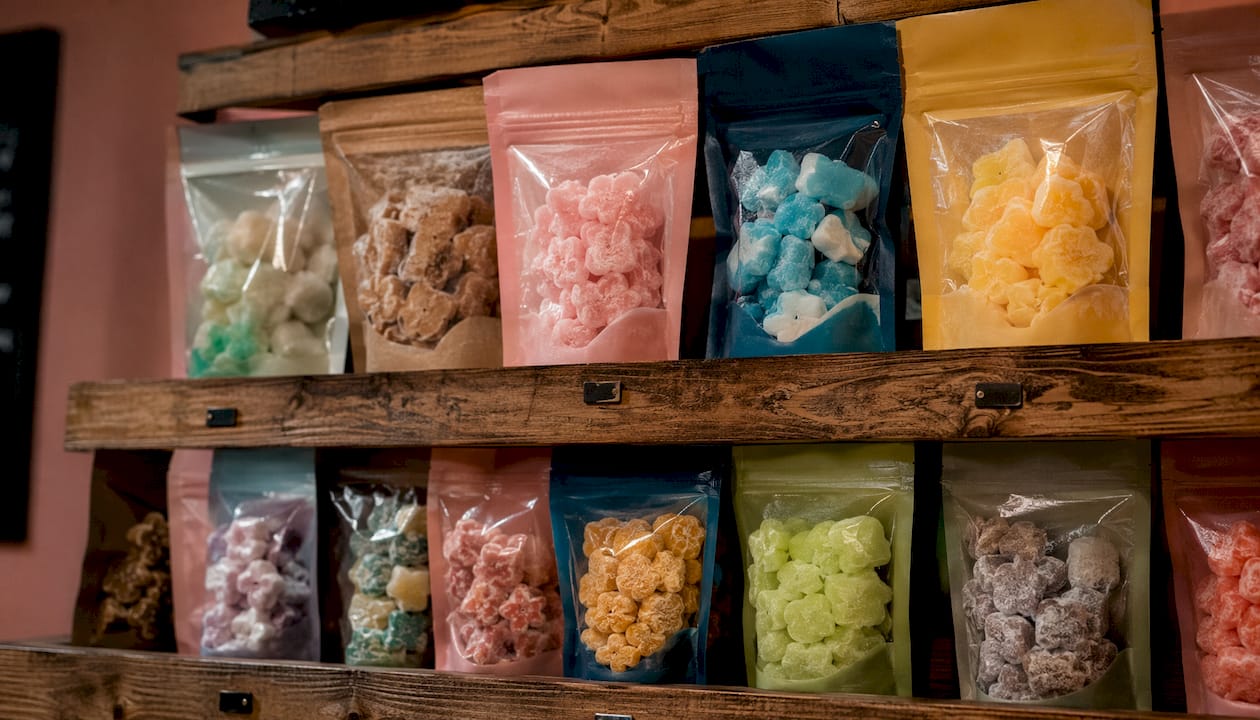
Pro Tip: Digital printing eliminates plate setup costs, making it the right call for short runs, seasonal flavors, and SKU testing. Launch a new freeze-dried flavor in a 500-unit digital run before committing to a gravure plate for 50,000 units.
For deeper guidance on translating these ideas into a complete design, Space-man’s resource on packaging design for freeze-dried candy walks through the full process.
How to choose the right packaging solution for your operation
Selecting packaging is a business decision, not just a materials decision. The wrong choice costs you in spoilage, compliance issues, or reorders when a SKU takes off faster than expected.
Evaluation checklist before you commit:
- Product sensitivity: What are your freeze-dried gummies’ actual OTR and WVTR requirements? Get this from your formulation or shelf-life testing data.
- Batch size and cadence: Small, frequent runs favor digital print and flexible minimums. High-volume, stable SKUs favor gravure or flexo with lower per-unit cost.
- Distribution environment: Ambient warehouse? Refrigerated transit? High-humidity regions? Each scenario changes your barrier requirements.
- Retail channel: Club store, specialty retail, e-commerce, or foodservice each have different size, labeling, and durability expectations.
- Regulatory requirements: US FDA food contact regulations, Nutrition Facts panel requirements, and state-level cannabis or supplement rules if applicable.
- Marketing goals: Private label with a retailer’s brand, your own brand, or co-branded? Each affects print complexity and lead time.
Cost factors break down predictably. Material choice is the largest lever — foil laminates cost more than standard PET/PE but protect your product. Print complexity (number of colors, specialty finishes) adds cost at setup and per unit. Minimum order quantities (MOQs) from most converters start in the thousands of units; suppliers offering lower MOQs typically charge a premium per unit, which is worth it for early-stage brands or seasonal SKUs.
For private label and co-packing specifically, lead time is often the constraint that catches brands off guard. A trusted packaging supplier with low MOQs and fast turnaround is not a nice-to-have — it is what lets you respond to a retailer’s reorder without a six-week gap. Verify lead times in writing before you sign.
Pro Tip: Work with a packaging partner who offers rapid prototyping or physical sampling before full production. A printed sample in hand catches color, finish, and structural issues that a digital mock-up never reveals.
US labeling compliance is non-negotiable. The FDA requires Nutrition Facts panels, ingredient lists, allergen declarations, and net weight statements on all retail food packaging. If your freeze-dried gummies contain added vitamins or are marketed with health claims, additional disclosure requirements apply. Build label compliance into your artwork review process, not as an afterthought.
Explore Space-man’s custom food packaging resources for more on material selection and label planning specific to candy producers.
Space-man brings freeze-dried candy packaging expertise to your brand
Freeze-dried candy is a niche that most generic co-packers do not fully understand. Space-man does, because it is the core of what they do. Their private label and co-packing services are built specifically for manufacturers and distributors who need customized gummy packaging solutions without the overhead of managing a production facility.
Space-man handles the details that trip up brands working with generalist suppliers: barrier material selection matched to freeze-dried product specs, child-resistant and tamper-evident closure options, sustainable material alternatives, and print-ready artwork support. Flexible minimums mean you can launch a new SKU without betting the business on a massive first run.
Key reasons freeze-dried candy brands work with Space-man:
- Category expertise: Deep knowledge of freeze-dried candy’s unique moisture sensitivity and packaging requirements
- Full-service co-packing: From bagging and sealing through labeling and retail-ready presentation
- Customization depth: Pouch format, barrier spec, closure type, finish, and print all configurable
- Scalability: Supports both small-batch private label launches and larger distributor volumes
- US market focus: Packaging and labeling aligned with FDA requirements
Get in touch with Space-man to discuss your private label or co-packing packaging project and get a quote tailored to your product and volume.
Key Takeaways
Custom gummy packaging for freeze-dried candy requires high-barrier laminates, verified OTR/WVTR specs, functional closures, and compliant US labeling to protect product quality and support retail success.
| Point | Details |
|---|---|
| Barrier materials are non-negotiable | PET/AL/PE foil laminates and films with EVOH or MET-PET layers are baseline requirements for freeze-dried gummies. |
| Verify OTR and WVTR specs | Always request data sheets; “high barrier” marketing language does not replace verified transmission rate numbers. |
| Functional closures protect post-open freshness | Resealable zippers paired with tear notches prevent zipper damage and humidity exposure after first open. |
| Digital printing enables low-risk SKU launches | Short runs and seasonal flavors are best served by digital print, which eliminates plate setup costs. |
| Space-man offers category-specific co-packing | Space-man’s private label and co-packing services are built around freeze-dried candy’s unique packaging requirements. |