

Over 45 percent of American small businesses report outgrowing their original freeze dryer within the first year of use. Choosing the right equipment is not just about capacity, it is crucial for efficient production and long-term cost savings. Whether you are scaling up a candy brand or running a home-based kitchen, understanding freeze dryer size and capacity helps you avoid costly mistakes and keeps your operation running smoothly.
Table of Contents
- Defining Freeze Dryer Size And Capacity
- Types Of Freeze Dryers For Candy Production
- Matching Dryer Size To Business Scale
- Cost, Efficiency, And Space Considerations
- Common Mistakes When Choosing Size
Key Takeaways
| Point | Details |
|---|---|
| Understand Equipment Size and Capacity | Selecting a freeze dryer involves evaluating shelf space, batch volume, and future growth to ensure optimal production efficiency. |
| Choose the Right Type for Production | Different freeze dryer types (batch, manifold, continuous) cater to specific production needs, requiring careful selection based on scale and product characteristics. |
| Plan for Future Expansion | Always factor in potential growth; selecting a dryer with 20-30% additional capacity can prevent bottlenecks and accommodate increased production demands. |
| Avoid Common Sizing Mistakes | Businesses often misjudge their needs by ignoring future scalability and operational costs, leading to rapid obsolescence or underperformance of equipment. |
Defining Freeze Dryer Size and Capacity
Freeze dryer size and capacity are critical factors determining the efficiency and suitability of your equipment for specific processing needs. Understanding these parameters helps you select the right machine that matches your production requirements. A freeze dryer’s size typically refers to its total shelf area and batch processing volume, which directly impact how much product you can freeze dry in a single operation.
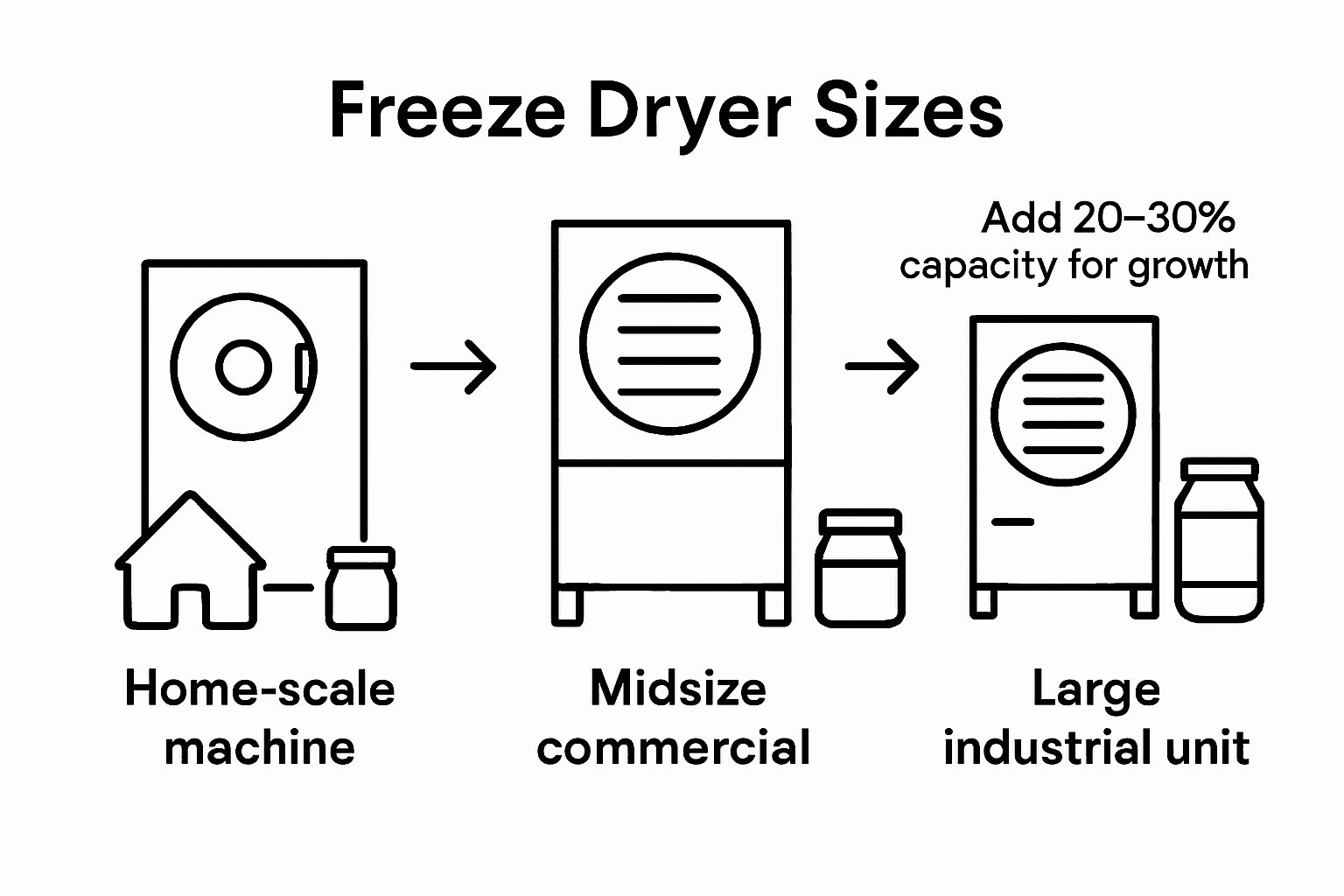
Research indicates that equipment capacity plays a significant role in process optimization. A multivial stochastic modeling framework highlights how equipment capacity fundamentally influences freeze-drying efficiency, particularly in pharmaceutical and scientific applications. Manufacturers generally categorize freeze dryers into three primary size ranges: small-scale (home/personal use), mid-range (small business/laboratory), and industrial-scale models.
The key dimensions to consider when evaluating freeze dryer size include shelf area, number of trays, total volume capacity, and manifold configuration. Small freeze dryers might range from 2-4 square feet of shelf space, suitable for home or small batch processing. Mid-range models typically offer 4-10 square feet, perfect for small businesses or research laboratories. Industrial freeze dryers can exceed 20 square feet, designed for large-scale commercial production.
Pro User Tip: Always measure your available workspace and planned production volume before selecting a freeze dryer. Choosing a machine that matches your specific needs prevents unnecessary expenses and ensures optimal processing efficiency.
Practical Sizing Recommendation: Estimate your daily or weekly product volume, then select a freeze dryer with 20-30% additional capacity to accommodate future growth and prevent bottlenecks in your production process.
Types of Freeze Dryers for Candy Production
Freeze dryers for candy production come in various configurations, each designed to meet specific processing requirements. Freeze-drying practices in food preservation reveal multiple equipment types tailored to different production scales and product characteristics. The primary types include batch freeze dryers, manifold freeze dryers, and continuous industrial freeze dryers, each offering unique advantages for candy manufacturers.
Batch freeze dryers represent the most common type for small to medium-scale candy production. These machines allow processors to load multiple trays of candy products simultaneously, with precise temperature and pressure controls. Manifold freeze dryers are particularly useful for smaller batches or specialized candy items, offering more controlled drying environments. Industrial continuous freeze dryers represent the highest-end solution, capable of processing massive volumes of candy products with automated loading and unloading systems.
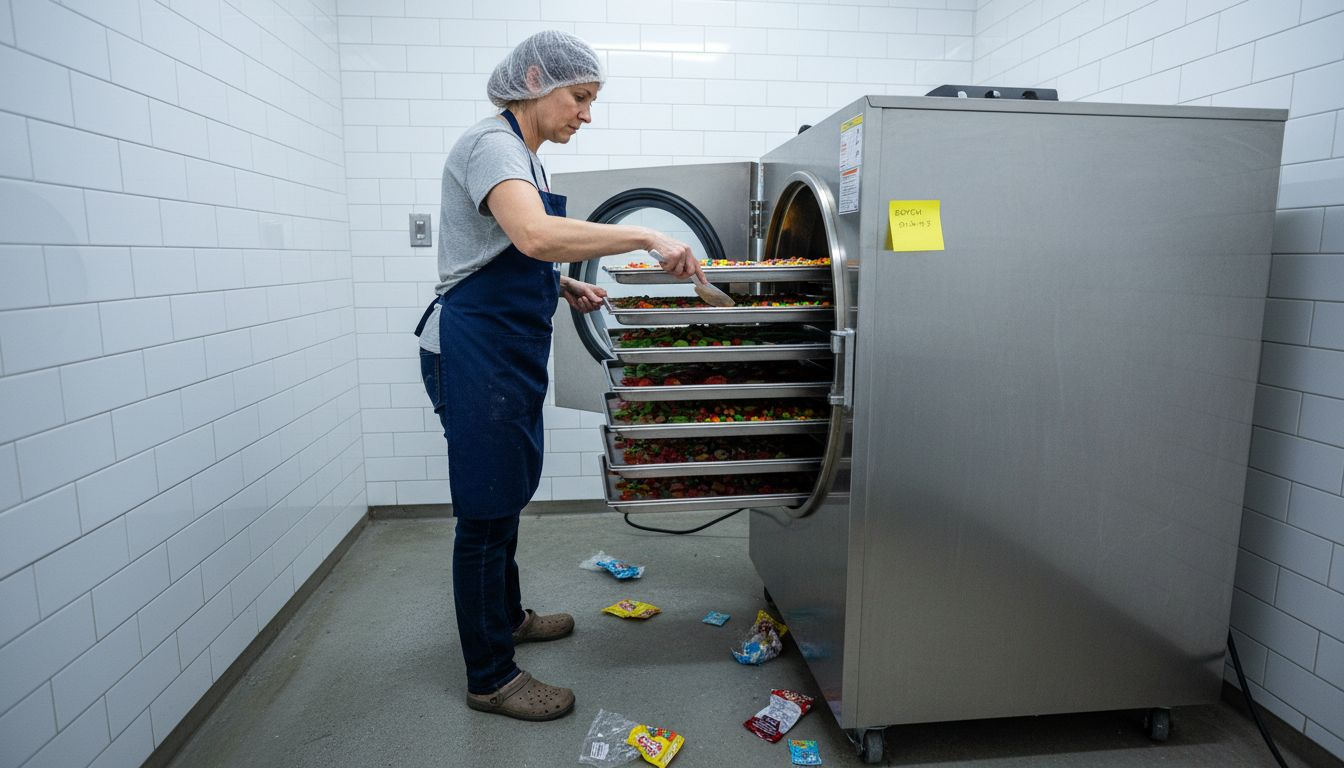
The selection of a freeze dryer depends on several critical factors beyond just size. Production volume, product complexity, moisture content, and desired final texture all play crucial roles in determining the most appropriate freeze-drying equipment. Comprehensive food processing research suggests that candy manufacturers must carefully evaluate their specific requirements before investing in freeze-drying technology.
Key considerations for selecting the right freeze dryer include:
- Batch size and production capacity
- Product complexity and variety
- Available workspace
- Budget constraints
- Future growth potential
Pro User Tip: Always request equipment demonstrations and sample processing runs before making a final purchase. This allows you to verify the freeze dryer’s performance with your specific candy products and production parameters.
Practical Selection Strategy: Match your freeze dryer type to your current production needs while maintaining flexibility for potential future expansion of your candy manufacturing operations.
See how different freeze dryer types fit production needs:
| Dryer Type | Best Suited For | Production Scale | Automation Level |
|---|---|---|---|
| Batch | Standard candies | Small to medium | Manual to semi-auto |
| Manifold | Specialty candies | Small | Manual control |
| Continuous | High-volume products | Medium to large | Fully automated |
Matching Dryer Size to Business Scale
Selecting the right freeze dryer size requires careful analysis of your specific business scale and production requirements. Small-scale freeze dryer effectiveness research highlights the critical importance of matching equipment capacity with operational needs. Businesses can typically be categorized into three primary scale segments: home/hobby, small commercial, and large industrial operations, each demanding a distinct approach to freeze drying equipment selection.
For home-based or small candy production businesses, compact freeze dryers ranging from 2-4 square feet of shelf space provide an ideal solution. These units accommodate batch sizes of 4-10 pounds per cycle, perfect for artisan candy makers or small local confectionery shops. Mid-range commercial operations require more robust equipment, with freeze dryers offering 6-12 square feet of shelf space and capacity for 10-30 pounds per batch. Scale-up considerations from pharmaceutical processing underscore the importance of selecting equipment that allows room for future growth without overinvesting in unnecessary capacity.
Large-scale candy manufacturers need industrial-grade freeze dryers with extensive shelf space exceeding 20 square feet, capable of processing 50-200 pounds per cycle. These high-capacity machines feature advanced automation, multiple trays, and sophisticated temperature and pressure control systems. The key is finding a balance between current production needs and potential business expansion.
Here’s how freeze dryer scale impacts key business factors:
| Business Scale | Typical Capacity per Batch | Key Advantages | Main Limitations |
|---|---|---|---|
| Home/Hobby | 4–10 lbs | Low cost, compact design | Limited volume, manual operation |
| Small Commercial | 10–30 lbs | Good for local sales, moderate automation | May require more space, higher cost |
| Industrial | 50–200 lbs | High throughput, advanced controls | Large space, significant investment |
Critical factors to evaluate when matching dryer size to business scale include:
- Current monthly production volume
- Projected growth rate
- Product diversity
- Available workspace
- Budget constraints
- Potential future product lines
Pro User Tip: Conduct a comprehensive production audit before purchasing. Calculate your exact daily and weekly processing requirements to ensure you select a freeze dryer that matches your specific operational needs without unnecessary overinvestment.
Practical Scaling Strategy: Choose a freeze dryer with 20-30% additional capacity beyond your current requirements to provide flexibility for business growth and unexpected production spikes.
Cost, Efficiency, and Space Considerations
Investing in a freeze dryer requires comprehensive evaluation of cost, efficiency, and spatial requirements. Computational modeling research reveals critical insights into equipment capability limits that directly impact financial and operational decision-making. The total cost of ownership extends far beyond the initial purchase price, encompassing energy consumption, maintenance expenses, and potential productivity gains.
Initial equipment costs vary dramatically based on size and complexity. Home-scale freeze dryers might range from $2,000-$5,000, while industrial-grade systems can exceed $50,000. Comprehensive freeze-drying challenge analysis emphasizes that efficiency metrics should include energy consumption, processing time, and product quality consistency. Operational efficiency becomes paramount, with factors like electricity usage, cycle duration, and batch processing speed significantly impacting long-term financial performance.
Spatial considerations demand careful planning. Freeze dryers require dedicated, climate-controlled environments with stable electrical connections and appropriate ventilation. Smaller units might need 10-15 square feet of dedicated space, while industrial systems can occupy 100-200 square feet. Critical spatial factors include:
- Ambient temperature stability
- Electrical infrastructure
- Ventilation requirements
- Floor load-bearing capacity
- Proximity to production areas
- Potential future expansion needs
Key cost considerations include:
- Initial equipment purchase price
- Energy consumption rates
- Maintenance and replacement part expenses
- Potential productivity improvements
- Potential product waste reduction
Pro User Tip: Create a comprehensive financial model that calculates total cost of ownership, including direct and indirect expenses associated with freeze-drying equipment.
Practical Budget Strategy: Allocate 15-20% of your equipment budget for ongoing maintenance and potential upgrades to ensure long-term operational efficiency.
Common Mistakes When Choosing Size
Common freeze-drying challenges in equipment selection reveal that most businesses make critical errors when choosing freeze dryer sizes. The most prevalent mistake is selecting equipment based solely on current production needs without considering future growth potential. Underestimating capacity requirements can lead to significant operational bottlenecks and unexpected additional investments.
Many candy manufacturers make fundamental errors in their sizing approach. Small-scale freeze dryer effectiveness research highlights several common miscalculations. These include overlooking critical factors like product diversity, seasonal production fluctuations, and potential expansion of product lines. Businesses often commit to equipment that becomes obsolete within 12-24 months due to rapid growth or changing production requirements.
The most significant sizing mistakes can be categorized into several key areas:
- Ignoring future production scaling
- Failing to account for product complexity
- Underestimating electrical and spatial requirements
- Neglecting maintenance and operational costs
- Choosing equipment without proper performance testing
- Overlooking specific product-related freeze-drying challenges
Additional critical considerations that businesses frequently overlook include:
- Moisture content variations
- Specific heat sensitivity of different candy types
- Batch processing time differences
- Energy consumption variations
- Potential product quality degradation
Pro User Tip: Conduct comprehensive product testing and create a detailed three-year production forecast before finalizing your freeze dryer selection to avoid costly equipment mismatches.
Practical Selection Strategy: Always choose a freeze dryer with 25-30% additional capacity beyond your current projected needs to provide flexibility and accommodate unexpected growth opportunities.
Find the Perfect Freeze Dryer Size for Your Candy Business Today
Choosing the right freeze dryer size is a pivotal challenge for any candy manufacturer or distributor. If you struggle with matching capacity to your production scale or worry about future growth and efficiency, you are not alone. The article highlights the importance of accounting for batch size, workspace, and product variety as well as planning for 20-30 percent additional capacity. Avoid costly mistakes like underestimating electrical and spatial needs or overlooking maintenance expenses.
At Space-Man, we specialize in freeze dried candy manufacturing and offer tailored solutions that align perfectly with your business goals. Whether you are a small artisan or an industrial producer, our co-packing, private labeling, and packaging services provide the flexibility and support you need to scale confidently. With expert guidance and customized freeze-drying options, you can optimize your operations and ensure your investment fits your current and future demands.

Ready to optimize your freeze drying process and grow your candy business without overpaying or outgrowing your equipment? Visit Space-Man now and discover how our comprehensive services and expertise can help you select and use the ideal freeze dryer size. Don’t wait until production bottlenecks slow you down. Take control of your freeze drying strategy today with our proven solutions.
Frequently Asked Questions
What factors should I consider when choosing the size of a freeze dryer?
When selecting a freeze dryer, consider total shelf area, batch processing volume, available workspace, production capacity, product complexity, and your budget constraints. It’s also important to account for future growth potential.
How do I estimate the right freeze dryer capacity for my candy production?
Estimate your daily or weekly product volume and choose a freeze dryer with 20-30% additional capacity to accommodate future growth and prevent bottlenecks in your production process.
What types of freeze dryers are available for candy production?
The main types include batch freeze dryers, manifold freeze dryers, and continuous industrial freeze dryers. Each is suited for different production scales and candy types, with batch dryers being common for small to medium productions.
What are common mistakes to avoid when selecting a freeze dryer size?
Common mistakes include underestimating capacity requirements for future production needs, failing to account for product complexity, neglecting energy consumption and maintenance costs, and not testing the equipment with your specific products.