

Kirkland Signature, Great Value, Amazon Basics, Simple Truth, and Market Pantry are all private-label brands. Each one is owned by a retailer, manufactured by a third party, and sold exclusively through that retailer’s stores or platform. That’s the short answer to what is an example of a private label brand.
A private-label brand is any brand where the retailer owns the name and controls the product specs, but outsources the actual manufacturing to a contract producer. The retailer decides what goes in the product, what the packaging looks like, and what price it sells for. They just don’t run the factory.
Here’s a quick reference for the most recognized U.S. examples:
- Kirkland Signature (Costco) — grocery, household, supplements, apparel
- Great Value (Walmart) — pantry staples, cleaning products
- Amazon Basics (Amazon) — electronics accessories, home goods
- Simple Truth (Kroger) — natural and organic food
- Market Pantry (Target) — everyday grocery and pantry items
- Specially Selected (Aldi) — premium food and seasonal items
- Clover Valley (Dollar General) — value-tier grocery and household
Pro Tip: If you’re an entrepreneur researching private label, start by buying and studying these brands. Notice the packaging, the positioning language, and the price gap versus the national brand sitting next to them on the shelf. That gap is the margin story.
Key Takeaways
Private-label brands are retailer-owned, third-party-manufactured products that give retailers control over pricing, margins, and exclusivity across every major consumer category.
| Point | Details |
|---|---|
| Definition | A private-label brand is owned by the retailer but manufactured by a third party to the retailer’s specs. |
| Top U.S. examples | Kirkland Signature, Great Value, Amazon Basics, Simple Truth, Market Pantry, Specially Selected, and Clover Valley. |
| How it differs | Private label is exclusive to one retailer; white label is generic and sold to many; national brands are owned by the manufacturer. |
| Why retailers use it | Higher margins, pricing control, shelf exclusivity, and direct customer data are the main drivers. |
| Starting point for entrepreneurs | Define your product spec, source a co-packer, and negotiate a pilot run before committing to large volumes. |
Table of Contents
- What is a private label brand, exactly?
- How does private labeling actually work?
- Where do private-label brands show up? Category examples
- Private label vs. white label vs. national brand: which model fits your goals?
- Why do retailers keep expanding their private-label lines?
- How to launch your own private-label product
- What working in private-label co-packing actually looks like
- Sources
What is a private label brand, exactly?
A private-label brand is a product line owned and marketed by a retailer but physically produced by a separate manufacturer. The retailer controls the brand name, packaging design, formulation specs, and pricing. The manufacturer stays invisible to the consumer.
This is different from two closely related models that often get mixed up:
- White label: A generic product manufactured once and sold to multiple retailers, each of whom slaps their own name on it. There’s no customization. The same shampoo formula might appear under a dozen different store names.
- National brand: A brand owned by the manufacturer itself (think Tide, Heinz, or Nike). The manufacturer controls the brand and sells it across many retailers.
- Private label: Sits between those two. The retailer owns the brand exclusively, but the product is customized to their specs rather than being a generic off-the-shelf formula.
One detail that surprises most people: the same factory that makes a national brand often also makes the private-label version sitting right next to it. A co-packer producing a well-known national cereal brand may fill a separate run for a retailer’s store brand using a nearly identical recipe. That’s why private-label quality has improved so dramatically over the past two decades. The manufacturing infrastructure is often identical.
How does private labeling actually work?
The mechanics are straightforward once you see the flow. Here’s how a private-label product typically goes from idea to shelf:
- Define the product spec. The retailer (or brand owner) writes a detailed specification: ingredients or materials, target cost, packaging dimensions, and any regulatory requirements.
- Source a manufacturer. The retailer identifies contract manufacturers or co-packers who can produce to those specs. For food, that means finding a facility with the right certifications and capacity.
- Request samples and test. The manufacturer produces samples. The retailer tests for quality, taste, durability, or whatever the relevant criteria are. Multiple rounds of revision are common.
- Finalize labeling and packaging. The retailer’s design team creates the packaging. For food and supplements, this must comply with FDA labeling rules. For electronics, FCC compliance applies. Cosmetics fall under FDA cosmetics regulations.
- Place the production order. Once samples are approved, the retailer places an initial order. Minimum order quantities (MOQs) vary widely by category and manufacturer.
- Receive, inspect, and distribute. Product arrives at the retailer’s warehouse or distribution center. Quality checks happen before it reaches shelves or fulfillment centers.
- Launch and iterate. Sales data, returns, and customer feedback drive the next round of spec adjustments or packaging updates.
The retailer owns the brand throughout. The manufacturer owns nothing except the production equipment. Regulatory compliance responsibility sits with the brand owner, which means the retailer, not the factory.
Pro Tip: Switching co-packers later is harder than it sounds. Requalifying a formulation with a new manufacturer can take months and may require new regulatory filings. Negotiate flexibility and pilot-run clauses into your first contract before you’re locked in.
The FDA’s current Good Manufacturing Practice regulations set the baseline quality standard for drugs and many supplement categories. Food manufacturers follow parallel FDA food safety rules. Knowing which framework applies to your product category before you sign a co-packing agreement saves significant headaches.
Where do private-label brands show up? Category examples
Private-label products appear in nearly every consumer category. BigCommerce notes that the most common sectors include food, personal care, apparel, and pet products, but the model has expanded well beyond those.
| Retailer (owner) | Typical category | Positioning | Why the retailer uses private label |
|---|---|---|---|
| Costco (Kirkland Signature) | Grocery, supplements, apparel | Premium | Higher margin, member loyalty, exclusivity |
| Walmart (Great Value) | Pantry staples, household | Value | Margin control, price leadership |
| Amazon (Amazon Basics) | Electronics accessories, home | Value to mid-tier | Marketplace data advantage, exclusivity |
| Kroger (Simple Truth) | Natural and organic food | Premium | Differentiation, health-trend capture |
| Target (Market Pantry) | Everyday grocery | Value | Shelf differentiation, margin |
| Aldi (Specially Selected) | Premium food, seasonal | Premium within Aldi | Upsell within value-store format |
| Dollar General (Clover Valley) | Grocery, household | Value | Margin in price-sensitive market |
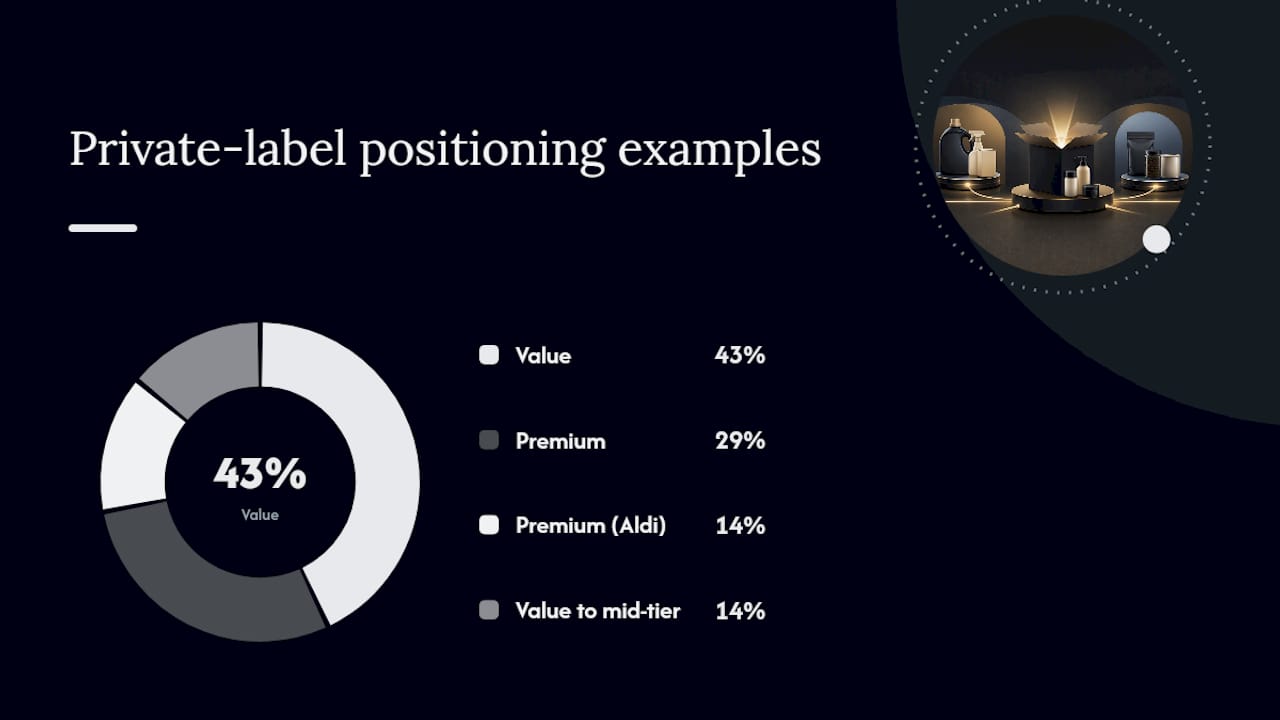
A few things worth noting about that table. Kirkland Signature and Amazon Basics are probably the two most studied private-label programs in the U.S. Kirkland in particular has built genuine brand equity: Costco members often prefer it over the national brand. Amazon Basics benefits from something no traditional retailer has: purchase data from millions of transactions that tells Amazon exactly which product categories are underserved and what price points work.
Supplements and personal care are two categories where private label has grown fast. The margins are attractive, the manufacturing infrastructure is mature, and consumers have become comfortable buying store-brand vitamins and skincare.
Private label vs. white label vs. national brand: which model fits your goals?
These three models solve different problems. Picking the wrong one wastes time and money.
Choose private label when:
- You want a brand that’s exclusively yours (no other retailer can sell the same product under the same name)
- You need control over pricing and positioning
- You’re building long-term brand equity, not just moving units
- You want direct customer data tied to your brand
Choose white label when:
- Speed to market matters more than differentiation
- You want to test a category with minimal upfront investment
- You’re comfortable with competitors selling a nearly identical product
Choose national brand licensing or co-branding when:
- The established brand equity of a national name is essential to your customer’s purchase decision
- You’re entering a category where trust is hard to build from scratch (pharmaceuticals, infant products)
The clearest signal that private label is the wrong choice: when your customer is buying the brand name, not the product. A retailer selling Tide detergent under a store brand loses the customer who specifically wants Tide. Private label works when the product’s performance can stand on its own.
For marketplace sellers, private label on Amazon follows the same logic but adds the complexity of Amazon’s own brand programs and algorithm dynamics.
Why do retailers keep expanding their private-label lines?
The business case is hard to argue with. Investopedia notes that private brands typically compete with name-brand products and are often priced lower, though retailers also operate premium private-label lines. That dual positioning is the key to understanding why private label has grown so consistently.
The core benefits of private-label brands for retailers include:
- Higher margins. Without paying a national brand’s marketing overhead, retailers keep more of each sale.
- Pricing control. The retailer sets the price and can adjust it without negotiating with a manufacturer.
- Exclusivity. A shopper who wants Kirkland Signature has to go to Costco. That’s a meaningful traffic driver.
- Shelf differentiation. Private-label products let retailers fill gaps that national brands don’t address.
- Customer data. When a customer buys your store brand, you own that transaction data entirely.
The strategic shift worth understanding is the move from single-tier to multi-tier private-label programs. Retailers used to run one store brand, positioned purely on price. Now most major retailers run at least two tiers: a value line (Great Value, Clover Valley) and a premium or specialty line (Simple Truth, Specially Selected). Some run three. That tiering lets a single retailer capture both the budget shopper and the quality-driven one without relying on national brands to fill either slot.
How to launch your own private-label product
If you’re an entrepreneur ready to move from understanding to doing, here’s a practical checklist:
- Define your product and position. What category? Value or premium? Who’s the customer? Write this down before you contact a single manufacturer.
- Prepare a product spec sheet. Ingredients or materials, target cost, packaging dimensions, and any certifications you need (organic, non-GMO, FDA-compliant labeling).
- Source manufacturers and request samples. Trade directories, industry trade shows, and co-packer networks are all valid starting points. Request samples from at least three candidates.
- Test and verify quality. Don’t skip this step to save time. For food products, this includes taste, shelf life, and packaging integrity. For supplements, third-party lab testing is standard practice.
- Arrange labeling and compliance. Work with a packaging designer and a regulatory consultant if your category is regulated. Food labels must meet FDA requirements. Cosmetics have their own rules under FDA cosmetics law.
- Trademark your brand name. File with the USPTO before you launch. A brand name you can’t protect is a liability.
- Plan order quantities and pricing. Understand your manufacturer’s MOQs and build your unit economics from there. Most small-run co-packers have MOQs starting in the hundreds of units; larger facilities may require thousands.
- Launch, collect feedback, and iterate. Your first run is a test. Use sales data and customer feedback to refine the product and packaging before scaling.
For food and candy entrepreneurs specifically, the how-to-start private label guide covers the category-specific steps in more detail.
Pro Tip: Ask your co-packer for a pilot run clause in your first contract. A pilot run lets you produce a small initial batch at a slightly higher per-unit cost, verify everything works, and then commit to larger volumes. It’s a standard ask and most reputable co-packers will accommodate it.
Key considerations before you sign anything:
- Confirm the manufacturer holds the certifications your product category requires
- Clarify who owns the formulation (you should, not the manufacturer)
- Understand lead times and minimum reorder quantities before setting customer expectations
- Get clarity on what happens to your tooling and molds if you switch suppliers
What working in private-label co-packing actually looks like
At Space-man, we manufacture and co-pack freeze-dried candy for brands across Canada. What we see consistently is that small food brands underestimate two things: how much the packaging design matters to perceived quality, and how long the sample approval process actually takes. Brands that budget six to eight weeks for sampling and revision cycles launch smoother than those who expect it done in two.
The encouraging part: the barrier to entry for private-label food products is genuinely lower than most entrepreneurs assume. You don’t need a factory. You need a clear product spec, a reliable co-packer, and a brand identity worth building. The manufacturing infrastructure already exists.
If you’re considering a private-label food or candy product and want to understand what co-packing looks like in practice, Space-man’s private-label and co-packing services cover the full range from bagging and packaging to full co-packing runs.
Sources
These are the sources used in this article, each worth bookmarking if you’re going deeper on private label:
- What Is a Private Label? How Private Labels Work (2026) - Shopify
- What Is a Private Label? Private Labeling Explained
- Private label
- What Is a Private Label? | BigCommerce
- Private brand definition - Investopedia