

Most American manufacturers now depend on freeze dryers to produce crisp, lightweight foods that last longer without losing quality. With more than 60 percent of American snack and candy companies using this advanced technology, freeze drying redefines what consumers expect from preserved foods. Understanding how these machines work and why they are essential gives business owners a powerful edge in making informed choices for product quality and shelf life.
Table of Contents
- Defining A Freeze Dryer In Food Processing
- Major Types Of Freeze Dryers Explained
- Core Components And Visual Features
- How Freeze Dryers Operate Step-By-Step
- Common Misconceptions And Buying Mistakes
Key Takeaways
| Point | Details |
|---|---|
| Freeze Dryers Preserve Quality | Freeze dryers use lyophilization to effectively remove moisture while maintaining the original shape, color, flavor, and nutritional profile of food products. |
| Types of Freeze Dryers | There are batch and continuous freeze dryers, with each type tailored to meet specific production needs and scales in the food processing industry. |
| Critical Components | Key components include a vacuum chamber, freezing system, and condenser, all designed to optimize drying efficiency and product preservation. |
| Avoid Misconceptions | Buyers should carefully assess their production requirements to choose the right freeze dryer, as not all machines are suitable for all food types or processing scales. |
Defining a Freeze Dryer in Food Processing
A freeze dryer represents a sophisticated food processing machine designed to preserve products by removing moisture through a unique scientific method called lyophilization. This advanced technology transforms how manufacturers approach food preservation, particularly in the candy and snack industries. Freeze-drying involves freezing the product and then reducing surrounding pressure to allow frozen water to sublimate directly from solid to gas, creating a preservation technique that maintains original product quality.
In the context of food processing, freeze drying operates through a precise multi-stage process. First, the product is completely frozen, then placed in a vacuum chamber where pressure is dramatically reduced. Under these controlled conditions, water molecules transition directly from solid ice to water vapor without passing through a liquid state - a process known as sublimation. This method allows candies, fruits, and other food items to retain their original shape, color, flavor, and nutritional profile while dramatically extending their shelf life.
The freeze drying machine itself typically consists of several critical components: a freezing chamber, a primary drying area, and a secondary drying zone. Manufacturers use these machines to create lightweight, crisp products that can be stored for extended periods without refrigeration. Freeze-drying is widely used in food processing to preserve products like meats, coffee, juices, dairy products, and various fruits and vegetables, maintaining their quality and extending shelf life. For candy production specifically, this means transforming traditional treats into innovative, crispy versions that offer consumers unique textural experiences while preserving original taste profiles.
Key characteristics of industrial freeze dryers include large stainless steel chambers, precise temperature and pressure controls, and advanced moisture extraction capabilities. These machines represent a significant technological investment for food manufacturers seeking to create premium, long-lasting products that stand out in competitive markets. Whether producing freeze-dried candies, fruit snacks, or specialty food items, these machines offer an unparalleled method of preservation that maintains product integrity from production to consumer consumption.
Major Types of Freeze Dryers Explained
Freeze dryers are complex machines with varying configurations designed to meet different production needs across food processing industries. Freeze-drying systems are primarily categorized into batch and continuous types, each serving unique manufacturing requirements. Batch freeze dryers are specialized units that process a specific quantity of product at one time, making them ideal for small-scale operations or specialized product lines where precision and controlled processing are critical.
Freeze dryers can be classified based on their operational scale and design into laboratory-scale, pilot-scale, and industrial-scale units. Laboratory-scale freeze dryers support research and development efforts, allowing food scientists to experiment with new preservation techniques. Pilot-scale units serve as crucial transitional equipment, bridging the gap between experimental research and full-scale production. Industrial-scale freeze dryers represent the pinnacle of commercial food processing technology, engineered to handle massive production volumes with consistent quality and efficiency.
The technical distinctions between these freeze dryer types are significant. Batch systems typically feature smaller chambers with manual product loading, making them perfect for artisanal candy makers or specialty food producers. Continuous freeze dryers, conversely, feature automated conveyor systems that enable non-stop processing, ideal for large-scale snack and candy manufacturers seeking high-volume output. Each type incorporates sophisticated temperature and pressure controls, vacuum chambers, and specialized condensation systems to ensure optimal moisture removal and product preservation.
Choosing the right freeze dryer depends on multiple factors including production volume, product type, available space, and budget. Small candy shops might opt for compact batch systems, while large-scale manufacturers will require continuous, industrial-grade equipment. The investment in the appropriate freeze drying technology can dramatically enhance product quality, extend shelf life, and create innovative food offerings that stand out in competitive markets.
Core Components and Visual Features
A typical freeze dryer consists of several sophisticated components that work together to transform food preservation technologies. The vacuum chamber serves as the central processing unit, a large, rectangular or cylindrical compartment where food products undergo the critical freeze-drying transformation. This chamber is typically constructed from high-grade stainless steel, designed to withstand extreme temperature and pressure variations while maintaining precise environmental conditions for sublimation.
The main components of a freeze dryer include a freezing system, vacuum chamber, condenser, and advanced control system to monitor and adjust process parameters. The freezing system rapidly reduces product temperature, typically to around -40 to -50 degrees Fahrenheit, ensuring complete product solidification before the drying process begins. Adjacent to the main chamber, the condenser plays a crucial role by capturing water vapor through a complex refrigeration mechanism, preventing moisture from damaging the vacuum pump and ensuring clean, efficient processing.
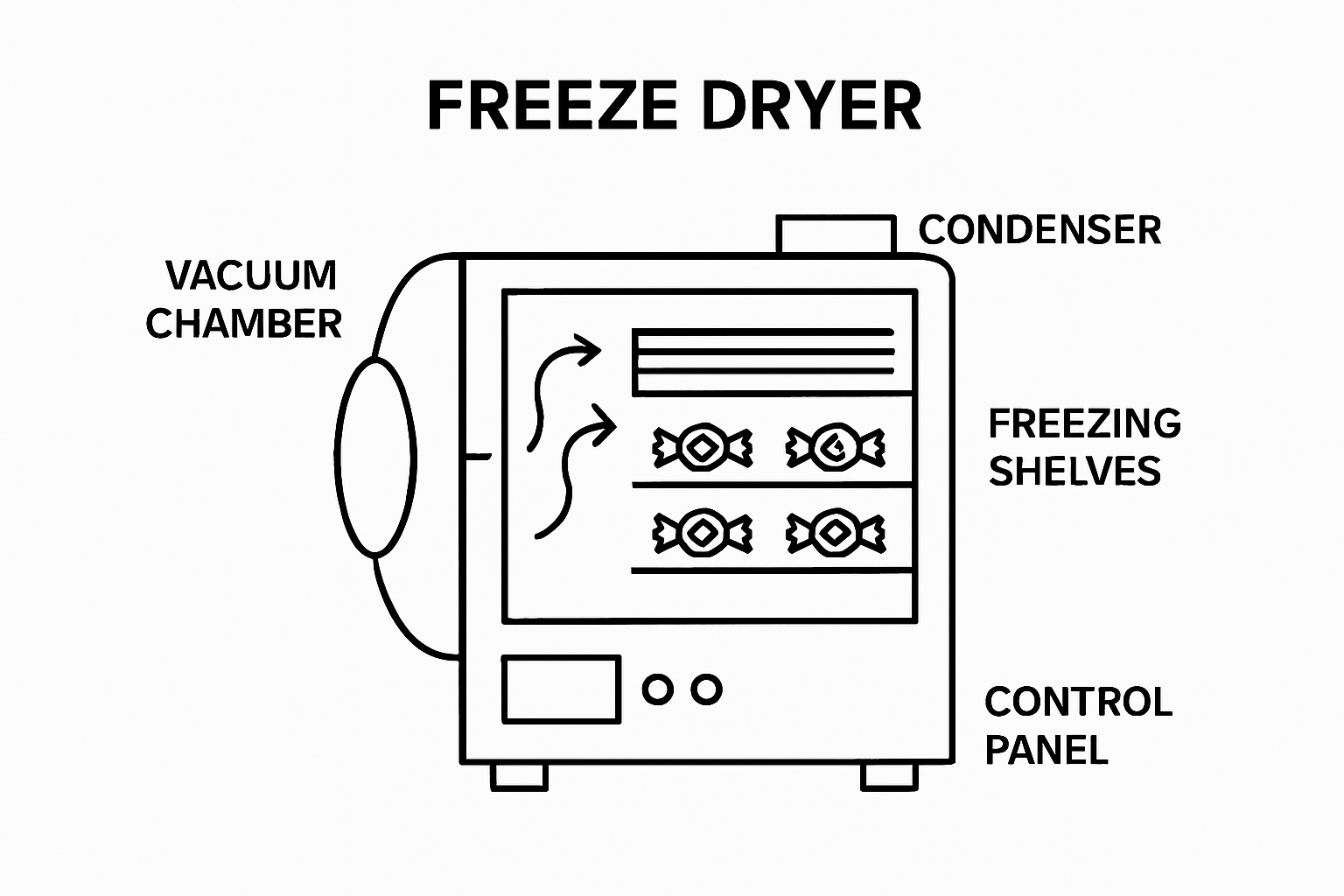
External visual features of industrial freeze dryers reveal their complex engineering. Most units feature robust control panels with digital displays, allowing operators to monitor temperature, pressure, and processing stages in real-time. Vacuum gauges, strategically positioned on the machine’s exterior, provide immediate insights into internal pressure conditions. Loading ports are typically designed with precision sealing mechanisms, ensuring airtight environments during the freeze-drying cycle. The overall aesthetic combines industrial functionality with technical sophistication - large, predominantly metallic structures with multiple access points and intricate mechanical components.
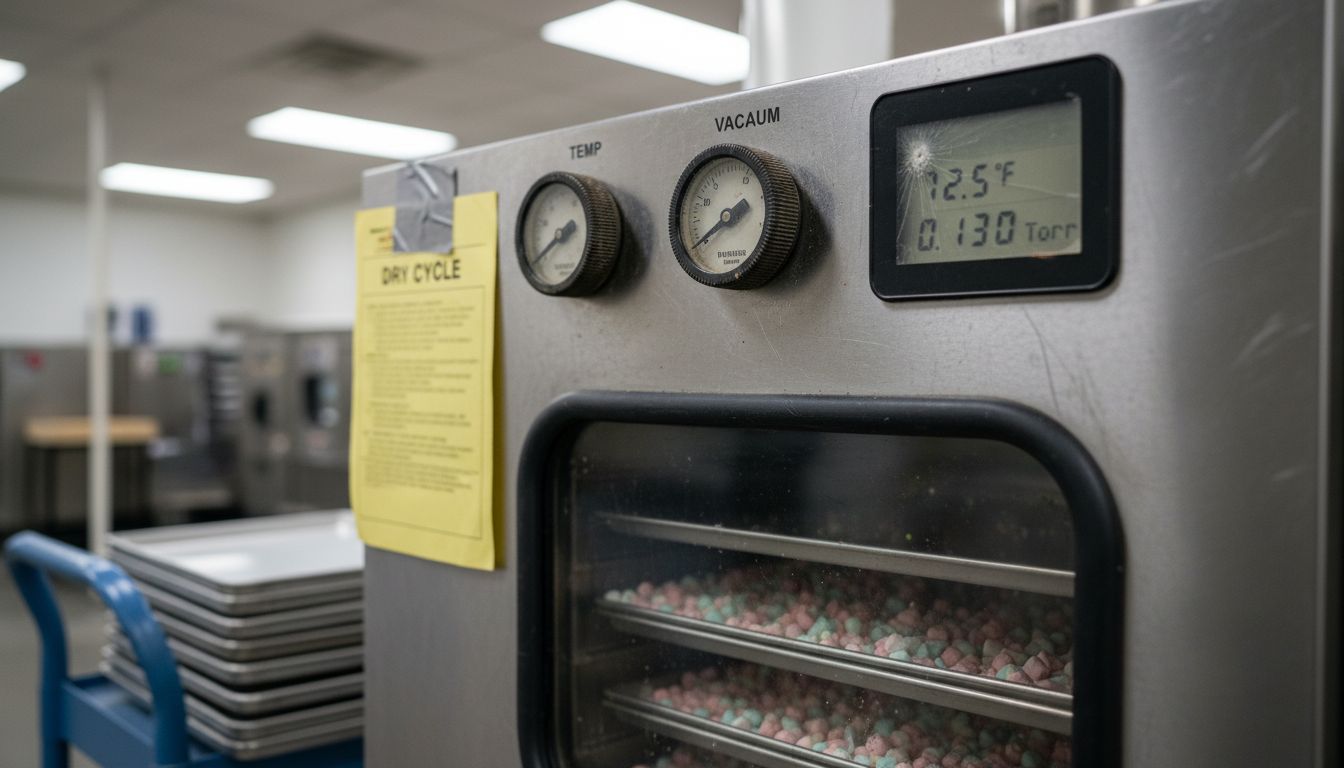
The technical complexity of freeze dryers demands specialized design considerations. Shelving inside the vacuum chamber is engineered to maximize surface area and ensure uniform heat distribution. Trays are often adjustable and constructed from materials that facilitate rapid and even heat transfer. Manufacturers typically incorporate multiple temperature sensors, pressure regulators, and safety mechanisms to guarantee consistent product quality. Whether processing delicate candies or robust food products, these machines represent a pinnacle of food preservation technology, transforming how manufacturers approach long-term product storage and quality maintenance.
How Freeze Dryers Operate Step-by-Step
Freeze-drying is a sophisticated multi-stage process that transforms food preservation through precise scientific techniques. The first critical stage is freezing, where product temperatures plummet rapidly to around -40 to -50 degrees Fahrenheit. This extreme cooling transforms the product’s water content into solid ice crystals while maintaining its original cellular structure. For candy production, this means capturing the treat’s exact shape, color, and intricate details before the moisture removal process begins.
The operation of a freeze dryer involves creating a vacuum environment to lower pressure and facilitate sublimation. During primary drying, the vacuum chamber’s pressure drops dramatically, allowing ice to transition directly from solid to vapor without passing through a liquid state. Controlled heat is carefully applied to encourage this sublimation process, ensuring that delicate candies retain their original texture and flavor profile. Manufacturers strategically adjust temperature and pressure to optimize moisture extraction while preserving the product’s essential characteristics.
The secondary drying stage focuses on removing residual moisture that resists initial sublimation. By incrementally increasing temperature under sustained vacuum conditions, the freeze dryer extracts deeply embedded water molecules. This phase is crucial for extending shelf life and preventing potential bacterial growth. Temperature ranges typically fluctuate between 20 and 40 degrees Fahrenheit, with precise monitoring ensuring that each product batch meets exact moisture content specifications. The result is a lightweight, crisp candy that maintains its original flavor intensity and structural integrity.
Final processing involves careful packaging to protect the newly transformed product. Moisture-proof containers with advanced sealing technologies prevent ambient humidity from reintroducing water molecules. Specialized packaging materials with high barrier properties ensure that freeze-dried candies remain stable and crisp, preserving their unique texture and flavor for extended periods. From artisanal chocolate pieces to fruit-based confections, freeze-drying represents a revolutionary approach to food preservation, allowing manufacturers to create innovative products that surprise and delight consumers with their intense flavors and unexpected textures.
Common Misconceptions and Buying Mistakes
Many potential buyers approach freeze dryer purchases with misconceptions about their universal applicability and operational complexity. The most prevalent error is assuming that all freeze dryers are identical, capable of handling any food product with equal efficiency. Industrial freeze dryers are highly specialized machines, with significant variations in design, capacity, and performance tailored to specific product requirements. Candy manufacturers, for instance, need equipment that can handle delicate sugar structures and maintain intricate flavor profiles, which differs dramatically from freeze dryers used in meat or pharmaceutical processing.
Purchasing decisions should carefully consider multiple variables beyond basic equipment specifications. Buyers frequently overlook critical factors such as production volume, product composition, desired shelf life, and processing time. A small artisan candy shop might require a compact batch system with precise temperature controls, while large-scale manufacturers need continuous flow machines capable of processing hundreds of pounds per hour. Neglecting these nuanced requirements can result in substantial financial investments in equipment that ultimately fails to meet operational needs.
Technical misconceptions often lead to inappropriate equipment selection. Some buyers mistakenly believe that larger machines automatically translate to better performance, overlooking the importance of matching machine specifications to specific production requirements. Energy efficiency, maintenance complexity, and compatibility with existing production lines are equally crucial considerations. Expensive industrial freeze dryers might prove counterproductive for smaller operations, while underpowered systems can create significant bottlenecks for expanding businesses.
Buying mistakes typically stem from insufficient research and hasty decision-making. Potential purchasers should conduct comprehensive assessments, including consulting industry experts, requesting detailed equipment demonstrations, and analyzing long-term operational costs. Factors like warranty coverage, replacement part availability, and manufacturer support are often neglected but can significantly impact overall equipment reliability. Successful freeze dryer investments require a holistic approach that balances technological specifications, production requirements, and future scalability, ensuring that the chosen equipment provides a strategic advantage in competitive food manufacturing landscapes.
Elevate Your Candy Production with Expert Freeze Drying Solutions
Manufacturers face unique challenges when preserving delicate candies using freeze drying technology. Maintaining candy texture, flavor, and shelf life requires precision freeze drying machines with advanced temperature and pressure controls. If you want to avoid costly mistakes like choosing the wrong equipment size or overlooking moisture removal steps, specialized expertise is essential. Our team at Space Man understands these challenges to help you create innovative freeze-dried candy that captivates consumers and remains fresh longer.

Discover how our Canadian freeze dried candy manufacturing and distribution services can transform your candy production. Whether you need private labeling, co-packing, or packaging support our comprehensive solutions ensure product integrity from freeze drying to final delivery. Don’t wait to upgrade your candy line with proven freeze drying technology and expert handling. Visit Space Man today and start creating next-level freeze dried confections designed to impress and perform.
Frequently Asked Questions
What is the primary function of a freeze dryer in candy production?
A freeze dryer preserves candies by removing moisture through lyophilization, maintaining their original shape, color, flavor, and nutritional profile while extending shelf life.
How does the freeze-drying process impact the texture of candies?
Freeze-drying transforms candies into lightweight, crispy versions without sacrificing their original taste, providing unique textural experiences for consumers.
What are the key components of a freeze dryer used for candy manufacturing?
A typical freeze dryer includes a vacuum chamber, freezing system, condenser, and control systems to manage temperature and pressure for optimal moisture removal.
What are the different types of freeze dryers available for candy production?
Freeze dryers can be categorized into batch and continuous types. Batch freeze dryers process specific quantities, ideal for small operations, while continuous freeze dryers support high-volume production for larger manufacturers.